
Zoeller M98
$321.49 at Amazon
Check it on AmazonPrice as of Oct 24, 2026, 5:30 AM EDT
Details ↓
Four submersible pumps scored on their makers’ own flow tables, with a lift checker that shows what each moves at your height.
As an Amazon Associate I earn from qualifying purchases.
Get the Zoeller M98 (9.5): 61 GPM at 10 feet and cast iron throughout. For the most water and a 5-year warranty, the Wayne CDU980E.
All four are submersible primary pumps with a built-in float switch and a 1-1/2 inch discharge. Each was new and in stock on Amazon on Oct 23, 2026, and each scores 7.0 or higher.


Product prices and availability are accurate as of the date/time indicated and are subject to change. Any price and availability information displayed on Amazon.com at the time of purchase will apply to the purchase of this product.
Six checks from Zoeller’s and Wayne’s data sheets, manuals and product pages, equal weight. The rules and every input are in the method section.
A sump pump has one job: move water out of the pit faster than it comes in, up the discharge pipe, every time the float lifts. So the score leads with the maker’s own flow at 10 feet of head, a typical basement lift, and how high the pump can push at all.
Then it looks at what the motor housing is made of, how long the warranty runs, whether the maker says each pump is tested before it ships, and whether the Amazon listing describes the pump the way the maker does. Two listings overstate their pumps, and that cost points.
What each maker publishes, which pit and water each suits, and where each lost points.
Flow-Mate 1/2 HP submersible sump pump, 98-0001
Prices and availability are accurate as of the time shown and may change.
You have a typical basement pit that runs often in wet seasons, a lift of 8 to 15 feet, and you want cast iron and a maker that tests every pump.
Your pit is shallow and runs a few times a year. The M53 is enough. Or your water table is high and the lift long, where the CDU980E moves more.
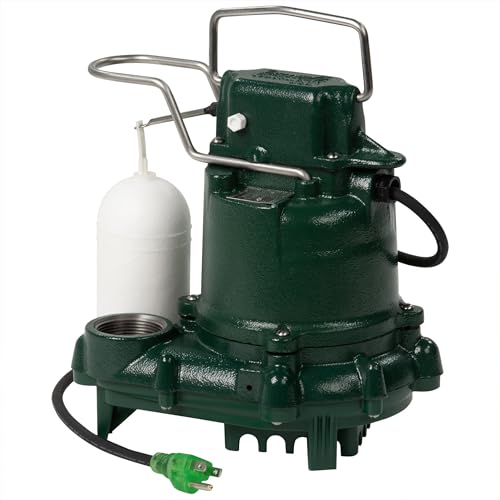
The M98 is the pump I’d put in most basements, and I’ve used it. It scored 9.5, the top of the four.
Flow first. Zoeller’s data sheet, FM2779, gives 72 gallons a minute at 5 feet of head, 61 at 10 feet, 45 at 15 and 25 at 20, with a 23 foot shut-off head. At 10 feet that’s 3,660 gallons an hour, our arithmetic. That’s a 9: second only to the Wayne CDU980E here.
Build is where it earns the rest. Zoeller lists a cast iron cap, motor housing and pump housing, oil-fed cast iron upper and lower bearings, carbon and ceramic seals and stainless hardware. The 1/2 HP permanent split capacitor motor is oil filled for cooling, with an automatic-reset thermal overload. The base and vortex impeller are engineered thermoplastic on the M98 version.
Zoeller’s product page says every Model 98 is submerged in water and tested to its published performance curve before shipment. That’s the only factory test claim among these makers, and it’s a 10.
It switches on at 9-1/2 inches of water and off at 3 inches, per the sheet, and handles 1/2 inch spherical solids. The automatic version has a 9 foot cord and Zoeller’s LED plug that shows the pump has power.
It lost points on warranty. Zoeller gives a 3-year limited warranty, an 8, where Wayne gives the CDU980E 5 years.
Install it the way Zoeller’s instructions say. No extension cord. Rigid pipe and fittings. A pit 18 inches or larger in diameter. And if you add a check valve, which you should, drill a vent hole of about 3/16 inch in the discharge pipe below the check valve and the pit cover, to let trapped air out.
The Amazon listing is model 98-0001, sold by Amazon, and describes it as 1/2 HP cast iron, matching Zoeller. A 10.
My call: the pump I’d choose for my own basement. Add a check valve, an alarm and a backup, and it’s a system.
Prices and availability are accurate as of the time shown and may change.
Your pit fills fast in storms, you have a high water table, or the discharge has a long vertical lift where smaller pumps fade.
Your pit rarely runs. A pit that runs a few times a year won’t use the extra flow; the Zoeller M53 or M98 will do.
The CDU980E is the pump for wet basements and long lifts, and I’ve used it. It scored 9.2.
Wayne’s sump pump manual has one performance table for its whole line, and the CDU980E is the 3/4 HP row: 5,490 gallons an hour at 0 feet, 5,076 at 5, 4,600 at 10, 4,100 at 15 and 3,500 at 20. That’s the most flow here at every height. A 10.
That 20 foot number is the reason to buy it. At 20 feet the M53 has stopped and the M98 is down to 25 gallons a minute, about 1,500 an hour. The CDU980E still moves 3,500.
Wayne lists a stainless steel motor housing, a cast iron volute and a glass-reinforced thermoplastic impeller, with a dielectric oil-filled single-phase motor. It switches on at about 9 inches and off at about 4 with the vertical float, per the manual.
The warranty is the longest of the four. Wayne’s limited warranty covers the CDU980E for five years from purchase. Read the condition, though: without proof of purchase from an authorized dealer, Wayne says the coverage changes. Keep the receipt.
It lost points on testing. Wayne’s manual doesn’t say each pump is tested before shipping; it tells the installer to test and watch the pump through several cycles. That’s a 5.
Wayne’s install rules are strict. It requires rigid PVC pipe, not flexible hose, and requires a check valve; Wayne suggests its own check valve placed just above the basin for easy removal. It wants a GFCI-protected outlet and no extension cord or surge protector.
The Amazon listing is model CDU980E, sold by Amazon, and calls it cast iron and stainless steel with a 5-year warranty, which matches the manual. A 10.
My call: buy it if your pump already runs hard in storms. It costs more, and in a dry pit that extra power sits unused.
Mighty-Mate 3/10 HP submersible sump pump, 53-0001
Prices and availability are accurate as of the time shown and may change.
Your pit runs a few times a year, the lift is under about 12 feet, and you want Zoeller’s cast iron build in the smallest pump.
Your pit fills fast in storms or the discharge climbs high. At 15 feet it’s down to 19 GPM.
The M53 is the classic small Zoeller, and I’ve used it. Zoeller says the Model 53 family has been around for over 50 years. It scored 8.2.
Zoeller’s data sheet, FM2778, gives 43 gallons a minute at 5 feet, 34 at 10 feet and 19 at 15, with a 19.25 foot shut-off head. At 10 feet that’s 2,040 gallons an hour, our arithmetic. That’s an 8, and the shut-off below 20 feet is another 8.
The build is better than its size suggests. Zoeller lists a cast iron cap, motor housing and pump housing on the M53, with a 3/10 HP shaded pole motor, oil filled, and an automatic-reset thermal overload. The impeller is a non-clogging vortex type and handles 1/2 inch solids.
Like the M98, Zoeller says every Model 53 is submerged and tested to its published curve before it ships, a 10, and it carries the same 3-year limited warranty, an 8.
It switches on at 7-1/4 inches of water and off at 3, per the sheet. That lower switch-on point suits a shallow pit.
The listing cost it. Amazon’s title calls it a 1/3 HP pump, where Zoeller’s sheet and product page say 3/10 HP. The model, 53-0001, matches, but the horsepower doesn’t. That’s a 5.
Install it the same way as the M98: rigid pipe, no extension cord, an 18 inch or wider pit, and a vent hole below the check valve. Zoeller notes the 53 has a vent in the pump housing opposite the float, and still recommends the extra hole.
My call: a good pump for a pit that only wakes up in spring. If yours runs every rainy day, buy the M98 instead.
Prices and availability are accurate as of the time shown and may change.
You want strong flow in a narrow pit at a lower price than the CDU980E, and you’re fine with a coated steel housing.
You want cast iron or stainless throughout. Wayne makes the CICDU800 and CDU800SS for that.
The CDU800 is Wayne’s 1/2 HP pump, and I’ve used it. On flow alone it beats the M98, but it scored 7.3 because of what it’s made of and how it’s listed.
Wayne’s manual table gives the 1/2 HP CDU800 row as 5,100 gallons an hour at 0 feet, 4,500 at 5, 3,840 at 10, 3,060 at 15 and 2,040 at 20. That’s a 9 on flow and a 10 on head.
Its housing is the catch. Wayne’s manual lists the motor housing as coated steel for the CDU800, cast iron only for the CICDU800 and stainless steel for the CDU800SS. The volute is cast iron. Coated steel scores a 7.
The Amazon title says “Cast Iron & Stainless Steel.” That matches the CDU800SS or CICDU800 more than this model, so the listing scores 5. Know which one you’re getting: this is the coated steel CDU800.
Wayne gives the CDU800 a 3-year limited warranty, an 8, and the stainless and cast iron versions 5 years. Like the CDU980E, the manual doesn’t claim a factory test, a 5.
The vertical float switches on at about 9 inches and off at about 4, per Wayne, and needs less room than a tethered float. That’s why it suits a narrow pit.
Wayne’s rules apply: rigid PVC, a required check valve, a GFCI outlet and no extension cord. Wayne says its pumps are for clear water only.
Wayne lists the same 11-1/2 inch height and 9-3/4 inch base for the line, and a 15 amp minimum circuit. Its warranty, like the CDU980E’s, depends on proof of purchase from an authorized dealer, so keep the receipt with the manual.
My call: a strong pump for the money, with a housing to keep an eye on. If you can, step up to the CDU800SS for stainless and 5 years.
Flow, head, housing and warranty from Zoeller’s data sheets and Wayne’s manual, read Oct 23, 2026.
| Pick | Spec score | Photo | HP | GPH at 10 ft | Max head | Short pros / cons | Buy |
|---|---|---|---|---|---|---|---|
| Zoeller M98 | 9.5 | | 1/2 | 3,660 | 23 ft | Cast iron, tested / 3-yr warranty | Check it on Amazon |
| Wayne CDU980E | 9.2 | | 3/4 | 4,600 | 20 ft+ | Most flow, 5 years / No test claim | Check it on Amazon |
| Zoeller M53 | 8.2 | | 3/10 | 2,040 | 19.25 ft | Cast iron, compact / Weak above 15 ft | Check it on Amazon |
| Wayne CDU800 | 7.3 | | 1/2 | 3,840 | 20 ft+ | Strong flow / Coated steel housing | Check it on Amazon |
Zoeller figures from FM2778 (Model 53) and FM2779 (Model 98), 0724; Wayne figures from its sump pump installation manual 600002W-001-J. Zoeller lists flow in gallons per minute; GPH is our arithmetic (GPM × 60). Wayne’s table stops at 20 feet.
Enter the height from the pump to where the discharge pipe leaves the house. The checker reads each maker’s flow table.
At 10 feet: Wayne CDU980E 4,600 GPH, Wayne CDU800 3,840, Zoeller M98 3,660, Zoeller M53 2,040.
Lift, or head, is the height the water climbs. Every pump moves less the higher it has to push, and the drop isn’t even. Between 10 and 20 feet, the M98 falls from 3,660 to about 1,500 gallons an hour, while the CDU980E only falls from 4,600 to 3,500.
Measure from the floor of the pit to where the pipe goes through the wall or rim joist. Long horizontal runs and elbows add friction, so treat the checker as a ceiling, not a promise.
My rough allowance for horizontal pipe is a rule of thumb, not a maker figure. Zoeller and Wayne publish flow at vertical head only.
Gallons per hour at each height. Zoeller publishes gallons per minute; we multiplied by 60.
| Pump | 5 ft | 10 ft | 15 ft | 20 ft | Shut-off |
|---|---|---|---|---|---|
| Wayne CDU980E | 5,076 | 4,600 | 4,100 | 3,500 | Past 20 ft |
| Wayne CDU800 | 4,500 | 3,840 | 3,060 | 2,040 | Past 20 ft |
| Zoeller M98 | 4,320 | 3,660 | 2,700 | 1,500 | 23 ft |
| Zoeller M53 | 2,580 | 2,040 | 1,140 | — | 19.25 ft |
Big numbers on a box are usually the 0-foot figure. Wayne’s CDU980E listing leads with 5,490 gallons an hour, which is its flow with no lift at all. At a real basement lift of 10 feet, its own table says 4,600. Compare pumps at the same height, from the maker’s table, not the box.
The motor housing sits in water for years. The makers list exactly what each is made of.
| Pump | Motor housing | Pump housing / volute | Impeller | Switch on / off |
|---|---|---|---|---|
| Zoeller M98 | Cast iron | Cast iron | Thermoplastic vortex | 9-1/2 in / 3 in |
| Wayne CDU980E | Stainless steel | Cast iron | Glass-reinforced thermoplastic | About 9 in / 4 in |
| Zoeller M53 | Cast iron | Cast iron | Plastic vortex | 7-1/4 in / 3 in |
| Wayne CDU800 | Coated steel | Cast iron | Glass-reinforced thermoplastic | About 9 in / 4 in |
Cast iron also pulls heat out of the motor, which is part of why Zoeller and Wayne both fill their motors with oil. My call: coated steel is fine until the coating is chipped or worn, which is why the score puts it below cast iron and stainless. Wayne sells the same 1/2 HP pump in cast iron (CICDU800) and stainless (CDU800SS) with a longer warranty.
The switch on and off points tell you how much water each cycle moves. A pump that starts higher and stops lower runs longer per cycle and starts less often, which is easier on the motor and switch.
A good pump installed badly fails early. These come from Zoeller’s and Wayne’s own instructions.
Both makers say not to use one. Wayne adds no surge protector. Plug straight into a receptacle the cord reaches.
Wayne requires rigid PVC and says not to use flexible hose. Zoeller recommends rigid pipe and fittings.
Wayne requires a check valve. Zoeller says to drill a vent hole of about 3/16 inch below the check valve and pit cover.
Wayne wants a GFCI-protected outlet and warns damp GFCIs can trip. Zoeller recommends a pit 18 inches or wider.
Wayne also notes that a tripped GFCI shuts off the pump, so check it after storms. That’s the best argument for an alarm. Our sump pump alarm guide and check valve guide cover both, and our battery backup guide covers the pump that runs when the power doesn’t.
| Question | If yes | If no |
|---|---|---|
| Does your pit fill fast in storms, or is the lift over 15 feet? | Wayne CDU980E | Next question |
| Does your pit run often in wet seasons? | Zoeller M98 | Next question |
| Is the pit narrow? | Wayne CDU800 (vertical float) | Next question |
| Does it only run a few times a year? | Zoeller M53 | Zoeller M98 |
My call: the Zoeller M98 for most homes, with a check valve, an alarm and a battery backup. If you’re replacing a pump that couldn’t keep up, go to the CDU980E. If the pump stopped instead, start with our sump pump troubleshooting guide before you buy.
Match the maker’s flow at your lift to how fast your pit fills. Time how long the pit takes to fill in a storm, then compare tables at your height: Zoeller’s M98 moves 61 GPM at 10 feet, Wayne’s 3/4 HP CDU980E about 77 GPM (4,600 GPH).
The makers use cast iron or stainless for the motor housing on their better pumps. Zoeller’s M53 and M98 have cast iron motor housings; Wayne’s CDU980E is stainless; the CDU800 is coated steel.
The makers don’t publish a life span. Warranties are a guide: 3 years on the Zoeller M53 and M98 and the Wayne CDU800, 5 years on the Wayne CDU980E.
Wayne requires one. Zoeller says that if you use one, drill a vent hole of about 3/16 inch below it to let trapped air out.
No. Both Zoeller and Wayne say not to use an extension cord, and Wayne also says no surge protector.
Gallons per hour when the pump lifts water 10 feet. It’s lower than the 0-foot number on the box. Wayne’s CDU980E is 5,490 GPH at 0 feet and 4,600 at 10.
Wayne says the receptacle must be GFCI protected, and warns that GFCIs in damp areas can trip and shut off the pump. Check it after storms.
Zoeller says it tests every pump to its curve; Wayne gives its stainless and cast iron pumps 5-year warranties. Our top two are one of each: the Zoeller M98 and the Wayne CDU980E.
I’m Isaac Daniels, a licensed journeyman plumber in Georgia (license #JP507711), and I’ve used all four picks. Every number here comes from Zoeller’s data sheets and product pages and Wayne’s installation manual, read Oct 23, 2026. Where I add advice of my own, it’s labeled as my call.
Six checks, one sixth each, 0 to 10, averaged to one decimal. The score reads maker documents; it isn’t a pump test, and buyers’ opinions play no part in it.
| Check (weight) | How it’s scored |
|---|---|
| Flow at 10 ft (1/6) | Maker table: 4,000 GPH or more 10; 3,000 to 3,999 9; 2,000 to 2,999 8; under 2,000 6 |
| Max head (1/6) | Shut-off head of 20 ft or more, or still pumping at 20 ft: 10; 15 to 19.9 ft: 8 |
| Motor housing (1/6) | Cast iron or stainless steel 10; coated steel 7; thermoplastic 5 |
| Warranty (1/6) | 5 years or more 10; 3 years 8; 2 years or less 5 |
| Factory test stated (1/6) | 10 when the maker says each pump is tested before it ships; 5 when it doesn’t |
| Listing match (1/6) | 10 when the Amazon model, HP and materials match the maker; 5 for one mismatch; 0 for no match |
| Total | Average of the checks, to one decimal |
| Pump | Flow | Head | Housing | Warranty | Test | Listing | Score |
|---|---|---|---|---|---|---|---|
| Zoeller M98 | 9 (3,660) | 10 (23 ft) | 10 (cast iron) | 8 (3 yr) | 10 | 10 | 9.5 |
| Wayne CDU980E | 10 (4,600) | 10 (3,500 at 20 ft) | 10 (stainless) | 10 (5 yr) | 5 | 10 | 9.2 |
| Zoeller M53 | 8 (2,040) | 8 (19.25 ft) | 10 (cast iron) | 8 (3 yr) | 10 | 5 (1/3 HP title) | 8.2 |
| Wayne CDU800 | 9 (3,840) | 10 (2,040 at 20 ft) | 7 (coated steel) | 8 (3 yr) | 5 | 5 (materials title) | 7.3 |