
Webstone E‑X‑P E2 service valves
$119.27 at Amazon
Check it on AmazonPrice as of Oct 24, 2026, 5:30 AM EDT · low stock then

Which one keeps up in your house, and what each needs.
As an Amazon Associate I earn from qualifying purchases.
Pick a tank for the lowest install cost, an easy swap and hot water in an outage. Pick gas tankless for endless showers and lower bills, if you have the gas line and will descale it yearly. Electric tankless needs 150 to 300 amp service.
A tank keeps 40 or 50 gallons hot all day. A tankless heats water only while a tap is open.
| Tank water heater | Tankless water heater | |
|---|---|---|
| How it makes hot water | Heats and stores 20 to 80 gallons (DOE) | Heats water as it flows through a heat exchanger |
| What limits you | Runs out after its first-hour rating | Flow: about 2 to 5 GPM at once (DOE) |
| Efficiency (UEF) | Gas 0.64 to 0.65; electric 0.93 | Gas 0.98 (Rinnai RX199iN); electric 0.92 to 0.97 |
| Life (DOE) | 10 to 15 years | More than 20 years |
| Yearly care | Flush sediment, check the anode (Rheem) | Flush or descale (Rheem, Rinnai) |
| Power outage | A full tank stays hot; some gas tanks need no power | Needs electric power to fire |
| Wall or floor space | About 19 to 24 in. wide, 49 to 64 in. tall | Wall-hung box, as small as 16-5/8 × 14-1/2 in. |
| Swap from what you have | Same pipes, vent and circuit in most cases | Often new gas line, vent, condensate drain or electric service |
Both kinds come in gas and electric, so there are really four choices. The big split is the way each delivers water. A tank gives you a lot at once and then slows down while it reheats. A tankless never runs out, but it can only heat so many gallons a minute.
That one difference drives most of the trade-offs below: how many showers can run at once, what the install needs, and why the energy savings depend on how much hot water your home uses.
Set your busiest moment and your incoming water. The checker compares a large tankless with a 50-gallon tank.
The checker follows DOE’s sizing method: add up the flow of everything running at once, then subtract your incoming water temperature from 120°F to get the temperature rise. The colder your water, the bigger the rise, and the fewer gallons a tankless can heat each minute.
For gas it reads Rinnai’s published flow table for the RX199iN, a 199,000 BTU unit, which is the top of the residential range. For electric it uses the makers’ own power rule, about 6.8 gallons a minute per kilowatt for each degree, divided by the rise, which matches Stiebel Eltron’s and EcoSmart’s tables. For tank size questions, the water heater size calculator goes deeper.
Tanks are rated by the first hour. Tankless units are rated by gallons a minute at a given rise.
DOE puts typical tankless output at 2 to 5 gallons a minute, with gas units on the high end. Its rule of thumb at a 70°F rise is about 5 GPM for gas and 2 GPM for electric. The maker numbers above land right on that.
A tank works the other way. Its first-hour rating is how many gallons it can deliver in one busy hour starting full. Rheem’s PROG50-40N gas tank is rated at 76 gallons, GE’s GG40 gas tank at 83, and Bradford White’s RE350S6 electric tank at 60. Electric tanks rate lower because a 4,500-watt element reheats more slowly than a 40,000 BTU burner.
| Heater | Kind | Rating | What it means for showers |
|---|---|---|---|
| Rinnai RX199iN | Gas tankless | 5.5 GPM at 70°F rise | Two 2.0 GPM showers and a faucet at once, with no time limit |
| EcoSmart ECO 36 | Electric tankless | 3.5 GPM at 70°F rise | One 2.5 GPM shower and a faucet, or two low-flow showers |
| Stiebel Eltron Tempra 24 | Electric tankless | 2.3 GPM at 70°F rise | One shower at a time in a northern winter |
| GE GG40 | 40-gallon gas tank | 83 gal first hour | About 21 minutes with two 2.0 GPM showers running |
| Rheem PROG50-40N | 50-gallon gas tank | 76 gal first hour | About 19 minutes with two showers, then a slow refill |
| Bradford White RE350S6 | 50-gallon electric tank | 60 gal first hour | About 15 minutes with two showers |
The minutes in the last column assume every gallon of the first-hour rating goes to two 2.0 GPM showers. Real showers mix in cold water, so they last longer than that, but the order holds: tanks win on a short burst, tankless wins on anything long.
This is the heart of the choice. A family that showers back to back for an hour is better served by a tankless. A home that needs three showers and a washer all at 7 a.m. may need a big tank or two tankless units, which DOE mentions as an option.
A tankless has to heat the whole rise while the water flows. Colder water means fewer gallons a minute.
| Incoming water | Rinnai RX199iN (gas) | EcoSmart ECO 36 | Stiebel Tempra 24 | EcoSmart ECO 11 |
|---|---|---|---|---|
| 70°F in (50°F rise) | 7.8 GPM | 4.9 GPM | 3.3 GPM | 1.8 GPM |
| 60°F in (60°F rise) | 6.5 GPM | 4.1 GPM | 2.7 GPM | 1.5 GPM |
| 50°F in (70°F rise) | 5.5 GPM | 3.5 GPM | 2.3 GPM | 1.3 GPM |
| 40°F in (80°F rise) | 4.8 GPM | 3.1 GPM | 2.0 GPM | 1.1 GPM |
A gas unit loses about a third of its flow between southern summer water and northern winter water. An electric unit loses even more in proportion, because it starts lower. The ECO 36 goes from about 4.9 GPM with 70°F water to 3.1 GPM with 40°F water.
DOE tells you to assume 50°F unless you know better. Well water and northern city water in January can run colder, so size a tankless for your coldest month, not the average. A tank has the same problem in a gentler way: its first hour drops a little in winter, but the stored 40 or 50 gallons are already hot.
If you want water hotter than 120°F, for a dishwasher without its own heater for example, DOE uses a 90°F rise. At that rise the Rinnai drops to 4.3 GPM.
A tank loses heat all day while it waits. A tankless doesn’t, but the savings shrink as your hot water use grows.
The reason is standby loss. DOE explains that a tank keeps reheating to its setpoint even when no tap is running, because heat leaks out to the room. Only tankless heaters avoid that loss. The less hot water you use, the bigger share of a tank’s energy goes to standby, which is why the savings are biggest in light-use homes.
The efficiency rating on the label, UEF (uniform energy factor), shows the same gap. Higher is better.
| Heater | Kind | UEF | Source |
|---|---|---|---|
| Rinnai RX199iN | Gas tankless, condensing | 0.98 | Rinnai spec sheet |
| Stiebel Eltron Tempra 24 | Electric tankless | 0.97 | Stiebel Eltron specs |
| EcoSmart ECO 36 | Electric tankless | 0.94 | EcoSmart spec sheet |
| Rheem PROE40 T2 | Electric tank | 0.93 | Rheem spec sheet |
| Rheem PROG50-40N | Gas tank, atmospheric vent | 0.65 | Rheem spec sheet |
| GE GG40 | Gas tank, atmospheric vent | 0.64 | GE spec sheet |
The big jump is on gas: 0.65 for a standard gas tank against 0.98 for a condensing gas tankless. On electric, the gap is small. A standard electric tank already turns nearly all its power into heat, so an electric tankless saves mostly the standby loss.
DOE adds one warning for gas tankless units: a standing pilot light can eat into the savings. Look for an intermittent ignition device instead. The Rinnai’s 1.3-watt standby draw shows how little a modern spark-ignition unit uses while it waits.
A heat pump water heater is a third route with a far higher electric UEF. Rinnai’s REHP50 listing gives 3.75 UEF for a 50-gallon tank. That trade-off has its own page: heat pump vs tankless.
Tankless units last longer on paper. Both need yearly care to get there.
DOE says tankless units have easily replaced parts that can stretch their life further. A tank’s life usually ends when the tank itself leaks, and that part can’t be swapped. That’s the main reason the tankless number is higher.
Upkeep is different for each. Rheem says sediment settles at the bottom of a tank, so it needs periodic flushing, and the anode rod that protects the lining needs checking or replacing. For tankless, Rheem says annual flushing or descaling keeps it efficient.
| Job | Tank | Tankless | Where it comes from |
|---|---|---|---|
| Flush | Drain sediment from the bottom | Circulate a descaler through the heat exchanger | Rheem |
| How often | Periodic, more with hard water | Once a year at 4 to 12 grains per gallon | Rheem; Rinnai manual |
| Extra parts | Anode rod check or swap | Inlet filter screen clean | Rheem; Rinnai manual |
| Tools | Garden hose on the drain valve | Service valves, a small pump, two hoses and 4 gallons of vinegar | Rinnai manual |
| Time | Under an hour | At least 1 hour of circulating | Rinnai manual |
Rinnai’s manual spells out the tankless flush: close the service valves, hook a pump and hoses to them, and circulate 4 gallons of undiluted white vinegar through the heater for at least an hour. That’s why the service valve kit and pump kit below matter. Without the valves, you can’t flush it at all. Our tankless descaling guide has every step.
Scale builds fast in a tankless heat exchanger. The makers put the limits in their manuals and warranties.
Rinnai’s manual for the RX199iN sets the line at 12 grains per gallon (200 mg/L). From 4 to 12 grains it recommends a softener or scale cutter and a yearly flush. Above 12 grains, treatment is required.
Stiebel Eltron’s warranty also excludes damage from hard or corrosive water, and EcoSmart tells owners with hard water to flush more often. So in a hard-water area, a tankless comes with a softener or a scale filter and a yearly descale, or it risks a warranty claim being turned down.
| Hard water | Tank | Tankless |
|---|---|---|
| Where the minerals go | Settle as sediment on the tank bottom | Coat the inside of the heat exchanger |
| What the maker asks | Periodic flushing (Rheem) | Yearly flush at 4 to 12 grains; treatment above 12 (Rinnai) |
| Warranty | Tank and parts for the stated years | Water-quality damage excluded (Rinnai, Stiebel Eltron) |
Tanks collect minerals too, as sediment on the bottom, which is why Rheem calls periodic flushing important for a tank’s life. Your water utility’s yearly quality report lists hardness, or a test strip from a hardware store gives a quick read. If you’re on a well, test before you choose.
Swapping a tank for a tank uses the pipes you have. Going tankless often means new gas, vent or electric work.
| Need | Gas tank | Gas tankless (Rinnai RX199iN) |
|---|---|---|
| Gas input | 40,000 BTU (Rheem PROG50, GE GG40) | Up to 199,000 BTU; size the gas line for the whole house per NFPA 54 |
| Gas connection | 1/2 in. (GE GG40) | 3/4 in. NPT; Rinnai lists 1/2 in. line compatible, but check the manual’s sizing |
| Vent | 3 or 4 in. atmospheric vent to a chimney or flue | 2 in. PVC up to 75 ft, or 3 in. up to 150 ft, through a wall or roof |
| Condensate | None | 1/2 in. NPT drain; local code may require a neutralizer |
| Electric | None for a thermopile gas control (GE GG40) | 120 V outlet, about 98 W running |
| Service clearance | Per the maker’s label | 24 in. in front |
The gas line is the surprise for most people. A tank burns about 40,000 BTU. A big tankless burns up to 199,000 BTU while a shower runs, so the meter and pipe have to carry that on top of the furnace and range. Rinnai’s manual says to size it for the whole house load.
The vent can be easier. A condensing tankless vents through 2 or 3 in. PVC, so it can go through a side wall instead of the old chimney. The trade-off is the acidic condensate, which needs a drain and often a neutralizer.
| Electric heater | Power | Breakers | Service the maker recommends |
|---|---|---|---|
| Electric tank (Rheem, Bradford White) | 4,500 W | One 30 A double-pole | Already in place if you have one now |
| EcoSmart ECO 11 (point of use) | 13 kW | One 60 A double-pole | 100 A |
| Stiebel Eltron Tempra 24 | 24 kW | Two 50 A double-pole | 150 A |
| EcoSmart ECO 36 | 36 kW | Four 40 A double-pole | 300 A |
This table is why plumbers warn people off whole-house electric tankless. An electric tank draws about 19 amps. An ECO 36 draws 150 amps and asks for 300 amp service, which many homes don’t have. A service upgrade adds a large cost before you’ve bought the heater. Our electric vs gas tankless guide has the rest of that comparison.
A small electric unit like the ECO 11 makes sense as a point-of-use heater under one sink, not as the main heater for a house.
These are the complaints that show up in forums. Most have a clear cause.
Each unit needs a minimum flow to switch on: 0.5 GPM for the Tempra 24, 0.3 GPM for the ECO 11. Rinnai’s manual says the water can alternate hot and cold near its minimum flow.
A tankless has to fire and heat before hot water leaves it, then that water still travels the pipe. A recirculation pump, or the RXP199iN’s built-in one, shortens the wait.
The Rinnai needs 120 V to run. In freezing weather with the power off, its manual says to drain the heater, so it doesn’t freeze.
As long as the flow stays inside the unit’s rating, the last shower of the morning is as hot as the first.
The wait for hot water is often blamed on the tankless, but most of it is the pipe run, which a tank has too. If your bathroom is far from the heater, a hot water recirculating pump fixes it either way.
A tank has fewer quirks. It holds hot water ready, and a gas tank with a thermopile control like the GE GG40 keeps heating with the power off. That’s a real reason people still choose tanks, especially where outages are common.
A tankless frees up floor space. The warranties differ more than the ads suggest.
| Heater | Kind | Size | How it mounts |
|---|---|---|---|
| Stiebel Eltron Tempra 24 | Electric tankless | 16-5/8 × 14-1/2 × 4-5/8 in. | On the wall |
| Rinnai RX199iN | Gas tankless | 18.5 × 25.8 × 11.4 in. | On the wall, 24 in. clear in front |
| Bradford White RE350S6 | 50-gallon electric tank | 49-7/16 in. tall × 24 in. wide | On the floor, often in a pan |
| Rheem PROG50-40N | 50-gallon gas tank | 62-1/2 in. tall × 21-1/2 in. wide | On the floor, under a flue |
Tankless warranties run longer but come with conditions. Rinnai covers the heat exchanger for 15 years and voids it for heaters bought from unauthorized dealers. EcoSmart’s lifetime warranty needs a licensed install with proof within 30 days. The best tankless guide lays out each one.
A tank warranty is simpler: the tank and parts for a set number of years. When the tank leaks after that, you replace the whole heater, which is part of why its life cost runs higher than its price.
A tankless costs more to buy and put in. It costs less to run and may last longer.
| Cost item | Tank | Tankless |
|---|---|---|
| Heater price | Lower | Higher (DOE) |
| Install, same fuel swap | Usually the same pipes, vent and circuit | Often a larger gas line, new PVC vent and condensate drain |
| Electric work | Existing 30 A circuit | Electric tankless: big breakers, maybe a service upgrade |
| Yearly upkeep | Flush, anode check | Descale, filter clean; softener in hard water |
| Energy | Standby loss all day | 24–34% less in light-use homes, 8–14% in heavy use (DOE) |
| Replacement | Every 10–15 years (DOE) | More than 20 years (DOE), with parts replaceable |
DOE’s own summary: tankless units cost more up front, but lower operating and energy costs and a longer life could offset the price. Whether they do depends on the install work your house needs and how much hot water you use.
For dollar figures on your own job, see the cost to install a tankless water heater and the cost to replace a water heater. Get written quotes for both kinds. DOE suggests asking whether the contractor will pull the local permit.
Two tankless brands sold on Amazon have active CPSC recalls. Neither maker is part of this page’s kit.
VST gas tankless recall. CPSC recall 26026 (Oct 16, 2025): about 36,700 VST heaters, models VRS, VRP, VTS and VTP in 150 and 199 sizes, can crack an exhaust duct and leak carbon monoxide. Stop using it and contact VESTA.DS for a free repair.
Camplux portable recall. CPSC recall 24137 (Feb 29, 2024): about 42,000 Camplux portable tankless heaters, models AY132, BD158, BW211, BW264 and BW422 made in 2021, can leak gas at the regulator. Turn it off and get the free regulator kit.
Any gas heater, tank or tankless, needs a working carbon monoxide alarm nearby. CPSC told VST owners who must keep using the heater to have working smoke and CO alarms while they wait for the repair.
The first three are for a tankless, the last two for a tank. Each was new and in stock when we checked. Prices come from Amazon with the time they were read.



Product prices and availability are accurate as of the date/time indicated and are subject to change. Any price and availability information displayed on Amazon.com at the time of purchase will apply to the purchase of this product.
| Part | Key specs | Pick it if | Skip it if |
|---|---|---|---|
| Webstone E‑X‑P E2 | 3/4 in., hot and cold full-port valves with hose drains, lead free, 500 WOG, includes a 150 psi / 200,000 BTU relief valve | You’re putting in a tankless. Rinnai calls isolation valves highly recommended, and you can’t descale without them. | Your heater already has service valves, or it’s a tank. |
| Superior Pump 91660 | 1/6 HP pump, up to 1,920 gallons an hour, 3.5-gallon pail, two 3/4 in. GHT × 6 ft stainless hoses, 7 oz descaler powder | You’ll do the yearly descale yourself with vinegar, as Rinnai’s manual describes. | A plumber services your heater every year with their own rig. |
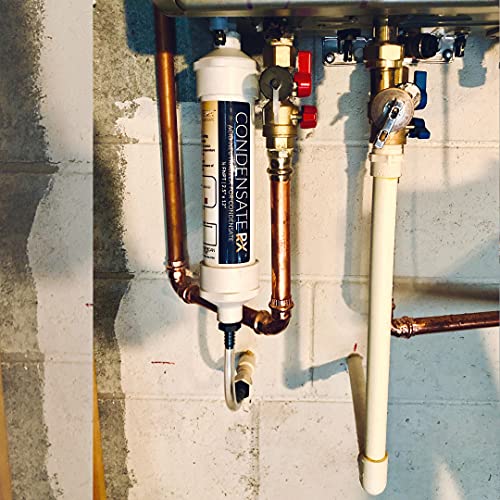
| American Valve CondensateRx | 1/2 in. FNPT with 1/2 in. barb and 3/4 in. PVC adapters, up to 220,000 BTU an hour and 3.8 gallons an hour, made in USA | Your condensing tankless drains to a line or a floor drain where code wants the acid neutralized. | Your heater isn’t condensing, or you have Rinnai’s own neutralizer kit. |
| Amtrol ST-5 | 2 gallons, 8 in. wide × 12-5/6 in. tall, 5 lb, max acceptance 0.45 | Your water system is closed (a check valve or pressure reducer), for a tank or a tankless. Rinnai says a closed system needs expansion control. | Your system is open with no check valve, and your inspector doesn’t require one. |
| Oatey 34083 | 24 in. round, .032 in. aluminum, built-in 1 to 1.5 in. PVC drain adapter | A tank sits over a finished floor or ceiling, where a leak would do damage. | Your tank is as wide as the pan, like the 24 in. Bradford White RE350S6. Measure first. |
I’ve used each of these parts. They’re listed as a kit with no score because each does a different job, so one formula wouldn’t be fair to all five.
For the heaters themselves, see the best tankless water heaters and the best tank water heaters. The size of the expansion tank and the drain pan each have their own guide.
Find the line that sounds like your house. Then run the checker above with your own numbers.
| Your situation | Better fit | Why |
|---|---|---|
| Gas line and side wall nearby, 1 to 3 people, long showers | Gas tankless | Never runs cold, biggest energy gain in light-use homes |
| Big family, three showers at 7 a.m. in a cold climate | Gas tank, or two tankless units | One 199,000 BTU unit makes about 4.8 GPM with 40°F water |
| Electric only, 100 or 150 A service | Electric tank (or a heat pump tank) | Whole-house electric tankless needs 150 to 300 A |
| Electric only, 400 A service, low-flow fixtures | Electric tankless can work | Run the checker; the ECO 36 makes about 3.5 GPM at a 70°F rise |
| Hard water over 12 grains, no softener planned | Tank | Rinnai requires treatment above 12 grains per gallon |
| Frequent power outages | Gas tank with a thermopile control | Keeps heating without power; a tankless needs 120 V |
| Small utility closet or tight basement | Tankless | Wall-hung, as small as 16-5/8 × 14-1/2 in. |
| Old tank failed, need hot water tomorrow | Same-kind tank | Same pipes, vent and circuit; no new gas or electric work |
Most homes that switch to tankless do it with gas. If you only have electric, a heat pump tank is usually the efficient upgrade, and a standard electric tank is the simple one.
If you’re replacing a failed tank in a hurry, a like-for-like tank is almost always the fastest fix. Plan a tankless switch when you have time to get the gas line, venting and permit sorted.
| Mistake | What goes wrong |
|---|---|
| Sizing for summer water | With 40°F water instead of 70°F, the Rinnai’s flow drops from 7.8 to 4.8 GPM |
| Keeping the old 1/2 in. gas line without checking | The heater can’t get the gas it needs at full fire; Rinnai says size for the whole house |
| Leaving out the service valves | No way to descale, and Rinnai calls them highly recommended |
| Skipping the softener in hard water | Scale builds, the unit errors out, and water damage isn’t covered |
| Buying from an unauthorized seller | Rinnai says the warranty is void |
| Electric tankless on a 200 A panel | The ECO 36 alone draws 150 A; the maker asks for 300 A service |
Each of these comes from a maker’s manual or warranty, not opinion. The fix for most is planning: measure the gas line, check the panel and test the water before you buy.
Mostly because of the install and upkeep. A gas tankless often needs a bigger gas line and new venting, an electric one may need a service upgrade, and both need a yearly descale. In hard water, Rinnai requires treatment above 12 grains per gallon.
A higher price to buy and install, a limit on how many fixtures can run at once, no hot water during a power outage, a minimum flow to fire, and yearly descaling. Electric whole-house units need 150 to 300 amp service.
They cost less to put in, swap easily for the old tank, deliver a lot of hot water at once, and a gas tank with a thermopile control keeps working without power.
Tankless. DOE gives more than 20 years for tankless and 10 to 15 for a storage tank. Rheem gives 15 to 20 years or more for tankless and 8 to 12 for a tank.
DOE says 24 to 34 percent in homes using 41 gallons a day or less, and 8 to 14 percent in homes using about 86 gallons a day.
A large gas unit can. Rinnai’s RX199iN makes 5.5 GPM at a 70°F rise, enough for two 2.0 GPM showers and a faucet. Most electric units can’t in a cold climate.
It’s most worth it with gas already at hand, light to moderate hot water use, and soft water or a softener. It’s least worth it when you need a service upgrade or a long new gas line to make it work.
If your water system is closed by a check valve or pressure reducer, yes. Rinnai’s manual says a closed system needs thermal expansion control.
No. A gas tankless like the Rinnai RX199iN needs 120 V to run. In freezing weather, its manual says to drain it during an outage.
I’m Isaac Daniels, a licensed journeyman plumber in Georgia. I’ve used each part in the kit. The flow, power, warranty and water-quality figures on this page come from the makers’ spec sheets and manuals, and the efficiency and life figures from the Department of Energy.