
Rinnai RX199iN
$1,532.79 at Amazon
Check it on AmazonPrice as of Oct 24, 2026, 5:30 AM EDT · low stock then
Details ↓
Picked by showers at your water temperature, then by what your house can feed it.
As an Amazon Associate I earn from qualifying purchases.
On gas or propane, I pick the Rinnai RX199iN: about 5.5 GPM of 105°F water even from 35°F groundwater. No gas? Get the Stiebel Tempra 24 Trend, which runs on two 50 A breakers.
All four were new and in stock on Oct 22, 2026, 6:46 AM EDT. Flow figures come from each maker’s own table. For one far sink, see the point-of-use section below.

Product prices and availability are accurate as of the date/time indicated and are subject to change. Any price and availability information displayed on Amazon.com at the time of purchase will apply to the purchase of this product.
Gas and electric on one scale: gallons per minute of 105°F water, by how cold your water comes in.
From 35°F water, the RX199iN makes about 5.5 GPM, enough for two showers and a sink. The biggest electric here makes about 3.5 GPM.
From 70°F water, the Tempra 24 Trend makes about 4.7 GPM, two showers’ worth, on two breakers.
The ECO 11 makes 1.3 to 2.5 GPM across the chart. That’s a sink at any temperature, not a shower in winter.
The same heater makes far less hot water in January than in July. Every tankless heater has a fixed amount of heat to give, so colder incoming water means a bigger temperature rise and fewer gallons per minute. None of the top Google results for this search charts it for gas and electric together.
Find your own starting point in winter. Run a cold tap for a few minutes and read the water with a kitchen thermometer. Then read across the chart to see how many showers each heater covers at that temperature.
Prices and availability are accurate as of the time shown and may change.
The house has natural gas or propane, your installer confirms the gas line can carry 199,000 BTU/h on top of the furnace and range, and there’s a wall where a PVC vent can exit.
A far bathroom takes a long time to run hot and you want that fixed too. The RXP199iN is the same heater with a pump.
The RX199iN is the largest of Rinnai’s SENSEI RX condensing heaters, rated 15,000 to 199,000 BTU/h on natural gas or propane. It was new and in stock from eFaucets on Oct 22, 2026. eFaucets is on Rinnai’s list of authorized online sellers, and Rinnai lets those sellers list on Amazon.
That seller detail matters with tankless heaters. Rinnai says a heater bought from an unauthorized dealer carries no Rinnai warranty. Check the seller against the maker’s list before you order any tankless heater online.
Flow is where the 199 earns its place. Rinnai’s brochure table gives 11.1 GPM up to a 35°F rise, 7.0 GPM at a 55°F rise and 5.5 GPM at a 70°F rise. With 35°F winter water and a 105°F shower, that’s two 2 GPM showers with 1.5 GPM left for a sink.
Rinnai rates it 0.98 UEF. The cabinet measures 18.5 by 25.8 by 11.4 in. and weighs 55 lb, the same box as the smaller RX models, so stepping up to the 199 takes no extra wall space.
The Smart-Sense gas valve runs natural gas or propane without a conversion kit, and a propane label comes in the box. Gas, cold and hot connections are ¾ in. NPT, with a ½ in. condensate drain. Rinnai lists it as ½ in. gas line compatible, but its manual still sizes the line for every gas appliance in the house.
It vents through 2 in. PVC, CPVC or polypropylene up to 75 equivalent feet, 3 in. pipe up to 150 ft, or Rinnai concentric pipe. Outdoors, it needs Rinnai’s RXOVC vent cap. It plugs into 120 V and draws 98 W while running.
The warranty is 15 years or 12,000 operating hours on the heat exchanger, 5 years on parts and 1 year on labor. Register within 90 days and labor goes to 5 years.
I’ve used this heater. My call: if the house has gas and the line can carry it, this is the one to buy. It has the most headroom in cold water on this page, and it fits anywhere a smaller RX would.
Rinnai SENSEI RXP199iN, 199,000 BTU/h with built-in pump
Prices and availability are accurate as of the time shown and may change.
The bathroom farthest from the heater waits a long time for hot water, and you can run a return line or fit the crossover valve under that sink.
Every fixture is a short run from the heater. The RX199iN is the same burner without the pump.
The RXP199iN is the RX199iN with a recirculation pump inside the cabinet. It has the same 199,000 BTU/h burner, the same 0.98 UEF and the same column in Rinnai’s flow table. eFaucets had it new and in stock on Oct 22, 2026.
The pump solves a different problem from the burner. A bigger burner can’t warm the water already sitting in a long pipe to a far bathroom. Recirculation keeps hot water moving through that pipe, so it reaches the tap sooner.
There are two ways to plumb it. A dedicated return line brings water back to the heater. Without one, a crossover setup uses a thermal bypass valve at the farthest fixture, and Rinnai’s brochure lists that valve in the box with the RXP models.
Crossover mode changes one setting. Rinnai’s brochure gives a 120°F minimum temperature in crossover mode, against 98°F in normal use. Settle with your installer which mode suits your pipes before the heater goes on the wall.
Smart-Circ, per Rinnai, learns seven days of hot water use and runs the pump around that pattern. Setting your own schedule or running it from a phone takes Rinnai’s RWM200 wireless module, which is sold separately.
The cabinet is the same 18.5 in. wide RX box. Rinnai’s brochure lists it at 58 lb, 3 lb more than the RX199iN. Venting, gas, condensate and the 120 V supply follow the same rules as the RX.
The warranty matches too: 15 years or 12,000 hours on the heat exchanger, 5 years on parts, and labor up to 5 years when you register within 90 days. If you buy the RX now, Rinnai sells an RX2RXPCK kit to add a pump later.
I’ve used this heater. My call: buy it when the far bathroom sits at the end of a long run and you can plan the return path. If every tap is close to the heater, save the pump and buy the RX199iN.
Prices and availability are accurate as of the time shown and may change.
There’s no gas, the panel has room for two 50 A double-pole breakers on 150 A or larger service, and your winter water comes in around 50°F or warmer.
Your winter water is near freezing and you want two showers at once. The ECO 36 makes more, if the house has 300 A service.
The Tempra 24 Trend is Stiebel Eltron’s 24 kW whole-house electric heater, item 239216. Amazon.com sold it new and in stock on Oct 22, 2026. It’s the pick for a house with no gas, or one where a vent run isn’t practical.
With electric tankless, the panel decides. Stiebel wires the Tempra 24 on two 50 A double-pole breakers with two runs of 8/2 copper, and recommends at least 150 A main service, depending on the rest of the house’s load. Get an electrician’s load calculation before you order.
Flow follows the 24 kW. Stiebel’s own table shows a 73°F rise at 2.25 GPM and a 54°F rise at 3.00 GPM. At a 105°F setting, the same arithmetic gives about 2.3 GPM from 35°F water and 4.7 GPM from 70°F water.
In plain terms, it runs one shower and a sink in a cold winter, and two showers once the incoming water reaches about 65°F. That’s the honest limit of 24 kW, and it’s why the chart above matters more than the box.
Stiebel rates it 0.97 UEF. The case is 16⅝ in. wide, 14½ in. tall and 4⅝ in. deep, and weighs 16.1 lb. There’s no vent and no condensate line to run. Water connections are ¾ in. NPT.
You can set it from 68 to 140°F, and Stiebel recommends 86 to 120°F to limit scale. It needs 30 psi of water pressure and 0.50 GPM of flow to switch on, so a tap barely cracked open won’t start it.
The warranty is 7 years against leaks and 3 years on parts, from purchase, and you register within 90 days to activate it. Stiebel excludes damage from hard water, freezing and moving the heater.
I’ve used this heater. My call: if the panel has room for two 50 A breakers, this is the electric heater I’d put in most homes in a mild climate. In a cold-water state, read the ECO 36 next.
Prices and availability are accurate as of the time shown and may change.
There’s no gas, the winters are cold, and the house already has 300 A service with room for four 40 A breakers.
Your panel is 200 A or smaller. The Tempra 24 Trend fits 150 A service on two breakers.
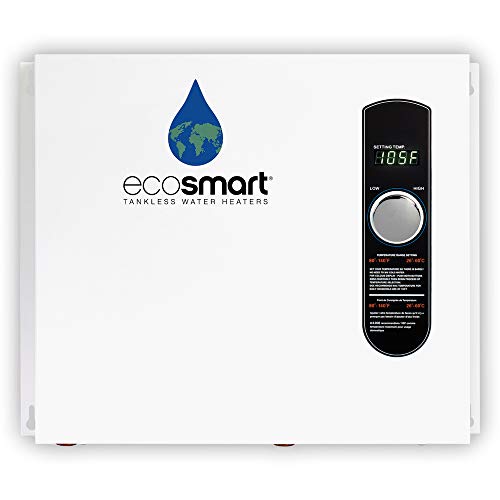
The ECO 36 is EcoSmart’s largest whole-house electric heater, rated 36 kW at 240 V. It was new and in stock from SpaceCityProviders, a third-party seller, on Oct 22, 2026, listed under brand EcoSmart and model ECO 36.
It’s the electric pick for cold groundwater. EcoSmart’s zone table gives 3.6 GPM at a 105°F setting from 37°F water, 4.6 GPM from 52°F and 6.5 GPM from 67°F. That’s about half again what the 24 kW Tempra makes at the same temperature.
The cost of that flow is the panel. It takes four 40 A double-pole breakers and four 8 AWG runs, 150 A of draw in all. EcoSmart recommends 300 A household service, and warns that switching from an electric tank often means a panel upgrade.
Hold that up against gas. The RX199iN makes about 5.5 GPM from 35°F water on a 120 V plug. With gas at the house, the Rinnai is the easier install; without it, the ECO 36 is the most electric hot water on this page.
The case is only 3⅝ in. deep and weighs 18.35 lb. You set it in 1° steps from 80 to 140°F. EcoSmart rates it 0.94 UEF. Connections are ¾ in. NPT, and the manual calls for a drained catch pan where a leak could cause damage.
The warranty is limited lifetime on the US mainland and in Canada, the longest here, with strict terms. A licensed electrician and plumber must install it within 30 days of receipt, with proof, and you must register within 30 days.
Plan the job before the box arrives. The 30-day clock starts at delivery, so book the electrician first and order second.
I’ve used this heater. My call: buy it when there’s no gas, the winters are cold and the house already has 300 A service. Without that panel, it’s the wrong heater however good the flow looks.
The ECO 11 heats one sink, not a house, so it isn’t scored against the four whole-house heaters.

The ECO 11 is a point-of-use heater: one small heater for one sink, under the counter. Despite the name, EcoSmart rates it 13 kW at 240 V. The EcoSmart ECO 11 on Amazon was new and in stock from The Factory Depot, a third-party seller, on Oct 22, 2026.
It’s the smallest electrical job on this page: one 60 A double-pole breaker and one 6 AWG run, with 54 A of draw. EcoSmart recommends 100 A service, the smallest panel on this page.
It needs 240 V, though, not a 120 V outlet. Plan a new circuit to the cabinet before you buy.
Flow is sink-sized. EcoSmart’s table gives 1.3 GPM at a 105°F setting from 37°F water, 1.7 from 52°F and 2.3 from 67°F. That fills a sink or runs a lavatory faucet; it won’t keep up with a winter shower.
Where it shines is distance. A sink at the far end of a house, or in a garage or an addition, can wait a long time for hot water from the main heater. A heater under that sink makes hot water right there, with no return line to run.
It measures 11.4 by 7.9 by 3.7 in. and weighs 6.5 lb, small enough for many vanity cabinets. It switches on at 0.3 GPM and uses ½ in. compression connections. EcoSmart rates it 0.92 UEF.
The ECO limited lifetime warranty applies, with the same terms as the ECO 36: a licensed electrician and plumber, install within 30 days of receipt and register within 30 days. The manual also wants a drained catch pan where a leak could cause damage.
I’ve used this heater. My call: when one sink is the problem, this beats replacing the main heater. For a whole house it’s the wrong size, so pick from the cards above.
Flow is gallons per minute of 105°F water. Sort by flow on a desktop.
| Heater | Spec score | Photo | Fuel and size | GPM from 35°F water | GPM from 70°F water | What the house needs | Short pros / cons | Buy |
|---|---|---|---|---|---|---|---|---|
| Rinnai RX199iN Whole house on gas | 9.8 | | Gas, 199,000 BTU/h | 5.5 | 11.1 | Gas line, vent, condensate drain, 120 V | Most flow / Vent and gas work | Check it on Amazon |
| Rinnai RXP199iN Far bathroom | 9.8 | | Gas, 199,000 BTU/h | 5.5 | 11.1 | Same as RX, plus a return line or crossover valve | Built-in pump / Return plan | Check it on Amazon |
| Stiebel Tempra 24 Trend 150 A service | 7.8 | | Electric, 24 kW | 2.3 | 4.7 | 2 × 50 A breakers, 150 A service | 0.97 UEF / Cold-water flow | Check it on Amazon |
| EcoSmart ECO 36 Cold groundwater | 8.8 | | Electric, 36 kW | 3.5 | 7.0 | 4 × 40 A breakers, 300 A service | Lifetime warranty / 300 A panel | Check it on Amazon |
Rinnai flow is from its brochure table at a 70°F and 35°F rise. Electric flow is kW × 6.824 ÷ rise, checked against each maker’s own table. Breaker and service figures are the makers’ recommendations; your electrician’s load calculation decides.
The right heater is usually the one your house can already feed.
| Needs | Rinnai RX199iN / RXP199iN | Tempra 24 Trend | EcoSmart ECO 36 | EcoSmart ECO 11 |
|---|---|---|---|---|
| Fuel | Natural gas or propane | Electric only | Electric only | Electric only |
| Power | 120 V outlet, 98 W running | 240 V, 2 × 50 A | 240 V, 4 × 40 A | 240 V, 1 × 60 A |
| Main service, per maker | Any | 150 A | 300 A | 100 A |
| Vent | 2 or 3 in. PVC, CPVC, PP or concentric | None | None | None |
| Condensate drain | ½ in. drain to an approved spot | None | None | None |
| Gas line | Sized for 199,000 BTU/h plus other gas loads | None | None | None |
| Outdoor install | Yes, with the RXOVC cap | No | No | No |
If the house already has gas at the water heater, the Rinnai is usually the simpler upgrade, because it plugs into a normal outlet. The work is the vent and the gas line. If the house is all-electric, the question becomes how much spare capacity the panel has.
Neither answer is free. A gas tankless often needs a new vent route, and a whole-house electric often needs breakers you don’t have room for. Our electric vs gas tankless guide goes deeper, and the cost to install a tankless water heater covers the bills.
Add up what runs at the same time, then check it against your winter water.
| Fixture | Federal maximum | WaterSense label |
|---|---|---|
| Showerhead | 2.5 GPM at 80 psi | 2.0 GPM or less |
| Bathroom faucet | 2.2 GPM at 60 psi | 1.5 GPM or less |
| Kitchen faucet | 2.2 GPM at 60 psi | No WaterSense spec |
Think of your busiest ten minutes, such as two showers and the kitchen sink on a weekday morning. Only fixtures that run at the same time count.
Use the table above, or read the flow stamped on your showerheads and aerators. Two 2 GPM showers and a 1.5 GPM sink come to 5.5 GPM.
Run a cold tap for a few minutes in January and read it with a thermometer. That’s your worst case.
Find your water temperature on the showers chart and pick a heater whose line sits above your total.
Here’s that example worked through. Two showers and a sink, 5.5 GPM in all, with 35°F water in January. Only the Rinnai line, RX199iN or RXP199iN, reaches 5.5 GPM at 35°F. In a house where the water stays near 60°F, the ECO 36’s 5.5 GPM would cover it too.
The chart uses 105°F water at the tap, so it already accounts for cold water mixing into the shower. For a fixture-by-fixture worksheet, try our tankless size calculator.
These are the RX199iN and RXP199iN numbers from Rinnai’s spec sheet and manual.
| Part of the job | What Rinnai specifies |
|---|---|
| Gas connection | ¾ in. NPT |
| Gas pressure at the heater | Natural gas 3.5 to 10.5 in. w.c.; propane 8.0 to 13.5 in. w.c. |
| Gas line size | Sized for the whole house’s gas load under NFPA 54 or CSA B149.1 |
| Vent | 2 in. pipe up to 75 equivalent ft, 3 in. up to 150 ft, or 2×4 or 3×5 in. concentric |
| Condensate | ½ in. NPT drain |
| Water | ¾ in. NPT; 15 psi minimum, 50 psi recommended, 150 psi maximum |
| Clearance | 24 in. in front for service; 12 in. below; 2 in. top and sides |
The vent is where most tank-to-tankless swaps get bigger. Rinnai lists PVC, CPVC, polypropylene and its concentric pipe for the RX. A typical atmospheric gas tank vents into a metal flue, so plan on a new vent route rather than reusing the old one.
The gas line is the other question. Rinnai’s manual tells the installer to size it for every gas appliance running at full load, not just the heater. A ½ in. line that worked for a 40-gallon tank may not carry 199,000 BTU/h with the furnace running.
Rinnai’s manual says not to light any appliance, touch an electrical switch or use a phone in the building. Call the gas supplier from a neighbor’s phone; if you can’t reach them, call the fire department.
Rinnai recommends a CO alarm in the hallway near each sleeping area. Its manual says to check the batteries monthly and replace them yearly.
Rinnai’s manual says a trained and qualified professional must install the heater, inspect it and leak test it before use.
The heater is light and simple to hang. The wiring is the job.
| Heater | kW at 240 V | Breakers | Wire runs | Draw | Service the maker recommends |
|---|---|---|---|---|---|
| Stiebel Tempra 24 Trend | 24 | 2 × 50 A | 2 × 8/2 AWG copper | 100 A | 150 A |
| EcoSmart ECO 36 | 36 | 4 × 40 A | 4 × 8 AWG | 150 A | 300 A |
| EcoSmart ECO 11 | 13 | 1 × 60 A | 1 × 6 AWG | 54 A | 100 A |
Count the empty breaker spaces before you count gallons. Each double-pole breaker takes two spaces, so the ECO 36 needs eight and the Tempra 24 needs four. A full panel means a subpanel or a service upgrade, and that’s an electrician’s call.
Voltage matters too. Stiebel rates the Tempra 24 at 24 kW on 240 V but 18 kW on 208 V. Check which one your building has, because less power means less flow at every temperature. Our 240 V vs 208 V guide explains why.
Rinnai sets a hardness limit for the RX, and neither Rinnai nor Stiebel covers scale damage.
Rinnai sets a 200 mg/L total hardness limit for the RX and RXP, about 12 grains per gallon. Above 61 mg/L it recommends a softener or its Scale Cutter and a yearly flush. Damage from water quality isn’t covered by the warranty.
The electric makers warn about scale too. Stiebel’s warranty excludes damage from hard water, and EcoSmart’s manual says to flush more often where water is hard. Get a hardness number from your water bill, your utility’s yearly report or a test strip before you choose.
The flush itself is a small pump, two hoses and a bucket of descaler run through the heater’s service valves. The Superior Pump 91660 kit comes with the pump and a non-toxic descaler: Check it on Amazon. Rinnai highly recommends isolation valves on the RX, which make the flush quick. The steps are in how to descale a tankless water heater.
All three makers attach conditions. Miss one and the coverage can shrink or vanish.
| Maker | Longest coverage | Parts | Labor | You must |
|---|---|---|---|---|
| Rinnai RX / RXP | Heat exchanger 15 years or 12,000 hours | 5 years | 1 year; 5 years if registered | Buy from an authorized seller; register within 90 days for labor |
| Stiebel Eltron Tempra | Leaks 7 years | 3 years | Not listed | Register within 90 days to activate |
| EcoSmart ECO | Limited lifetime, US mainland and Canada | Included | Not listed | Licensed electrician and plumber install within 30 days; register within 30 days |
The seller rule catches people out. Rinnai says heaters bought from unauthorized dealers carry no Rinnai warranty, and both Rinnai picks here were sold by eFaucets, which is on Rinnai’s authorized list. Navien goes further: its warranty is void for any purchase through the internet.
EcoSmart’s 30-day clock starts when the heater arrives, not when it’s installed. If your electrician is booked out for six weeks, order later.
A tankless heater holds little water, but what it holds can still freeze and burst.
| Heater | With power on | In a power outage |
|---|---|---|
| Rinnai RX199iN / RXP199iN | Protects itself to −22°F indoors, −4°F outdoors out of the wind | No hot water; drain the heater, condensate trap and drain in freezing weather |
| Stiebel Tempra 24 Trend | Indoor install; freeze damage isn’t covered | No hot water |
| EcoSmart ECO 36 / ECO 11 | Indoor install | No hot water |
Every heater here needs electricity. The Rinnai uses 120 V for its fan, controls and ignition, so a power cut stops the gas heater too. Rinnai’s freeze protection draws 142 W and only works while the power is on.
For an outdoor or garage install in a cold area, Rinnai offers a Drain Down Kit, part 104000285, that empties the heater when the power fails. The external pipes and valves still need insulation, because the heater’s own protection stops at its cabinet.
Google’s top results are mostly brand lists. Here’s how the big names fit on this page.
| Brand | What we found | Where it is on this page |
|---|---|---|
| Rinnai | RX199iN and RXP199iN in stock from an authorized seller | Two picks |
| Navien | No genuine Navien heater on Amazon at our Oct 20 check; Navien voids its warranty for internet purchases | No pick; buy through an installer |
| Rheem | RTGH gas models had 5 to 9 left at our check, under our stock rule | No pick this time |
| Stiebel Eltron | Tempra 24 Trend sold by Amazon.com | One pick |
| EcoSmart | ECO 36 and ECO 11 in stock from third-party sellers | Two picks |
Navien makes good condensing heaters, and plenty of plumbers install them. Its warranty rules make it an installer-supplied brand, so we compare it model for model in Navien vs Rinnai instead of linking a listing here.
Rheem’s gas tankless line is worth a look from a supply house or installer. If you already own one, our Rheem tankless error codes page covers the fixes. For a brand-by-brand list, see the best tankless water heater brands.
Four trade-offs, with the numbers from the makers’ own papers.
| Downside | The numbers | What to do |
|---|---|---|
| Less flow in cold water | RX199iN: 11.1 GPM at a 35°F rise, 5.5 GPM at 70°F | Size for your January water, not July |
| Bigger install than a tank | A new vent and gas line, or 150 to 300 A electric service | Get the vent, gas or panel checked before you buy |
| Yearly upkeep in hard water | Rinnai: flush once a year above 61 mg/L hardness | Fit isolation valves and keep a flush kit |
| A minimum flow to start | RX: 0.26 GPM; Tempra 24: 0.50 GPM; ECO 11: 0.3 GPM | A trickle may not trigger the heater |
The first two are the ones people ask about most. A tank heater stores hot water, so its limit is how much is left. A tankless heater’s limit is flow, and that limit moves with the seasons. If the heater can’t keep up with the January load, the water at the tap runs cooler.
Still deciding between the two types? Tank vs tankless lays out the choice, and heat pump vs tankless covers the other efficient option for electric homes.
CPSC recall 26026 (Oct 16, 2025) covers VST brand gas tankless heaters for a carbon monoxide hazard. Recall 24137 (Feb 29, 2024) covers Camplux portable tankless heaters for a fire hazard. Navien recalled some tankless heaters and boilers in 2018 and 2011. If you own one, check the model on cpsc.gov.
None of the five heaters on this page is on a CPSC recall in our searches of Oct 21 and 22, 2026. Rinnai’s 2025 recall covers boilers, not the RX water heaters.
| Your house | Heater | Why |
|---|---|---|
| Gas or propane, cold winters, two or more showers | Rinnai RX199iN | About 5.5 GPM from 35°F water |
| Gas, and the far bathroom takes ages to run hot | Rinnai RXP199iN | Same burner with a built-in pump |
| All-electric, 150 A service, mild winters | Stiebel Tempra 24 Trend | Two 50 A breakers, 0.97 UEF |
| All-electric, 300 A service, cold winters | EcoSmart ECO 36 | Most electric flow here |
| One sink far from the main heater | EcoSmart ECO 11 | One 60 A breaker under the sink |
Work in this order: fuel, then winter water, then the panel or the gas line. The fuel you already have rules out half the list. The water temperature tells you how big to go, and the panel or gas line tells you whether the house can feed it.
If two heaters fit, choose the one with the easier install. A heater that needs a service upgrade or a new gas line costs more than its sticker, and our gas tankless guide and electric tankless guide cover more sizes in each fuel.
For most homes with gas or propane, the Rinnai RX199iN: 199,000 BTU/h, 0.98 UEF and about 5.5 GPM of 105°F water from 35°F groundwater. For all-electric homes on 150 A service, the Stiebel Tempra 24 Trend.
No maker publishes failure rates, so compare warranties instead. Rinnai covers the RX heat exchanger for 15 years or 12,000 hours, EcoSmart offers a limited lifetime warranty on its ECO line, and Stiebel covers leaks for 7 years. Each has conditions, listed above.
We don’t pick a Navien or a Rheem gas model on this page. Navien voids its warranty for internet purchases, and Rheem’s gas models were short on stock at our check. For Navien against Rinnai, see our Navien vs Rinnai comparison.
As a plumber, I look at the house before the heater: the gas line size, where a vent can exit, the panel’s spare capacity and the water hardness. A well-chosen heater on a poor install still disappoints.
Flow drops in cold weather, so a heater that runs three showers in July may run two in January. And the install is bigger than a tank’s: a new vent and gas line for gas, or 150 to 300 A of service for whole-house electric.
Add up the fixtures that run at the same time, at about 2 GPM per shower, then check that total against the heater’s flow at your winter water temperature. The showers chart on this page does the second step for all five heaters.
Gas makes more hot water per heater: the RX199iN gives about 5.5 GPM from 35°F water against 3.5 GPM for the 36 kW ECO 36. Electric needs no vent or gas line, but whole-house models need 150 to 300 A service.
It depends on your water temperature. The RX199iN runs two showers even from 35°F water. The Tempra 24 Trend runs two once the incoming water reaches about 65°F. The ECO 11 never does.
Rinnai says once a year for homes with water above 61 mg/L hardness, with a softener or its Scale Cutter recommended. Soft water under 60 mg/L needs no set schedule, per Rinnai.
No. The electric models need 240 V to heat, and the Rinnai needs 120 V for its fan, controls and ignition. In freezing weather, Rinnai says to drain the heater if the power goes out.
Rinnai’s manual says a trained and qualified professional must install and leak test the heater, and EcoSmart’s lifetime warranty needs a licensed electrician and plumber with proof. A homeowner install can cost you the warranty.
Usually. The RX vents in 2 or 3 in. PVC, CPVC or polypropylene, or Rinnai concentric pipe. A standard gas tank vents into a metal flue, which isn’t on Rinnai’s list.
Written by Isaac Daniels, a licensed journeyman plumber in Georgia (license #JP507711), who has used every heater on this page. Flow, power and warranty figures come from Rinnai’s, Stiebel Eltron’s and EcoSmart’s own documents; seller and stock come from Amazon’s Creators API.
Each check scores 0 to 10 and counts one fifth. It’s our score from Rinnai’s, Stiebel Eltron’s and EcoSmart’s published figures, not a customer rating or a field test. The ECO 11 heats one sink, so it isn’t scored against these four.
Fuel and panel size still come first: a high score doesn’t help if the house has no gas line or the panel can’t carry the breakers.
| Check (weight) | How it’s scored |
|---|---|
| Winter flow (⅕) | GPM of 105°F water from 35°F incoming water, from the maker’s table: 10 for 5.0 or more; 8 for 3.0 to 4.9; 7 for 2.0 to 2.9 (one 2.0 GPM WaterSense shower); 5 below 2.0 |
| Summer flow (⅕) | GPM of 105°F water from 70°F incoming water: 10 for 7.0 or more; 8 for 4.0 to 6.9; 6 below 4.0 |
| Efficiency (⅕) | Uniform Energy Factor (UEF) the maker lists: 10 for 0.97 or higher; 9 for 0.94 to 0.96; 8 for 0.90 to 0.93 |
| Warranty (⅕) | Longest coverage in the maker’s warranty: 10 for limited lifetime; 9 for 15 years; 8 for 10 to 14 years; 7 under 10 years |
| Freeze protection (⅕) | 10 when the maker lists a freeze-protection temperature with power on; 7 for an indoor-only install with no rating listed |
| Total | Average of the checks, to one decimal |
| Pick | Winter flow | Summer flow | Efficiency | Warranty | Freeze protection | Score |
|---|---|---|---|---|---|---|
| Rinnai RX199iN | 10 | 10 | 10 | 9 | 10 | 9.8 |
| Rinnai RXP199iN | 10 | 10 | 10 | 9 | 10 | 9.8 |
| Stiebel Tempra 24 Trend | 7 | 8 | 10 | 7 | 7 | 7.8 |
| EcoSmart ECO 36 | 8 | 10 | 9 | 10 | 7 | 8.8 |