
Kenmore 420
$819.47 at Amazon
Check it on AmazonPrice as of Oct 24, 2026, 5:30 AM EDT · low stock then
Details ↓
Five certified whole-house softeners, matched to your home and your water test.
As an Amazon Associate I earn from qualifying purchases.
Get the Kenmore 420 for most homes; it’s certified and rated for 10 ppm of iron. For 1 to 4 people, get the Kenmore 350. For phone alerts, the GE GXSH35W. For big homes, the Aquasana 60K.
Five whole-house salt softeners, one for each kind of home. Each one is certified to NSF/ANSI 44 as a complete system, and all five were new and in stock from Amazon.com when I re-checked on Oct 22, 2026, 9:06 PM EDT.



Product prices and availability are accurate as of the date/time indicated and are subject to change. Any price and availability information displayed on Amazon.com at the time of purchase will apply to the purchase of this product.
Each card gives the maker’s certified numbers, what the Amazon listing adds, and who should buy a different one. Every figure here comes from the maker’s manual or performance data sheet.
Water softener, 40,000 grain, model 625.384200
Prices and availability are accurate as of the time shown and may change.
You have a family of up to five, city water or a well with some clear water iron, and you want one cabinet that sets its own salt dose.
Your house runs two showers, a washer and a dishwasher at once. The Aquasana’s 11.02 gpm rating gives more room before the pressure drops.
The Kenmore 420 is the softener I’d put in most houses. Kenmore lists it for households of 1 to 5, and its use and care guide prints the numbers most listings leave out. NSF International certifies the whole system to NSF/ANSI 44 for hardness reduction and efficiency, and to NSF/ANSI/CAN 372 for lead content.
The guide gives three capacities: 16,900 grains on a 3.3 lb salt dose, 31,700 on 8.8 lb and 40,100 on 15.1 lb. At the low dose it’s rated at 5,090 grains per pound of salt. The control picks the dose itself at each regeneration, from the water use it has learned, which Kenmore calls IntelliSoft.
Iron is where it pulls ahead. Kenmore rates the 420 for up to 120 grains per gallon of hardness and 10 ppm of clear water iron. That’s twice the GE’s iron rating and ten times the Aquasana’s. Both makers set the hardness number 5 grains higher for every 1 ppm of clear iron, so test for iron before you program it.
Flow is its trade-off. Kenmore rates the service flow at 7.7 gpm with a 14.9 psi pressure drop. That handles a shower and a washer together in most homes, but a big house running several fixtures will feel it sooner than with an Aquasana.
Replacing an old Kenmore is easy. Kenmore lists 44 older 625-series models with the same 3/4 in. valve and the same floor-to-inlet height, so the new cabinet lines up with the old pipes. Five shorter older models need extra pipe; the checker below tells you which.
The cabinet is 48 in. tall, 15 in. wide and 20½ in. deep, with 1 in. NPT male connections. It comes with a bypass valve and an installation kit, per Kenmore.
Warranty: one year full on parts and labor, three years on the electronic control board and ten years on the salt and resin tanks. Kenmore’s guide says the buyer must purchase from an authorized dealer, and Kenmore’s own page lists Amazon under where to buy. Keep the delivery receipt; the warranty runs from the delivery date.
My call: start here unless your home is very large or you want app alerts. I’ve used it; the iron rating and the clear numbers are why it’s my top pick.
Water softener, 32,000 grain, model 625.383500
Prices and availability are accurate as of the time shown and may change.
You’re a couple or a small family with moderately hard water and want the same Kenmore cabinet with a smaller resin bed.
Your water tests over 90 grains per gallon once iron is added in, or you have five or more people. The 420 covers both.
The Kenmore 350 is the 420’s smaller sibling, and Kenmore lists it for households of 1 to 4. It’s the same 48 by 15 by 20½ in. cabinet with the same 1 in. NPT connections and the same 3/4 in. valve, so the swap list for older Kenmores is identical.
Inside, it carries 0.83 cubic feet of resin against the 420’s 1.11. Kenmore’s use and care guide rates it at 12,600 grains on a 2.5 lb salt dose, 26,900 on 7.9 lb and 32,100 on 13.3 lb, with a rated efficiency of 5,040 grains per pound at the low dose.
Water use is its best number. Kenmore lists 1.7 gallons of regeneration water per 1,000 grains at the low dose, against 2.4 for the 420 and 3.0 for the GE. At the top dose a regeneration uses 32.4 gallons. If you pay for city water and sewer by the gallon, that adds up over a year.
NSF International certifies the system to NSF/ANSI 44 for hardness reduction and efficiency, and to NSF/ANSI/CAN 372 for lead content, per the guide.
Limits are lower than the 420’s: 90 grains per gallon of hardness, 8 ppm of clear water iron and a 7.2 gpm rated service flow with a 15 psi pressure drop. Pressure has to stay between 20 and 125 psi and water between 40 and 120°F.
The Amazon listing shows part number 383500E, and Kenmore’s page and guide call it model 625.383500. They’re the same softener; the listing’s title and photos match Kenmore’s page.
Warranty is the same as the 420’s: one year full, three years on the electronics and ten years on both tanks, from an authorized dealer. Kenmore’s page lists Amazon as a place to buy it.
My call: buy the 350 for a small household on city water, or a well with light iron. I’ve used it, and it’s the Kenmore I’d install where the 420’s iron rating isn’t needed.
Prices and availability are accurate as of the time shown and may change.
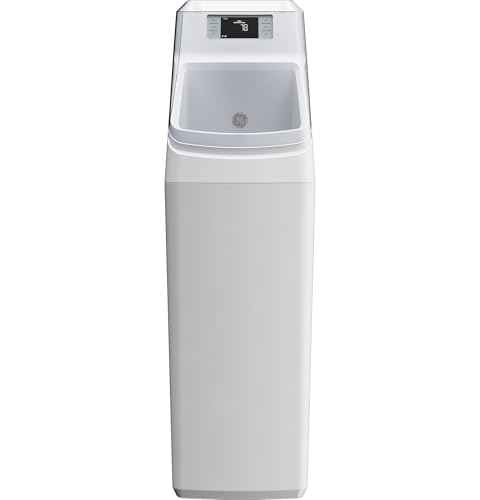
You want your phone to tell you when salt runs low or water keeps running, and you might add GE’s shutoff valve later.
Your well water carries more than 5 ppm of clear iron. The Kenmore 420 is rated for 10.
The GE GXSH35W is the pick for anyone who wants alerts. GE’s support page lists it as manufactured from November 2025, and the Amazon listing describes built-in Wi-Fi through GE’s SmartHQ app. It sends alerts for low, medium or high continuous water flow, plus low-salt reminders.
The listing adds that GE’s RMVALVESFT water shutoff valve, sold separately, lets you shut the house water off from your phone when a leak is detected. Amazon also sells the two as a bundle. Without the valve you get the alert but still have to close the main yourself.
The numbers come from GE’s owner’s manual 49-6000319, which covers the GXSH35W, GXMD30W and GXSH45W. IAPMO R&T certifies all three to NSF/ANSI 44 for hardness reduction and efficiency, to NSF/ANSI 372 for lead content, and the GXSH35W to CSA B483.1.
Rated capacity is 13,311 grains on a 2.6 lb salt dose, 32,636 on 9.8 lb and 37,065 on 17.1 lb. Its low-dose efficiency of 5,120 grains per pound of salt is the best on this page. The trade is water: 3.0 gallons per 1,000 grains and 77 gallons per regeneration at the top dose.
It holds 1 cubic foot of resin in a 10 by 35 in. tank. GE rates the service flow at 8 gpm with only a 9 psi pressure drop, and it treats up to 165 grains per gallon. The clear water iron limit is 5 ppm.
GE’s power rules are strict. The included 12 V supply must plug into a 120 V circuit protected by a GFCI, with no extension cord or surge protector. GE also warns that chlorine above 2 ppm can shorten resin life.
Warranty: one year on any part, with labor; three years on the electronic monitor; ten years on the resin tank, from the date of purchase. The cabinet is 46 in. tall, 15 in. wide and 26 in. deep, so it’s the deepest here.
My call: buy the GE if leak alerts matter to you. I’ve used it; for heavy iron or tight floor space, a Kenmore fits better.
Aquasana SimplySoft 40,000 grain water softener, WH-SF40
Prices and availability are accurate as of the time shown and may change.
You’re on city water with up to five people and want the most flow and the biggest salt bin in this size.
Your well has iron above 1 ppm. Aquasana rates it for 1 ppm; the Kenmore 420 handles 10.
The Aquasana SimplySoft 40K is the flow pick. Aquasana’s performance data sheet rates the WH-SF40 at 11.02 gpm with a 15 psi pressure drop, the highest service flow in this size on this page. The Amazon listing says it suits homes of up to 5 people and 4 bathrooms.
IAPMO R&T certifies it to NSF/ANSI 44 for water hardness, to NSF/ANSI/CAN 372 and to CSA B483.1. Aquasana rates its efficiency at 4,423 grains per pound of salt on a 3 lb dose, which gives 13,269 grains at that setting. It doesn’t publish the capacity at its top dose; 40,000 is the size in the name.
It holds 1 cubic foot of 8% crosslink resin in a 10 by 35 in. tank and stores 230 lb of salt, the only maker here that prints a salt capacity. The cabinet is 43 in. tall on a 30 by 15 in. footprint, with 1 in. male NPT connections.
Iron is the catch. Aquasana rates it for only 1 ppm of ferrous iron and a minimum pH of 6.5. Its manual adds 4 grains of hardness per ppm of iron and 8 per ppm of manganese when you program it, a different rule from Kenmore and GE.
The Amazon listing is the base system, WH-SF40-BASE. The listing recommends the pre-filter that comes in Aquasana’s Softener Installation Kit, which Amazon sells separately as B0DHFMJHK6 on Amazon. Aquasana’s own site sells the 40K with the pre-filter included.
Warranty: five years on the control valve and ten years on the pressure vessel and brine tank. Media, piston, seals and the brine valve are wear items it doesn’t cover. Aquasana’s warranty applies only to products bought from Aquasana or an authorized reseller, with proof of purchase, so keep the Amazon receipt and confirm with Aquasana at 866-662-6885.
My call: buy it for a city-water home that runs a lot of fixtures at once. I’ve used it; skip it on an iron well.
Aquasana SimplySoft 60,000 grain water softener, WH-SF60
Prices and availability are accurate as of the time shown and may change.
You have five or more people, three or four bathrooms, and city water that’s very hard.
Your drain is a small standpipe or laundry sink that can’t take 3.5 gpm, or your well carries iron.
The SimplySoft 60K is the big-house pick. The Amazon listing says it suits larger homes of 5 or more people and 4 or more bathrooms. Aquasana’s performance data sheet gives it 1.5 cubic feet of 8% crosslink resin in a 12 by 35 in. tank, half again the resin of the 40K.
It keeps the same 43 in. cabinet on the same 30 by 15 in. footprint, so it doesn’t take more floor than the 40K. Service flow is 11.1 gpm with a 15 psi pressure drop, and it treats up to 200 grains per gallon of compensated hardness.
Aquasana rates it at 4,543 grains per pound of salt on a 4.5 lb dose, or 20,443 grains at that setting. Like the 40K, it doesn’t publish a top-dose capacity; 60,000 is the size in the name. IAPMO R&T certifies it to NSF/ANSI 44 for hardness, NSF/ANSI/CAN 372 and CSA B483.1.
Plan the drain before it arrives. The 60K’s backwash runs up to 3.5 gpm to the drain, against 2.4 for the 40K and about 2 for the Kenmores and GE. Aquasana’s manual asks for an air gap of 2 pipe diameters or 1 in., whichever is larger. A floor drain is best.
It’s also heavy: 120 lb to ship, per the data sheet. Get a second person to set it.
The iron limit is the same 1 ppm as the 40K, so this is a city-water softener. On a well with iron, Aquasana’s sheet doesn’t cover it, and you should look at our well water picks instead.
Warranty and seller terms match the 40K: five years on the valve, ten on the tanks, and only through Aquasana or an authorized reseller with proof of purchase. The pre-filter is in the separate installation kit, B0DHFMJHK6 on Amazon.
My call: buy the 60K when a 40,000-grain softener would regenerate every few days in your home. I’ve used it; the checker below shows whether yours would.
Every number comes from the maker’s manual or data sheet. Scroll sideways on a phone. Prices are in each card and the picks above.
| Pick | Spec score | Photo | Rated flow | Iron limit | Pros / cons | Buy |
|---|---|---|---|---|---|---|
| Kenmore 420 Most homes | 9.1 | | 7.7 gpm | 10 ppm | Iron, old-Kenmore swap / Lower flow | Check it on Amazon |
| Kenmore 350 1 to 4 people | 8.8 | | 7.2 gpm | 8 ppm | Least water / Smallest resin bed | Check it on Amazon |
| GE GXSH35W Phone alerts | 9.4 | | 8 gpm | 5 ppm | Wi-Fi alerts / 77 gal per regeneration | Check it on Amazon |
| Aquasana 40K High flow | 9.1 | | 11.02 gpm | 1 ppm | Flow, 230 lb salt / Iron limit | Check it on Amazon |
| Aquasana 60K 5 or more people | 9.4 | | 11.1 gpm | 1 ppm | Most resin / 3.5 gpm drain | Check it on Amazon |
Green marks a strength and amber a trade-off. Iron is clear water (ferrous) iron. Salt efficiency and hardness limits are in the sections below.
Enter your daily water use and your water test. The checker applies each maker’s own iron rule and limits, then shows how long each pick runs between regenerations.
The math is short. Hardness in grains per gallon times the gallons you use a day gives the grains the softener has to remove each day. Divide its capacity by that number and you get the days between regenerations.
The 300-gallon default is EPA WaterSense’s figure for an average American family’s daily use at home. Use your own bill if you can.
Two things move the answer most. Iron is the first: the Kenmore and GE manuals add 5 grains per gallon for every 1 ppm of clear water iron, and Aquasana adds 4, plus 8 for every 1 ppm of manganese. Two ppm of iron on 15-grain water makes it 25-grain water to a Kenmore.
Salt setting is the second. The capacities above are at the top salt dose; a softener set to save salt runs shorter between regenerations, as the next section shows.
The grain number on the box is the capacity at the heaviest salt dose. NSF/ANSI 44 makes makers publish capacity at more than one dose, and the low doses are where a softener saves salt.
| Pick | Low salt dose | Middle dose | Top dose | Grains per lb at low dose |
|---|---|---|---|---|
| Kenmore 420 | 16,900 gr at 3.3 lb | 31,700 gr at 8.8 lb | 40,100 gr at 15.1 lb | 5,090 |
| Kenmore 350 | 12,600 gr at 2.5 lb | 26,900 gr at 7.9 lb | 32,100 gr at 13.3 lb | 5,040 |
| GE GXSH35W | 13,311 gr at 2.6 lb | 32,636 gr at 9.8 lb | 37,065 gr at 17.1 lb | 5,120 |
| Aquasana 40K | 13,269 gr at 3 lb | Not published | Not published | 4,423 |
| Aquasana 60K | 20,443 gr at 4.5 lb | Not published | Not published | 4,543 |
From Kenmore’s use and care guides 7393307 and 7393292, GE’s owner’s manual 49-6000319 and Aquasana’s WH-SF40/SF60 performance data sheet. Each maker says operating efficiency in a home is typically lower than the lab rating.
Look at the Kenmore 420’s row. At its low dose it removes 5,090 grains per pound of salt, but it only regenerates 16,900 grains. At the top dose it reaches 40,100 grains, which works out to about 2,656 grains per pound.
So the top dose buys capacity with salt. Kenmore’s and GE’s controls choose the dose for you; GE and Kenmore also have a salt efficiency setting that holds the softener to 4,000 grains per pound or better.
NSF/ANSI 44 sets a floor of 3,350 grains per pound for a softener to be called efficiency rated, and every pick here clears it. The lab test runs at a set flow and pressure; GE lists 7.5 gpm and 35 psi, a pH of 7.5. Your hardness, iron and use will pull the real number lower.
Every softener costs some pressure. The rated service flow is the flow the maker proved it softens at for ten straight minutes, and the pressure drop is what you lose at that flow.
| Pick | Rated flow | Pressure drop | Pressure range | Water temp. |
|---|---|---|---|---|
| Kenmore 420 | 7.7 gpm | 14.9 psi | 20 to 125 psi | 40 to 120°F |
| Kenmore 350 | 7.2 gpm | 15 psi | 20 to 125 psi | 40 to 120°F |
| GE GXSH35W | 8 gpm | 9 psi | 20 to 125 psi | 40 to 100°F |
| Aquasana 40K | 11.02 gpm | 15 psi | 20 to 125 psi* | 40 to 100°F* |
| Aquasana 60K | 11.1 gpm | 15 psi | 20 to 125 psi* | 40 to 100°F* |
*From Aquasana’s performance data sheet. Its install manual says 30 to 125 psi and 40 to 110°F; go by the narrower numbers, 30 psi and 100°F.
A rough count helps. Federal rules cap a shower head at 2.5 gpm and a kitchen faucet at 2.2 gpm, and a washer filling draws more on top. Two showers and a washer at once can pass 7 gpm.
At that point a Kenmore is near its rating and will cost you about 15 psi. The Aquasanas still have room. Also check the bottom of the range: Kenmore lists a 3 gpm minimum supply flow, which a weak well pump may not give.
High pressure is the other risk. Kenmore, GE and Aquasana all cap the inlet at 125 psi and say to add a pressure reducing valve when daytime pressure is over 80 psi, since night pressure can climb past the limit. Kenmore and GE add that a house with a backflow preventer needs an expansion tank, installed to local code.
A salt softener swaps calcium and magnesium for sodium on its resin bed. It also takes some clear water iron, up to each maker’s limit. Test before you buy.
This is the job. Every pick is certified to NSF/ANSI 44 for hardness reduction, up to 90 gpg on the Kenmore 350 and 200 gpg on the Aquasanas.
Water that comes out clear and turns orange after it sits. Kenmore 420 handles 10 ppm, the 350 8 ppm, the GE 5 ppm and the Aquasanas 1 ppm.
GE and Kenmore list reduction of both under their NSF/ANSI 44 certification.
GE says chlorine above 2 ppm can shorten resin life. Aquasana’s warranty excludes failures from chlorine degradation. City water on chloramine is worth a carbon filter ahead of the softener.
GE’s manual says its softener won’t remove ferric (red water), bacterial or colloidal iron. That takes an iron filter, and bacteria take chlorination.
Kenmore, GE and Aquasana all say not to use their softeners on water that is microbiologically unsafe or of unknown quality without disinfection.
If your test shows red water iron, iron bacteria or more clear iron than the picks above handle, read our water softener for well water guide first. If you only want less scale and no salt, our salt-free softener guide covers conditioners, which don’t make water soft.
Not sure you need one at all? Our do I need a water softener page walks through the test.
Plenty of older Kenmore softeners are still in basements. Kenmore publishes which old models the 420 and 350 replace without moving pipe.
| Old Kenmore model | Old inlet height | Extra rise to the 420 or 350 |
|---|---|---|
| 625.348460 | 22-1/2 in. | 19 in. |
| 625.340400 | 34 in. | 7-1/2 in. |
| 625.348512 | 36-1/2 in. | 5 in. |
| 625.388110 | 36-1/2 in. | 5 in. |
| 625.340500 | 36-3/4 in. | 4-3/4 in. |
From Kenmore’s 420 and 350 product pages. Kenmore uses 41-1/2 in. for the new height on this list and 41-3/8 in. in its spec block, and says valve height can vary by up to 1/2 in. between units.
The model number is on a label under the salt lid or on the back of the cabinet. If yours is one of the 44 direct swaps, the job is mostly disconnecting the old bypass, setting the new cabinet and reconnecting.
Kenmore lists 1 in. NPT male connections on the 420 and 350 and includes an installation kit. Lay the kit next to your old fittings before you shut the water off, so a missing adapter doesn’t stall the job.
All five manuals agree on the layout: on the main cold line, after the pressure tank on a well, before the water heater, with outside faucets left on hard water.
Close to where the main enters, near a drain and a grounded outlet, indoors and away from freezing. Aquasana says no direct sunlight either. Never after the water heater.
Kenmore and GE say outside faucets should stay on untreated water, so tee them off ahead of the softener. Lawn water doesn’t need softening.
All five come with a bypass valve. It lets you shut the softener off and keep water in the house during service.
Kenmore and GE call for a 1-1/2 in. air gap at the end of the drain hose and runs under 30 feet. Aquasana asks for 2 pipe diameters or 1 in., whichever is larger. Never push the hose into the drain.
If your electrical system grounds to a metal cold water pipe, a plastic bypass breaks that path. Kenmore says to bridge it with #4 copper wire clamped at both ends, per local code.
Plug into a grounded outlet; GE requires a GFCI circuit and no extension cord. Add salt, then program hardness from your water test using the maker’s iron rule.
Kenmore and GE say not to run hot water over 120°F through the softener. Aquasana says not to install it after a water heater or on the hot water line.
Add a pressure reducing valve ahead of the softener. All three makers say so. Our pressure reducing valve guide covers sizing by brand.
GE and Kenmore say Massachusetts requires a licensed plumber under 248 CMR. Check your own state; many need a permit for work on the main.
Kenmore lists 1 in. NPT male, Aquasana 1 in. MNPT, and GE 1 in. with quick connectors for 3/4 in. and 1-1/4 in. pipe, per its listing.
If cutting into the main, running a drain and bonding a ground wire are all new to you, hire a licensed plumber for the install. Our softener install cost guide shows what the job runs. If a softener stops making soft water later, start with our softener not regenerating checklist.
All five run on ordinary softener salt, and every manual names the same kinds.
| Question | What the makers say | Source |
|---|---|---|
| Which salt? | Nugget, pellet or coarse solar salt. Kenmore says under 1% impurities; GE says at least 99.5% pure. | Kenmore 420 guide; GE manual |
| What to avoid | Rock salt, block, granulated, table, ice-melting and ice cream salt (Kenmore). Natural rock salt and mixing salt types (Aquasana). | Kenmore 420 guide; Aquasana data sheet |
| Potassium chloride? | GE says it can replace sodium chloride. Kenmore has a setting for KCl; set it so the salt monitor reads right. | GE manual; Kenmore 420 guide |
| Salt level | Aquasana says keep salt above the brine water level. Kenmore and GE count salt with a monitor you reset each time you fill. | Aquasana manual; Kenmore and GE guides |
| Resin care | Aquasana says it may be disinfected with 5.25% sodium hypochlorite, household bleach: 4 fl oz in the brine well, then its sanitizing steps. | Aquasana install manual |
For brands and bag sizes, our water softener salt guide compares them. A crust across the salt, called a bridge, stops brine from forming; Kenmore’s guide covers breaking it up. For iron fouling, a resin cleaner helps, and our softener cleaner guide lists the ones that fit.
We read every Amazon listing against the maker’s documents. These are the differences that matter, and which number we used.
| Product | The listing says | The maker says | We used |
|---|---|---|---|
| Kenmore 420 | A “powerful sediment pre-filter” for well water | A built-in screen against large particles | Kenmore: a screen, not a filter |
| Kenmore 350 | Part number 383500E | Model 625.383500 | Same softener; both shown |
| GE GXSH35W | 35,000 grains | 37,065 grains at a 17.1 lb dose | GE’s certified figures |
| Aquasana 40K and 60K | 15.5 gpm and 16.6 gpm in the titles | Rated service flow 11.02 and 11.1 gpm at a 15 psi drop | Aquasana’s rated figures |
| Aquasana 40K and 60K | Base system, pre-filter in a separate kit | Aquasana’s site sells the 40K with a pre-filter | Listing: base system |
| Aquasana 40K and 60K | Data sheet: 20 to 125 psi, 40 to 100°F | Install manual: 30 to 125 psi, 40 to 110°F | The narrower: 30 psi, 100°F |
| Check | How to find it | What it points to |
|---|---|---|
| Hardness | City water quality report, or a well test in grains per gallon | Over 90 gpg rules out the Kenmore 350 |
| Iron and manganese | Same report or test, in ppm | Over 1 ppm: Kenmore or GE; over 5 ppm: Kenmore 420 |
| Daily use | Monthly gallons on your bill ÷ 30 | Run the size checker above |
| Peak flow | Count showers, washer and dishwasher running at once | Over about 7 gpm: an Aquasana |
| Space and drain | Floor space, a grounded outlet and a drain within 30 feet | GE is 26 in. deep; Aquasana 60K drains 3.5 gpm |
Most homes end at the Kenmore 420. Swap to the 350 for a small household, the GE if you want alerts, and an Aquasana when flow or household size is the limit.
Wondering about a filter as well? Our softener vs whole house filter page explains what each does, and our reverse osmosis vs softener page covers drinking water.
For most homes, the Kenmore 420. NSF International certifies it to NSF/ANSI 44 at 40,100 grains on a 15.1 lb salt dose, and it’s rated for 120 grains per gallon of hardness and 10 ppm of clear water iron.
No maker publishes failure rates, so we look at certification and warranty. Kenmore, GE and Aquasana all have whole systems certified to NSF/ANSI 44. Aquasana covers its control valve for 5 years; Kenmore and GE cover parts for 1 year and electronics for 3.
Multiply your daily gallons by your hardness in grains per gallon, adding the maker’s allowance for iron. Divide the softener’s capacity by that number to get days between regenerations. The checker on this page does it for all five picks.
It depends on your plumbing, the drain and your local permit. Our water softener install cost guide breaks down the job. The bypass and installation parts come with each pick here.
If you can cut into the main, run a drain line with an air gap and restore an electrical ground across the valve, yes. The Kenmore and GE manuals walk through it. Massachusetts requires a licensed plumber, per GE and Kenmore.
Only clear water (ferrous) iron, up to each maker’s limit: 10 ppm for the Kenmore 420, 8 for the 350, 5 for the GE and 1 for the Aquasanas. GE says softeners won’t remove red water, bacterial or colloidal iron.
A little. The makers list a pressure drop at the rated flow: 9 psi for the GE at 8 gpm, about 15 psi for the others. Below that flow, the drop is smaller.
No. Kenmore and GE both say outside faucets should stay on untreated water, so branch them off ahead of the softener.
GE says potassium chloride can replace sodium chloride in its softener, and Kenmore has a KCl setting for its salt monitor.
All five regenerate on demand, when the metered water use has used up the capacity. At 300 gallons a day and 15 grains per gallon, that’s about every 7 to 13 days for these picks.
GE builds a sediment filter into its softener, and Kenmore uses a built-in screen. Aquasana recommends a pre-filter and sells it in a separate installation kit for its Amazon base systems.
I’m Isaac Daniels, a licensed journeyman plumber in Georgia, and I’ve used every softener on this page. Every number here comes from the makers’ own manuals, data sheets and warranty documents, read on Oct 22, 2026, and every product was re-checked on Amazon the same evening.
Each check scores 0 to 10 and counts one fifth. It rewards a softener certified as a whole system, one that gets more softening from each pound of salt, more flow, a wider range of water and a longer warranty. It’s our score from the makers’ documents, not a customer rating or a home test.
The Kenmore 420 scores below the GE and the Aquasana 60K because of its flow rating. It’s still my top pick for most homes, for its 10 ppm iron rating and the old-Kenmore swap; the cards say which home each one suits.
| Check (weight) | How it’s scored |
|---|---|
| Certified system (⅕) | 10 when the complete softener is certified to NSF/ANSI 44 by NSF International or IAPMO R&T; 0 when only parts are |
| Salt efficiency (⅕) | The maker’s rated grains per pound of salt: 10 for 5,000 or more; 8.5 for 4,500 to 4,999; 7 for 4,000 to 4,499; 5.5 for 3,350 to 3,999 |
| Rated flow (⅕) | The maker’s rated service flow: 10 for 10 gpm or more; 8.5 for 8 to 9.9; 7 for 7 to 7.9; 5.5 below 7 |
| Water it handles (⅕) | 10 when it’s rated for 100 gpg of hardness or more and 5 ppm of clear water iron or more; 8.5 when it meets one of the two; 7 for neither |
| Warranty (⅕) | 10 for a control valve covered 5 years or more; 8.5 for 3 years on the electronics and 10 years on the tanks; 7 for 1 year on everything |
| Total | Average of the checks, to one decimal |
| Pick | Certified system | Salt efficiency | Rated flow | Water it handles | Warranty | Score |
|---|---|---|---|---|---|---|
| Kenmore 420 | 10 | 10 | 7 | 10 | 8.5 | 9.1 |
| Kenmore 350 | 10 | 10 | 7 | 8.5 | 8.5 | 8.8 |
| GE GXSH35W | 10 | 10 | 8.5 | 10 | 8.5 | 9.4 |
| Aquasana 40K | 10 | 7 | 10 | 8.5 | 10 | 9.1 |
| Aquasana 60K | 10 | 8.5 | 10 | 8.5 | 10 | 9.4 |