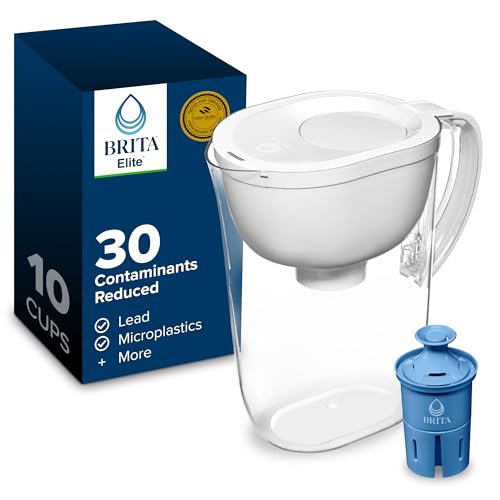
Brita Large 10-Cup (Elite)
$44.99 at Amazon
Check it on AmazonPrice as of Oct 24, 2026, 5:30 AM EDT
Details ↓
Three pitchers scored on their makers’ performance data sheets: what each filter is certified to reduce, and how long it lasts.
As an Amazon Associate I earn from qualifying purchases.
Get the Brita 10-Cup Elite (10.0): lead and PFAS on its data sheet, 120 gallons a filter.
All three are gravity pitchers for treated tap water, each with a published performance data sheet. Each was new, in stock and sold by Amazon.com on Oct 23, 2026, and each scores 7.0 or higher.

Product prices and availability are accurate as of the date/time indicated and are subject to change. Any price and availability information displayed on Amazon.com at the time of purchase will apply to the purchase of this product.
Pick your main concern and how much you drink. The planner names a starting pick and counts filters by each maker’s rated life.
Start with your water utility’s annual Consumer Confidence Report, or a lab test if you’re on a well. A filter is only worth what it removes from your water, and every data sheet here says to compare its claims with your actual water first.
Filter life is the running cost most people miss. At a gallon a day, a 15-gallon filter means two a month; a 120-gallon filter means three a year. Our how often to change a pitcher filter guide covers the timing.
Six checks from each filter’s performance data sheet and the Amazon listing, equal weight.
A performance data sheet is the maker’s legal list of what the filter was tested to reduce, under which NSF/ANSI standard, and how long it lasts. The score reads those sheets: lead under Standard 53, PFAS, the Standard 401 emerging compounds, filter life, microplastics, and whether the listing matches.
ZeroWater lost points on what its sheet doesn’t cover: no Standard 401 testing, no microplastics line, and a 15-gallon life. Its strength, dissolved solids, isn’t one of these checks; it’s explained on its card.
What each data sheet lists, which homes each suits, and where each lost points.
Brita Large 10-Cup Elite water filter pitcher (OB46) with Elite filter (OB06)
Prices and availability are accurate as of the time shown and may change.
You want lead and PFAS covered and the fewest filter changes a year.
Your concern is minerals or hardness taste. A pitcher like this keeps most minerals.
The Brita Elite has the broadest data sheet and the longest filter life here, and I’ve used it. It scored 10.0.
Brita’s performance data sheet for the Elite filter (OB06) covers system models including the OB46 Large 10-Cup. It says the systems were tested to NSF/ANSI 42, 53 and 401, and that the Elite filter is certified by WQA to those three standards.
Lead reduction is 99.5% at pH 6.5 and 99.6% at pH 8.5, from a 150 ppb challenge to under the 5 ppb limit; Brita notes NSF International certification for lead on the listed pitchers. That’s a 10.
PFOA and PFOS show 98.1% reduction, certified by IAPMO R&T for the specified pitchers. Microplastics (0.5 to 1 µm particles) show 99.6%, and the sheet lists Standard 401 compounds such as bisphenol A, naproxen and metolachlor. Tens on all three checks.
Filter life is the standout: Brita says to replace the Elite every 120 gallons, about every 6 months for the average family, and to process no more than 2 gallons a day. That’s a 10, and it’s three times the PUR filter’s life.
Other lines from the sheet: chlorine 97.4%, mercury about 95.5% to 95.9%, cadmium 96.9% to 99.2%, plus benzene, atrazine and other organics.
One caution printed on the sheet: some claims are valid only for certain pitcher models. The OB46 is on the list, but check the model if you buy a different Brita body.
The same OB06 filter fits Brita’s Ultramax dispenser (OB24) and the other system models listed on the sheet, so a household that outgrows 10 cups can switch bodies and keep the same filter supply. The sheet also shows asbestos over 99% and Health Canada guideline values next to the U.S. limits.
My call: the default pitcher for treated city water, and the one that needs the fewest filters a year.
Water filter pitcher (PPT711) with PUR Plus filter (PPF951K)
Prices and availability are accurate as of the time shown and may change.
You want a total-PFAS claim and a pitcher that fits the fridge door.
You hate changing filters. At 40 gallons, it needs one about every two months.
The PUR Plus is the PFAS-focused pick in a slim, fridge-door size, and I’ve used it. It scored 9.5.
PUR’s performance data sheet covers pitcher models including the PPT711 and the PUR Plus filter, PPF951K. It says the systems were tested to NSF/ANSI 42, 53 and 401, and certified by IAPMO R&T for the listed claims.
Lead reduction for the Plus filter is 99.2% at pH 8.5 and 99.9% at pH 6.5. The sheet is clear that the basic PUR filter, PPF900Z, isn’t certified for lead; the Plus filter is. That’s a 10.
Total PFAS shows 99.75%. PUR defines total PFAS as a seven-compound mix: PFOA, PFOS, PFHxS, PFNA, PFHpA, PFBS and PFDA. That’s broader than a PFOA/PFOS-only claim, and a 10.
Microplastics show 99.8%, and the Standard 401 table lists bisphenol A, estrone, ibuprofen, naproxen and more. Tens on both.
It lost points on filter life: PUR gives 40 gallons per filter, a 7 on our scale. Usable water temperature is 34 to 82°F, so don’t pour hot water through it.
Other lines: chlorine 97.5%, copper, cadmium, mercury, benzene and toluene. PUR’s sheet also notes that, like other leading brands, it doesn’t filter microbes.
PUR’s data sheet covers more than this pitcher: the same PPF951K filter fits PUR’s other listed pitchers and its DS1800 and DS1811 dispensers, so you can move up to a 30-cup PUR Plus dispenser without changing filters.
Other Plus-only lines include carbon tetrachloride and simazine. PUR’s listing notes the basic filter filters faster, which makes sense: the Plus filter is doing more work. It also warns that “compatible does not mean comparable” for off-brand filters.
My call: the pick when total PFAS is the worry and fridge space is tight; plan on more frequent filters.
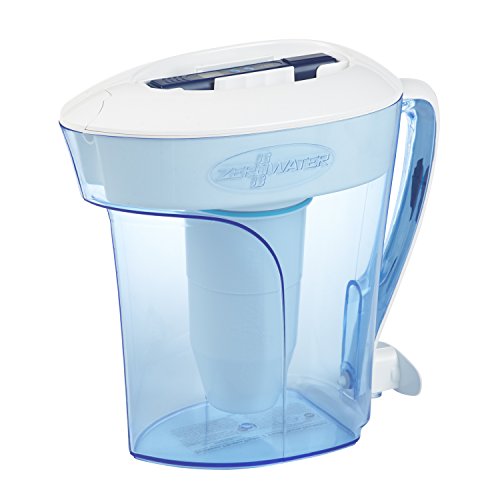
Ready-Pour pitcher with 5-stage ion exchange filter, ZP-010
Prices and availability are accurate as of the time shown and may change.
You want water with almost nothing dissolved in it, or your report shows chromium 6.
Your water is hard. High dissolved solids use up a 15-gallon filter fast.
ZeroWater is the specialist: it strips dissolved solids that carbon filters leave in, and I’ve used it. It scored 7.5.
ZeroWater’s performance data sheet (dated April 22, 2026) covers models including the ZP-010. It says the system was tested to NSF/ANSI 42 and 53. ZeroWater’s results page says its 5-stage ion exchange filter is IAPMO certified for PFOA/PFOS, lead, chlorine, chromium and mercury.
The numbers are strong: PFOA/PFOS 99.8%, lead 98.9% at pH 6.5 and 98.8% at pH 8.5, hexavalent chromium 99.4% to 99.5%, mercury 94.2% to 96.6%, chlorine 99.4%. Tens on lead and PFAS.
Its point is total dissolved solids. ZeroWater’s listing says the filter removes virtually all TDS and ships with a meter so you can see when it’s time to change: when the reading climbs. That’s why the water tastes flat compared with mineral-rich tap water.
It lost points in three places. The sheet lists no Standard 401 testing and no microplastics line, so a 5 on each. And the rated life is 15 gallons, a 5; on hard water the meter will tell you sooner.
Rated service flow is 4 gallons a day, and operating temperature is 40 to 90°F. The warranty is 90 days on the pitcher and 30 days on the filter, the shortest here.
The sheet also warns not to use water that is microbiologically unsafe or of unknown quality without disinfection, as all three makers do.
The sheet lists dispenser models on the same filter, such as the ZD-018 and ZD-030RP, and names the replacement element as ZR-001 or ZF-201.
My call: the right tool for very low TDS or a chromium 6 concern on soft water; the wrong one for hard well water.
From each performance data sheet, read Oct 23, 2026.
| Pick | Spec score | Photo | Lead | PFAS | Filter life | Standards | Short pros / cons | Buy |
|---|---|---|---|---|---|---|---|---|
| Brita Large 10-Cup (Elite) | 10.0 | | 99.5–99.6% | PFOA/PFOS 98.1% | 120 gal | 42, 53, 401 | Longest life / 2 gal/day limit | Check it on Amazon |
| PUR Plus 7-Cup | 9.5 | | 99.2–99.9% | Total PFAS 99.75% | 40 gal | 42, 53, 401 | Seven-PFAS mix / 40 gal | Check it on Amazon |
| ZeroWater 10-Cup | 7.5 | | 98.8–98.9% | PFOA/PFOS 99.8% | 15 gal | 42, 53 | Strips TDS / Short life | Check it on Amazon |
Sources: Brita performance data sheet for the Elite filter (OB06); PUR performance data sheet for PPF951K and PPF900Z; ZeroWater performance data sheet (April 22, 2026). Reduction figures are each maker’s lab results under the listed standards.
Each maker’s data sheet covers dispensers that take the same filter, so size is easy to change later.
| Maker | Filter | Larger models on the same sheet | Example on Amazon |
|---|---|---|---|
| Brita | Elite OB06 | Ultramax OB24 and others | Brita XL 27-cup dispenser (OB24) |
| PUR | PUR Plus PPF951K | DS1800, DS1811 dispensers | PUR Plus 30-cup dispenser (DS1811) |
| ZeroWater | 5-stage ZR-001 | ZD-018, ZD-030RP and others | See ZeroWater’s model list |
A 10-cup pitcher holds a few glasses of filtered water at a time, and every refill waits for the water to drip through. Households that drink a gallon or more a day often switch to a countertop or fridge dispenser that takes the same filter. Buying within one maker keeps your filter supply the same.
The flow limits still apply. Brita says to process no more than 2 gallons a day through the Elite filter, and PUR rates 2 gallons a day. A bigger tank doesn’t raise the filter’s daily limit; it just stores more filtered water.
Fridge fit is the other size question. The PUR Plus 7-cup is slim enough for many fridge doors, per PUR’s listing; 10-cup pitchers usually live on a shelf.
The standard number tells you what kind of claim it is. The data sheet tells you what was actually tested.
| Standard | Covers | Examples on these sheets |
|---|---|---|
| NSF/ANSI 42 | Aesthetic effects: taste, odor, particulates | Chlorine, zinc, particulate classes |
| NSF/ANSI 53 | Health effects | Lead, mercury, cadmium, PFOA/PFOS, benzene, chromium 6 |
| NSF/ANSI 401 | Emerging compounds at trace levels | Bisphenol A, ibuprofen, naproxen, microplastics (PUR, Brita) |
| NSF/ANSI 372 | Lead-free materials in the product | Not a reduction claim |
Two traps. First, a brand can be “certified” to a standard for one substance and not others; read the line for the substance you care about. Second, the certifier can be NSF, WQA or IAPMO R&T, all accredited, but the claim has to be on the sheet for that exact filter model.
PUR’s sheet shows the trap clearly: the PUR Plus filter is certified for lead and the basic PUR filter isn’t, even though both fit the same pitchers. Our NSF-certified water filter guide covers certification in more depth.
Rated gallons assume the maker’s test water. Hard water, sediment or high TDS use filters up faster, especially ZeroWater’s ion-exchange filter, whose meter shows when it’s spent. Change filters on time: a filter past its rated life can stop reducing what it was certified for.
Use the planner above to count filters a year. Then check the replacement filter price on Amazon for each, because the filter, not the pitcher, is most of what you’ll spend.
“PFAS” on a box can mean two compounds or a mix of seven. The data sheet says which.
| Filter | What the sheet tests | Result |
|---|---|---|
| Brita Elite | PFOA and PFOS | 98.1%, certified by IAPMO R&T |
| PUR Plus | Total PFAS: PFOA, PFOS, PFHxS, PFNA, PFHpA, PFBS, PFDA | 99.75% |
| ZeroWater 5-stage | PFOA and PFOS | 99.8% |
If your utility report lists PFAS beyond PFOA and PFOS, PUR’s total-PFAS claim covers more of the family. If it lists only those two, all three sheets address them. For whole-house or under-sink PFAS treatment, see our under-sink water filter guide.
Total dissolved solids are the minerals and salts in water, mostly calcium and magnesium on hard water. Carbon pitchers like Brita and PUR leave most of them in, which is why the water still tastes like your tap, just cleaner. ZeroWater’s ion-exchange filter removes them, which reads near zero on its meter and tastes flat to some people.
Removing minerals isn’t a health claim on any of these sheets. It’s a taste and preference choice, and on hard water it costs filter life. If hardness is your real problem, a softener or a reverse osmosis system makes more sense; see reverse osmosis vs water softener.
| Limit | From the sheets |
|---|---|
| Microbes | Not filtered; PUR’s sheet says so, and ZeroWater says to disinfect unsafe water first |
| Hot water | PUR: 34 to 82°F; ZeroWater: 40 to 90°F |
| Volume | Brita: no more than 2 gallons a day; PUR: 2 gallons a day rated; ZeroWater: 4 |
| Untreated well water | All three are for potable water; test a well first |
On a private well, test for bacteria, nitrate and arsenic before trusting a pitcher. A pitcher is a finishing filter for water that’s already safe to drink. For wells, our whole house well water filter guide is the place to start.
Follow the maker’s soak or flush steps; carbon fines in the first fill are normal.
Hot water can damage the filter and is outside the rated range.
Use the indicator or write the start date on the lid.
Brita about 6 months, PUR 2 months, ZeroWater when its meter reading rises or at 15 gallons.
Clean the reservoir and lid between filters to stop slime and algae.
Keep the pitcher in the fridge or out of direct sun. Filtered water has less chlorine, so it can grow algae faster in a warm, bright spot. Our countertop water filter guide covers bigger systems if a pitcher can’t keep up.
| Trap | Why it matters | What to do |
|---|---|---|
| Off-brand “compatible” filters | The certification belongs to the maker’s filter, not the pitcher | Buy the filter model named on the data sheet |
| Basic vs upgraded filter | PUR’s basic filter isn’t certified for lead; the Plus is | Match the filter to your concern |
| Claims limited to some models | Brita marks some claims as valid only for listed pitchers | Check your pitcher’s model number on the sheet |
Cheap look-alike filters are the most common way a good pitcher stops doing its job. They may fit perfectly and still have no certification for lead or PFAS. The data sheet’s replacement filter number is the one to reorder.
Keep the box or photograph the model number on the bottom of the pitcher. Months later, that number is how you confirm which claims apply.
| Question | If yes | If no |
|---|---|---|
| Is lead a concern? | Brita Elite or PUR Plus | Next question |
| Does your report list several PFAS? | PUR Plus (total PFAS) | Next question |
| Do you want near-zero dissolved solids? | ZeroWater | Next question |
| Want the fewest filter changes? | Brita Elite | PUR Plus |
Whatever you pick, buy the matching filter. PUR’s own sheet is the clearest proof: the same pitcher with the wrong filter loses the lead claim.
On our spec score, the Brita Large 10-Cup with the Elite filter (10.0): lead, PFOA/PFOS and microplastics on its data sheet, and 120 gallons per filter.
These three list lead reduction under NSF/ANSI 53: Brita Elite 99.5–99.6%, PUR Plus 99.2–99.9%, ZeroWater 98.8–98.9%.
All three list it. PUR Plus tests a seven-compound total PFAS mix; Brita Elite and ZeroWater test PFOA and PFOS.
By rated gallons or time: Brita Elite 120 gallons (about 6 months), PUR Plus 40 gallons (2 months), ZeroWater 15 gallons.
None of these three data sheets lists fluoride. Check the sheet for any pitcher that claims it.
For dissolved solids, yes. For filter life, Standard 401 compounds and microplastics, the Brita Elite sheet covers more.
Only if the water is already safe. The sheets are for potable water, and none filters microbes.
No. PUR’s data sheet shows the basic PPF900Z as not certified for lead; the PUR Plus PPF951K is.
I’m Isaac Daniels, a licensed journeyman plumber in Georgia (license #JP507711), and I’ve used all three picks. Every figure here comes from Brita’s, PUR’s and ZeroWater’s own performance data sheets, read Oct 23, 2026. Where I add my own advice, it’s labeled as my call.
Six checks, one sixth each, 0 to 10, averaged to one decimal. The score reads performance data sheets; it isn’t our own water test, and buyers’ opinions play no part in it.
| Check (weight) | How it’s scored |
|---|---|
| Lead certified (1/6) | Lead reduction listed under NSF/ANSI 53 10 |
| PFAS reduction (1/6) | PFOA/PFOS or total PFAS listed 10 |
| Emerging compounds (1/6) | Tested to NSF/ANSI 401 10; not tested 5 |
| Filter life (1/6) | 100 gallons or more 10; 40 to 99 gallons 7; under 40 gallons 5 |
| Microplastics (1/6) | Microplastics line on the sheet 10; none 5 |
| Listing match (1/6) | 10 when the Amazon pitcher model is on the sheet |
| Total | Average of the checks, to one decimal |
| Pitcher | Lead | PFAS | Std 401 | Life | Microplastics | Listing | Score |
|---|---|---|---|---|---|---|---|
| Brita Elite | 10 | 10 | 10 | 10 (120) | 10 | 10 | 10.0 |
| PUR Plus | 10 | 10 | 10 | 7 (40) | 10 | 10 | 9.5 |
| ZeroWater | 10 | 10 | 5 | 5 (15) | 5 | 10 | 7.5 |