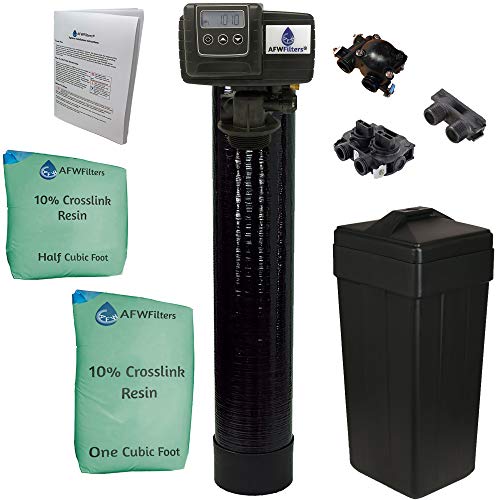
AFWFilters Fleck 5600 SXT 48K
$804.99 at Amazon
Check it on AmazonPrice as of Oct 24, 2026, 5:30 AM EDT
Read the installation fit
Split unit, hookup and new plumbing in each quote.
As an Amazon Associate I earn from qualifying purchases.
Existing-loop hookups run $250 in Arizona (Clear Water Concepts), or $1,800 to $2,800 with equipment in Houston (Repipe Solutions). Test hardness first, then pick AFWFilters 48K for hardness alone or its carbon combo.
Price the plumbing separately for either package. Both use a Fleck 5600SXT controller; a carbon tank changes the connection plan. The Hach kit gives the hardness number both quotes should start from.

Product prices and availability are accurate as of the date/time indicated and are subject to change. Any price and availability information displayed on Amazon.com at the time of purchase will apply to the purchase of this product.
| Pick | Key specs | Pick it if | Skip it if |
|---|---|---|---|
| AFWFilters Fleck 5600 SXT 48K | Fleck 5600SXT, 48K label, 10% crosslink resin, 1.5 cu ft, Bypass included | Your water test calls for hardness removal and the site has approved drainage for a regenerating softener. | You need a separately specified filtration stage, or onsite salt regeneration is prohibited. |
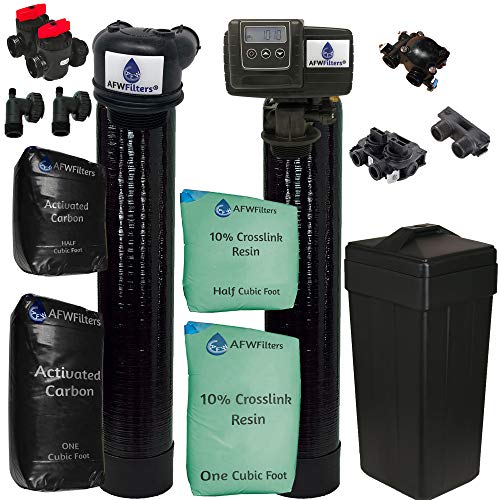
| AFWFilters Fleck 5600SXT with upflow carbon | Fleck 5600SXT softener, 48,000 grain label, 10% resin, Upflow carbon stage | You have a defined carbon-filtration need alongside hardness removal and space for the separate treatment tanks. | The job calls only for hardness removal, or the water test calls for a different treatment process. |
| Hach Model 5-B hardness test kit | Drop count EDTA titration, 1–30 gpg in 1 gpg steps, about 100 tests, Hach part 145300 | You don’t have a recent hardness number for the water that will feed the softener. | You already have a dated lab report that gives total hardness, or you need iron, pH or bacteria results too. |
Published service figures show why a hookup quote and an equipment package cannot be compared as if they cover the same job.
| Published example | Installation or labor only | Equipment included? | Source and scope |
|---|---|---|---|
| Arizona, existing loop | $250 | No; equipment priced separately | Clear Water Concepts: installation for valve systems up to 1.25 in. |
| Arizona, no loop | $800 to $3,500 | No; equipment priced separately | Clear Water Concepts: full-line installation |
| Las Vegas, loop | $300 to $700 labor | $1,200 to $2,500 with a unit | Active Plumbing: its local loop-installation examples |
| Houston, existing loop | Not separated in this example | $1,800 to $2,800 installed | Repipe Solutions: standard 32K single-tank package |
Service examples re-read October 22, 2026. Sources: Clear Water Concepts, Water Softener & Filtration Pricing; Active Plumbing, Water Softener Install Cost in Las Vegas; Repipe Solutions, Water Softener Installation Houston TX. These are local published examples, not a national average or a quote for either Amazon package on this page.
Start with the equipment question. The Arizona hookup figure excludes the separately priced equipment, while the Houston figure includes a specified softener. Subtracting one from the other would mix regions and different scopes. Neither number tells you the installation bill for your house.
Use the loop and no-loop rows to decide which kind of written estimate you need. If the main must be rerouted or the drain is missing, a loop-hookup example is the wrong comparison. Have the bidder identify those missing connections before you use any published total.
For DIY, make your own equipment-and-materials total from current offers and the actual connection list. Add any licensed-trade work that remains necessary. We do not assign a nationwide DIY allowance to unknown fittings, permits or drain work. Keep your time separate from the cash outlay.
These do different jobs on the same project, so none of the three is scored against the others.
The installation question with this AFWFilters package is which connections your house needs. AFWFilters links this exact Amazon listing from its 48k-56SXT-10 product page. That gives you a specific package to put on the quote, rather than an unspecified softener with a familiar controller name.
AFWFilters describes a complete softener with 1.5 cubic feet of 10% crosslink resin, a bypass and a separate brine tank. List those supplied parts on your worksheet before accepting another equipment allowance. Ask what the added bypass charge covers if a bid includes one.
The maker offers several connection configurations. Your existing pipe and the delivered bypass must match the adapters in the installation quote. A photo of the loop helps the plumber identify that work, but it does not establish the thread type on the equipment you will receive.
Treat the 48K name as a package identifier when comparing bids. Ask for the programmed working capacity and salt dose as separate entries. A large capacity label alone does not tell you whether the system suits several fixtures running together or how often it will regenerate.
A usable loop also needs a workable discharge route. Before the installer opens a connection, the main water must be isolated and pressure relieved as the equipment instructions require. Leave new drain construction or uncertain main-line routing to a licensed plumber. Keep electrical work with an electrician.
Put startup on the labor line. The written scope should include the supplied system instructions, controller settings based on the water test and a check of the drain during regeneration. A carton of complete equipment and a completed plumbing connection are different milestones.
My call: use this as the hardness-only reference package for comparing installation quotes. Keep the exact ASIN on both bids and have each bidder identify missing adapters. Choose the carbon combination only after you have a reason for that additional treatment stage and room to install it.
This AFWFilters combination adds an upflow carbon filter to a Fleck 5600SXT softener. AFWFilters sells it as the 10% resin version with carbon. Put that full configuration on your quote; a softener-only installation and a combination installation do not describe the same equipment layout.
The useful installation distinction is at the carbon stage. AFWFilters describes that stage as operating without backwash, so its no-drain description belongs to the carbon filter. The regenerating softener still needs its own discharge route. Do not accept a whole-package no-drain promise based on the carbon wording.
Ask each bidder to draw the tank arrangement before quoting the connection work. Include access for servicing each stage and for filling the brine tank. An existing loop can provide a connection point without providing enough floor space for the combination you have selected.
Keep the treatment question specific. Ask which water-test result or treatment goal calls for carbon and what documentation supports that application. A carbon stage added to a hardness project needs its own reason. Do not treat a broad filtration description as proof that every contaminant is addressed.
The maker publishes different service-flow descriptions across its softener and combination pages. We would ask for the complete package specification before planning simultaneous fixture demand. A Fleck controller name does not settle the flow limits of the resin bed, carbon stage or supplied bypass.
For the labor comparison, identify the carbon-to-softener interconnection separately from the loop hookup. Have the quote say which fittings are included and which startup instructions apply to each tank. That makes a later scope change visible before any pipe is cut or equipment is connected.
My call: choose this combination when the carbon stage has a clear job in your water-treatment plan. If the only verified need is hardness removal, compare the hardness-only package first. Carry the selected package through both installation bids so the final totals cover the same work and equipment.
The Hach 5-B is the pick for the step before any quote: finding out how hard your water is. Hach sells it as part 145300 and lists a range of 1 to 30 grains per gallon (gpg) in 1 gpg steps, with reagents for about 100 tests.
It works by counting drops. Hach’s instruction sheet, DOC326.97.80523, says to fill the plastic tube with water, pour it into the square bottle, add one level scoop of UniVer 3 hardness reagent and swirl. Then add Hardness 3 titrant one drop at a time.
When the sample turns from pink to blue, stop. The number of drops is the total hardness in grains per gallon, as calcium carbonate. If the first drop turns it blue, the water is under 1 gpg and a softener has little to remove.
Test the water that will feed the softener. On a well, take it after the pressure tank. On city water, any cold tap ahead of existing treatment works. City reports often give hardness in mg/L; divide by 17.1 to get gpg, the factor on Hach’s listing.
The number sets the controller and the capacity question. Here is the arithmetic with example figures: 12 gpg times 300 gallons a day is 3,600 grains a day. Ask each bidder to show that math with your reading and your water use, not a guess. Drop kits and test strips are compared in water hardness test kits.
It also keeps two quotes honest. If one bidder sizes a 48,000 grain system and another a 32,000 grain one, ask which hardness number each used. A bid that never asks for one is pricing equipment, not your water.
Hardness is one result. It doesn’t tell you about iron, manganese, pH or whether the water is safe to drink. If you’re on a well and have no recent lab report, get one before adding a carbon stage or anything else to the job.
| Pick | Use | Included treatment | Installation advantage | Installation limit | Amazon |
|---|---|---|---|---|---|
| AFWFilters 48K | Hardness alone | Resin softener and brine tank | No separate carbon stage to connect | Verify selected bypass connections and discharge | Check it on Amazon |
| AFWFilters carbon combo | Hardness plus carbon filtration | Resin softener, brine tank and upflow carbon | Carbon stage described as non-backwashing | Extra tank and interconnection; softener still drains | Check it on Amazon |
| Hach 5-B kit | Measuring hardness | Two reagents, measuring tube, mixing bottle, scoop | Drop count equals grains per gallon | Hardness only; no iron or safety result | Check it on Amazon |
Use this worksheet with the exact package on both bids. Mark each line included, extra, excluded or unknown, then enter the written amount. A blank is not a zero.
| Cost item | What triggers the work | Package or site evidence | Quote A: status / amount | Quote B: status / amount |
|---|---|---|---|---|
| Complete equipment | New system or replacement | Exact ASIN, resin option, tanks and supplied packing list | ____ / ____ | ____ / ____ |
| Pipe adapters | Pipe and delivered connections differ | Pipe material/size, bypass thread and orientation | ____ / ____ | ____ / ____ |
| Bypass arrangement | Service isolation or changed layout | AFW hardness package includes bypass; identify any additional assembly | ____ / ____ | ____ / ____ |
| Regeneration drain | No suitable route or receptor | Complete system drain instructions and local approval | ____ / ____ | ____ / ____ |
| Brine overflow | No gravity path from tank fitting | Separate route; do not merge with valve drain | ____ / ____ | ____ / ____ |
| Power and bonding | Missing outlet or interrupted metal pipe | Supplied adapter, outlet plan and electrician assessment | ____ / ____ | ____ / ____ |
| Pressure correction | Site pressure or expansion needs attention | Measured pressure and adopted local requirements | ____ / ____ | ____ / ____ |
| Pretreatment | Water test requires another process | Test results and treatment limits for the actual package | ____ / ____ | ____ / ____ |
| Permits and inspection | Authority requires them | Current local requirements; named responsible party | ____ / ____ | ____ / ____ |
| Removal and disposal | Old equipment is being replaced | Identify old tanks, contents and removal route | ____ / ____ | ____ / ____ |
| Startup and handover | Every completed installation | Programming record, flushing, sanitizing and leak checks | ____ / ____ | ____ / ____ |
For the AFWFilters hardness package, ask why a bypass appears twice if both the equipment description and the installation bill list one. The installer may be proposing a separate service-valve arrangement. That can be a different scope, but the quote should explain it.
For the carbon combination, attach a tank-layout sketch to this worksheet. The additional treatment stage is a specific reason for more connection work. Do not spread an unspecified plumbing allowance across the bid and then add those same connections again at completion.
Keep unknown lines open until the bidder answers them. Compare equipment ownership and warranty responsibility alongside the amount: who handles a damaged shipment, who verifies the delivered connection option, and what happens if the supplied system differs from the quoted model? Get those terms in writing.
| Site condition | What to confirm | What belongs in the quote |
|---|---|---|
| Replacing a softener in place | New connections match; old drain remains suitable | Removal, adapters, inspection and startup |
| Unused softener loop | The pipes serve the intended fixtures | Hookup plus any missing drainage or power |
| No loop at the chosen location | Main routing, outdoor branches and access | New piping plan and any building repairs |
| Adding a carbon stage | Tank access and stage arrangement | Interconnection, service access and stage-specific startup |
Photograph the loop, main shutoff and proposed drain location before requesting an installation estimate. Include enough of the room to show pipe access. Two capped pipes tell the bidder something useful, but they do not prove that the drainage or electrical supply is ready.
A replacement should still be quoted against the new package. The old unit may have different inlet spacing or fittings, even when both controllers say Fleck. Ask which existing components the installer intends to retain and which have to change.
For a new location, settle which household branches will receive treated water before equipment arrives. GE’s installation-location guidance places softeners ahead of the water heater and leaves outdoor faucets untreated. Use the selected system instructions and local plumber’s routing assessment for your own layout.
| Connection | Purpose | Quote check |
|---|---|---|
| Valve regeneration drain | Carries discharge during regeneration | Route, permitted receptor and required air gap |
| Brine-tank overflow | Provides a gravity overflow path | Separate route below overflow fitting |
| Brine connection | Connects the salt tank to the control valve | Correct assembly under the package instructions |
| Carbon stage in this combo | Non-backwashing filtration stage | No carbon backwash drain; retain softener drainage |
Pentair’s 5600SXT downflow service manual requires an air gap of twice the drain-pipe diameter, with a minimum of 1 inch. That is a controller-family reference, not permission to disregard the AFWFilters package instructions or local discharge rules. Have the plumber specify the approved termination.
Pentair’s VT softener-system manual shows a separate overflow line that must not rise above the tank fitting or join the control drain. Ask for that gravity route on the installation sketch. An overhead valve drain does not establish a workable brine overflow.
Before committing to either regenerating package, confirm whether the local sewer or septic authority accepts its discharge. A nearby drain is only a possible destination. If the authority prohibits onsite regeneration or the receptor cannot take the discharge, settle that problem before buying the equipment.
Pentair’s downflow manual calls for uninterrupted power. Have an electrician quote any new outlet and verify the supplied adapter requirements.
Ask an electrician to assess bonding continuity before the plumbing is cut. A plastic bypass is not an electrical design.
Have the plumber record static pressure and check local pressure-control requirements. A valve rating alone does not settle building compliance.
Hardness removal does not establish safe drinking water. Resolve unknown or microbiologically unsafe water with appropriate testing and treatment.
The electrical allowance should identify actual work, such as adding an outlet near the planned controller. Do not accept an unexplained power charge just because the softener has a plug. For the selected AFWFilters configuration, confirm the delivered adapter before the electrician finalizes the connection.
A water test also keeps the equipment scope honest. If a well-water result calls for treatment beyond hardness removal, have that requirement documented before comparing a softener-only bid with a combination bid. Added carbon is a specific treatment choice, not a substitute for interpreting the water test.
| Recurring item | Record for your house | How to estimate without an invented allowance |
|---|---|---|
| Regenerant | Actual salt dose and regenerations | Salt used × current delivered cost per unit |
| Water and sewer | Water used per cycle and local billing rules | Cycle water × cycle count × applicable rate |
| Electricity | Documented or measured controller use | Energy use × your electricity rate |
| Service and media | Actual maintenance requirements | Use dated service terms and the correct media schedule |
Ask the installer to leave the programmed capacity and salt setting with the handover paperwork. The Whirlpool WHES30 manual illustrates why: it lists 12,500 grains at 2.4 pounds of salt and 31,700 grains at 13.1 pounds. Those are Whirlpool figures, not settings to copy into either AFWFilters controller.
For your running estimate, use the selected package’s working settings and your household consumption. Keep maximum capacity separate from the chosen salt dose. Multiplying a marketing capacity by an assumed annual cycle count will not give a defensible ownership total.
Start a simple record after commissioning: date of salt addition, quantity added and controller settings. Use the same period when comparing water bills. If household occupancy or outdoor watering changes, note that too; a change in the bill cannot automatically be credited to the softener.
| Situation | Planning decision | What remains to price |
|---|---|---|
| Matched loop, approved drain, suitable power | Assess skills and local permissions before DIY | Equipment, exact fittings, tools and startup supplies |
| New main-line route or drain construction | Use a licensed plumber | Piping, receptor and access work |
| New outlet or uncertain metal-pipe bonding | Use a licensed electrician | Outlet or bonding assessment and correction |
| Water shutoff cannot be confirmed | Stop before loosening connections | Safe isolation and plumbing repair |
Compare the work left after DIY, not just the labor you hope to remove. If a plumber must still build the drain route and an electrician must still add an outlet, keep both quotes in the project total. Supplying the softener yourself does not remove those site requirements.
Before opening equipment, shut off the main water and relieve pressure under the complete system instructions. Disconnect its power adapter before service. Pentair warns against opening pressurized connections. If you cannot confirm isolation or depressurization, stop and call a licensed plumber.
This is not a soldering, wiring or sanitizing procedure. Any hot work belongs under the fitting maker’s fire precautions; chemical handling follows the supplied sanitizer label and its PPE instructions. Ask the installer to identify these procedures in the startup scope rather than copying a generic bleach dose.
Keep the package model, supplied instructions and delivered connection option with the final invoice.
Have the installer demonstrate the bypass and identify the main shutoff and approved discharge points.
Require flushing, sanitizing and programming under the supplied system instructions; do not substitute generic controller settings.
Have the installer verify discharge operation and inspect connections, including the brine connection.
Record the water-test result, selected salt dose, capacity setting and maintenance instructions.
Ask whether the callback covers workmanship alone or also diagnosis of homeowner-supplied equipment. That distinction matters if the unit fails to draw brine after installation: the final invoice should say who checks the plumbing and who handles equipment support.
If the job replaces an old softener, specify what leaves the house. An equipment-removal line should identify whether it includes the old tanks and their contents. Keep access or finish repairs on the same written scope so the final cost comparison survives the installation day.
Published examples need their scope attached. Clear Water Concepts lists $250 for an existing-loop installation in Arizona, excluding separately priced equipment. Repipe Solutions lists $1,800 to $2,800 for a specified installed package in Houston. Neither establishes a national average or a quote for your house.
Use a drop count kit such as Hach’s 5-B, where each drop to the blue color change is 1 grain per gallon, or read a lab or city report and divide mg/L by 17.1. Give the same number to every bidder so their sizing can be compared.
Active Plumbing publishes $300 to $700 for a Las Vegas loop hookup with homeowner-supplied equipment. Ask your bidder to identify the exact package, missing fittings and startup work. A new drain, outlet or main-line route requires its own scope.
It can provide the water connection point. You still need suitable drainage, power and matching equipment connections. Compare the loop-hookup scope with the actual room before treating it as a complete installation.
The quote needs a plan for the new water connections and the chosen location. Include any drain or electrical work that is absent. Have a licensed plumber assess routing before the system is purchased.
A ready loop with matching connections is a different job from constructing a new route. Check local permissions and your ability to follow the complete system instructions. New electrical work, uncertain bonding and new drain construction belong with the appropriate licensed trade.
Ask for the scheduled water-shutoff window and startup time for your exact site. A replacement on matching connections and a new location with drainage work are different scopes. No single installation duration is established by the examples here.
The AFWFilters package includes a regenerating softener, so the package still needs a softener drain. The maker’s no-backwash description applies to the separate upflow carbon stage.
Ask the local authority and septic professional about the proposed discharge. The existence of a septic tank does not confirm acceptance. Keep the decision separate from the air-gap and receptor details in the equipment instructions.
Check equipment inclusion first, then compare adapters, drainage and startup. The quote worksheet also separates disposal and permits. Ask each bidder to mark exclusions so an unspecified allowance cannot be mistaken for the same completed job.
Have the fault identified before comparing a repair with a complete installation. A valve or brine-draw problem does not by itself prove the resin tank needs replacement. Our regeneration troubleshooting guide covers the diagnostic questions to raise.
Isaac Daniels, a licensed journeyman plumber in Georgia, is the named author. We separate published service scopes from product specifications so a hookup figure cannot be mistaken for the installed price of an unrelated system.
We read local providers’ published cost scopes and AFWFilters’ package descriptions. The two softener picks illustrate hardness-only treatment and added carbon filtration; the Hach 5-B is the hardness test both quotes should start from.
Amazon’s Creators API returned New, in-stock buy-box offers for all three on Oct 22, 2026, 4:49 PM EDT. CPSC lists no recall for Hach, Fleck, AFWFilters or water softeners. These are installation-fit choices, with no numeric performance score.
| Evidence | How it is used | Limit |
|---|---|---|
| Published service figures | Show location and equipment inclusion | Not a nationwide survey or binding quote |
| Maker package descriptions | Identify supplied treatment and connection choices | Confirm the delivered variant |
| Controller-family manuals | Explain drain and safety questions | Complete system instructions govern the actual installation |
| Homeowner questions | Shape quote and loop FAQs | Not used as price or performance evidence |