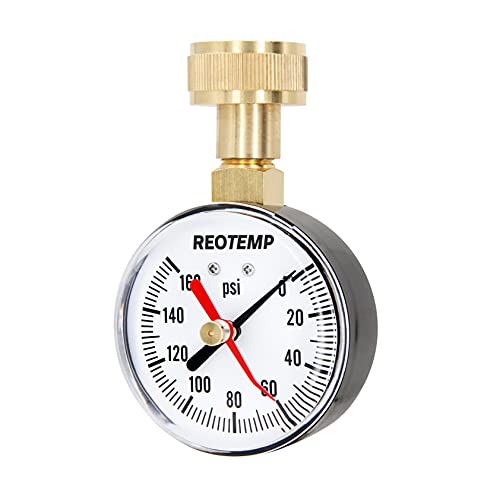
Reotemp PD25H
$12.99 at Amazon
Check it on AmazonPrice as of Oct 24, 2026, 5:30 AM EDT

What’s behind the drip, and whether it’s a part or the tank.
As an Amazon Associate I earn from qualifying purchases.
A. O. Smith says almost all leaks are at connections, not the tank. A dripping relief valve means high pressure or no expansion tank. A leaking tank means a new heater.
Switch off the breaker on an electric heater. On gas, turn the gas control or shut-off valve to off if you’re confident doing so, A. O. Smith says.
It’s the shut-off on the cold line leading to the heater. That stops the tank from refilling as it leaks.
Move boxes, mop the water and put a pan or towels down so you can see fresh water appear.
A. O. Smith says if the relief valve is discharging large amounts of very hot water, turn the gas off and call a qualified person.
Don’t cap or plug the relief valve or its pipe to stop a drip. A. O. Smith’s manual warns that a blocked relief valve or discharge pipe could cause an explosion. That valve is leaking because it’s doing its job, and the fix is upstream.
Pick where the water is coming from, your heater’s age and your house pressure. The finder gives the likely cause, whether it’s fixable and what keeps it from coming back.
| Where you see water | Usual cause | Fix or replace | Guide |
|---|---|---|---|
| Pipe connections on top | Loose or worn fittings, from thermal expansion and wear | Fix | Leaking from the top |
| Relief valve or its pipe | High pressure or no expansion tank; sometimes a worn valve | Fix the pressure; replace a worn valve | Relief valve |
| Drain valve | Loose, not fully closed, or worn | Fix | Leaking from the bottom |
| Base, with no part dripping | Corroded tank | Replace | Tank leaks |
| Small puddle after lighting (gas) | Condensation | Neither; it stops when hot | Condensation |
A. O. Smith’s manual puts it plainly: almost all leaks occur at connections and are not a tank leak. So before anyone quotes you a new heater, find the exact spot. Dry the heater and pipes with a towel, then watch where water comes back first.
Water runs down, so a drip from a fitting on top can show up as a puddle at the base. The bottom-leak guide covers the five places bottom water comes from in detail; this page is about why leaks start and how to stop the next one.
| Cause | What A. O. Smith says | Fixable? |
|---|---|---|
| Loose pipe connections | Thermal expansion and wear loosen them over time | Yes: tighten or replace |
| Faulty drain valve | Loose or faulty valves leak | Yes: tighten or replace |
| High water pressure | Stresses the tank and connections; a PRV or expansion tank fixes it | Yes |
| No expansion tank on a closed system | Pressure spikes as water heats | Yes: add one |
| Hard water | Minerals cause corrosion that can’t be repaired | No: the tank goes |
| Sediment | Collects on the bottom, causes overheating and cracks | Prevent by flushing |
| Spent anode rod | Rods usually last 3–5 years before they need replacing | Prevent by replacing it |
| Old age | Heaters typically last 8 to 20 years depending on type | Usually replace |
Four of these are parts you can fix in an afternoon. The other four, hard water, sediment, a spent anode and age, all end in the same place: a tank that corrodes from the inside. That’s why maintenance matters more than any one repair.
A. O. Smith’s list of warning signs before a leak includes rusty, cloudy or metallic-smelling water and popping or rumbling sounds from sediment. The water heater noise guide covers those sounds.
The temperature and pressure relief valve on the side of the tank opens when pressure or temperature gets too high. A. O. Smith says a dripping relief valve is usually caused by the home’s water pressure being too high and/or the lack of a thermal expansion tank.
Here’s why so many homes now see it. Water expands when heated. A. O. Smith explains that backflow preventers and check valves, often hidden in the water meter, keep that water from flowing back to the city, so most plumbing systems are now closed and almost all homes need an expansion tank.
| Pressure reading | What A. O. Smith says | What to do |
|---|---|---|
| 50–60 psi | Its recommended working pressure | Nothing; check the expansion tank if the valve still drips |
| 61–80 psi | Above its recommendation; most codes allow up to 80 | Consider a pressure-reducing valve set to 50–60 |
| Over 80 psi | Over what most codes allow; can damage the heater, pipes and appliances | Install a pressure-reducing valve set to 50–60 psi |
| Climbs while the heater runs | Thermal expansion on a closed system | Add a thermal expansion tank sized to the heater |
A. O. Smith suggests an inexpensive water pressure gauge from a plumbing supplier.
Open the faucet fully so the gauge reads the house pressure.
A. O. Smith says to measure the maximum pressure over a 24-hour period, because the highest pressures often happen at night. A gauge with a max pointer records the peak for you.
Compare it to the table above.
An expansion tank only works when it’s set up right. A. O. Smith says the tank has to be sized to the water heater’s capacity and its air charge set to match the home’s incoming pressure, never above 80 psi. The expansion tank guide has a sizer.
A. O. Smith also says to operate the relief valve by hand at least once a year, and that one left dripping for a long time should be inspected for mineral buildup. If it won’t reseat after you’ve fixed the pressure, replace it with the valve your heater’s maker calls for; the T&P valve guide covers matching.
A. O. Smith lists loose pipe connections first among common causes and says thermal expansion and wear loosen them over time. Its fix: gently tighten the fitting with a wrench, without overdoing it, because overtightening can damage the fitting and make the leak worse.
If a connector is corroded or the threads keep weeping, replace the connector rather than cranking on it. Rheem’s advice is to photograph visible leaks, rust or unusual condensation and note the model number before you call a plumber, so they bring the right parts.
A union or connector nut that’s a little loose, a flexible connector with a worn washer, a fitting that weeps after a pressure spike.
Corroded nipples into the tank, leaks at soldered joints, or a gas line anywhere near the leak.
A. O. Smith says a drain valve that won’t close properly is usually best replaced. The leaking from the bottom guide covers that swap step by step, with the parts.
The test is time. A. O. Smith says condensation is not a leak and goes away once the tank reaches normal operating temperature. Rheem says small amounts of condensation are normal but pooling water points to a problem. Water that keeps coming after the heater has been hot for a while is a leak.
A. O. Smith says water from the base is often the first sign of a serious internal problem such as a corroded tank, and that it’s usually more practical and cost-effective to replace than repair. Rheem says the same: leaks from the bottom often signal tank corrosion that requires replacement.
There’s no patch for a tank. A. O. Smith says corrosion from hard water can’t be repaired, and a cracked tank typically means replacing the heater. Turn it off, close the cold supply, drain it if it’s safe, and get quotes; the best water heater guide compares replacements.
Water from under the jacket with every fitting and the drain valve dry, rust streaks from the bottom, or a heater past its expected life.
A drip you can trace to a fitting, valve or pipe; water that stops once a gas heater has been hot a while.
| What’s leaking | Heater under 8 years | 8 to 12 years | Over 12 years |
|---|---|---|---|
| A fitting | Fix it | Fix it | Fix it, and get a replacement quote |
| The drain valve | Replace the valve | Replace the valve | Weigh the repair against a new heater |
| The relief valve | Fix the pressure | Fix the pressure | Fix the pressure; plan ahead |
| The tank | Replace (check warranty) | Replace | Replace |
A. O. Smith says water heaters typically last 8 to 20 years depending on the type, and that in most cases replacing an old heater is more cost-effective than repairing it. Rheem lists a unit 8 to 12 years or older among its signs to call a pro.
A younger heater with a tank leak may still be under warranty. Rheem says to find the model number on the maker’s label and the warranty paperwork before you call.
Four parts cover the causes you can fix. Each was new and in stock on the day of the update. Prices come from Amazon with the time they were read.


Product prices and availability are accurate as of the date/time indicated and are subject to change. Any price and availability information displayed on Amazon.com at the time of purchase will apply to the purchase of this product.
| Part | Key specs | Pick it if | Skip it if |
|---|---|---|---|
| Reotemp PD25H | 0–160 psi, red max pointer, ASME 3-2-3% accuracy, 3/4 in. female hose thread | The relief valve drips and you don’t know your pressure, especially at night. | You already have a pressure reading over 24 hours. |
| Amtrol ST-5 | 2.0 gal, 3/4 in. connection, 150 psi, 200°F, seven-year limited warranty | Your system is closed and pressure climbs as the heater runs. | You already have a working expansion tank. Check its air charge instead. |
| Cash Acme NCLX-5LX | 3/4 in., 150 psi and 210°F standard settings, listed to ANSI Z21.22/CSA 4.4, test lever | The valve still drips after the pressure is fixed, and your heater’s maker allows this valve. | Pressure is the cause. A new valve will drip too. |
| Oatey 34083 | 24 in. aluminum pan, PVC drain adapter for 1–1-1/2 in. pipe | The heater sits on a floor that water would damage. | Your heater is wider than about 22 in. A. O. Smith says the pan must be 2 in. wider than the heater. |
I’ve used each of these. Start with the gauge: the reading tells you whether you need the expansion tank, a pressure-reducing valve, or neither.
A. O. Smith recommends a metal drain pan piped to a drain under every heater, at least 2 in. wider than the heater, with water limited to 1-3/4 in. deep. It also suggests an automatic leak detector and shut-off. The drain pan guide covers sizes.
| Task | How often | Why | Source |
|---|---|---|---|
| Flush the tank | Once a year | Removes the sediment that overheats and cracks the bottom | A. O. Smith, Rheem |
| Operate the relief valve | At least once a year | Keeps minerals from sticking it shut | A. O. Smith manual |
| Check the anode rod | Rods usually last 3–5 years | It corrodes so the tank doesn’t | A. O. Smith |
| Test house pressure | When anything drips, and after plumbing work | Keeps pressure at 50–60 psi | A. O. Smith manual |
| Look over valves and connections | With each flush | Early corrosion and drips are cheap to fix | A. O. Smith |
A. O. Smith lists annual flushing, checking and replacing the anode rod and testing the relief valve as typical maintenance, and says following the schedule also helps keep the warranty valid. The anode rod guide covers which rod fits.
Turn off the heat and close the cold supply until you know the source. A drip at a fitting or the drain valve can be fixed and the heater used again; a leaking tank needs replacing.
It depends on the source. A loose fitting or drain valve can be fixed for years of use. A. O. Smith says a corroded tank leaking from the base usually means replacement, and those leaks don’t fix themselves.
Only if the leak is small, from a fitting or valve, and you’ve ruled out the tank. If the tank is leaking, shut it down; A. O. Smith says to turn off the power or gas and the water supply.
No. A. O. Smith says to turn off the power or gas and close the water supply first. Very hot water pouring from the relief valve means turn the gas off and call a qualified person.
A. O. Smith says it’s usually high water pressure and/or no thermal expansion tank. Check the pressure over 24 hours and keep it at 50–60 psi.
A steady leak, a leak from the tank, or very hot water from the relief valve is. A slow drip from a fitting is urgent but not an emergency once the water is off.
A fitting, drain valve or relief valve is a parts-and-labor repair; a leaking tank means a new heater. The water heater repair cost guide has typical prices.
The drain valve, the relief valve pipe, condensation, water running down from above, or the tank. The bottom-leak guide walks through each.
I’m Isaac Daniels, a licensed journeyman plumber in Georgia (license #JP507711). I’ve used every part in the kit above. The causes and limits come from A. O. Smith’s leak guide and use and care manuals and Rheem’s service guidance, read Oct 23, 2026.