RIDGID 690-I kit
Shown for comparison only.

Three hand-held power threaders scored on RIDGID’s own specs, plus when a bench machine or a manual ratchet set makes more sense.

As an Amazon Associate I earn from qualifying purchases. Links go to listings sold by Amazon.com.
For threading on the job, get the RIDGID 600-I (8.7): 1/8 to 1-1/4 in. pipe, 12.7 lb, 36 RPM, die heads sold separately. Past 1-1/4 in., the RIDGID 700 (8.2) runs 12-R heads to 2 in. For shop volume, RIDGID’s 300 bench machine.
All three are RIDGID hand-held power drives that spin standard die heads on steel pipe. The two linked drives each score 7.0 or higher.
Shown for comparison only.

Product prices and availability are accurate as of the date/time indicated and are subject to change. Any price and availability information displayed on Amazon.com at the time of purchase will apply to the purchase of this product.
Pick the biggest pipe, how often you thread and where. The chooser points you to a manual set, a hand-held drive or a bench machine.
Threading machines come in three kinds. A manual ratchet threader turns the die head by hand. A hand-held power drive turns the same kind of die head with a motor while you hold the tool and a support arm takes the torque. A bench machine holds and spins the pipe itself, with a cutter, reamer and oiler built on.
Most plumbers who thread black iron for gas lines or galvanized repairs land on a hand-held drive, which is why those are the scored picks here. The bench and manual options are covered further down.
Six checks from RIDGID’s product pages and the Amazon listing, equal weight.
The checks are what matter when you buy: the pipe range, whether the listing includes die heads or you buy them separately, the drive’s weight, its spindle speed, whether RIDGID shows a warranty on the page, and whether the listing is RIDGID’s catalog number.
They land close because they’re close. The 690-I wins on a complete kit and 2 in. capacity; the 600-I on weight; the 700 on its long track record with 12-R heads.
What RIDGID publishes, which jobs each suits, and where each lost points.
RIDGID 44923 Model 690-I hand-held power drive kit with 1/2 to 2 in. 11-R NPT die heads and carrying case
Shown for comparison only.
The 690-I kit is the most complete way to start power threading. It scored 8.8.
RIDGID lists the 690-I at 1/8 to 2 in. pipe with 11-R die heads, a 1270-watt universal motor and 21.1 lb for the drive alone. That’s a 10 on capacity and an 8 on weight.
This listing is RIDGID catalog 44923, the 690-I 115 V complete kit. RIDGID’s ordering table gives it 36 RPM at 115 V and 12 amps, and a 59.4 lb kit weight. The Amazon title says it comes with 1/2 to 2 in. 11-R NPT die heads and a carrying case, so you can thread out of the box. Tens on die heads and speed.
The build is the same family as the 600-I: a die-cast aluminum gear head that RIDGID says is permanently greased, a fiberglass-reinforced plastic body, a forward/reverse slide switch and a two-step momentary on/off trigger. The listing adds a quick-release die head retaining system and screw-in brush covers for easier service.
The dual V-jaw support arm clamps to the pipe and takes the threading torque. Always use it; a hand-held drive can spin you around if the arm isn’t on.
It lost points on the warranty check. RIDGID’s 600-I and 700 pages show a Full Lifetime Warranty, but its 690-I page text didn’t show a warranty line when I read it, so it’s a 5 until RIDGID shows it.
RIDGID’s 600-I/690-I operator’s manual covers both drives, and the support arm and die heads are common supply-house parts.
The kit’s case keeps the drive, arm and heads together, which matters on a service truck where die heads otherwise end up loose in a bin and get chipped.
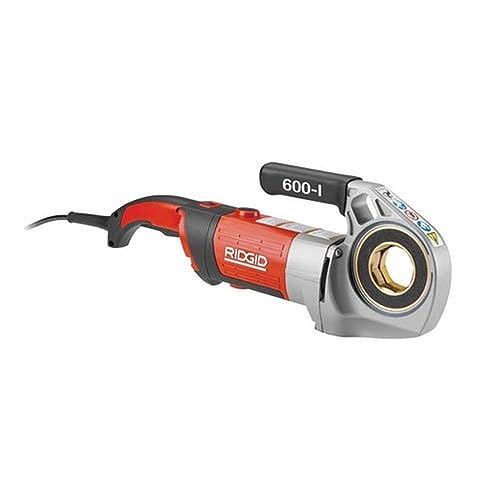
RIDGID 44913 Model 600-I hand-held power drive with carrying case and dual V-jaw support arm
Prices and availability are accurate as of the time shown and may change.
Your threading is mostly 1/2 to 1 in. gas and water pipe, and you carry the tool up ladders or into crawl spaces.
You thread 1-1/2 or 2 in. pipe. Get the 690-I.
The 600-I is the light one of the three RIDGID drives here. It scored 8.7.
RIDGID lists the 600-I at 1/8 to 1-1/4 in. with 11-R die heads, a 1270-watt universal motor and 12.7 lb for the drive alone. That weight is the best here, a 10. The capacity is a 7 against the 2 in. drives.
This listing is catalog 44913: the drive with a carrying case and the 602 support arm. RIDGID’s table gives 36 RPM at 115 V and 12 amps, and 29.1 lb with the case. Speed is a 10.
It lost points on die heads: 44913 doesn’t include any. RIDGID sells the 44918 complete version with 1/2 to 1-1/4 in. NPT 11-R heads; if you buy this listing, plan on buying heads separately. That’s a 5.
RIDGID’s page shows a Full Lifetime Warranty, a 10. The body is fiberglass-reinforced plastic over a die-cast gear housing, with a molded, contoured handle.
The listing calls it the easiest RIDGID power drive to handle, which matches its weight. For most residential gas work, 1/2 to 1 in. black iron, it covers every size you’ll thread.
It shares the 600-I/690-I operator’s manual and uses the same 11-R die heads as the 690-I, so a shop can run both.
Its size, 20 in. long and 3.75 in. wide per RIDGID, also helps between joists and in a tight mechanical room, where a longer drive and its arm can’t swing.
Light weight pays off when you thread overhead: a lighter drive is easier to hold square on the pipe, and square starts make straight threads.
My call: the right tool for residential gas and water threading; skip it if you see 2 in. pipe.
RIDGID 41935 Model 700 hand-held 120-volt power drive
Prices and availability are accurate as of the time shown and may change.
You already own 12-R manual die heads, or you want one drive that also turns a 258 pipe cutter.
You’re starting from nothing and want a kit in one box.
The 700 is the long-running workhorse that turns the same 12-R heads as RIDGID’s manual ratchet set, so dies you already own carry over. It scored 8.2.
RIDGID lists the 700 at 1/8 to 2 in. pipe and 1/4 to 1 in. bolt with 00-RB die heads. It’s designed for 12-R heads, and RIDGID says 00-R, 00-RB and 11-R heads fit with adapters. Capacity is a 10.
The body is cast aluminum with a spur gear reduction, face gear drive and a hardened steel spindle gear, and the switch is double-throw reversible. RIDGID adds that it can power its 258 and 258XL pipe cutters.
It lost points on weight, speed and die heads. RIDGID gives 25 lb for the drive (a 6), 26 to 30 RPM for catalog 41935 at 115 V (an 8), and this listing is the drive only, with no heads (a 5).
RIDGID’s page shows a Full Lifetime Warranty, a 10. The ordering table lists 13 amps at 115 V, and the drive is 28-1/4 in. long.
Why choose it over a 690-I: if you already own a 12-R ratchet set, the 700 turns those heads with no new dies to buy. That’s the most common upgrade path from manual threading.
RIDGID also sells a 775 support arm for the 700, and the drive has its own operator’s manual and parts list on RIDGID’s page.
The cast aluminum body is the reason for its weight, and the reason it holds up to truck life. Expect it to feel front-heavy with a 2 in. head on; the support arm carries that load.
My call: the upgrade for anyone with a 12-R set; for a first threader, the 690-I kit is simpler.
From RIDGID’s product pages and ordering tables, read Oct 23, 2026.
| Pick | Spec score | Photo | Pipe range | RPM (115 V) | Drive weight | Die heads | Short pros / cons | Buy |
|---|---|---|---|---|---|---|---|---|
| RIDGID 690-I kit (44923) | — | 1/8–2 in. | 36 | 21.1 lb | 11-R, 1/2–2 in. included | Complete kit / Heavy kit | Reference (not linked) | |
| RIDGID 600-I (44913) | 8.7 | | 1/8–1-1/4 in. | 36 | 12.7 lb | 11-R, sold separately | Lightest / 1-1/4 in. max | Check it on Amazon |
| RIDGID 700 (41935) | 8.2 | | 1/8–2 in. | 26–30 | 25 lb | 12-R, sold separately | Runs 12-R heads / Heaviest | Check it on Amazon |
Source: RIDGID product pages and ordering tables for the 690-I, 600-I and 700 (ridgid.com), read Oct 23, 2026. Catalog numbers match the Amazon listings.
Two other kinds of threader, scored separately from the hand-held drives because they do a different job.
| Kind | Example | What RIDGID lists | Pick it if |
|---|---|---|---|
| Bench machine | RIDGID 300 Complete (15682) | 1/2 HP, 1700 W, 36 RPM; 811A 1/8–2 in. die head, cutter, reamer, oiler, stand; 212 lb complete; Full Lifetime Warranty | You cut and thread lots of pipe at a shop bench |
| Manual ratchet set | RIDGID 12-R set (36475) | Exposed ratchet, 1/2 to 2 in. NPT die heads in a case | You thread a few joints a year |
The 300 is a different machine: it chucks and spins the pipe, and the cutter, reamer and die head ride on a carriage. RIDGID calls it lightweight and portable at 115 to 154 lb, which tells you how heavy the alternatives are. This Amazon listing bundles the 300 Complete with an 824 pipe wrench.
The 12-R set is how most plumbers start. The same 12-R heads later fit the RIDGID 700, so a manual set isn’t wasted money if you move to power.
The die head holds the cutting dies for one pipe size. The drive decides which heads you can use.
| Drive | Native heads | Other heads |
|---|---|---|
| 690-I | 11-R | — |
| 600-I | 11-R | — |
| 700 | 12-R | 00-R, 00-RB, 11-R with adapters |
| 12-R manual set | 12-R | Same heads fit the 700 |
Buy into one head system. If your truck already has 12-R heads, the 700 uses them. If you’re starting fresh, the 690-I kit gives you a full 11-R set in the case.
Dies wear. Replace them when threads tear or come out rough, and keep a spare set for the sizes you cut most, usually 1/2 and 3/4 in. for residential gas.
Weight matters most when you thread in place: overhead, in a crawl space or up a ladder. The 600-I is half the 700’s weight. Speed is close: 36 RPM for the 600-I and 690-I at 115 V, 26 to 30 for the 700. Slower isn’t a flaw on hard pipe; it’s just a little more time per thread.
Clean threads come from setup as much as the machine.
Cut with a wheel cutter and ream the burr; a rough end chips dies.
Hold it in a pipe vise or on a stand; long lengths need support at the far end.
Clamp the drive’s support arm to the pipe before you pull the trigger.
Keep the dies flooded the whole cut.
Stop when the pipe end is flush with the die face, then reverse off.
Wipe chips and oil; check the thread with a fitting before you install.
Our pipe threading oil guide covers which oil to use. A good pipe vise and stand makes the difference between straight threads and a fight.
My rule on any threader: no gloves, loose sleeves or rags near a spinning die head or pipe. Fabric catches and wraps fast. Check the safety section of your machine’s operator’s manual before the first cut.
RIDGID’s operator’s manual for the 600-I and 690-I lists a few setup checks worth doing before the first cut.
Make sure the pipe is stable and secured so it can’t tip, and use pipe stands to carry long lengths. If you use a RIDGID 418 oiler, check the oil level, pull the chip tray and confirm the filter screen is clean and fully under the oil, then set the bucket under the pipe end.
Once the dies engage, they pull themselves onto the pipe. The manual says to stop pushing on the cover plate at that point and flood the cut with thread cutting oil, which it says lowers threading torque, improves thread quality and extends die life.
Hold the handle firmly against the twisting force, because a support device can slip. Releasing the ON/OFF switch stops the drive at any time.
The manual’s safety symbols also warn against wearing gloves near the machine because of the risk of getting caught, and call for a GFCI-protected supply if you have to work in a damp spot.
Every machine here cuts the same tapered pipe thread. Knowing what it should be helps you spot worn dies.
| Pipe size | Threads per inch (NPT) | Note |
|---|---|---|
| 1/2 in. and 3/4 in. | 14 | Most residential gas branches |
| 1 in. to 2 in. | 11-1/2 | Mains and larger runs |
| All sizes | Taper of 1 in 16 on diameter | About 3/4 in. per foot; the taper makes the seal |
NPT threads seal because they’re tapered: the joint tightens as the threads wedge together, with joint compound or tape filling the gaps. A thread cut too short won’t make up enough turns; one cut too long lets the fitting run on past the taper and leak.
Run the die until the pipe end is flush with the face of the die, then back off. Check the first few joints against a fitting: hand-tight, then a few more turns with a wrench is the usual feel for a good thread. Torn, shiny or wavy threads mean dull dies, not enough oil, or a pipe that wasn’t reamed.
RIDGID’s manual starts the check by wiping off oil, chips and debris. Then look the thread over: it should be smooth and complete, with good form. Torn or thin threads, or pipe that’s out of round, may not seal.
The manual prefers a ring gauge for checking size. Screw the gauge on hand-tight, and the pipe end should sit flush with the side of the gauge, give or take one turn.
With no gauge, use a new, clean fitting like the ones on the job. NPT threads 2 in. and under should take 4 to 5 turns to hand-tight engagement (BSPT threads take 3).
If a thread doesn’t gauge right, the manual says to cut it off, adjust the die head and cut a new one, because a thread that doesn’t gauge can leak.
If a shop machine is your answer, here’s what RIDGID’s 300 Complete (catalog 15682) includes.
| Part | What it does |
|---|---|
| 300 power drive | 1/2 HP, 1700 W universal motor; speed chuck; integral foot switch; 36 RPM |
| 811A die head | Quick-opening head, 1/8 to 2 in. NPT, with 1/2–3/4 in. and 1–2 in. alloy die sets |
| 360 cutter and 341 reamer | Cut and ream on the machine before threading |
| 311 carriage | Carries the cutter, reamer and die head on support bars |
| Oiler | Self-contained oil system with 1 gallon of thread cutting oil |
| 1206 stand and #32 cart | Working height and transport |
RIDGID lists the 300 Complete at 212 lb with its stand and parts, and gives a quiet 79.5 dB(A) for the machine. The 15722 version runs at 57 RPM instead of 36. RIDGID notes it also pairs with its roll groovers, which is why mechanical shops keep one even after they stop threading daily.
| Job | Pipe | Typical sizes |
|---|---|---|
| Natural gas and propane lines | Black iron (steel) | 1/2 to 1-1/4 in. in homes |
| Galvanized water repairs | Galvanized steel | 1/2 to 1 in. |
| Commercial gas and fire lines | Black iron | Up to 2 in. and beyond |
| Conduit and rod | Steel conduit, threaded rod | Bolt threads with 00-RB heads (700) |
Gas codes control fittings, joint compound and testing; check your local code before any gas work, and pressure-test after. Our CSST vs black iron guide covers the newer alternative that skips threading altogether.
Wipe off cutting oil and chips; sealant won’t hold on an oily thread.
Gas-rated pipe joint compound or yellow gas PTFE tape on gas lines; follow the label.
Hand-tight, then wrench it a few turns; don’t back a joint off to line up a fitting.
Pressure-test gas piping as your local code and inspector require, and leak-check every joint.
Our Teflon tape vs pipe dope guide covers which sealant goes where. A perfect thread with the wrong sealant, or none, still leaks, and on gas that’s a hazard, not a callback.
| Question | If yes | If no |
|---|---|---|
| Only a few joints a year? | RIDGID 12-R manual set | Next question |
| Threading at a shop bench daily? | RIDGID 300 bench machine | Next question |
| Already own 12-R die heads? | RIDGID 700 | Next question |
| Ever thread over 1-1/4 in.? | RIDGID 690-I kit | RIDGID 600-I |
Comparing RIDGID with Milwaukee’s cordless threader? Our Milwaukee vs RIDGID pipe threader page covers that matchup.
For threading on the job, the RIDGID 600-I is the top linked pick (8.7): 1/8 to 1-1/4 in. pipe, 12.7 lb, 36 RPM. For pipe to 2 in., the RIDGID 700. For a shop bench, the RIDGID 300.
Capacity and weight: the 600-I covers 1/8 to 1-1/4 in. at 12.7 lb; the 690-I covers 1/8 to 2 in. at 21.1 lb. Both use 11-R heads.
Yes. RIDGID designed it for 12-R heads, with adapters for 00-R, 00-RB and 11-R.
Depends on the listing. The 690-I kit 44923 does; the 600-I 44913 and 700 41935 here don’t.
RIDGID lists 36 RPM for the 600-I and 690-I at 115 V, and 26 to 30 RPM for the 700.
Up to 2 in. for the 690-I and 700, and up to 1-1/4 in. for the 600-I, with standard die heads.
Yes. It takes the threading torque so the drive can’t spin around the pipe.
For a few joints a year, yes. A RIDGID 12-R set covers 1/2 to 2 in., and its heads fit the 700 later.
I’m Isaac Daniels, a licensed journeyman plumber in Georgia (license #JP507711). Every spec here comes from RIDGID’s own product pages and ordering tables, read Oct 23, 2026. Where I add my own advice, it’s labeled as my call.
Six checks, one sixth each, 0 to 10, averaged to one decimal. The score reads RIDGID’s published specs; buyers’ opinions play no part in it.
| Check (weight) | How it’s scored |
|---|---|
| Pipe capacity (1/6) | Up to 2 in. 10; up to 1-1/4 in. 7 |
| Die heads in the box (1/6) | Listing includes die heads 10; drive only 5 |
| Weight (1/6) | 15 lb or less 10; 16 to 22 lb 8; over 22 lb 6 (drive only) |
| Speed (1/6) | 35 RPM or more 10; 25 to 34 RPM 8 (115 V) |
| Warranty published (1/6) | Lifetime warranty shown on the maker’s page 10; not shown 5 |
| Listing match (1/6) | 10 when the Amazon catalog number matches RIDGID’s |
| Total | Average of the checks, to one decimal |
| Drive | Capacity | Heads | Weight | Speed | Warranty | Listing | Score |
|---|---|---|---|---|---|---|---|
| 690-I kit | 10 | 10 | 8 (21.1) | 10 (36) | 5 | 10 | 8.8 |
| 600-I | 7 | 5 | 10 (12.7) | 10 (36) | 10 | 10 | 8.7 |
| 700 | 10 | 5 | 6 (25) | 8 (26–30) | 10 | 10 | 8.2 |