
Bemis Rise A84505T
$74.73 at Amazon
Check it on AmazonPrice as of Oct 24, 2026, 5:30 AM EDT
Why it’s my pick ↓
Four locking or bolt-on raised seats, scored on maker specs, and how high yours will sit.
As an Amazon Associate I earn from qualifying purchases.
Get the Bemis Rise: it bolts on, adds 4.5 in. and has arms tested to 200 lb each. For an elongated bowl and up to 400 lb, the Medline 5 in. locks on with no tools.


Product prices and availability are accurate as of the date/time indicated and are subject to change. Any price and availability information displayed on Amazon.com at the time of purchase will apply to the purchase of this product.
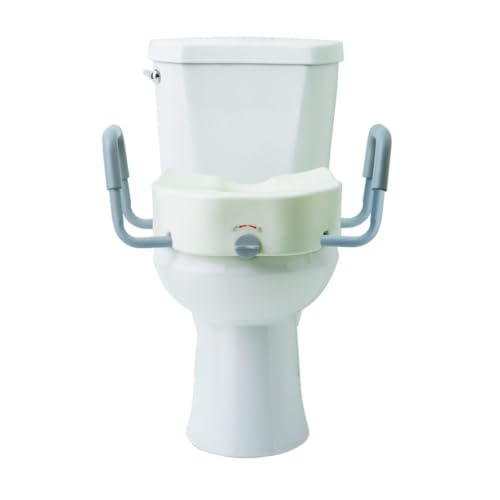
A84505T 4.5 in. raised toilet seat with support arms, fits round and elongated
Prices and availability are accurate as of the time shown and may change.
The seat will stay on for months, and you want the most secure fit you can get without a plumber.
The user weighs over 300 lb, or several people share the toilet and want the normal seat back between uses.
The Bemis Rise is the raised seat I’d put on a toilet for someone who’ll use it every day. It scores 9.6, the top of this page, and it’s the only pick that bolts on rather than clamping to the bowl.
It replaces your toilet seat. A mounting base bolts into the same two holes the old seat used, the raised seat sits on that base, and two keys lock it down. Bemis calls this Dual Lock: two independent locking systems so the seat won’t wiggle or loosen with use.
The bolts use Bemis’s Stay·Tite fastening. Its instructions say to tighten until the lower portions snap off, which stops over-tightening and keeps the nut from backing off. Bemis guarantees it never loosens.
Height and support are clear on Bemis’s spec sheet: a 4.5 in. raised seat, support arms tested to 200 lb on each side, 18-9/16 in. between the arms, and a seat capacity of 300 lb. Bemis adds a note to always check the load-bearing weight of the toilet itself.
Fit is the easy part. The adjustable mounting base takes round and elongated bowls, and the ring opening is elongated size for hygiene access and comfort. The same seat works on either bowl shape.
For cleaning, Bemis’s Easy·Clean lets you release the seat from the mounting base and lift it off, then wipe the rim and base. That beats scrubbing around a clamp inside the bowl.
Bemis lists the seat at 20-7/8 in. wide and 19.35 in. deep with the arms, and 8.65 lb. It’s a closed-front seat with no cover, so there’s no lid while it’s installed.
Bemis’s warranty covers its toilet seats against defects in material and workmanship for at least one year from purchase. Bemis publishes a spec sheet, installation sheet, care guide and warranty for this model.
Medline G4-503LRX1 5 in. elongated raised locking toilet seat with removable padded arms, 400 lb
Prices and availability are accurate as of the time shown and may change.
You have an elongated bowl, need more than 300 lb capacity, or want a seat you can lift off without tools.
Your bowl is round, or the bowl rim has raised or protruding sections. Medline says not to use it on those.
The Medline G4-503LRX1 scores 9.5. It has the highest weight capacity on this page at 400 lb, and Medline publishes a full user guide for it.
It sits on the bowl rather than bolting on. Two rear wings hook under the back lip of the bowl, and a knob at the front turns a locking mechanism that grips the inside of the bowl. Medline says to turn the knob until you feel resistance, then about another 1/8 in. until snug, and never to use a wrench on it.
Fit is elongated bowls only, per Medline’s product page, and the listing says the same. Medline adds that some bowls need the existing seat or lid removed to fit, and that it shouldn’t be used if the bowl top or inner rim has raised or protruding points.
The arms snap into brackets under the seat, marked L and R, at the width you choose. They come off, and the seat can be used without them. Medline’s guide says not to use the arms to hold your full body weight, and to keep your weight even between them when you get on or off.
Medline is clear that this isn’t a permanent fixture. Its guide says to loosen and retighten the unit at least once a week to keep a proper fit, and not to use it if it’s wobbly or not level.
The seat is easy-clean polypropylene with slip-resistant pads and a lip inside the toilet for stability. Medline says to clean it with a non-abrasive cleaner and warm water, and it’s not made with natural rubber latex.
The listing gives the size as 15.5 in. wide, 5 in. tall and 16.7 in. long. Medline’s own pages don’t list dimensions, which is the one check it loses half a point on.
Medline’s warranty covers defects in materials and workmanship for as long as the original buyer uses it. Grips and other wear parts aren’t covered.
Carex E-Z Lock raised toilet seat with adjustable padded armrests, 5 in. (FGB30300)
Prices and availability are accurate as of the time shown and may change.
The user is tall or short enough that fixed arms sit at the wrong height, and the toilet is a round bowl.
Your bowl is elongated. Carex’s own page lists this model for standard round toilets, so measure first.
The Carex E-Z Lock with adjustable armrests scores 8.4. It’s the pick when the arm height matters, because Carex designed the armrests to adjust for users of different heights.
It adds 5 in. of height and locks onto the bowl with Carex’s patented lock. Carex’s listing says installation takes three steps and a minute or two, and the arms come off with a few screws.
Carex publishes the specs: 300 lb weight capacity, 5 in. tall, 17 in. deep and 15.5 to 22 in. wide with the arms, and 5.6 lb. The arms are aluminum with polyethylene padding on a blow-molded plastic seat.
The fit needs a check. Carex’s product page says it fits most standard round toilets. The Amazon listing says it fits round, standard and elongated toilets, with a 9 in. hole and arms that adjust from 18 to 20 in. Because the two don’t agree, it gets half credit on fit. Measure your bowl before ordering; the steps are below.
The arms are the reason to choose it. If the arms on a fixed seat sit too low, a user has to lean forward to push up. Being able to change the height helps match them to the person.
Carex’s limited warranty covers defects in materials and workmanship for the original buyer, but it gives no term in years and excludes nondurable parts such as grips and handles. Carex also says it doesn’t accept returns on raised toilet seats bought from its own store, opened or not.
Carex’s listings on its other risers recommend using a toilet safety frame or a wall grab bar along with a raised seat. That’s sensible here too if the user is unsteady.
Carex says not to use abrasive cleaners or cloths, which can damage the seat.
Locking raised toilet seat, 5 in., with built-in hand grips (FGB312C0)
Prices and availability are accurate as of the time shown and may change.
You want height without arms, for example where the toilet already has a grab bar or a safety frame.
The user needs something to push up from. Choose a seat with arms or add a safety frame.
The Carex E-Z Lock scores 7.6. It’s the same lock and 5 in. height as the Carex above, without the armrests, which suits a toilet that already has grab bars or a safety frame.
Carex says the locking mechanism secures the seat to the bowl and the seat fits most toilets. The listing says it fits round and elongated bowls and has a 9 in. center hole.
Carex lists a 300 lb capacity, 5 in. height, 15.5 in. width and 17 in. depth, and a 4.5 lb weight. It’s molded plastic.
Instead of arms, the seat has built-in hand grips molded into its sides. They help when you’re settling on the seat or adjusting position, but they aren’t a substitute for arms or a grab bar when standing up.
Because there are no arms, it’s the lightest pick here. Carex says it can be attached and removed easily, which makes it practical to take to another bathroom or on a visit.
It loses points for having no arms and for having no instruction manual linked on Carex’s product page. Carex’s limited warranty applies, with no term in years and handles and grips excluded.
Carex’s listing says to avoid abrasive cleaners or cloths, which can damage the seat.
Carex builds it from heavy-duty molded plastic meant for continuous, long-term use, per its product page, and ships it in a box about 8 by 14.5 by 16 in. That’s small enough to pack for a family visit. If the user needs to push up with their hands, though, pick the armrest version above instead.
A seat like this is the simplest add-on for a home where one person needs extra height and others can use the toilet after lifting it off. Carex’s listing says installation takes three steps and a minute or two.
| Seat | Spec score | Photo | Rise | Capacity | Attaches by | Arms | Bowl | Buy |
|---|---|---|---|---|---|---|---|---|
| Bemis Rise A84505T | 9.6 | | 4.5 in. | 300 lb | Bolts on | Yes, 200 lb each | Round or elongated | Check it on Amazon |
| Medline G4-503LRX1 | 9.5 | | 5 in. | 400 lb | Front knob clamp | Removable | Elongated | Check it on Amazon |
| Carex E-Z Lock with arms | 8.4 | | 5 in. | 300 lb | E-Z Lock | Adjustable | Round (Carex) | Check it on Amazon |
| Carex E-Z Lock | 7.6 | | 5 in. | 300 lb | E-Z Lock | Hand grips only | Most toilets | Check it on Amazon |
| Seat | Spec score | What held it back | What it does well |
|---|---|---|---|
| HealthSmart 4 in. riser with lid | 5.8 | No arms; listing says round only while HealthSmart’s page says round and elongated; no warranty stated | Clamps on, 418 lb capacity, built-in lid |
| AquaSense 770-610 4 in. riser | 4.9 | Rests on the bowl with no lock; no arms; maker page gives no specs | 400 lb on the listing and a lifetime limited warranty |
| Carex Toilet Seat Elevator 3.5 in. | 6.2 | Sits under your seat with no lock; no arms; only 3.5 in. | Keeps your own seat and lid |
| Drive Medical 2-in-1 | — | Only a used listing in stock | Removable padded arms |
Measure from the floor to the top of your toilet seat, then pick your bowl shape. The checker adds each pick’s rise.
The ADA standard for accessible toilets sets the seat height at 17 to 19 in. from the floor to the top of the seat. That’s the range public restrooms are built to, and it’s a good starting point for a home. The right height for one person still depends on their leg length and how they move, so ask their therapist if they have one.
| Bowl shape | Bolt holes to front edge | Picks that fit |
|---|---|---|
| Round | About 16.5 in. | Bemis Rise, Carex E-Z Lock with arms, Carex E-Z Lock |
| Elongated | About 18.5 in. | Bemis Rise, Medline G4-503LRX1, Carex E-Z Lock |
Bemis’s size guide says to measure from between the seat bolt holes to the front of the bowl: about 16.5 in. means round, about 18.5 in. means elongated. Lift the seat first, and measure the bowl itself, not the seat. Our round vs elongated guide has more on the two shapes.
Clamp-on seats also care about the rim. Medline says not to use its seat if the bowl top or inner rim has raised or protruding points, and that some bowls need the existing seat or lid removed. Skirted and one-piece toilets with unusual rims are worth a closer look before you buy one.
| Type | How it holds | Example | Good for | Watch for |
|---|---|---|---|---|
| Bolt-on | Bolts into the seat holes | Bemis Rise | Long-term daily use | Replaces your seat while it’s on |
| Clamp-on (locking) | A knob or lock grips the bowl | Medline, Carex E-Z Lock | Lifting off for others or travel | Retighten weekly (Medline) |
| Under-seat riser | Sits under your seat; some bolt | Carex Toilet Seat Elevator | Keeping your own seat and lid | Only 3.5 in.; often no lock |
| Resting riser | Sits on the rim with pads or a lip | AquaSense 770-610 | Short visits | Can shift; no lock |
The most important question is whether the seat can move. A bolt-on seat can’t slide off the rim; a locking clamp grips the bowl and is safe when tightened; a seat that only rests on the rim relies on pads. That’s why the score gives 2 of 10 points to how the seat attaches, and why resting risers were left out.
Clamp-on seats need checking. Medline’s guide says its seat isn’t designed for permanent installation and should be loosened and retightened at least once a week. A bolt-on seat like the Bemis doesn’t need that.
The user pushes up with their hands to stand, there’s no grab bar beside the toilet, or balance is unsteady.
A wall grab bar or a toilet safety frame is already in place, or the arms would block a side transfer from a wheelchair.
Arms on a raised seat help with balance and with the last part of standing up, but they have limits. Bemis tests its Rise arms to 200 lb on each side. Medline’s guide says not to use its arms to support full body weight, and to keep weight even between both arms when getting on and off.
Carex goes further on its risers without arms: its listings recommend a toilet safety frame or a permanently installed wall grab bar along with the raised seat. If the user leans hard on something to stand, a wall grab bar into blocking or studs is the sturdier choice.
Each maker’s limit is for the seat, not the toilet. Bemis’s spec sheet adds a reminder to always check the load-bearing weight of the toilet itself, which matters most for wall-hung bowls. Medline also says not to “plop” onto the seat; ease down instead, because sudden weight is harder on any seat than the rated load.
If the user is near 300 lb, the Medline’s 400 lb rating gives margin on an elongated bowl. Carex also sells a Safe Lock bariatric seat rated to 500 lb, per its product page.
| Option | What it does | Best when | Install |
|---|---|---|---|
| Raised toilet seat | Adds 3.5–5 in. of height | Recovery or a need that may change | Minutes, no plumber |
| Toilet safety frame | Adds arms around the toilet | Height is fine; standing up is the problem | Minutes |
| Wall grab bar | A fixed handhold | Long-term support | Into studs or blocking |
| Comfort-height toilet | Bowl itself sits higher | A permanent change for the household | A plumber or a careful DIY swap |
A raised seat is the quickest fix, and it comes off when it’s no longer needed.
If everyone in the house would be better off with a taller bowl, a comfort-height toilet is the cleaner long-term answer; see our comfort height vs standard toilet and ADA chair-height toilet guides. On a comfort-height toilet, a 5 in. riser can put the seat above the ADA range, so run the checker above first.
Measure from the seat bolt holes to the front of the bowl, per Bemis’s size guide.
Medline says to back the knob off until the lock clears the inner rim, hook the rear wings under the back lip, center the seat and push it back.
Turn the knob until you feel resistance, then about 1/8 in. more. Medline says never to use a wrench.
Remove the old seat, bolt the Bemis mounting base into the same holes and tighten until the Stay·Tite tops snap off.
Rock it gently. Medline says not to use a seat that’s wobbly, unstable or not level.
Medline says to loosen and retighten its clamp-on seat at least once a week. Bemis’s Rise uses two keys to lock the seat to its base; turn both to locked after cleaning. The toilet seat size guide covers bolt spacing if you’re swapping seats.
No. Medicare’s national coverage list for durable medical equipment (NCD 280.1) says raised toilet seats are denied as a convenience item and hygienic equipment, not primarily medical in nature. The same list covers commodes only when a patient is confined to a room, or to a floor of the home with no bathroom on it.
Medicare Advantage plans, Medicaid and FSA or HSA accounts have their own rules. Medline’s store marks this seat as FSA/HSA eligible; check with your plan before you buy.
The American Academy of Orthopaedic Surgeons lists a raised toilet seat among the items that help with daily activities after a total hip replacement, along with safety bars, a stable chair with arms and a reacher. Your surgeon or therapist will tell you how high the seat should be and how long to use it; follow their instructions over any general guide.
For recovery, a clamp-on seat with arms is the usual choice because it comes off when you no longer need it. The Medline and Carex E-Z Lock with arms both fit that role; check your bowl shape first.
| Seat | How it comes off | Maker’s cleaning note |
|---|---|---|
| Bemis Rise | Turn the keys and lift the seat off its base | Smooth, glossy surface that wipes clean |
| Medline G4-503LRX1 | Loosen the knob and tilt it out | Non-abrasive cleaner and warm water, then dry |
| Carex E-Z Lock (both) | Release the lock and lift | No abrasive cleaners or cloths |
The gap where a raised seat meets the bowl is where grime collects, so take the seat off for a full clean once a week. With a clamp-on seat, that lines up with Medline’s weekly loosen-and-retighten check.
The Bemis Rise scores highest here: it bolts on, adds 4.5 in. and has arms tested to 200 lb each. For an elongated bowl and up to 400 lb, the Medline G4-503LRX1 locks on without tools.
No. Medicare’s coverage list (NCD 280.1) denies raised toilet seats as a convenience and hygienic item. Other plans and FSA or HSA accounts may differ.
Clamp-on seats need regular retightening, a seat on a tall toilet can end up too high, and the gap at the bowl needs cleaning. Some seats also have no lid.
Most add 3.5 to 5 in. The ADA puts accessible toilet seats at 17 to 19 in. from the floor. Use the checker above with your own seat height.
Yes. The AAOS lists a raised toilet seat among helpful items after hip replacement. Follow your surgeon’s or therapist’s height advice.
No. The Medline fits elongated bowls only, and Carex lists its armrest model for round bowls. The Bemis Rise fits both. Measure from the bolt holes to the front edge.
Clamp-on seats hook under the back of the bowl and lock with a front knob by hand. Bolt-on seats like the Bemis replace your seat and bolt into its holes.
The picks here are rated 300 to 400 lb. Bemis rates its Rise arms at 200 lb each, and Medline says its arms aren’t for full body weight.
The spec score uses the same eight checks for every seat, scored only from the maker’s spec sheet, manual or product page, plus the Amazon listing for the fit check. It’s my score from those documents, not a lab test.
| Check (points) | How it’s scored |
|---|---|
| Height added stated (1) | The maker states how much height the seat adds |
| Weight capacity (1.5) | Full points for 400 lb or more, three quarters for 300 lb |
| Secure attachment (2) | Full points for a bolt-on or locking seat; 0.3 for one that rests on the rim or under the seat |
| Support arms included (1.5) | Full points for support arms; one third for molded hand grips |
| Bowl fit stated and listing matches (1.5) | Full points when the maker states the bowl fit and the listing agrees; half when they differ |
| Maker spec sheet with dimensions (1) | Full points for maker-published dimensions; half when only the listing has them |
| Instructions published (0.5) | The maker publishes installation instructions or a manual |
| Written warranty with a term (1) | Full points for a warranty with a stated term; half for a written warranty with no term |
| Total (10) | Sum of the checks |
| Seat | Height added stated | Weight capacity | Secure attachment | Support arms included | Bowl fit stated and listing matches | Maker spec sheet with dimensions | Instructions published | Written warranty with a term | Score |
|---|---|---|---|---|---|---|---|---|---|
| Bemis Rise | 1 | 1.1 | 2 | 1.5 | 1.5 | 1 | 0.5 | 1 | 9.6 |
| Medline G4-503LRX1 | 1 | 1.5 | 2 | 1.5 | 1.5 | 0.5 | 0.5 | 1 | 9.5 |
| Carex E-Z Lock with arms | 1 | 1.1 | 2 | 1.5 | 0.75 | 1 | 0.5 | 0.5 | 8.4 |
| Carex E-Z Lock | 1 | 1.1 | 2 | 0.5 | 1.5 | 1 | 0 | 0.5 | 7.6 |
| HealthSmart riser (left out) | 1 | 1.5 | 2 | 0 | 0.75 | 0.5 | 0 | 0 | 5.8 |
| AquaSense 770-610 (left out) | 1 | 1.5 | 0.6 | 0 | 0.75 | 0 | 0 | 1 | 4.9 |
| Carex Elevator (left out) | 1 | 1.1 | 0.6 | 0 | 1.5 | 1 | 0.5 | 0.5 | 6.2 |
I’m Isaac Daniels, a licensed journeyman plumber in Georgia (license #JP507711). I’ve used every seat picked here. The specs come from Bemis’s spec sheet, instructions and warranty, Medline’s user guide and product page, Carex’s product pages and warranty, HealthSmart’s and Drive Medical’s product pages, read Oct 23, 2026.