
Swanson S0101 Speed Square, 7 in.
$9.98 at Amazon
Check it on AmazonPrice as of Oct 24, 2026, 5:30 AM EDT
Why it's my pick ↓
For marking joists, studs and pipe.
As an Amazon Associate I earn from qualifying purchases.
Get Swanson's 7 in. S0101. Marking 2x10 or 2x12 joists? Add the Big 12.



Product prices and availability are accurate as of the date/time indicated and are subject to change. Any price and availability information displayed on Amazon.com at the time of purchase will apply to the purchase of this product.
A speed square is a framing tool, and a plumber cuts through framing. Most of its work is a square line before a bore, a notch or a cut.
A square line across the face and the edge, so the hole lands where the pipe needs it and you can check it against the code limits below.
Swanson's 7/8 in. heel holds the square on a board edge to guide a circular saw for a square or 45° cut.
Scribe notches hold a pencil at a set distance from the edge: 1/4 in. steps on the Swanson S0101 and the Klein.
Johnson's magnets hold the square on ferrous metal, so it stays put while you mark a cut or check a 90.
Magnets don't hold on them. For round pipe, Swanson's Speedlite has a center-line guide and Klein's square has a pipe prop.
A square rides in your pouch all day. Weight follows material and size: aluminum weighs more than composite, and 12 inches weighs more than 7.
The Speedlite weighs less than half the S0101 because it's composite instead of aluminum. Swanson says that composite glides on finished surfaces without leaving scuffs. That matters if you're marking a cut on a painted shelf or a finished cabinet back, not on a joist.
The Big 12 is the heaviest, and it's the one you carry only when you need the reach. I'd keep a 7 inch square in the pouch and leave the 12 inch in the truck for joist days.
Prices and availability are accurate as of the time shown and may change.
You want one square in the pouch for marking studs, plates and blocking, and a heel solid enough to guide a circular saw.
You mark across 2x10 and 2x12 joists most days. The 12 inch Big 12 reaches across them in one line.
The Swanson S0101 is the square I'd put in a plumber's pouch first. It's the 7 inch Speed Square, CNC machined from heavy-gauge aluminum alloy to a 45° and 90° corner. Swanson invented the Speed Square in 1925, and the S0101 is still made in Frankfort, Illinois.
The corner is the reason it's my pick. Swanson cuts it on a CNC machine, and says the body is 15 times stronger than standard aluminum construction. A square that gets dropped off a ladder onto a slab needs to stay square, because every line you draw off it depends on that corner.
The markings are recessed into the aluminum and filled with black. Swanson's point is that surface etching can wear off under saw shoes, sweat and dust, while recessed marks stay readable. The finish is matte, so the scale doesn't throw glare back at you under a work light or outside.
The 7/8 inch heel is the lip that hooks the board edge. Hold it against a 2x4 and you get a square or 45° line in one motion, or a fence for a circular saw when you cut blocking. The 1/4 inch scribe bar holds a pencil tip at a fixed distance from that same edge for a parallel line.
Swanson calls it five tools in one: try square, miter square, saw guide, line scriber and protractor. The scales are degree, common rafter and hip/valley. Swanson's Blue Book, a pocket reference for roof pitch, rafter length and stair stringers, comes with it.
For a plumber, the work is mostly a square line across a stud or joist before you bore it. At 7 inches, the S0101 spans the 3-1/2 inch face of a 2x4 and the 5-1/2 inch face of a 2x6 in one line. On a 7-1/4 inch 2x8 you'll need two passes, and the Big 12 is the better tool for that.
It weighs 0.68 pounds, more than the composite Speedlite but light enough for the pouch. What it doesn't have is a magnet or a guide for round stock. If you work on steel pipe, the Johnson adds magnets. If you mark centers on pipe, the Speedlite adds a center-line guide.
Swanson S0107 Big 12 Speed Square, 12 in., with Layout Bar
Prices and availability are accurate as of the time shown and may change.
You run drains and supply lines through floor joists and want a square line across a 2x10 or 2x12 in one pass.
You mostly mark studs and plates. A 7 inch square spans a 2x4 or 2x6 and fits a pouch better.
The Big 12 is Swanson's 12 inch Speed Square, built the same way as the S0101: heavy-gauge aluminum alloy, CNC machined to a 45° and 90° corner, with a matte finish. The difference is reach, and that's the reason a plumber would buy it.
Floor joists are where plumbers bore the biggest holes. A 2x10 has a 9-1/4 inch face and a 2x12 has an 11-1/4 inch face. A 7 inch square can't draw a line across either in one pass. The Big 12 can, so the line for a 3 inch drain hole is straight from top edge to bottom edge.
That full-depth line also makes the code check easier. The joist limits further down the page measure from the top and bottom edges. With one line across the whole face, you can mark the center, the 2 inch edge distances and the hole size on the same line.
The Layout Bar is the extra part. Swanson describes it as an aluminum bar that hooks onto the square head and slides along the body. It marks parallel lines without a chalk box, extends past the 12 inch reach for long layouts, and measures the offset on out-of-square corners.
The graduations add an inch ruler in 1/8 inch markings to the degree, common rafter and hip/valley scales. That ruler is handy for marking a hole center a set distance from the top of a joist without reaching for a tape.
Weight is the trade-off. Swanson's page lists both 1.05 pounds and 1.2 pounds for it, and either way it's the heaviest square here. At 12 inches it's also too big to work inside a narrow stud bay. I'd keep it in the truck and carry a 7 inch square on the belt.
Like the S0101, it's made in Frankfort, Illinois, and comes with Swanson's Blue Book. It has no magnet and no center-line guide.
Prices and availability are accurate as of the time shown and may change.
You mark the center of pipe or dowel, want the lightest square in the pouch, or work around finished cabinets and trim.
You use the square as a fence for a circular saw on framing. The aluminum S0101 has a listed 7/8 inch heel for that.
The Speedlite is Swanson's composite Speed Square, 8 inches on a side and 0.28 pounds. It's molded from what Swanson calls a high-impact engineering composite, in Hi-Viz Orange or Matte Gray. The orange one is the one linked here.
The feature that makes it useful to a plumber is the center-line guide. The listing describes a C/L guide for locating the center of round stock. On pipe, dowel or a round post, that gives you a center line to mark from instead of eyeballing it.
The second reason is weight. At 0.28 pounds, it's well under half the 0.68 pound S0101. If your pouch already carries a tape, a level and a marker, the composite square is the one you'll forget is there.
Swanson says the composite glides on soft finishes without leaving scuffs, and that aluminum or steel squares can leave dark marks. That's worth knowing when you mark a cut-out on the back of a finished vanity or a painted access panel.
The markings are molded into the composite, not printed on, according to Swanson. The edge is beveled for easier reading, and the 1/8 inch spaced notches let you scribe lines at close spacing. Swanson says the Speedlite keeps all five functions of the original square.
The 8 inch size gives an inch more reach than the 7 inch squares. Swanson sizes it for 8 inch siding, but for a plumber it means a 2x8's 7-1/4 inch face fits under one line.
What I'd weigh against it: Swanson doesn't list a heel size for the Speedlite, and composite is a different material from the machined aluminum body of the S0101. For guiding a circular saw through framing, I'd take the aluminum square. For marking centers and finished work, I'd take this one.
Prices and availability are accurate as of the time shown and may change.
You work on black or galvanized steel pipe, strut and hangers, and want a square that stays on the metal while you mark.
Your work is copper, PEX and PVC. The magnets won't hold, and the Swanson S0101 is the better 7 inch square for wood.
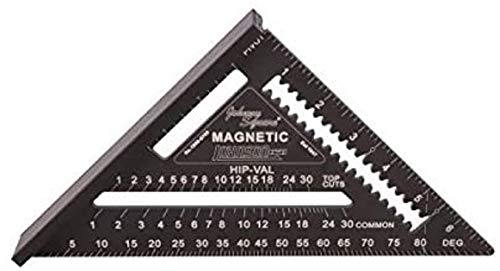
The Johnson 1959-0700 is a 7 inch aluminum square with magnets in its edge. Johnson says the magnets are strong enough for hands-free use, and that the magnetic edge attaches to ferrous metal. That's the reason it's on a plumber's list.
Ferrous means iron or steel. Black steel gas pipe, galvanized pipe, steel strut channel and many hanger parts are steel. Set the square on a length of strut and it stays put while you mark a cut line, so one hand holds the marker and the other holds the work.
Johnson also writes it up for setting and checking squares before or after welding, and for measuring angles. For a plumber, the same use is checking that a bracket or a strut cut is at 90° before you hang pipe from it.
The body is aluminum with CNC machined edges, which Johnson says are for greater accuracy and durability. The markings are EZ Read laser etching, which Johnson says reduces glare outdoors. The listing adds an anti-glare coating that also adds friction to help the square grip lumber as a saw guide.
The notches are laid out for framing. There are continuous scribing notches for ripping, notches at 3-1/2 and 5-1/2 inches, and marks for 2x4 dimensions at 1-1/2, 3 and 3-1/2 inches. Those match the actual sizes of a 2x4 and a 2x6.
Johnson backs it with a Limited Lifetime Warranty. The model is sold without a printed manual; Johnson posts the full instruction manual on its website.
Two things to know. Magnets don't hold on copper, brass, PEX or PVC, so on a copper job this is a plain 7 inch square. Johnson also doesn't list a weight. The listing linked here was in stock from a third-party seller on the day of the update it, not from Amazon.com.
Prices and availability are accurate as of the time shown and may change.
You cut PVC, ABS or metal pipe on the job and want a square that also props the pipe up for a straight cut.
You only mark framing. The Swanson S0101 has machined, recessed markings and the same 7 inch reach.
The Klein 9357SSQ is a 7 inch aluminum rafter square with one feature aimed straight at plumbers: a pipe prop. Klein's own words are that you feed metal or plastic pipe through the pipe prop to cut pipe on the job.
That's the reason it's on this list. Cutting PVC or ABS on the floor of a basement, the pipe rolls. A square that holds the pipe still and gives you a straight edge to cut against does two jobs at once. None of the other squares here lists that.
The heel is 1-1/8 inches, the widest listed on this page. Klein says the heel edge gives stability when you hold it against or slide it across wood or other materials. A wider heel gives more contact with the board edge when you use it as a saw fence.
The markings are double laser etched for visibility, even in sunlight, according to Klein. There's a preset angle guide from 0° to 90°. The 1/4 inch scribe notches are large enough to hold a carpenter pencil, so you can draw evenly spaced lines off the board edge.
The body is anodized aluminum in orange, which Klein says resists corrosion. It's 7.29 by 7.25 by 1.13 inches and weighs 7.84 ounces, or about 0.49 pounds, so it sits between the Speedlite and the S0101.
Where it differs from the Swanson is the markings. Klein's are laser etched on the surface. Swanson's are recessed into the body and filled with black, and Swanson argues those last longer. Klein doesn't publish a test either way, so I'd treat that as a difference in method, not a proven gap.
It has no magnet and no center-line guide. Klein also sells a two-piece kit, model 93547SQVP, with a 4-1/2 inch and a 7 inch square, if you want a small square for tight spots.
| Square | Best for | Size | Body | Markings | Weight | Extra |
|---|---|---|---|---|---|---|
| Swanson S0101 | 2x4 and 2x6 framing | 7 in. | CNC machined aluminum | Recessed, black-filled | 0.68 lb | 7/8 in. heel, Blue Book |
| Swanson Big 12 | 2x10 and 2x12 joists | 12 in. | CNC machined aluminum | Recessed, black-filled | 1.05 to 1.2 lb | Layout Bar, 1/8 in. ruler |
| Swanson Speedlite | Center of round stock | 8 in. | Composite | Molded in | 0.28 lb | C/L guide |
| Johnson 1959-0700 | Steel pipe and strut | 7 in. | Aluminum, CNC edges | Laser etched | Not listed | Magnets |
| Klein 9357SSQ | Propping pipe for a cut | 7 in. | Anodized aluminum | Double laser etched | 0.49 lb | Pipe prop, 1-1/8 in. heel |
Lumber is sold by nominal size but measures smaller. A square draws a line across the face in one pass only if its reach is longer than the board's actual width.
| Board | Actual face | 7 in. (S0101, Johnson, Klein) | 8 in. (Speedlite) | 12 in. (Big 12) |
|---|---|---|---|---|
| 2x4 | 3-1/2 in. | One line | One line | One line |
| 2x6 | 5-1/2 in. | One line | One line | One line |
| 2x8 | 7-1/4 in. | Two passes | One line | One line |
| 2x10 | 9-1/4 in. | Two passes | Two passes | One line |
| 2x12 | 11-1/4 in. | Two passes | Two passes | One line |
Actual sizes are standard dressed lumber dimensions. One line or two passes is my math from each square's listed size.
Studs and plates are 2x4 or 2x6, so a 7 inch square covers most wall work. Floor joists are usually 2x8 to 2x12, and that's where the reach runs out. You can still mark a 2x10 with a 7 inch square by flipping it and drawing from the other edge, but the two lines have to meet, and a small error at each edge shows up at the middle.
Before you mark a joist, know the limit. The International Residential Code sets the size and position of holes and notches in sawn lumber floor joists.
| Joist | Actual depth | Max notch depth (1/6) | Max end notch (1/4) | Max hole (1/3) | Room between 2 in. edges |
|---|---|---|---|---|---|
| 2x6 | 5-1/2 in. | 7/8 in. | 1-3/8 in. | 1-13/16 in. | 1-1/2 in. |
| 2x8 | 7-1/4 in. | 1-3/16 in. | 1-13/16 in. | 2-3/8 in. | 3-1/4 in. |
| 2x10 | 9-1/4 in. | 1-1/2 in. | 2-5/16 in. | 3-1/16 in. | 5-1/4 in. |
| 2x12 | 11-1/4 in. | 1-7/8 in. | 2-13/16 in. | 3-3/4 in. | 7-1/4 in. |
Limits from IRC Section R502.8.1 for sawn lumber. Sizes are my math, rounded down to the nearest 1/16 inch. Your local code edition and inspector have the final say.
The code allows notches up to one-sixth of the joist depth, no longer than one-third of the depth, and never in the middle third of the span. Notches at the ends can go to one-quarter of the depth. A bored hole can be up to one-third of the depth, and must stay at least 2 inches from the top and bottom edges, from any other hole, and from a notch.
Look at the 2x6 row. One-third of 5-1/2 inches is 1-13/16, but the 2 inch edge rule leaves only 1-1/2 inches between the edges. So the edge rule, not the one-third rule, sets the biggest hole in a 2x6. On a 2x8 and up, the one-third rule is the tighter limit.
Max hole 3-1/16 in., so a hole sized for 2 inch pipe fits. Center it on your square line at least 2 in. from both edges.
Max hole 3-3/4 in. A hole sized for 3 inch pipe can fit; measure its outside diameter first.
Max hole 3-1/16 in. Measure the pipe's outside diameter: if the hole must be bigger than that, reroute or ask the inspector.
Don't cut or bore them unless the maker's design allows it (IRC R502.8.2). The table above is for sawn lumber only.
Plumbing drains need slope, so a run of holes through joists steps down from one joist to the next. Mark each one with the square, then measure the edge distances on each joist.
A drain stack or vent often goes up through a wall's top plate. In an exterior or load-bearing wall, the 2021 IRC adds a strap when that cut takes more than half the plate.
| Cut through the top plate of an exterior or load-bearing wall | What the 2021 IRC asks for (R602.6.1) |
|---|---|
| 50% of the plate width or less | No strap required by this section |
| More than 50% of the plate width | A galvanized metal tie, at least 16 gauge and 1-1/2 in. wide |
| Strap fastening | At least eight 10d nails at each side of the opening (some local codes change the count) |
| Strap length | Extends at least 6 in. past the opening |
| Exception | Not needed where the wall side is fully sheathed with wood structural panels |
A 2x4 plate is 3-1/2 inches wide, so any hole over 1-3/4 inches crosses the 50% line. A 3 inch PVC vent stack goes well past that. Mark the hole center with a square line across the plate, cut, and plan the strap before the drywall goes up. Your local code edition may differ, so check with your inspector.
The scale is the part you read. Each maker puts it on a different way, and each says why its method is better.
| Square | How the markings are made | What the maker says |
|---|---|---|
| Swanson S0101 and Big 12 | Recessed into the body and filled with black | Stay readable after saw shoes, sweat and dust; matte body cuts glare |
| Swanson Speedlite | Molded into the composite | Not printed on, so they don't wear off the surface |
| Johnson 1959-0700 | EZ Read laser etching | Reduces glare outdoors |
| Klein 9357SSQ | Double laser etched | Highly visible, even in sunlight |
None of these makers publishes a wear test, so I can't tell you one lasts a set number of years longer. What I can tell you is the method. Swanson cuts the marks into the metal. Johnson and Klein etch them into the surface. If your square lives in a pouch with screws and a hacksaw, recessed marks have more material to lose before they fade.
| Feature | Square | What it does |
|---|---|---|
| Magnets | Johnson 1959-0700 | Holds on black steel, galvanized pipe and strut; not on copper, PEX or PVC |
| Center-line guide | Swanson Speedlite | Marks the center of round stock |
| Pipe prop | Klein 9357SSQ | Holds metal or plastic pipe for measuring and cutting |
| Saw-guide heel | Swanson S0101 (7/8 in.), Klein (1-1/8 in.) | Fence for a circular saw cutting blocking |
| Inch ruler, 1/8 in. | Swanson Big 12 | Marks a hole center a set distance from the joist edge |
No single square has all of these. If you work mostly in copper and PEX, the magnet won't help and the 7 inch Swanson is the better pick. If you run steel gas pipe or hang a lot of strut, the Johnson earns its spot. If you cut a lot of PVC on the floor, look at the Klein.
A factory edge of plywood or a straight board works.
Hold the heel on the edge and draw along the blade.
Turn it over so the heel is on the same edge, from the other side, and line the blade up with your mark.
If the two lines match, the corner is square. If they spread apart, the error is half the gap.
A square that's out will put every hole and cut out by the same amount.
Do this when a square is new and after it takes a hard drop. Swanson says its machined aluminum holds its 90° corner under drops and jobsite abuse. A flip test takes a minute and tells you for sure.
7 inches for studs and plates, 8 for a 2x8 face, 12 for 2x10 and 2x12 joists.
Machined aluminum for a saw fence and drops; composite for light weight and finished surfaces.
Steel pipe and strut: a magnetic square. Copper, PEX and PVC: skip the magnet.
Recessed marks on the Swanson aluminum squares; laser etched on the Johnson and Klein.
A center-line guide (Speedlite), a pipe prop (Klein) or a Layout Bar (Big 12).
If you buy one square, buy the Swanson S0101. It covers stud and plate work, guides a circular saw for blocking, and has a machined corner and recessed marks. Add the Big 12 if you bore through floor joists often, and check the joist table before you drill.
For plumbing, the Swanson S0101. It's the 7 inch Speed Square, CNC machined from heavy-gauge aluminum to a 45° and 90° corner, with recessed black-filled markings and a 7/8 inch heel.
7 inches covers 2x4 and 2x6 framing. Add a 12 inch square, like the Swanson Big 12, to mark across 2x10 and 2x12 joists in one line.
Swanson invented the Speed Square in 1925 and still CNC machines its aluminum squares in Frankfort, Illinois. It's my pick for most plumbers, with the Johnson and Klein picked for steel pipe and propping pipe.
No maker publishes an accuracy test. Swanson machines its corner to 45° and 90°, and Johnson lists CNC machined edges. Check any square with the flip test: draw a line, flip it, draw again.
This page covers speed squares only. A combination square has a sliding head on a steel rule and is a different tool.
Swanson's Speedlite has a center-line (C/L) guide for locating the center of round stock. The other squares here don't list one.
No. Magnets hold only on ferrous metal like black steel pipe, galvanized pipe and steel strut. They don't hold on copper, brass, PEX or PVC.
Swanson's aluminum squares are machined and weigh 0.68 pounds at 7 inches. Its composite Speedlite weighs 0.28 pounds and glides on finished surfaces without scuffs. Aluminum is the better saw fence.
Under IRC R502.8.1, up to one-third of the joist depth, at least 2 inches from the top and bottom edges. That's 2-3/8 inches in a 2x8, 3-1/16 in a 2x10 and 3-3/4 in a 2x12. Check your local code.
In sawn lumber, the IRC allows notches up to one-sixth of the depth, no longer than one-third of the depth, and not in the middle third of the span. End notches can be one-quarter of the depth.
A pocket reference Swanson includes with its aluminum Speed Squares, covering roof pitch, rafter length, stair stringers and field measurements.
Makers use both names for the same triangle tool. Swanson calls its square a Speed Square, and Johnson and Klein call theirs rafter squares.
I'm Isaac Daniels, a licensed journeyman plumber in Georgia (license #JP507711). I picked these for what a plumber marks: studs and joists before a bore, blocking, steel pipe and strut. Specs come from Swanson, Johnson and Klein Tools, and the joist limits from the IRC.