
FLIR C8 (320 × 240)
$898.99 at Amazon
Check it on AmazonPrice as of Nov 22, 2026, 9:30 AM EST
Details ↓
Six cameras that show the cold, wet patch before the ceiling stains.

As an Amazon Associate I earn from qualifying purchases.
My call: the FLIR C8. It has the most real thermal pixels here, 320 × 240, plus a cold alarm that paints wet spots. For a pistol grip, the FLIR E6 Pro. To use your phone, the TOPDON TC001 Max.
All genuine, new and in stock on Oct 19. One is sold by Amazon.com; the rest by Northwest Selling Solutions and TOPDON Authorized on Amazon, named in each card. Prices show the time they were read.




Product prices and availability are accurate as of the date/time indicated and are subject to change. Any price and availability information displayed on Amazon.com at the time of purchase will apply to the purchase of this product.
Every camera here makes its image from a grid of heat sensors. That grid is the native resolution. Bigger numbers on the box, like 512 × 384, come from software that sharpens the picture.
TOPDON's TISR turns 256 × 192 into a 512 × 384 picture. FLIR's VividIR does the same on its phone cameras. Both are processing. They can make edges look cleaner, but they don't add heat sensors.
For leaks this matters more than for hot breakers. FLIR's own leak guide says moisture shows as small temperature differences, and that a camera for this work needs high resolution and good sensitivity. A wet patch the size of a fist is a handful of pixels on a 160 × 120 camera across a room.
Prices and availability are accurate as of the time shown and may change.
You're tracing a stain on a ceiling or a damp section of drywall back to its source, and you want the clearest picture you can carry in a pocket.
You mostly check things within a foot of the lens, like a valve body or a fitting under a sink. The C8 won't focus closer than 0.4 m.
The C8 is a FLIR pocket camera. It keeps the C5's flat 138 × 84 mm body and swaps in a 320 × 240 sensor, which is four times the C5's thermal pixels.
That jump is the reason it tops this page. FLIR's leak guide says moisture usually shows as subtle temperature differences, so you need real resolution and low noise. The C8 has both: 76,800 native pixels and a sensitivity under 50 mK.
The field of view is 35° × 27°, narrower than most cameras here. FLIR lists the spatial resolution at 2.0 mrad. At 6 ft from a wall, each pixel covers about 0.14 in., the smallest of the six.
The feature I'd use most on leak calls is the isotherm. You set a temperature, and the C8 paints every pixel above or below it in a contrasting color. FLIR's manual says the C5 doesn't have this, which is the biggest gap between the two.
You can also set the temperature scale by hand. FLIR's leak guide suggests a span of about 10 to 20°C so small differences stand out. The C8 has manual, automatic and 1-Touch level and span.
MSX lays edges from the 5 MP visual camera over the thermal image. That helps you see which joist bay or which corner a cold patch sits in.
It's IP54, rated for a 2 m drop, and weighs 0.19 kg (0.42 lb). The screen is a 3.5 in. touchscreen at 640 × 480. Battery life is 3 hours on FLIR's page, with a 2 hour USB-C charge.
Images upload over Wi-Fi to FLIR Ignite. FLIR says new C8 purchases include a 12-month Ignite Pro subscription, onboarding and its IR Fundamentals training. The listing names FLIR's 2-10 warranty: 2 years on the camera, 10 on the detector.
Two things on the spec page are off. It lists ±2°C as ±5.5°F, which is wrong; ±2°C is ±3.6°F. It also lists the depth as 34 mm and 0.94 in. I note both in the spec conflicts table.
My call: the camera I'd buy for leak hunting. It was new and sold by Northwest Selling Solutions, a third-party seller, on the day of the update.
Prices and availability are accurate as of the time shown and may change.
You do water damage, remodel or inspection work and want a camera that sits in your hand like a drill, with a hard case and a 4 hour battery.
You want it in your shirt pocket on every call. The C8 gives you more pixels in a smaller body.
The E6 Pro is a pistol-grip camera in FLIR's Ex Pro series. In FLIR's guide to finding water leaks, it's the model FLIR names for basic moisture work, with the E8 Pro and E96 above it.
The sensor is 240 × 180, or 43,200 pixels. That's more than half the C8's count and well over twice the C5's. Sensitivity is under 50 mK at 30°C, the same class as the C8.
The lens covers 33° × 25° with a 2.5 mrad spatial resolution. At 6 ft, each pixel covers about 0.18 in. of wall. Minimum focus is 0.36 m (1.18 ft).
It has the isotherm tool, with above and below alarms. On a leak call, set a below alarm a few degrees under the dry wall temperature and the cooler, wetter area lights up.
FLIR's leak guide also says to adjust level and span by hand. The E6 Pro has 1-Touch Level/Span: tap a spot and the camera sets the scale around it.
The range runs from -4 to 1022°F in two ranges, the widest FLIR here. You'll never need the top end for leaks, but it covers electrical and HVAC work too.
Battery life is 4 hours. FLIR says the battery charges inside the camera or in a separate charger, and the box has a hard transport case and a power supply with US and other plugs.
It's IP54, rated for a 2 m drop and 25 g shock, and runs from 5 to 122°F. FLIR lists the weight two ways, 0.590 kg with battery and 0.610 kg, so call it about 1.3 lb.
FLIR says new Ex Pro-Series purchases include an extended FLIR Protect warranty, a 12-month Ignite Pro subscription and FLIR Academy training. The listing names FLIR's 2-10 warranty.
My read: the pick for anyone who'd rather hold a grip than a phone-shaped slab. It was new and sold by Northwest Selling Solutions, a third-party seller, on the day of the update.
Prices and availability are accurate as of the time shown and may change.
You want a camera in your shirt pocket on every service call, to check a wall behind a fixture or a supply line up close before you open anything.
You hunt leaks across whole ceilings and rooms. The C8's pixels and cold alarm do that job better.
The C5 is the camera the C8 grew out of: same 138 × 84 mm body, same 5 MP visual camera, same Wi-Fi and FLIR Ignite upload. FLIR's own page lists plumbing issues among the jobs it's for.
The sensor is 160 × 120, 19,200 pixels, with sensitivity under 70 mK. That's the coarsest picture and the noisiest sensor of the FLIRs here. It still shows a wet patch you're standing near.
Where it wins is up close. Thermal focus starts at 0.1 m (3.94 in.), and MSX works from 0.3 m. The C8 needs 0.4 m. Under a vanity or along a short run of pipe, the C5 gets a sharper picture.
FLIR's Cx-series manual says color alarms don't apply to the C5. You can still set the temperature scale by hand, and FLIR's page lists 1-Touch Level/Span for quick contrast.
Accuracy is ±3°C from 32 to 212°F, at room temperatures between 59 and 95°F. The range is -4 to 752°F. The frame rate is 8.7 Hz, so move it slowly.
It has an LED flashlight, which earns its keep in crawlspaces and under cabinets. It's IP54 and designed for a 2 m drop.
Battery life is 4 hours, and it charges in 2 hours over USB-C at 1 A. It stores more than 5,000 images, saved as JPEGs with 14-bit measurement data.
The Cx manual's advice applies to every camera here. Shiny objects can look warm or cold because they reflect the room. Measure on a matte area, and watch for your own reflection.
FLIR's product page doesn't list the C5's field of view or weight, so I leave those blank. The listing names FLIR's 2-10 warranty: 2 years on the camera, 10 on the detector.
My read: a fine first camera for a plumber who wants it on them all day. It was new and sold by Northwest Selling Solutions, a third-party seller, on the day of the update.
Prices and availability are accurate as of the time shown and may change.
You want more real pixels than a 160 × 120 camera and a battery that lasts a whole day of inspections.
You want a cold alarm that paints the wet area, or a sensitivity figure in writing. The FLIRs publish both.
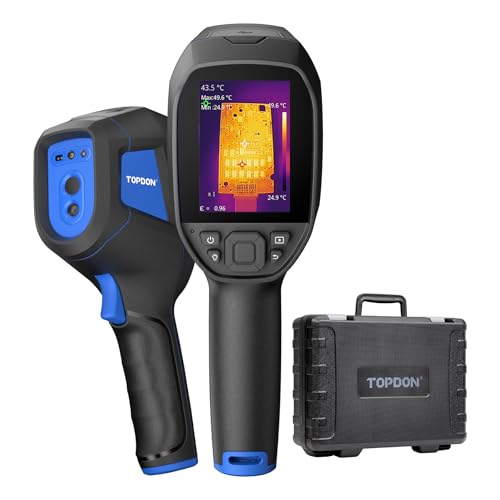
The TC005 is TOPDON's 3.5 in. handheld with a 256 × 192 sensor and a 2 MP visual camera beside it. TOPDON's TISR processing turns the image into 512 × 384 on screen.
The native count is 49,152 pixels, between the E6 Pro and the C8. The lens covers 40° × 30°. By my math from those numbers, each pixel covers about 0.20 in. of wall from 6 ft.
It refreshes at 25 Hz, almost three times the FLIRs' 9 Hz. You'll notice it when you sweep across a ceiling: less smear while you move.
Battery life is the standout. TOPDON's page says 8.5 hours, the listing says 8 hours. Either way, it's twice the FLIRs. The battery is 5000 mAh.
Accuracy is ±2°C or ±2%, and the range runs from -4 to 1022°F. It has center, hot and cold spot readings and high and low temperature alarms, but no isotherm painting.
TOPDON's spec table leaves the NETD line blank. Without a sensitivity number, I can't compare its noise to the FLIRs. That's why it sits below them.
The laser marks what you're measuring. TOPDON's page says the laser distance reaches 2 m; the Amazon listing says 4 m. The page also says it charges in 2 hours in one place and 4 hours in another.
Storage is 64 GB. Files move over Wi-Fi to the TopInfrared app, or by USB to TopView software on a Windows PC for reports.
It's IP54 and rated for a 2 m drop. The box includes a hard case, a travel adapter, a USB cable and a calibration certificate. The warranty is 1 year.
My read: the most screen time and pixels you can get without a FLIR. It was new and sold by TOPDON Authorized, TOPDON's seller on Amazon, on the day of the update.
Prices and availability are accurate as of the time shown and may change.
You already carry a phone, want real resolution for the least weight, and don't mind plugging in when you need to look.
You work in wet crawlspaces and want a sealed tool. TOPDON lists no IP rating for the TC001 Max.
The TC001 Max plugs into a phone and uses its screen. The sensor is the same 256 × 192 count as the TC005, and TOPDON's TISR shows it at 512 × 384.
It has the lowest sensitivity figure I found in writing: 40 mK or better. A visible-light camera sits beside the thermal lens so the app can blend outlines into the heat image.
Compatibility is broad. TOPDON lists iOS, Android and Windows, and the box has USB-C to USB-C and USB-C to Lightning adapters. It works through most phone cases, per the listing.
There's no battery. TOPDON says it draws less than 0.38 W from your phone. The page says it weighs 33 g; the spec table says 30 g. Either way, it disappears in a pocket.
The lens is wide: 56° × 42°. That's great for seeing a whole wall from close up in a small bathroom. From farther back, each pixel covers more wall, about 0.27 in. at 6 ft by my math.
It refreshes at 25 Hz. Accuracy is ±2°C or ±2%, and the range runs from -4 to 1022°F.
The TopInfrared and TopView apps handle photos, video, temperature graphs and reports. TOPDON lists high and low temperature warnings, plus dot, line and area measurements.
TOPDON's spec table lists a 2.0 m drop rating and no IP rating. I'd keep it out of standing water and dripping ceilings more carefully than the sealed handhelds.
In the box: the camera, a USB-A to USB-C cable, both adapters, a cleaning cloth, a carry bag and a manual. The warranty is 1 year.
My read: the best picture per dollar of weight in your pocket, if your phone is up to it. It was new and sold by TOPDON Authorized, TOPDON's seller on Amazon, on the day of the update.
Prices and availability are accurate as of the time shown and may change.
You want a plain button-and-screen imager for checking a wall, a radiant floor or a water heater inside a dry house.
You work in crawlspaces, attics in summer or anywhere damp. Klein's manual limits it to indoor use under 75% humidity.
The TI250 is Klein's rechargeable handheld imager. It's the only pick here sold by Amazon.com, and the simplest to run: buttons, a 2.4 in. screen and three color palettes.
The sensor is a 160 × 120 VOx microbolometer, 19,200 pixels. The screen shows 320 × 240. It reads the hottest, coldest and center points, and you can set high and low alarms.
Emissivity adjusts from 0.01 to 0.99, with 0.95 as the default. Klein's manual prints a table of common materials, which I've used for the emissivity table below.
Klein's own documents don't agree with each other. The product page lists a 50° field of view and under 60 mK; the manual says 56° and under 50 mK. Weight is 8.5 oz on the page and 5.5 oz in the manual.
The bigger point for leak work is in the manual's environment line: indoor only, do not expose to moisture, rain or snow. It's rated to run from 32 to 113°F at under 75% humidity.
That rules it out of a sweaty crawlspace or a summer attic. Inside a conditioned house, it's fine for finding a cold, wet patch on drywall.
Accuracy depends on which document you read: ±2° or 2% above 212°F and ±3° or 3% below on the page, or ±3° or 3% in the manual. It isn't calibrated below 14°F.
It saves JPGs to 32 GB of internal memory and moves them over USB-C. The 1350 mAh battery charges in about 3 hours, and it calibrates itself for 10 seconds at start-up.
It's rated for a 6.5 ft (2 m) drop. The box has the imager, a charging cable, a case and instructions. Klein points to its warranty page for terms.
My read: a fair indoor imager from a tool brand most plumbers already carry. It was new and sold by Amazon.com on the day of the update.
Tap a number column header to sort on desktop. On a phone, swipe the table sideways.
| Camera | Photo | Type | Native pixels | NETD (mK) | Field of view | Frame rate (Hz) | Cold alarm | Warranty | Buy |
|---|---|---|---|---|---|---|---|---|---|
| FLIR C8 Wet spots in walls | | 76,800 | <50 | 35° × 27° | 9 | Isotherm | 2-10 (listing) | Check it on Amazon | |
| FLIR E6 Pro Pistol grip | | Pistol grip | 43,200 | <50 | 33° × 25° | 9 | Isotherm | 2-10 (listing) | Check it on Amazon |
| FLIR C5 Shirt pocket | | 19,200 | <70 | Not published | 8.7 | None | 2-10 (listing) | Check it on Amazon | |
| TOPDON TC005 Long shifts | | Handheld | 49,152 | Not published | 40° × 30° | 25 | Low alarm | 1 yr | Check it on Amazon |
| TOPDON TC001 Max Plugs into a phone | | Phone | 49,152 | ≤40 | 56° × 42° | 25 | Low warning | 1 yr | Check it on Amazon |
| Klein TI250 Simple, indoors | | Handheld | 19,200 | <50 to <60 | 50° to 56° | <9 | Low alarm | Klein policy | Check it on Amazon |
From the makers' product pages and manuals, read Oct 19, 2026. NETD is thermal sensitivity: lower numbers show smaller temperature differences. "Not published" means the maker's page leaves it blank.
Where Klein's page and manual give different numbers, I show both. FLIR's 2-10 warranty is 2 years on the camera and 10 on the detector, as named in the Amazon listings.
Resolution and lens angle together decide how much wall each pixel covers. The smaller the patch, the smaller the wet spot or pipe you can pick out from across a room.
| Camera | One pixel at 3 ft | One pixel at 6 ft | One pixel at 10 ft |
|---|---|---|---|
| FLIR C8 | 0.07 in. | 0.14 in. | 0.24 in. |
| FLIR E6 Pro | 0.09 in. | 0.18 in. | 0.30 in. |
| TOPDON TC005 | 0.10 in. | 0.20 in. | 0.33 in. |
| TOPDON TC001 Max | 0.14 in. | 0.27 in. | 0.46 in. |
| Klein TI250 | 0.20 to 0.22 in. | 0.39 to 0.44 in. | 0.65 to 0.73 in. |
| FLIR C5 | Not published | Not published | Not published |
FLIR's manual gives the rule of thumb: the center of the spot tool shows the smallest object you can measure, and you should move closer if your target is smaller. My read: plan on several pixels across anything you want a number from, not one.
That's why the wide-lens phone camera is happiest close up. In a 5 by 8 ft bathroom, the TC001 Max sees the whole wall from where you stand. Across a 20 ft living room ceiling, the C8's narrow lens and extra pixels pull ahead.
NETD is the smallest temperature difference a camera can show above its own noise. Lower is better. FLIR's leak guide calls 30 mK great for moisture and 100 mK better suited to big industrial differences.
FLIR's guide says moisture tends to cause only subtle temperature differences. They come from evaporation, capacitance or conduction, and weather and indoor humidity change them. That's why FLIR ties moisture work to sensitivity as well as resolution.
Makers measure NETD at different temperatures, so treat close numbers as a tie. The gap that matters is between under 50 and under 70. That's the real step between the C8 and the C5.
Emissivity is how well a surface gives off heat instead of reflecting the room. Paint and drywall do it well. Bare metal mostly reflects, so the camera reads the room, not the pipe.
| Surface | Emissivity | What the camera does |
|---|---|---|
| Black paint | 0.96 | Reads close to true |
| Rough concrete | 0.94 | Reads close to true |
| Hard rubber | 0.94 | Reads close to true |
| Smooth glass | 0.92 to 0.94 | Reads close to true, but reflects you |
| Porcelain ceramic | 0.92 | Reads close to true |
| Wood | 0.80 to 0.90 | Close at the default 0.95 |
| Cotton cloth | 0.77 | Reads a little off |
| Cold rolled steel | 0.75 to 0.85 | Reads off unless you change the setting |
| Smooth white marble | 0.56 | Reads well off |
| Matte copper | 0.22 | Mostly reflects the room |
| Commercial sheet aluminum | 0.09 | Almost all reflection |
Emissivity values from the Klein Tools TI250 instruction manual's emissivity chart. Every camera here defaults to 0.95. FLIR's Cx-series manual recommends 0.95 when you're unsure and says emissivity is the most important setting to get right.
Klein's manual puts it as a burn warning: reflective materials may be hotter than the reading. FLIR's manual says shiny objects may look warm or cold because they mainly reflect the environment, and to measure on a matte area.
For a leak hunt, that means two things. Don't trust the number on a bare copper line; look at the painted wall or ceiling beside it. And when a pipe looks oddly hot or cold, check whether it's just mirroring a window, a light or you.
A thermal camera can't see water. It sees temperature, and water changes temperature in patterns. FLIR's leak guide describes three.
Water spreads downward from its source, so FLIR describes a top-down triangle. The point of the leak is usually near the top.
FLIR describes an amorphous shape, wet in the middle and damp at the edges, each at a different temperature.
Water wicks up the wall into the insulation and up the studs. Look for a band near the floor.
FLIR says many things besides moisture cause a temperature difference. Read the pattern, then confirm it.
Bare metal, glass and glossy tile reflect the room. Read the matte surface next to them.
FLIR says to always confirm with a moisture meter before acting on what the camera shows.
Wet spots often show up cooler, and FLIR's guide names evaporation as one cause. It also says weather and humidity change what you see, so the picture can change through the day. A wall that dried overnight may show nothing in the morning.
A supply line leak can look different. My read: if hot water is running through a leaking line, the wet area may show warm instead of cool. Run the fixture for a few minutes and watch the wall, then turn it off and watch it cool.
These steps come from FLIR's leak guide and the Cx-series manual, in the order I'd do them.
FLIR's recommended default for painted walls and ceilings. Leave it there unless you're measuring bare metal.
FLIR's manual says to avoid direct sunlight on what you're inspecting.
FLIR's guide suggests a span of about 10 to 20°C (18 to 36°F) so small differences stand out. Use manual or 1-Touch level and span.
At 9 Hz, the FLIRs smear if you sweep fast. Stand square to the wall and move a step at a time.
On the C8 or E6 Pro, set an isotherm a few degrees below the dry wall. The wet area fills in with color.
FLIR says to always confirm with a moisture meter. A pinless meter checks without holes; a pin meter gives the number.
Snap the thermal and visual pair for the customer or the insurance file before you cut anything.
FLIR's guide also says to take your time, because the readings depend on weather and indoor humidity. My read: if the picture is unclear, come back after running the water or after the HVAC has cycled. For the meter, see our moisture meter guide.
Frame rate is how many times a second the picture updates. Screen size decides how easily you can read a faint pattern on site.
| Camera | Frame rate | Screen | Visual camera blend |
|---|---|---|---|
| FLIR C8 | 9 Hz | 3.5 in., 640 × 480 touch | MSX, 5 MP |
| FLIR E6 Pro | 9 Hz | 3.5 in., 640 × 480 touch | MSX, 5 MP |
| FLIR C5 | 8.7 Hz | Touchscreen; size not on page | MSX, 5 MP |
| TOPDON TC005 | 25 Hz | 3.5 in. | Dual fusion, 2 MP |
| TOPDON TC001 Max | 25 Hz | Your phone | Dual fusion |
| Klein TI250 | Under 9 Hz | 2.4 in., 320 × 240 | None |
For leak work, 9 Hz is fine if you move slowly. Wet patches don't move. The faster TOPDONs feel smoother when you sweep a whole ceiling, and their pictures settle sooner when you stop.
The visual blend matters more than it sounds. A thermal image of a plain white ceiling has nothing to hang your eye on. MSX and TOPDON's fusion draw in light fixtures, joints and corners, so you can find the spot again once the camera is down.
Leaks live in damp, dirty and hot places. The makers' ratings say which cameras belong there.
| Camera | Dust and water rating | Drop rating | Runs from | Note |
|---|---|---|---|---|
| FLIR C8 | IP54 | 2 m | 14 to 122°F | Humidity tested to 95% |
| FLIR E6 Pro | IP54 | 2 m | 5 to 122°F | Humidity tested to 95% |
| FLIR C5 | IP54 | 2 m | 14 to 122°F | LED flashlight |
| TOPDON TC005 | IP54 | 2 m | 14 to 122°F | LED flashlight |
| TOPDON TC001 Max | Not listed | 2 m | 14 to 122°F | Your phone sets the limit |
| Klein TI250 | Indoor only | 2 m | 32 to 113°F | Under 75% humidity |
IP54 means protected against dust and splashing water. It doesn't mean you can drop it in a puddle. For a crawlspace with standing water, the IP54 cameras are the ones I'd bring, in a pocket or a pouch.
If your attic runs hotter than 113°F, that's past the top of the Klein's range. The FLIRs and the TC005 are rated to 122°F.
A phone camera is light and uses a screen you already own. A handheld is one tool that's always ready.
| Question | Phone camera (TC001 Max) | Handheld (the other five) |
|---|---|---|
| Weight in your pocket | 33 g | 0.34 to 1.3 lb where published |
| Battery | Uses your phone's | 3 to about 8 hours where published |
| Ready to shoot | Plug in, open the app | Press the button |
| Dust and water rating | Not listed | IP54, except the Klein |
| Screen | Your phone's, often the biggest | 2.4 to 3.5 in. |
| Reports | TopInfrared and TopView apps | FLIR Ignite, TopView, or USB transfer |
My read: if you check for leaks a few times a month, the phone camera gives you real pixels for the least money and weight. If it's part of most calls, a handheld that's ready the moment you pull it out saves time and keeps your phone dry.
I read each camera's product page, manual and listing on the same day. These are the places they don't match, and which number I'd plan around.
| Camera | One source says | Another says | What I'd follow |
|---|---|---|---|
| FLIR C8 | Spec page: ±2°C (±5.5°F) | ±2°C converts to ±3.6°F | ±2°C |
| FLIR C8 | Spec page size: 34 mm deep | Same line: 0.94 in. (24 mm) | Check in hand |
| FLIR E6 Pro | Spec page: 0.590 kg with battery | Same page: 0.610 kg | About 1.3 lb |
| TOPDON TC005 | Product page: laser to 2 m | Amazon listing: 4 m | 2 m |
| TOPDON TC005 | Product page text: charges in 2 hours | Spec table: 4 hours | 4 hours |
| TOPDON TC005 | Spec table: 8.5 hour battery | Amazon listing: 8 hours | 8 hours |
| TOPDON TC005 | Spec table NETD | <40 mK | On the US product page |
| TOPDON TC001 Max | Product page: 33 g | Spec table: 30 g | Either is light |
| Klein TI250 | Product page: <60 mK, 50° lens | Manual: <50 mK, 56° lens | The page, the more cautious |
| Klein TI250 | Product page: 8.5 oz | Manual: 5.5 oz | Check in hand |
| Klein TI250 | Page: ±2° or 2% above 212°F | Manual: ±3° or 3% | ±3° or 3% |
None of these is a reason to skip a camera. They're reasons to plan around the more cautious number. The blank NETD on the TC005 is the one that cost it a higher spot, because sensitivity is the spec that matters most for moisture.
| Your job | Pick | Why |
|---|---|---|
| Stain on a ceiling, source unknown | FLIR C8 | Most real pixels and an isotherm cold alarm |
| Water damage and restoration jobs | FLIR E6 Pro | FLIR names it for moisture; grip and 4 hour battery |
| Service calls, checking up close | FLIR C5 | Pocket body, focuses to 3.94 in. |
| Long inspection days | TOPDON TC005 | About 8 hours of battery, 25 Hz |
| Occasional use, lightest kit | TOPDON TC001 Max | 33 g on your phone, ≤40 mK |
| Dry, conditioned house only | Klein TI250 | Simple buttons; indoor only by its manual |
| Wet crawlspace | Any IP54 camera | Not the Klein; no rating on the TC001 Max |
| Gas leak | None of these | Use a combustible gas detector |
My call from the makers' documents. The picks rest on published specs, manuals and FLIR's own leak guidance.
Ceilings across a room favor more pixels. Under sinks and vanities favor close focus or a wide lens.
Ignore 512 × 384 and 480 × 360 claims. Compare the sensor count.
Under 50 mK is the class FLIR's guide points to for moisture.
An isotherm paints the wet area for you. Only the C8 and E6 Pro have one here.
IP54 for crawlspaces; the Klein stays indoors.
The camera points; the meter confirms.
Not directly. FLIR says a thermal camera can't see moisture in walls, but it shows the temperature differences that water causes, mostly cooling from evaporation. FLIR also says a pattern that looks like moisture isn't proof, so confirm it with a moisture meter.
My call: the FLIR C8. It has 320 × 240 native pixels, sensitivity under 50 mK and an isotherm that paints areas colder than a temperature you set. For a pistol grip, the FLIR E6 Pro is the model FLIR's own leak guide names for basic moisture work.
For leak hunting, the FLIR C8. For checking fittings and lines up close on service calls, the FLIR C5 focuses as close as 3.94 in. and fits a shirt pocket. If you'd rather use your phone, the TOPDON TC001 Max.
It can show the wet area on the wall's surface when the water has changed its temperature. FLIR describes a top-down triangle on walls and an uneven shape on ceilings. It can't see through the wall, and it won't show a leak that hasn't wet or cooled the surface yet.
Up close, yes. From across a room, each pixel covers a lot of wall: about 0.4 in. at 6 ft on the Klein TI250. FLIR's guide says moisture work needs high resolution and good sensitivity, which is why the 320 × 240 C8 is my top pick.
It's processing. TOPDON's TISR shows its 256 × 192 sensor at 512 × 384, and FLIR's VividIR shows the Edge Pro's 160 × 120 at 480 × 360. It can clean up edges, but it doesn't add heat sensors. Compare the native numbers.
Bare metal reflects the room instead of giving off its own heat. Klein's manual lists matte copper at an emissivity of 0.22, against 0.95 for the camera's default. Read the painted surface next to the pipe instead, or set the emissivity for the material.
Pick an IP54 camera: the FLIR C8, E6 Pro or C5, or the TOPDON TC005. Klein's TI250 manual says indoor only, no moisture, and under 75% humidity. TOPDON lists no IP rating for the TC001 Max.
I'm Isaac Daniels, a licensed journeyman plumber in Georgia (license #JP507711). Every number here comes from the makers' product pages, manuals and FLIR's leak guidance, read the same day.
Recall check, Oct 19, 2026: no CPSC recalls found for FLIR, Teledyne, TOPDON or thermal cameras. Klein Tools has three past recalls for other products (power stations, voltage testers and clamp meters), none for thermal imagers.
Also checked, not picked: Klein TI223 phone camera (160 × 120; works with USB-C iPhones, 15 or newer, and most Android phones), FLIR Edge Pro wireless phone camera (160 × 120 native, 70 mK). Klein TI290 and Fluke TiS20+ were low stock on Amazon on Oct 19, so I left them out.