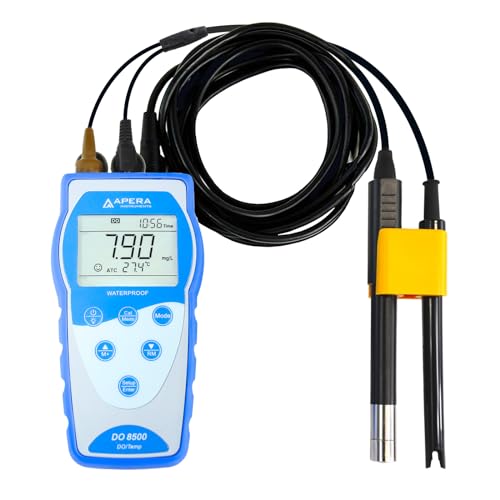
Apera DO8500
$1,004.28 at Amazon
Check it on AmazonPrice as of Nov 6, 2026, 5:30 AM EST · low stock then
Details ↓
Four handheld DO meters compared from the makers’ specs, and what your reading means at your water temperature.

As an Amazon Associate I earn from qualifying purchases.
Get the Apera DO8500: optical probe, auto salinity and a data log. Spot checks only: the Apera DO850. A lower-cost membrane meter: Extech DO210.
All four are handheld meters sold as complete kits with a probe, for ponds, tanks, wastewater and field checks. All were new and in stock on Amazon on Oct 23, 2026, and each scores 7.0 or higher.


Product prices and availability are accurate as of the date/time indicated and are subject to change. Any price and availability information displayed on Amazon.com at the time of purchase will apply to the purchase of this product.
Recall: CPSC recall 26-005 covers Almpal dissolved oxygen test kits sold on Amazon from May to August 2025. Their sulfuric acid bottle isn’t child-resistant, a poisoning risk to young children. Stop using one and follow the recall notice. None of the meters on this page is part of it.
Five checks from each maker’s own specs, equal weight. Rules and inputs are in the method section.
The checks are what decide whether a DO reading can be trusted: the sensor type, the stated accuracy at a normal 8 mg/L reading, which corrections the meter makes for you, the warranty, and how much the probe needs between uses.
The two Apera meters lead on almost every check. The Sper is optical too, but its stated accuracy is looser and its sensing tip can’t be replaced. The Extech is the only membrane probe that made the cut.
What each maker’s specs say, what they mean in the water, and where each lost points.
Apera Instruments DO8500 portable optical dissolved oxygen meter kit (AI485), 10 ft probe
Prices and availability are accurate as of the time shown and may change.
You check the same pond, tank or treatment basin over weeks and want the readings saved with a time stamp, in salt or fresh water.
You only take a reading now and then in fresh water; the DO850 is the same probe without the logger and salinity probe.
The DO8500 is the meter I’d hand to anyone who has to keep records, and I’ve used it. It pairs Apera’s luminescent optical probe with a data logger and an automatic salinity probe.
Apera lists a range of 0 to 20.00 mg/L and 0 to 200% saturation. Accuracy is ±2% of reading or ±0.2 mg/L, whichever is greater, so ±0.2 mg/L at an 8 mg/L reading.
Optical means no membrane and no electrolyte. Apera says the probe doesn’t consume oxygen, so there’s no limit on water flow speed, and readings settle in 2 to 3 minutes with no polarization wait.
It corrects for temperature automatically from 0 to 50°C and for air pressure from 60 to 120 kPa. The DO8500 adds automatic salinity correction through its second probe, where the DO850 needs it entered by hand.
It stores 500 groups of data with time and date and sends them out over USB. It runs on three AA batteries, rated over 200 hours, and has a foldable stand for bench use.
Apera says you don’t need to calibrate before every use. Calibration is two points, zero oxygen and saturated air, and the kit’s calibration cap lets the probe be calibrated and stored in saturated air.
Warranty, per Apera: 3 years on the meter, 2 years on the DO803 optical probe, and 1 year on the DO8032 sensor cap.
In the box: the meter, the 10-foot optical probe, the salinity probe, a calibration cap and a rugged carrying case. Apera gives the probe cap’s diameter as about 1.3 inches (3.3 cm), so check that it fits your sample bottle or sampling port.
My call: download the log after each sampling trip and clear it. Five hundred readings is a season of weekly checks on one pond, not on ten.
Apera Instruments DO850 portable optical dissolved oxygen meter kit (AI480), 10 ft probe
Prices and availability are accurate as of the time shown and may change.
You want optical readings for spot checks in fresh water and will write the number down yourself.
You need a saved record with time stamps, or you test salt water often; the DO8500 logs and reads salinity itself.
The DO850 is the plain version of the DO8500, and I’ve used it. It has the same DO803 optical probe and the same accuracy, without the logger, clock or salinity probe.
Apera’s spec sheet lists 0 to 20.00 mg/L and 0 to 200.0%, at 0.01 mg/L and 0.1% resolution. Accuracy is ±2% of reading or ±0.2 mg/L, whichever is greater, and response is 30 seconds or less to 90% at 25°C.
Temperature correction is automatic from 0 to 50°C and pressure correction is automatic from 60 to 120 kPa. Salinity is entered by hand from 0 to 45 ppt, which is the one check it didn’t max out.
The kit includes the meter, the 10-foot optical probe, a calibration and storage cap and a hard case. Apera also sells it with a 33-foot cable for deeper water.
The meter weighs 313 g, runs on three AA batteries and is rated IP57. It has stable-reading indication and an auto-lock mode that holds the number once it settles.
Apera rates the luminescent cap for over 8,000 hours and says its coating isn’t affected by light or chemicals. The cap is a replaceable part, DO8032.
Warranty is the same as the DO8500: 3 years on the meter, 2 on the probe and 1 on the cap. The Amazon listing says IP67, but Apera’s own spec says IP57, so treat the meter as splash and dust proof, not something to leave underwater.
Apera says the DO850 needs no warm-up time and isn’t flow dependent, which suits still water like a trough, tank or pond edge.
My call: if you test brackish or salt water, look up the salinity first or buy the DO8500. A hand-entered salinity that’s wrong shifts every mg/L reading.
Portable optical dissolved oxygen meter
Prices and availability are accurate as of the time shown and may change.
You test wastewater, brewing water or other samples with acid gases and want an optical probe that comes factory calibrated.
You need the tightest accuracy or plan to keep the probe for years; the Apera’s sensor cap can be swapped, the Sper’s tip can’t.
Sper Scientific’s 860067 is an optical meter I’d use where the water smells, and I’ve used it. Sper lists aquaculture, environmental monitoring, wastewater treatment and brewing as its uses.
Sper’s spec table gives 0 to 20.0 mg/L and 0 to 200% saturation. Accuracy is ±0.3 mg/L below 5 mg/L and ±0.4 mg/L from 5 to 20 mg/L, at 0.1 mg/L resolution.
Sper says it stays accurate in the low oxygen range and isn’t affected by acid gases, needs no polarization time, and has no minimum inflow, so it reads in still water.
Temperature correction is automatic from 0 to 40°C. Salinity, 0 to 55 ppt, and barometric pressure, 50 to 115 kPa, are entered by hand. Calibration is two points, 0% and 100%.
The probe is factory calibrated. Sper’s manual says not to calibrate unless it reads wrong or after chemical cleaning, and to soak a dried-out tip in distilled water for 12 hours.
Where it lost points: the looser accuracy above 5 mg/L, manual pressure and salinity entry, no warranty term stated for this model on its page or in its manual, and a sensing tip Sper says isn’t replaceable. Sper rates sensor life at over a year with good care.
Sper’s manual lists an IP67 meter, a 3-meter cable and six AAA batteries, rated for about 10 hours of operation.
Sper’s manual lists what the optical method buys you: lower running costs with no electrolyte changes, longer calibration intervals from low drift, no polarization voltage, no oxygen consumption and no minimum inflow. The meter measures 169 by 78.3 by 43.4 mm and weighs about 400 g.
My call: keep spare AAA batteries in the case. Ten hours goes quickly on a long sampling day.
Portable dissolved oxygen meter with polarographic probe
Prices and availability are accurate as of the time shown and may change.
You want a compact membrane meter with spare parts in the box, or you also check oxygen percent in air.
You test still water or don’t want to change membranes; the optical meters need no flow and no electrolyte.
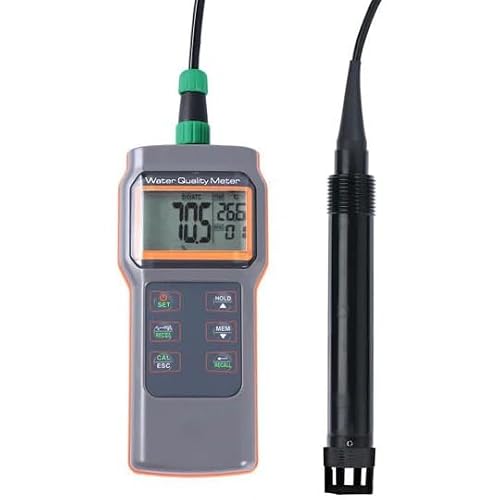
Extech’s DO210 is the compact membrane meter of the four, and I’ve used it. Extech says it measures dissolved oxygen in water or percent oxygen in air, plus temperature.
Extech’s page lists 0 to 20.0 mg/L at ±0.4 mg/L, 0 to 100.0% saturation at ±0.7%, and 32 to 122°F temperature at ±1.5°F. That ±0.7% is the tightest percent-saturation figure any of the four makers lists.
The probe is polarographic, with the temperature sensor built in for automatic correction. The meter has adjustable altitude and salinity correction, plus min, max and data hold.
The kit comes with the probe, two spare membranes, electrolyte, a 9-volt battery and a soft case. The meter measures 5.3 by 2.4 by 1.3 inches and weighs 15.7 oz with the probe and battery.
Extech lists a 2-year warranty. One quirk: Extech’s own page gives the probe cable as 39 inches (1 m) in one line and 13 feet (4 m) in another, and the listing says 13 feet, so check before you count on the reach.
Where it lost points: a membrane probe scores 6 against optical, ±0.4 mg/L scores 7, and changing membranes and electrolyte scores 6 on upkeep.
Membrane probes work differently from optical ones. Milwaukee’s manual for its own membrane meter says the probe must be polarized first and needs at least 0.3 m per second of water movement for an accurate reading.
Extech lists the probe at 1.1 inches across and 7.5 inches long, small enough for a sample cup. The meter runs on one 9-volt battery and carries a CE mark.
My call: stir the probe gently while you read. If the number climbs when you move it faster, the water around the membrane wasn’t moving enough.
From the makers’ specs. Scroll sideways on a phone.
| Pick | Photo | Spec score | Sensor | Accuracy at 8 mg/L | Salinity | Pressure | Data log | Warranty | Buy |
|---|---|---|---|---|---|---|---|---|---|
| Apera DO8500 | | 10.0 | Optical | ±0.2 mg/L | Automatic | Automatic | 500 readings, USB | 3 years | Check it on Amazon |
| Apera DO850 | | 9.8 | Optical | ±0.2 mg/L | Manual, 0–45 ppt | Automatic | None | 3 years | Check it on Amazon |
| Sper Scientific 860067 | | 7.2 | Optical | ±0.4 mg/L | Manual, 0–55 ppt | Manual | None | Not stated | Check it on Amazon |
| Extech DO210 | | 7.0 | Polarographic | ±0.4 mg/L | Adjustable | Altitude setting | Min/max/hold | 2 years | Check it on Amazon |
All four read temperature and correct for it automatically. Green marks a strength and amber a gap.
Enter the water temperature, elevation and salinity. Add your reading to see its percent of saturation.
A DO number means little without the temperature next to it. USGS says cold water holds more dissolved oxygen than warm water, so 7 mg/L can be healthy in summer and poor in winter. Percent saturation takes the temperature out of it.
My call: write the temperature down with every reading. All four meters show it on screen, and it’s the first thing anyone will ask when the fish are gasping.
100% saturation in mg/L. Our arithmetic from the same equations USGS uses.
| Water temp | Sea level | 2,500 ft | 5,000 ft | Seawater, sea level |
|---|---|---|---|---|
| 32°F (0°C) | 14.6 | 13.3 | 12.2 | 11.4 |
| 41°F (5°C) | 12.8 | 11.6 | 10.6 | 10.1 |
| 50°F (10°C) | 11.3 | 10.3 | 9.4 | 9.0 |
| 59°F (15°C) | 10.1 | 9.2 | 8.4 | 8.1 |
| 68°F (20°C) | 9.1 | 8.3 | 7.5 | 7.4 |
| 77°F (25°C) | 8.3 | 7.5 | 6.8 | 6.8 |
| 86°F (30°C) | 7.6 | 6.9 | 6.2 | 6.2 |
| 95°F (35°C) | 6.9 | 6.3 | 5.7 | 5.8 |
Seawater is 35 ppt salinity. The sea-level fresh water column matches the table in Milwaukee Instruments’ DO manual to within 0.1 mg/L. Elevation matters as much as salt: at 5,000 feet, saturated water holds about 17% less oxygen than at sea level.
EPA’s general guide for fish. Each species has its own range.
| Reading | What EPA says |
|---|---|
| 5 mg/L and up | Above the level EPA calls stressful for fish |
| 3 to 5 mg/L | Stressful for fish |
| 1 to 3 mg/L | Too low to support fish |
| Below 1 mg/L | Hypoxic and usually devoid of life |
Definitions vary by agency. USGS’s Water Science School page cites a 2 mg/L line for hypoxic water in the Gulf, where EPA’s survey guide uses 1 mg/L. Both agree the level swings by season and through the day.
My call: in a pond, the lowest reading comes around dawn, after a night with no photosynthesis. One afternoon reading can look fine and miss the problem.
The biggest difference between DO meters is the probe. From Apera’s, Sper’s, Extech’s and Milwaukee’s documents.
| Optical (luminescent) | Membrane (polarographic) | |
|---|---|---|
| Warm-up | None | Polarize first; Milwaukee says wait at least 15 min before calibrating |
| Water movement | No minimum flow (Apera, Sper) | At least 0.3 m/s (Milwaukee) |
| Uses up oxygen | No (Apera) | Yes, at the membrane |
| Consumables | Sensor cap (Apera) or whole probe (Sper) | Membranes and electrolyte |
| Picks here | Apera DO8500, DO850; Sper 860067 | Extech DO210 |
Galvanic probes are a third type, also with a membrane and electrolyte. YSI’s Pro20 meter takes either a galvanic or polarographic probe, and Milwaukee sells a galvanic probe, MA860. None of the complete kits we scored uses one.
My call: for still water like a tank, trough or pond edge, optical is the easier tool. A membrane probe can read low in still water simply because it’s using up the oxygen next to it.
From each maker’s own instructions.
| Meter | Points | How often | Maker note |
|---|---|---|---|
| Apera DO8500 / DO850 | Zero oxygen and saturated air | Not before every use | Calibration cap holds the probe in saturated air |
| Sper 860067 | 0% and 100% | Only if it reads wrong or after chemical cleaning | Factory calibrated; saturated-air check after cleaning |
| Extech DO210 | Not given on Extech’s page | Not given | Includes spare membranes and electrolyte |
| Milwaukee MW600 PRO (left out) | Zero and slope | Slope weekly | Zero solution MA9070, 2–3 min; slope in saturated air |
Saturated-air calibration means holding the probe in air that’s at 100% humidity, for example over a little water inside a cap or bottle. My call: wipe drops off the sensing face first.
What wears out, and what the makers say about it.
| Meter | Part that wears | Life or warranty | Care |
|---|---|---|---|
| Apera DO8500 / DO850 | DO8032 sensor cap | Over 8,000 hours; 1-year cap warranty | Store in the calibration cap |
| Sper 860067 | Sensing tip (not replaceable) | Over 1 year with good care | Don’t touch or twist the black tip; soak 12 h if dry |
| Extech DO210 | Membrane and electrolyte | 2 spare membranes in the kit | Refill electrolyte when changing a membrane |
| Milwaukee MW600 PRO (left out) | Membrane cap | Probe warranty 6 months | MA841 spare membranes, MA9071 electrolyte |
Sper’s manual warns that a biofilm on the sensing surface causes errors, and Milwaukee says a wrinkled or torn membrane must be replaced. My call: rinse the probe in clean water after every use, especially after wastewater or a green pond.
A DO meter calculates mg/L. These three inputs change the answer.
| Meter | Temperature | Air pressure | Salinity |
|---|---|---|---|
| Apera DO8500 | Auto, 0–50°C | Auto, 60–120 kPa | Auto, second probe |
| Apera DO850 | Auto, 0–50°C | Auto, 60–120 kPa | Manual, 0–45 ppt |
| Sper 860067 | Auto, 0–40°C | Manual, 50–115 kPa | Manual, 0–55 ppt |
| Extech DO210 | Auto, in the probe | Altitude setting, 0–3,900 m (listing) | Adjustable (listing: 0–39) |
Milwaukee’s manual spells out why this matters: its readings are referenced to sea level, and at higher elevations the real oxygen concentration is lower than the display shows. A meter that reads pressure itself, like both Aperas, saves you that correction.
From each maker’s specs.
| Meter | Batteries | Stated run time |
|---|---|---|
| Apera DO8500 | 3 × AA, or USB | Over 200 hours |
| Apera DO850 | 3 × AA | Over 200 hours |
| Sper 860067 | 6 × AAA | About 10 hours of operation |
| Extech DO210 | 1 × 9 V | Not stated |
Uses the makers list, with my notes on what to watch.
Read at dawn and late afternoon to catch the daily low and high.
Sper lists wastewater; an optical probe avoids membrane fouling.
Sper lists brewing and says acid gases don’t affect its probe.
A long cable reaches past the bank; Apera sells a 33 ft version.
For drinking water quality, a DO meter isn’t the usual first test. Start with a water test kit or a TDS meter, and check flow with a water flow meter if you’re sizing aeration or treatment.
These came up on Amazon or in Google’s results.
| Meter | What we found | Why it’s out |
|---|---|---|
| Milwaukee MW600 | 6 left | 6.3: membrane probe, temperature-only correction (0–30°C), spare membranes sold separately |
| YSI Pro20 (6050020) | In stock | Meter only; YSI sells the cable and probe separately |
| Extech 407510 | 6 left | Listing text describes a strobe tachometer, not a DO meter |
| Milwaukee AQ600a | In stock | Listing gives no DO specs; maker sheet not found |
| Unbranded optical testers | Many listings | Little-known brands with no maker documents to check |
| Almpal chemical DO test kits | Recalled | CPSC recall 26-005 |
| Question | If yes | If no |
|---|---|---|
| Need saved readings with time stamps? | Apera DO8500 | Keep going |
| Testing salt or brackish water often? | Apera DO8500 | Keep going |
| Testing wastewater or brewing samples? | Sper Scientific 860067 | Keep going |
| Happy to change membranes? | Extech DO210 | Apera DO850 |
A handheld meter with a probe that reads how much oxygen is dissolved in water, in mg/L and percent saturation, plus temperature.
Yes: a DO meter with an optical or membrane probe, or a chemical test kit. Meters give a number in a minute or two.
The oxygen gas held in the water that fish and other aquatic life breathe. EPA calls it a direct indicator of water’s ability to support aquatic life.
EPA: below 5 mg/L is stressful for fish, below 3 too low to support fish, below 1 hypoxic.
Optical needs no warm-up, flow or electrolyte. Membrane probes cost less to start but need polarizing, water movement and new membranes.
Apera says not before every use; Sper only if it reads wrong or after chemical cleaning; Milwaukee suggests a weekly slope calibration.
A membrane probe uses up oxygen at its surface. Milwaukee calls for at least 0.3 m/s of water movement.
The reading as a share of what water could hold at that temperature, elevation and salinity. Use the calculator above.
Yes. Apera and Sper meters read to 200%. USGS names photosynthesis as the main process behind oxygen’s daily and seasonal cycle.
Apera rates its sensor cap over 8,000 hours; Sper rates its sensor over a year with good care.
Yes. USGS says cold water holds more dissolved oxygen than warm water.
Yes. Less air pressure means less oxygen in saturated water: about 17% less at 5,000 ft than at sea level.
In salt or brackish water, yes. Seawater holds about 19% less oxygen than fresh water at 68°F.
My call: around dawn, after a night with no photosynthesis.
Check recalls first: CPSC recall 26-005 covers Almpal kits whose sulfuric acid bottle isn’t child-resistant.
All four picks include the probe. Apera adds a calibration cap and case; Extech adds spare membranes and electrolyte.
I’m Isaac Daniels, a licensed journeyman plumber in Georgia (license #JP507711), and I’ve used all four picks. Specs come from Apera’s, Sper Scientific’s and Extech’s own documents, read Oct 23, 2026. Saturation uses USGS’s equations and fish levels come from EPA. My own advice is labeled as my call.
Each check scores 0 to 10 and counts one fifth. It’s our score from maker documents, not a customer rating.
| Check (weight) | How it’s scored |
|---|---|
| Sensor type (⅕) | 10 for an optical probe; 6 for a membrane probe |
| Accuracy (⅕) | At an 8 mg/L reading: 10 for ±0.2 mg/L, 8.5 for ±0.3, 7 for ±0.4 |
| Compensation (⅕) | Automatic temperature 4; pressure automatic 3 or manual 2; salinity automatic 3 or manual 2 |
| Warranty (⅕) | On the meter: 10 for 3 years, 8 for 2, 6 for 1, 4 when not stated |
| Probe upkeep (⅕) | 10 for a replaceable optical cap with a stated life; 7 for an optical tip that isn’t replaceable; 6 for membranes with spares in the kit; 5 for membranes sold separately |
| Total | Average of the checks, to one decimal |
| Pick | Sensor | Accuracy | Compensation | Warranty | Upkeep | Score |
|---|---|---|---|---|---|---|
| Apera DO8500 | 10 | 10 | 10 | 10 (3 yr) | 10 | 10.0 |
| Apera DO850 | 10 | 10 | 9 | 10 (3 yr) | 10 | 9.8 |
| Sper 860067 | 10 | 7 | 8 | 4 | 7 | 7.2 |
| Extech DO210 | 6 | 7 | 8 | 8 (2 yr) | 6 | 7.0 |