
GE GG40T08BXR (gas)
See today’s price on Amazon
Check it on AmazonDetails ↓
What each costs to run, and which tank to buy.
As an Amazon Associate I earn from qualifying purchases.
Gas at the heater? Stay gas: the GE GG40T08BXR (9.5) costs about $256 a year to run against $604 for an electric tank. No gas line? Get the GE GE50T10BLM (10.0).
Each one is a 40- or 50-gallon home tank from GE or Rheem, new and in stock on Amazon as of Oct 22, 2026. Each scores 7.0 or higher.


Product prices and availability are accurate as of the date/time indicated and are subject to change. Any price and availability information displayed on Amazon.com at the time of purchase will apply to the purchase of this product.
Four checks from GE’s and Rheem’s spec sheets, manuals and warranties, equal weight. Every input is in the method section.
The score doesn’t pick a fuel for you. Gas or electric is decided by what’s already at your heater and what you pay for each, and the calculator below handles that. The score ranks tanks within that choice: how much hot water each delivers in the first hour, and how long the maker covers the tank and parts.
GE’s tanks carry longer warranties than Rheem’s Professional Classic line: 8 years on the gas model and 10 on the electric, against Rheem’s 6. That gap, plus the smaller Rheem electric tank’s 55-gallon first hour, is where the points went.
What GE and Rheem publish for each one, the house it suits and where it lost points.
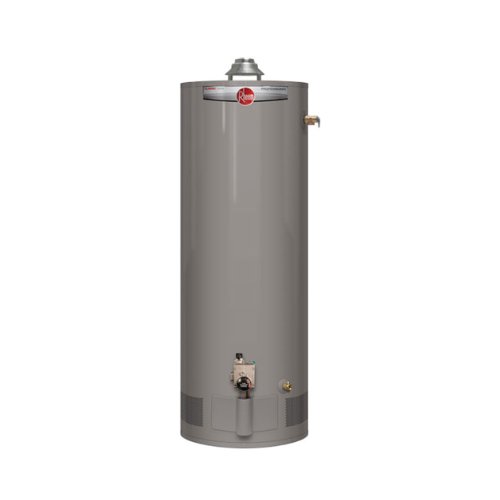
GE RealMAX Choice 40-gallon tall atmospheric natural gas water heater
Prices and availability are accurate as of the time shown and may change.
You have a 40-gallon gas tank now, a working vent and gas line, and a family of two to four.
There’s no gas line at the heater, or the tank sits where a flue can’t run. Go electric instead.
The GG40T08BXR is GE’s 40-gallon tall atmospheric gas tank, and I’ve used it. GE’s spec table lists an 83-gallon first-hour rating, a 40,000 BTU/h natural gas burner and 42 gallons an hour of recovery at a 90°F rise. It scored 9.5.
That first hour is the number to look at. It’s how much hot water the tank delivers in an hour starting full, by DOE’s test. 83 gallons from a 40-gallon tank beats both electric picks, including the 50-gallon GE, by a few gallons.
It lost points on warranty only. GE covers the tank and parts for 8 years, with labor in year 1. The 08 in the model number is the warranty term; 8 years earns an 8 on our scale.
GE rates its UEF at 0.64. That’s the share of the gas energy that ends up in your hot water over DOE’s test day, standby losses included. At EIA’s 2025 average gas price, that works out near $256 a year for a typical family, in the calculator below.
It’s a Category I, natural draft heater, GE’s manual says, so it takes combustion air from the room or from a duct to outside and vents through a 3 or 4 inch flue. The gas connection is 1/2 inch and water connections are 3/4 inch. A like-for-like swap reuses all of that.
GE’s SmartShield system monitors the air around the heater and shuts it off if it detects abnormal temperatures. GE’s manual also lists a flammable-vapor (FVIR) system that shuts the heater down if vapors like gasoline reach the burner. A status light reports what the gas control sees, which helps when the pilot won’t stay lit.
The tank stands 58½ inches to the top and 20 inches across, about 61⅞ to the top of the vent hood. Measure your closet before you order.
My call: if there’s a gas tank in the closet now, this is the swap I’d make. Same fuel, same vent, and more first-hour water than either electric pick.
GE smart 50-gallon tall electric water heater with built-in Wi-Fi
Prices and availability are accurate as of the time shown and may change.
There’s no gas at the heater, you have or can add a 240-volt, 30-amp circuit, and you want first-hour delivery close to a gas tank.
You pay a lot for power and have gas available. The yearly cost gap is in the calculator.
The GE50T10BLM is GE’s smart 50-gallon tall electric tank, and I’ve used it. GE’s spec table lists a 78-gallon first-hour rating, two 5,500-watt elements and a UEF of 0.93. It scored 10.0, the only perfect score here.
78 gallons in the first hour is the reason it’s here. The usual knock on electric is slow recovery, and it’s true of the elements. But a full 50-gallon tank with 5,500-watt elements gets an electric house within a few gallons of the 40-gallon gas pick in that first hour.
GE covers the tank and parts for 10 years, labor in year 1. The 10 in the model number is that term. It’s the longest warranty of the four.
It needs a dedicated circuit. GE’s spec table says 240 volts, 60 Hz, 30 amps minimum, direct wired, copper conductors. Most homes with an electric tank already have that; adding one where there was a gas tank is electrician work.
Running cost is the trade. At 0.93, nearly all the power becomes hot water, but electricity costs more per unit of heat than gas in most of the country. At EIA’s 2025 averages, the calculator puts it near $604 a year against about $256 for the GE gas tank.
The Wi-Fi runs through GE’s SmartHQ app: temperature, vacation schedules and alerts. GE also lists a sensing anode rod and diagnostic feedback. The temperature range is 100 to 140°F, set at 120 from the factory.
GE’s table lists the drain valve as plastic, even though its feature list calls the drain valve rust-proof. If you flush the tank every year, handle that valve gently.
My call: in an all-electric house with a 30-amp circuit at the heater, this is the tank I’d put in. It’s 22 inches across, so check the closet width first.
Rheem Professional Classic PROG50-40N RH62 50-gallon tall atmospheric natural gas water heater
Prices and availability are accurate as of the time shown and may change.
You have a 50-gallon gas tank now, a big family or a large tub, and the vent and gas line are in place.
Your tank is a 40 in a tight closet. The GE 40 delivers more in the first hour in a narrower tank.
The PROG50-40N RH62 is Rheem’s 50-gallon tall atmospheric gas tank from the Professional Classic line, and I’ve used it. Rheem’s sheet lists a 76-gallon first-hour rating, a 40,000 BTU/h burner, 40.4 gallons an hour of recovery at a 90°F rise and a UEF of 0.65. It scored 9.0.
It lost points on warranty. Rheem covers the tank and parts for 6 years, which earns a 6. Rheem’s sheet says its ProtectionPlus plan turns the tank coverage into 10 years; that’s an add-on, so it isn’t scored.
Rheem’s Guardian System is the flammable-vapor shut-off every gas tank needs now: Rheem says it disables the heater if flammable vapors build up, with no filter to clean. The sheet also lists a low-NOx burner meeting 40 ng/J.
On paper it trails the GE 40 on first hour, 76 gallons against 83, even though it holds more water. Both burners are 40,000 BTU/h. What you get with the bigger tank is more stored water for a long run of back-to-back showers before recovery matters.
The tank is 62½ inches tall and 21½ inches across, and Rheem lists a 165-pound shipping weight. Rheem’s sheet gives a 3 or 4 inch vent and 3/4 inch water connections.
Rheem’s extras are practical ones: an enhanced-flow brass drain valve, the EverKleen system against sediment, Rheemglas tank lining and a pilot Rheem says lights with no matches required.
Rheem certifies every model in the line to 5,999 feet above sea level and some to 10,000. If you live higher than 6,000 feet, confirm the model with Rheem before you order.
My call: where a 50-gallon gas tank is coming out, this is a straight swap. If the warranty matters more to you than the brand, the GE family also comes in a 50.
Rheem Professional Classic PROE40 T2 RH95 40-gallon tall electric water heater
Prices and availability are accurate as of the time shown and may change.
You’re replacing a 40-gallon electric tank on its existing circuit, in a household of two or three, and closet width is tight.
You have a big family or a soaking tub. The GE 50 gives 78 gallons in the first hour.
The PROE40 T2 RH95 is Rheem’s 40-gallon tall electric tank from the Professional Classic line, and I’ve used it. Rheem’s sheet lists a 55-gallon first-hour rating, 21 gallons an hour of recovery at a 90°F rise and a UEF of 0.93. It scored 8.3.
It lost points on two checks. 55 gallons in the first hour earns a 7.3 against our 75-gallon scale top, and Rheem’s 6-year tank and parts warranty earns a 6. Both are honest numbers for a standard 40-gallon electric tank.
Its elements are the standard size. Rheem ships it with two 4,500-watt elements wired non-simultaneous, so only one heats at a time. 4,500 watts at 240 volts is 18.75 amps by the math. That’s the load most existing electric water heater circuits were built for.
That’s also why it recovers at 21 gallons an hour against about 40 for the gas picks. One 4,500-watt element puts in about 15,400 BTU an hour; the gas burners put in 40,000, and even at their lower efficiency they reheat faster.
The tank is 19¼ inches across and 60¾ inches tall, the narrowest and lightest pick at 109 pounds shipping. Water connections are 3/4 inch, and Rheem includes the relief valve.
Rheem lists resistored stainless steel elements, which it says prolong anode and tank life, plus an over-temperature protector that cuts power in excess heat, the EverKleen sediment diffuser and a brass drain valve.
Rheem’s sheet also says the models meet HUD standards for manufactured and modular homes. Check your home’s own rules before you order.
My call: for a two-person house replacing a 40-gallon electric tank, it’s a simple swap on the circuit you have. For bigger families, step up to the GE 50 and check the circuit is 30 amps.
The makers’ numbers for all four, grouped by fuel. Scroll sideways on a phone.
| Pick | Spec score | Photo | Fuel | First hour | Recovery, 90°F rise | UEF | Width | Warranty | Short pros / cons | Buy |
|---|---|---|---|---|---|---|---|---|---|---|
| GE GG40T08BXR | 9.5 | | Natural gas | 83 gal | 42 gal/h | 0.64 | 20 in. | 8 yr | Most first-hour water / Needs a vent | Check it on Amazon |
| Rheem PROG50-40N | 9.0 | | Natural gas | 76 gal | 40.4 gal/h | 0.65 | 21½ in. | 6 yr | 50 gal stored / 6-year warranty | Check it on Amazon |
| GE GE50T10BLM | 10.0 | | Electric | 78 gal | Not published | 0.93 | 22 in. | 10 yr | Longest warranty / 30 A circuit | Check it on Amazon |
| Rheem PROE40 T2 | 8.3 | | Electric | 55 gal | 21 gal/h | 0.93 | 19¼ in. | 6 yr | Narrowest / Least first-hour water | Check it on Amazon |
From GE’s RealMAX atmospheric gas spec sheet, GE’s GE50T10BLM spec sheet, and Rheem’s Professional Classic gas (Rev. 7, 05/24) and electric (Rev. 16, 05/24) sheets, read Oct 22, 2026. GE’s GG40T08BXR product sheet says 84 gallons first hour; its spec table says 83, used here.
| What you compare | Gas tank | Electric tank | Ahead |
|---|---|---|---|
| Yearly energy cost, 55 gal a day, 2025 US average prices | About $256–252 | About $604 | Gas |
| Recovery at a 90°F rise | 40–42 gal/h | 21 gal/h (4,500 W) | Gas |
| First hour, 40-gallon tanks | 83 gal (GE) | 55 gal (Rheem) | Gas |
| First hour, 50-gallon tanks | 76 gal (Rheem) | 78 gal (GE) | Even |
| Share of energy that reaches the water (UEF) | 0.64–0.65 | 0.93 | Electric |
| Venting and combustion air | Flue to outside, room air | None | Electric |
| Works in a power outage | Standing pilot models with a thermopile, yes | No | Gas |
| Warranty on these picks | 6–8 yr | 6–10 yr | Even |
Costs use DOE’s 55-gallon test day and EIA 2025 averages: $1.48 a therm, 17.3¢ a kWh. Outage line: GE’s manual shows the GG40’s gas control runs on a thermopile heated by its standing pilot. Power-vent gas models need power; check your model’s manual.
Pick how much hot water your house uses and type the rates from your gas and power bills. The calculator does the rest.
Here’s how the numbers come out. DOE rates a tank like these on a 55-gallon day, heating water from 58°F to 125°F. That’s about 30,400 BTU of heat in the water each day. Divide by the tank’s UEF and you have the energy you pay for, standby losses included.
On a gas tank at 0.64, that’s about 173 therms a year. On an electric tank at 0.93, it’s about 3,490 kWh. At EIA’s 2025 averages of $1.48 a therm and 17.3¢ a kWh, gas runs about $256 and electric about $604.
Your rates set the answer. Georgia’s residential power averaged 16.27¢ a kWh in July 2026 by EIA’s count, while New England’s ran 28¢. My call: put in your own bill numbers before you decide anything on cost.
These are the two numbers behind “gas heats faster.” One of them favors gas every time; the other can come out even.
Recovery is how many gallons the heater can warm by 90°F in an hour once the tank is drained. The gas picks do 40 to 42 gallons; Rheem’s 4,500-watt electric does 21. A 40,000 BTU burner simply puts more heat into the water each hour than a 4,500-watt element.
The first-hour rating adds the stored water to that. A full 50-gallon electric tank with 5,500-watt elements, like the GE, reaches 78 gallons, ahead of the 50-gallon Rheem gas tank. My call: for a busy morning, size the tank by its first-hour rating, not its gallons.
Our water heater size calculator turns your morning into a first-hour number.
A same-fuel swap reuses what’s already there. A fuel change adds work on the other side of the wall.
| Switching to | What has to be there | Who does it |
|---|---|---|
| Electric | A dedicated 240 V circuit; GE asks for 30 A minimum and copper conductors | Electrician; permit in most places |
| Electric | The old gas line capped and the flue sealed or reused for another appliance | Plumber or gas fitter |
| Gas | A gas line sized for the burner, with a shutoff and sediment trap | Plumber or gas fitter; permit |
| Gas | A vent to outside, 3 or 4 in. on these picks, with the right rise and clearances | Plumber or HVAC installer |
| Gas | Enough combustion air in the room, or a duct from outside | Per the maker’s manual and local code |
From GE’s GE50T10BLM spec sheet, GE’s atmospheric gas owner’s manual (49-6000245 Rev. 3) and Rheem’s Professional Classic gas sheet, read Oct 22, 2026. Permits and who may do the work are set by your state and city.
Gas to electric is the easier direction in most houses. The circuit is the work: the panel needs room for a 240-volt breaker and the run to the heater. GE’s manual for its gas tank, by contrast, spends pages on vent pipe, draft hoods and air supply, because a gas tank pulls room air to burn and sends exhaust up the flue.
Electric to gas means running a gas line and a flue where there were none. My call: get a quote for both sides before you commit, because the switch can cost more than years of running-cost savings. Our water heater replacement cost guide covers the swap prices.
Both need a relief valve and a pan where a leak would do damage. Gas adds combustion and venting.
A blocked or loose flue spills exhaust into the house. Put a CO alarm near the heater and the bedrooms.
Keep gasoline, paint thinner and the like away. GE’s and Rheem’s vapor shut-off systems are a backstop, not permission.
GE’s manual prints the burn chart: at 120°F it takes more than 5 minutes; at 140°F, under 5 seconds.
Turn the breaker off before you open an element cover. Never power an empty tank.
GE’s gas manual warns that the heater must be vented to outdoors to avoid carbon monoxide, and its burn table, credited to the Shriners Burn Institute, shows why the factory setting is 120°F. Both GE tanks ship set at 120°F.
Every tank here needs a temperature and pressure relief valve. Rheem’s sheets say theirs comes included, and GE’s sheets show one on each tank. Our relief valve guide covers the discharge pipe, and the expansion tank guide covers closed systems.
Look at the top and the bottom of the tank. You’ll know in a minute.
| You see | Gas tank | Electric tank |
|---|---|---|
| On top | A metal vent pipe rising from a draft hood | Only the water pipes and an electrical cable or conduit |
| Near the bottom | A gas control knob, a pipe with a shutoff, a burner door | Two square covers on the front (elements), no burner |
| The rating label | Input in BTU/h and the gas type | Volts and watts per element |
| Model number (these makers) | GE GG…, Rheem PROG… | GE GE…, Rheem PROE… |
The rating label is the sure answer. It’s on the front of the tank, and GE’s gas manual asks you to have the model and serial from it ready when you call for service. Rheem’s and GE’s model prefixes make it easy: G for gas, E for electric.
Once you know what you have, the no hot water guide splits the checks by fuel.
A heat pump tank is electric, but it moves heat from the room air instead of making it, so it isn’t a fair card next to these four.
| Electric tank (these picks) | Heat pump tank (Rinnai REHP50 listing) | |
|---|---|---|
| UEF | 0.93 | 3.75 |
| Yearly cost, 55 gal a day, 2025 averages | About $604 | About $150 |
| Circuit | 240 V, 30 A (GE) | 240 V, 30 A (listing) |
| Room it needs | Any | Room air to pull heat from; it cools the space |
Heat pump figures from Rinnai’s REHP50 Amazon listing text read through Amazon’s product data, Oct 22, 2026. Not a pick: it’s a different kind of heater.
In the calculator, the heat pump line shows why a heat pump comes up in every gas-versus-electric thread. At a UEF of 3.75, it lands below the gas tanks on yearly cost. It needs a room that can give up heat, and it takes more up-front money and floor space.
My call: in an all-electric house with a garage or big basement, price a heat pump before a plain electric tank. Our tank vs tankless guide and electric vs gas tankless guide cover the other choices.
These came up in Amazon searches on Oct 22, 2026. Here’s what kept each off the list.
| Tank | What we found | Why it’s out |
|---|---|---|
| Rheem “GIDDS-2487244” 40-gal gas | A distributor code in the title, not a Rheem model | Model can’t be matched to Rheem’s sheet |
| Rheem PROE50 M2 RH95 | 50-gallon electric sold by Amazon.com | Ships in 1 to 2 months |
| GE 50-gallon short electric | Sold by Amazon.com | Temporarily out of stock |
| GE GE50S10BMM | GE’s flexible-capacity 50-gallon electric | One left; same family as the GE pick |
| A. O. Smith GCR-40LP | 40-gallon propane tank | Propane only; two left |
| Rinnai REHP50 | 50-gallon heat pump tank | A different kind of heater; in the calculator |
| Question | If yes | If no |
|---|---|---|
| Is there a gas line and a vent at the heater now? | Stay gas: GE GG40T08BXR or Rheem PROG50-40N | Next question |
| Is there a 240 V circuit at the heater? | Electric: GE GE50T10BLM or Rheem PROE40 T2 | Plan for an electrician or a gas line |
| Four or more people, or a big tub? | A 50-gallon tank or the GE 40 gas (83 gal first hour) | A 40-gallon tank |
| Is the closet under 21 in. wide? | Rheem PROE40 T2 (19¼ in.) or GE gas 40 (20 in.) | Any pick |
My call for most homes: keep the fuel you have. Switching only pays when the yearly gap in the calculator is big and the switch itself is cheap. If you do go electric in a house with room for it, look at a heat pump before a plain tank.
A same-fuel swap reuses the gas line and flue, and gas costs less a year at average prices.
40 gallons an hour of recovery keeps up with back-to-back showers.
No flue, no combustion air, no gas line to run.
Electric tanks can sit where a flue can’t run; the Rheem 40 is 19¼ in. wide.
Usually gas. At EIA’s 2025 averages and DOE’s 55-gallon test day, a gas tank runs about $256 a year and an electric tank about $604. Your own rates can change that.
Yes. The gas picks recover 40 to 42 gallons an hour at a 90°F rise; Rheem’s 4,500-watt electric recovers 21.
Higher running cost at average prices, slower recovery, and it needs a 240-volt circuit. It stops in a power outage.
It needs a gas line, a vent to outside and combustion air, and it brings carbon monoxide risk if the vent fails.
The gas tanks here were sold new on Oct 22, 2026. Some cities limit gas in new buildings, so check your local code before a new install.
Yes, with a dedicated 240-volt circuit. GE asks for 30 amps minimum for its 50-gallon tank. The gas line gets capped by a pro.
A 4,500-watt element draws 18.75 amps at 240 volts. GE lists a 30-amp minimum dedicated circuit for its 5,500-watt tank.
Size by first-hour rating. GE says its 40-gallon gas tank suits 2 to 4 people and its 50-gallon electric 3 to 5.
Standing-pilot models like GE’s GG40 run their gas control on a thermopile heated by the pilot, so they keep heating. Power-vent models need power.
Gas tanks have a vent pipe on top and a gas control at the bottom. Electric tanks have element covers on the front and a cable on top.
I’m Isaac Daniels, a licensed journeyman plumber in Georgia (license #JP507711), and I’ve used all four picks. Every spec here comes from GE’s and Rheem’s spec sheets, manuals and warranties, read Oct 22, 2026. Costs are our math from DOE’s test rules and EIA’s prices. Where I add advice of my own, it’s labeled as my call.
Each check scores 0 to 10 and counts one quarter. It’s our score from the makers’ documents, not a customer rating or a lab test of our own. Fuel isn’t scored; the calculator handles that.
| Check (weight) | How it’s scored |
|---|---|
| First-hour delivery (¼) | 10 × first-hour rating ÷ 75 gallons, top of 10 |
| Warranty (¼) | 10 × years of tank and parts coverage ÷ 10 |
| Listing matches maker (¼) | 10 when the Amazon model matches the maker’s sheet; 5 for a near match; 0 for none |
| Maker documents (¼) | 10 when the maker publishes a spec sheet, a manual and a warranty; minus 3 for each missing |
| Total | Average of the checks, to one decimal |
| Tank | First hour | Warranty | Listing | Documents | Score |
|---|---|---|---|---|---|
| GE GE50T10BLM | 10 (78 gal) | 10 (10 yr) | 10 | 10 | 10.0 |
| GE GG40T08BXR | 10 (83 gal) | 8 (8 yr) | 10 | 10 | 9.5 |
| Rheem PROG50-40N | 10 (76 gal) | 6 (6 yr) | 10 | 10 | 9.0 |
| Rheem PROE40 T2 | 7.3 (55 gal) | 6 (6 yr) | 10 | 10 | 8.3 |