
Flash RU101SS
See today’s price on Amazon
Check it on AmazonDetails ↓
Four Flash rough-in valves from American Standard’s spec sheet, and a picker that matches one to your pipe.
As an Amazon Associate I earn from qualifying purchases.
Get the RU101SS: threaded or sweat connections and built-in stops. On PEX crimp, the RU107ESS. You also need a TU trim, which carries the cartridge.
All four are American Standard Flash rough valve bodies for TU series trims, new and in stock on Amazon on Oct 24, 2026. Each scores 7.0 or higher.


Product prices and availability are accurate as of the date/time indicated and are subject to change. Any price and availability information displayed on Amazon.com at the time of purchase will apply to the purchase of this product.
Five checks from American Standard’s Flash spec sheet, equal weight. Rules are in the method section.
All four share one body: cast DZR brass, a flat back, a flush plug and the same wall depth range. They differ in two places, so the scores do too. The SS models add screwdriver stops, and the inlets come as universal (male thread or female sweat), PEX crimp elbows or stub-outs.
None of them is a working valve on its own. American Standard says the cartridge is sold separately; it comes with a TU series trim. The picker below matches your pipe to the right Flash model.
What American Standard’s spec sheet and install guides say, what it means in your wall, and where each lost points.
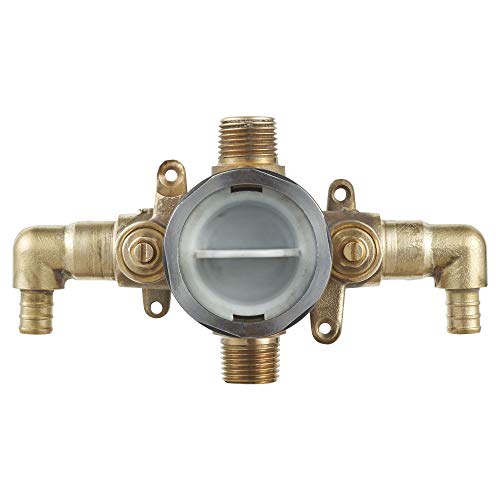
American Standard RU101SS Flash shower rough-in valve with universal inlets and outlets and screwdriver stops
Prices and availability are accurate as of the time shown and may change.
You’re plumbing in copper or threaded pipe and want a way to shut the shower off at the valve when the cartridge needs service.
Your supplies are PEX; the RU107ESS takes crimp rings without adapters.
American Standard’s RU101SS is the Flash rough valve I’d put in for copper with stops, and I’ve used it. Its inlets and outlets are what American Standard calls universal: ½ in. nominal copper sweat or ½ in. male NPT.
The SS means screwdriver stops. With them you can shut off hot and cold at the valve to change the cartridge, without shutting down the house.
The body is cast DZR brass, which American Standard says resists corrosion from high chloride and pH levels in water. It has a flat back that mounts flush against a 2 × 4 cross brace with wood screws.
A flush plug comes installed. American Standard says you can test the body with it using air at 200 psi or water at 300 psi, and flush hot and cold at the same time without the cartridge in place.
Its PEX install guide adds one caution for the SS models: the service stops and flush plug must be removed before soldering.
The rough-in range is 1-3/4 to 2-3/4 in. from the finished wall to the back of the valve for a standard wall, with a 4 in. wall opening. The plaster guard doubles as a mount for thin walls from 7/8 to 2 in., with a 3-1/2 in. opening.
The spec sheet lists ASSE 1016 and ASME A112.18.1 compliance, with TU series trims and their cartridges. Back-to-back installs work by rotating the cartridge 180°.
On the sheet’s drawing the body is 4-7/8 in. wide across the inlets and 3-5/8 in. tall, 7/16 in. wider than the plain RU101 because of the stops. The stainless retaining ring has flats so it loosens with a wrench, and it holds the plug or cartridge without screws.
My call: buy the stops version whenever your pipe allows it. The day the cartridge needs changing, you’ll be glad.
American Standard RU107ESS Flash shower rough-in valve with PEX crimp inlet elbows, universal outlets and screwdriver stops
Prices and availability are accurate as of the time shown and may change.
Your house is plumbed in PEX with crimp or cinch rings and you want the inlets to connect without adapters.
You use expansion-type PEX-A; the RU108ESS is the cold expansion version.
American Standard’s RU107ESS is the Flash rough valve I’d use on PEX crimp, and I’ve used it. Its model list calls the inlets ½ in. PEX crimp elbows to ASTM F1807, with universal outlets and screwdriver stops.
The elbow inlets are the reason to pick it over the straight RU107. American Standard says the valve can be rotated 180° for supply lines that come down from the ceiling.
It’s wider than the straight models because of the elbows: 6-1/2 in. on the sheet’s drawing, against 4-7/8 in. for the RU101SS.
Watch the outlets. American Standard’s sheet and guides say not to use PEX on any outlet, to avoid shower rise or related problems. Run the riser and tub spout pipe in copper or threaded pipe.
There’s a discrepancy to know about: the model list says F1807 crimp, but the sheet’s dimension table prints ASTM F1960 (cold expansion) under the RU107E and RU107ESS drawings. The Amazon title and American Standard’s product page both say crimp ring system, so I treat it as crimp.
Everything else matches the RU101SS: cast DZR brass, a flat back, the flush plug for testing to 200 psi air or 300 psi water, and a 1-3/4 to 2-3/4 in. rough-in range.
The stops and flush plug come out before any soldering on the outlets, per American Standard’s PEX connection guide.
It’s 3-5/8 in. tall like the RU101s, and the elbows make it 6-1/2 in. wide; the straight RU107SS without elbows is 4-7/8 in. wide. American Standard also makes an expansion-ring version with the same elbows, the RU108ESS, for ASTM F1960 PEX-A.
Where it lost points: inlets that take only one PEX system scored 8.
My call: confirm which ring your crimp tool uses before you buy, and use the elbows so the PEX doesn’t kink where it turns into the valve.
American Standard RU102SS Flash shower rough-in valve with stub-outs and screwdriver stops
Prices and availability are accurate as of the time shown and may change.
You press copper and want a stub on every port, plus stops so the cartridge can be serviced without shutting off the house.
You thread or sweat into the valve body; the RU101SS takes ½ in. copper sweat or male NPT.
American Standard’s RU102SS is the Flash rough valve with stub-outs on all four ports and screwdriver stops, and I’ve used it. The sheet groups it under stub-outs for press-connect fittings.
Each inlet and outlet is a ½ in. stub-out, so you press a coupling onto the stub instead of threading into the body; American Standard’s sheet calls them stub-outs for press-connect fittings. The drawing shows it 5-7/8 in. wide across the stubs and 4-3/4 in. tall.
That makes it the tallest body of the four, because the stubs stand out on every port; the RU107ESS is wider. The plain RU102, without stops, is 5-5/8 in. wide on the same drawing.
It shares the Flash body: cast DZR brass, a flat back for a cross brace, a pre-installed flush plug that tests to 200 psi air or 300 psi water, and the stainless retaining ring with flats that holds the plug or cartridge without screws.
American Standard’s rough-in diagram puts the shower head usually between 65 and 78 in. off the finished floor, with the tub spout connection below the valve.
Connect the riser to the top outlet marked UP and the tub filler pipe to the bottom outlet, cap both, and pressure test with the test cap and bonnet nut in place, per the install guide.
Then remove each cap in turn to flush the shower and tub lines, and put the plaster guard back on until the trim goes in.
The Amazon listing’s part number is RU102SS, matching the sheet, and the listing photo shows the stops on both inlets.
Where it lost points: stub-outs only, for one fitting system, scored 8.
My call: it’s a good valve for a press-tool job, and the built-in stops let you shut the shower’s supply at the valve when the cartridge needs service.
American Standard RU101 Flash shower rough-in valve with universal inlets and outlets
Prices and availability are accurate as of the time shown and may change.
There’s an accessible shutoff for the bathroom already and you want the simplest Flash body for copper or threaded pipe.
Changing the cartridge would mean shutting off the whole house; get the RU101SS.
American Standard’s RU101 is the plain Flash rough valve, and I’ve used it. It’s the RU101SS without the stops: universal ½ in. inlets and outlets that take copper sweat or male NPT.
On the sheet’s drawing it’s 4-7/16 in. wide across the inlets, the narrowest of the four, which helps in a tight stud bay.
The body is the same cast DZR brass with a flat back for a 2 × 4 cross brace, and like every Flash body it supports back-to-back installs. The flush plug tests to 200 psi with air or 300 psi with water.
American Standard’s install guide warns that cross flow can occur during testing if hot and cold pressures aren’t equal; for that case it sells flush plug M954334 separately.
It also says to inspect the body for debris after installation, because debris can damage the pressure balance cartridge.
The same rough-in range applies: 1-3/4 to 2-3/4 in. from the finished wall to the back of the valve, or 7/8 to 2 in. on a thin wall with the plaster guard as the mount.
Its listing says the flush plug lets the installer flush the lines without cross flow, with no need to remove a cartridge during installation. The drawing shows the body 3-5/8 in. tall, and it takes the same TU series trims as the RU101SS.
Trim and cartridge are separate. American Standard pairs Flash bodies with TU series trims, and its Colony Pro TU075500.002 trim includes a one-piece double ceramic pressure balance cartridge.
Where it lost points: no service stops scored 0.
My call: skip the savings unless a bathroom shutoff is within reach; the stops let you shut the water at the valve for a cartridge swap instead of shutting off the whole house.
From American Standard’s Flash spec sheet. Scroll sideways on a phone.
| Pick | Photo | Spec score | Inlets | Outlets | Stops | Width | Buy |
|---|---|---|---|---|---|---|---|
| Flash RU101SS | | 10.0 | ½ in. universal | ½ in. universal | Yes | 4-7/8 in. | Check it on Amazon |
| Flash RU107ESS | | 9.6 | ½ in. PEX crimp elbows | ½ in. universal | Yes | 6-1/2 in. | Check it on Amazon |
| Flash RU102SS | | 9.6 | ½ in. stub-outs | ½ in. stub-outs | Yes | 5-7/8 in. | Check it on Amazon |
| Flash RU101 | | 8.0 | ½ in. universal | ½ in. universal | No | 4-7/16 in. | Check it on Amazon |
Universal means ½ in. nominal copper sweat or ½ in. male NPT, per American Standard. Width is the span across the inlets on the sheet’s drawings. My call: pick by your supply pipe first, then add stops wherever you can.
American Standard makes 14 Flash rough valves. Tell the picker your pipe and it names the model, from AS’s spec sheet.
The picker only names models that exist on American Standard’s sheet. It links every Flash body Amazon.com had new and in stock on Oct 24, 2026, including the four in the table below; for any other model, ask a supply house for it by number. For PEX tools, see PEX crimp tools and PEX-A vs PEX-B.
| Other Flash body | Spec score | Use it for | Buy |
|---|---|---|---|
| Flash RU109 | 7.6 | CPVC supply lines; it’s the only Flash body for CPVC, and it has no stops | Check it on Amazon |
| Flash RU102 | 7.6 | Press stub-outs with a shutoff elsewhere; the RU102SS adds stops | Check it on Amazon |
| Flash RU107E | 7.6 | PEX crimp from above with a shutoff elsewhere; the RU107ESS adds stops | Check it on Amazon |
| Flash RU107 | 7.6 | PEX crimp from below with a shutoff elsewhere; straight inlets, no stops | Check it on Amazon |
These four were new and in stock from Amazon.com on Oct 24, 2026 and score 7.6 on the same checks, losing points for having no service stops. The cards cover the stops version for each pipe, plus the RU101 as the no-stops universal body; these are the no-stops bodies for the other pipes.
From American Standard’s Flash spec sheet and install guides.
| Wall | Depth: finished wall to back of valve | Wall opening | How it mounts |
|---|---|---|---|
| Standard wall | 1-3/4 to 2-3/4 in. | 4 in. round | Wood screws into a 2 × 4 cross brace |
| Thin wall | 7/8 to 2 in. | 3-1/2 in. round | Plaster guard rotated 90°, locking screw, self-centering hole guides |
| Deeper wall | Past 2-3/4 in. | — | Optional deep rough-in kit M970649-YYY0A |
The plaster guard is the depth gauge: American Standard designed it as the rough-in guide and says to leave it on until the trim goes in. Tile, backer board and mud all count toward finished wall, so add them up before you set the brace.
My call: set the brace for the actual tile you’re using, not a guess, and check the guard against a scrap of the backer and tile stacked together.
American Standard’s standard-wall steps, in order.
Turn off hot and cold before you start.
Take it off for the install; it goes back on after testing.
Wood screws into a 2 × 4 cross brace, flat back flush to the brace.
Hot and cold by the method your model takes; remove stops and plug before soldering.
Riser to the top outlet marked UP; tub filler pipe to the bottom outlet.
Cap both pipes, test with the test cap and bonnet nut in place, check for leaks.
Remove each cap in turn to flush the shower and tub lines.
Reinstall the plaster guard and inspect the body for debris.
American Standard notes that cross flow can happen during testing if hot and cold pressures aren’t equal, and sells flush plug M954334 for that case. It also says to look inside the body for debris before the cartridge goes in. For back-to-back showers, it reverses hot and cold by rotating the cartridge 180° during trim install.
From American Standard’s product pages and the Colony Pro trim listing.
| Part | What it is | Notes |
|---|---|---|
| Colony Pro TU075500.002 | Shower trim: metal handle, escutcheon and one-piece cartridge | Double ceramic pressure balance cartridge; rough valve sold separately |
| M970654-0070A cartridge | Pressure balance cartridge for Flash | For replacing a worn cartridge; includes a removal ring |
| Flush plug M954334 | Spare flush plug | Sold separately, for testing with unequal pressures |
| Deep rough-in kit M970649-YYY0A | Extension for deep walls | Optional accessory on the spec sheet |
American Standard’s product pages say the cartridge is sold separately, and the spec sheet says Flash bodies are for use with TU series trim kits with cartridges. So in practice you buy two boxes: the rough valve now, and the trim when the tile is up. Our American Standard shower cartridge replacement guide covers swapping the cartridge later.
From IRC 2021 P2708.3 and P2708.4. Your local code may add to it.
| Rule | IRC 2021 | What it means for you |
|---|---|---|
| Valve type | P2708.4: balanced-pressure, thermostatic or combination | The Flash cartridge is pressure balance |
| Standard | P2708.4: ASSE 1016/ASME A112.1016/CSA B125.16 or ASME A112.18.1/CSA B125.1 | The Flash sheet lists ASSE 1016 and ASME A112.18.1 |
| Maximum temperature | P2708.4: a limit stop, field adjusted so water doesn’t exceed 120°F | Set the trim’s limit stop at install |
| Flow rating | P2708.4: rated for the installed shower head’s flow | Check the shower head’s gpm |
| Location | P2708.4: installed at the point of use; in-line thermostatic valves don’t count | The valve goes in the shower wall |
| Riser support | P2708.3: fastened to the structure with supports made for the pipe | Strap the riser to blocking |
The 120°F limit is set in the trim, not the rough valve, which is one more reason the trim matters. For how pressure balance and thermostatic valves differ, see pressure balancing vs thermostatic shower valves.
From American Standard’s Flash sheet and install guides.
Don’t use PEX connections on any of the outlets, to avoid shower rise or related issues.
The RU107 and RU108 families are built for PEX inlets.
Even the PEX models have copper sweat or male NPT outlets.
The PEX guide repeats the warning for the tub outlet connection.
Shower rise means water coming out of the shower head while the tub spout runs. My call: run the tub filler and riser in ½ in. copper or threaded pipe, as American Standard’s diagrams show, and you won’t chase that problem later. See slip-on vs threaded tub spouts for the spout end.
My call, from the specs above.
| Question | If yes | If no |
|---|---|---|
| Are your supplies PEX with crimp rings? | RU107ESS | Keep going |
| Do you press copper? | RU102SS | Keep going |
| Is there no bathroom shutoff within reach? | RU101SS | RU101 |
No. American Standard says the cartridge is sold separately; it comes with a TU series trim.
Screwdriver stops, so you can shut off hot and cold at the valve.
½ in. nominal copper sweat or ½ in. male NPT, per American Standard.
RU107 for crimp (ASTM F1807), RU108 for cold expansion (ASTM F1960).
Inlet elbows that let the valve rotate 180° for supplies from above.
1-3/4 to 2-3/4 in. from finished wall to the back of the valve on a standard wall.
Yes, from 7/8 to 2 in., using the plaster guard as the mount and a 3-1/2 in. opening.
4 in. on a standard wall, per American Standard.
Yes, with the flush plug: 200 psi with air or 300 psi with water.
American Standard says not to use PEX on any outlet, to avoid shower rise.
With its TU trim cartridge, yes; the sheet lists ASSE 1016.
American Standard’s diagram shows it usually between 65 and 78 in. off the floor.
Yes; rotate the cartridge 180° to reverse hot and cold for back-to-back installs.
Dezincification-resistant brass, which American Standard says resists corrosion from high chloride and pH.
American Standard’s TU series trims, such as Colony Pro TU075500.002.
Yes; American Standard says remove the stops and flush plug before soldering.
I’m Isaac Daniels, a licensed journeyman plumber in Georgia (license #JP507711), and I’ve used all four picks. Connections, sizes and test pressures come from American Standard’s Flash spec sheet and install guides; code rules from the IRC 2021, all read Oct 24, 2026.
Each check scores 0 to 10 and counts one fifth. It’s our score from American Standard’s documents, not a test of our own or a customer rating.
| Check (weight) | How it’s scored |
|---|---|
| Service stops (⅕) | 10 with screwdriver stops; 0 when the sheet shows none or doesn’t say |
| Inlet options (⅕) | 10 for universal (sweat or male NPT); 8 for one system only (PEX crimp or stub-outs); 0 when not stated |
| DZR brass body (⅕) | 10 for cast DZR brass, per the sheet; 5 for brass with no DZR rating; 0 when the material isn’t stated |
| Flush and test plug (⅕) | 10 for a pre-installed plug rated for 200 psi air / 300 psi water testing; 5 for a plug with no test rating; 0 for none stated |
| Wall depth range (⅕) | 10 for 1-3/4 to 2-3/4 in. standard and 7/8 to 2 in. thin wall; 6 for one range only; 0 when not stated |
| Total | Average of the checks, to one decimal |
| Ties | Picks with the same score aren’t ranked against each other; choose between them by your pipe, using the model picker |
| Pick | Stops | Inlets | Body | Plug | Depth | Score |
|---|---|---|---|---|---|---|
| Flash RU101SS | 10 | 10 | 10 | 10 | 10 | 10.0 |
| Flash RU107ESS | 10 | 8 | 10 | 10 | 10 | 9.6 |
| Flash RU102SS | 10 | 8 | 10 | 10 | 10 | 9.6 |
| Flash RU101 | 0 | 10 | 10 | 10 | 10 | 8.0 |
| Flash RU102 (linked, not carded) | 0 | 8 | 10 | 10 | 10 | 7.6 |
| Flash RU107 (linked, not carded) | 0 | 8 | 10 | 10 | 10 | 7.6 |
| Flash RU107E (linked, not carded) | 0 | 8 | 10 | 10 | 10 | 7.6 |
| Flash RU109 (linked, not carded) | 0 | 8 | 10 | 10 | 10 | 7.6 |