SharkBite PEX-B ½ in. white, 300 ft
$85.52 at Amazon
Check it on AmazonPrice as of Nov 22, 2026, 9:30 AM EST
Details ↓
Same size and ratings. The fittings decide.

As an Amazon Associate I earn from qualifying purchases.
The letter only names how the plastic was cross-linked. SharkBite’s own A and B sheets list the same size, wall and 160 psi rating. Pick by fittings: Uponor AquaPEX (PEX-A) for ProPEX expansion, SharkBite PEX-B for crimp, clamp or push.

Two pipes are linked, one PEX-A and one PEX-B. We matched each pipe to its maker’s 2026 spec sheet before linking it. Uponor AquaPEX is covered below as a reference, shown for comparison only.
Product prices and availability are accurate as of the date/time indicated and are subject to change. Any price and availability information displayed on Amazon.com at the time of purchase will apply to the purchase of this product.
This is Uponor’s ½ in. AquaPEX white in a 100 ft coil, part F1040500. Uponor’s 2026 submittal lists the same part with a 0.625 in. outside size, a 0.475 in. bore and a coil weight of 6 lb.
AquaPEX is Engel-method PEX-a. Uponor’s FAQ says that method cross-links the plastic to 80% or more, against 65 to 70% for silane PEX-b. That number sounds like a quality grade, but the ratings don’t show it: Uponor’s sheet gives the same 160 psi at 73°F, 100 at 180°F and 80 at 200°F as SharkBite’s PEX-B.
Where the method shows up is the joint. ProPEX is an expansion system under ASTM F1960. You slip a PEX ring on the pipe, stretch the end with an expander, push it over the fitting and let it shrink back. Uponor says the joint holds with up to 1,000 lb of radial force.
Uponor gives a bend radius of six times the outside size, 3¾ in. at ½ in.
If you kink it, Uponor’s installation guide says it can be reformed with an electric heat gun, and that this works only on PEX-a. Its steps, in order:
Make sure the system isn’t pressurized.
Straighten the kinked part.
Heat it evenly to about 265°F with an electric heat gun of about 450 watts. Never use an open flame, and keep the pipe surface under 338°F.
Let it cool undisturbed to room temperature. It’s done when the pipe turns opaque again.
Viega, which sells PEX-B, calls heat repair time-consuming and says cutting out the kink is more reliable.
Watch the sun on the white coil. Uponor’s FAQ rates white AquaPEX for one month of UV, and red and blue for six. Leave a white coil outside on a job site for weeks and you can use up its rating before it’s covered. Store it in its bag or indoors.
Hot water has a limit too. Uponor’s submittal says domestic hot water and recirculation lines shouldn’t exceed 140°F at 80 psi, per ASTM F2023. That matches the chlorine rating in its FAQ: full-time use at 140°F.
Prices and availability are accurate as of the time shown and may change.
You want PEX-A’s tighter bend and expansion option but may also use crimp rings or push fittings on the same job.
You’re building around Uponor ProPEX fittings and want one maker’s warranty on pipe and fittings. Use AquaPEX.
This is SharkBite’s ½ in. blue PEX-A in a 100 ft coil, model UA60B100. SharkBite’s PEX-a spec sheet, revised May 27, 2026, lists this part and calls the tubing peroxide-method PEX-a.
This is the pipe to look at if you want PEX-A but don’t want to be tied to one fitting system. The listing names four: expansion under ASTM F1960, push-to-connect under ASSE 1061, plastic crimp under ASTM F2159 and brass crimp under ASTM F1807. SharkBite’s blog says crimp and clamp fittings work with any type of PEX.
The print line reads PEX 5306. That’s the top chlorine class and the top UV class, six months, on the same 06 pressure base as every PEX sold in the US. White Uponor AquaPEX is rated for one month of sunlight, so this blue coil can sit out longer before it’s covered.
Size and ratings match SharkBite’s PEX-B exactly: 0.625 in. outside, 0.070 in. wall, 0.475 in. bore, and 160, 100 and 80 psi at 73, 180 and 200°F. What PEX-A adds is the bend. SharkBite rates it at six times the outside size, 3¾ in. for ½ in., against eight times for its PEX-B.
SharkBite approves it for direct burial and for embedding in concrete when it’s installed per code. Both sheets give the same thermal growth, 1.1 in. per 10°F per 100 ft, so a long hot run needs the same room to move whichever letter you buy.
Blue is just a marking color. Blue and red make cold and hot lines easy to trace later, but SharkBite’s sheet gives one set of ratings for the tubing. Check the print line on your coil if you want proof.
My call: it’s the easiest way to get PEX-A’s bend and expansion option while keeping crimp rings as a backup, which helps on a repair where you can’t fit an expander head.
Prices and availability are accurate as of the time shown and may change.
You’re using copper crimp rings, stainless clamp rings or push fittings, from a single repair to a full house, and want a long coil.
Your fittings are ProPEX or another F1960 expansion system. Use PEX-A; SharkBite says its expansion fittings need PEX-a.
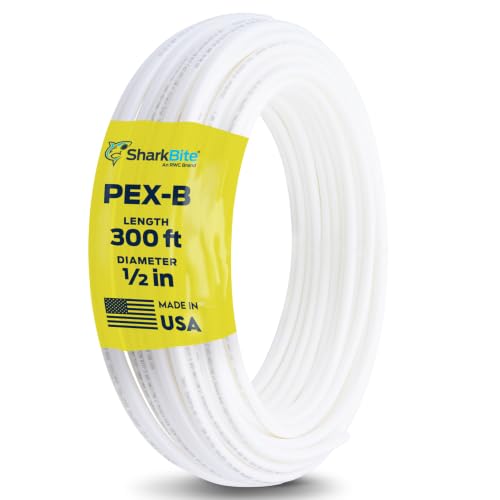
This is SharkBite’s ½ in. white PEX-B in a 300 ft coil, model U860W300. SharkBite’s PEX-b spec sheet, revised July 15, 2026, lists this part and calls it silane-method PEX-b.
SharkBite calls PEX-B the most common PEX pipe, offered in more sizes than PEX-A. Its blog lists push-to-connect, EvoPEX and crimp systems for it, and says crimp and clamp connections work with any type of PEX. All SharkBite tubing is marked with ASSE 1061, the push-fitting standard.
On paper it’s the same tube as SharkBite’s PEX-A. The two sheets give the same 0.625 in. outside size, the same 0.070 in. wall and the same 0.475 in. bore. Both carry PEX 5306 and the same ratings: 160 psi at 73°F, 100 at 180°F and 80 at 200°F.
Two things change. The bend radius is eight times the outside size, 5 in. for ½ in., so tight turns at a stub-out may need a bend support or an elbow. And SharkBite says its expansion system works only with PEX-a or PE-RT, so this coil isn’t for ProPEX-style fittings.
A 300 ft coil weighs about 16 lb, from the sheet’s 0.053 lb per foot. The listing says it’s made in coils up to 1,000 ft. Long coils mean fewer connections in a run; the listing calls those potential leak points.
Plan for growth on long hot runs. The sheet gives 1.1 in. of length change per 10°F per 100 ft. A 100 ft hot line that warms 50°F grows about 5½ in., so leave slack and don’t pin it tight at both ends.
My call: if your fittings are crimp, clamp or push, PEX-B is the practical buy. Ring each joint with a tool made for that ring, and check copper crimps with a go/no-go gauge.
These two tools decide which pipe you buy.
| 2532-20 | What the maker says |
|---|---|
| Specs | ⅜ to 1 in. capacity · 3 heads included · 4.54 lb · 7.28 in. long · M12 battery · ProPEX |
| Pick it if | You’re running PEX-A with ProPEX fittings and want an expander that handles the ½ to 1 in. sizes a house uses. |
| Skip it if | Your pipe is PEX-B, or you’re making a few repair joints. A crimp ring kit works on both letters. |
| On Amazon | Reference (not linked). |
This is Milwaukee’s M12 FUEL ProPEX expander, model 2532-20, with ½, ¾ and 1 in. RAPID SEAL heads. Milwaukee’s page lists the heads as 49-16-2414, 2416 and 2418.
The “-20” means bare tool. Milwaukee’s box list is the tool, the three heads, cone grease and a carry case, with no battery or charger. It runs on any M12 battery, so if you already own M12 tools, you’re set.
This tool is the real reason to buy PEX-A. ProPEX joints need the pipe and ring stretched before they go over the fitting. You can do it with a hand expander, but a powered one does a whole house of joints without wearing out your hands.
| Does well | Watch for |
|---|---|
| Comes with ½, ¾ and 1 in. RAPID SEAL heads | Bare tool: no battery or charger in the box |
| Auto-rotating head | For F1960 expansion only; not for PEX-B rings |
| 4.54 lb, light enough for overhead work | Reference (not linked) |
| Runs on any M12 battery | |
| 5-year limited warranty |
Milwaukee says the tool is designed for Uponor ProPEX connections, with an auto-rotating head. It claims RAPID SEAL heads seal up to 65% faster at 45 degrees; that’s Milwaukee’s figure, not ours.
Capacity is ⅜ to 1 in., with the ½, ¾ and 1 in. heads in the box. It weighs 4.54 lb and is 7.28 in. long, which matters when you’re expanding over your head in a joist bay. Milwaukee backs it with a 5-year limited warranty.
Don’t use it on PEX-B unless the pipe says it’s allowed. SharkBite says expansion fittings need PEX-a or PE-RT. Zurn is the exception we found: it says its silane PEX is third-party certified for both F1960 expansion and F1807 crimp. The print line on the pipe tells you.
My call: if you’re committing to PEX-A for a repipe, a powered expander is what makes ProPEX faster than crimping. Our DeWalt vs Milwaukee expander guide compares it with the 20V option.
| IWS-1807CN | What the maker says |
|---|---|
| Specs | ASTM F1807 · ½ and ¾ in. rings · Go/no-go gauge · Ring remover · PEX cutter · Carry case |
| Pick it if | You’re making copper-ring crimp joints in ½ and ¾ in. PEX, either letter, and want the gauge, cutter and remover in one case. |
| Skip it if | You use stainless clamp (cinch) rings; those take an F2098 clamp tool. Our crimp ring vs cinch clamp guide covers the difference. |
| On Amazon | Reference (not linked). |
This is iCrimp’s IWS-1807CN kit for ½ and ¾ in. copper crimp rings, made by Zhejiang IWISS. iCrimp’s page lists angled crimpers, a PEX cutter, a ring removal tool, a gauge and a case in this configuration.
Copper crimp rings are the one joint that works on both letters without question. SharkBite’s blog says crimp is a durable way to connect any type of PEX, and SharkBite’s PEX-A listing names ASTM F1807 brass crimp fittings. If a house has both A and B in it, this is the tool that joins either.
The standard is ASTM F1807, for brass insert fittings with copper rings. The listing says the tools are factory calibrated and the go/no-go gauge is in the kit. Use it on every ring: SharkBite’s instructions say the “go” side fits snugly over a good crimp and the “no go” side doesn’t fit at all.
| Does well | Watch for |
|---|---|
| Copper crimp rings work on PEX-A and PEX-B | ½ and ¾ in. only; 1 in. rings need another crimper |
| Go/no-go gauge in the kit | Two crimpers to swap between sizes |
| Angle-head crimpers fit tight spots | No warranty length on the maker’s page |
| Ring remover lets you reuse the fitting | |
| Cutter handles PEX up to 1 in. |
Crimp at a right angle. SharkBite tells you to close its crimper on the ring at 90° until the handles meet. Then check the ring with the gauge before you move on.
The angle-head crimpers are the reason to pick this kit over a straight-jaw tool. The listing says they suit tight spaces, and that’s where crimp joints usually end up: between studs, behind a vanity, or at a stub-out close to the wall.
The removal tool cuts copper rings off ½, ¾ and 1 in. fittings so you can reuse the brass. The cutter handles PEX up to 1 in. If you need 1 in. crimps, though, you’ll need a 1 in. crimper; this kit stops at ¾ in.
My call: for repairs on PEX you didn’t install, copper crimp rings and a gauged crimper are a common route once you’ve confirmed the tubing is PEX listed for ASTM F1807 fittings. Our best PEX crimp tool guide compares the other crimpers.
SharkBite makes and sells both, so its two 2026 spec sheets are a fair test. Scroll sideways on a phone.
| Spec, ½ in. tube | SharkBite PEX-A (UA60B100) | SharkBite PEX-B (U860W300) | Ahead |
|---|---|---|---|
| How it’s cross-linked | Peroxide (Engel) method | Silane (moisture cure) method | Different |
| Outside diameter | 0.625 in. | 0.625 in. | Even |
| Wall | 0.070 in. | 0.070 in. | Even |
| Inside diameter | 0.475 in. | 0.475 in. | Even |
| Material code | PEX 5306 | PEX 5306 | Even |
| Rated at 73°F | 160 psi | 160 psi | Even |
| Rated at 180°F | 100 psi | 100 psi | Even |
| Rated at 200°F | 80 psi | 80 psi | Even |
| Smallest bend without support | 6 × OD, 3¾ in. | 8 × OD, 5 in. | PEX-A |
| Growth with heat | 1.1 in. per 10°F per 100 ft | 1.1 in. per 10°F per 100 ft | Even |
| Direct burial and in concrete | Approved per code | Approved per code | Even |
| Standard expansion (ASTM F1960) | Yes, per listing | No, per SharkBite | PEX-A |
Nine of those twelve lines match. Besides the method itself, two lines differ, and they’re the ones that matter on the job: how tight you can bend the pipe without a support, and whether it takes standard expansion fittings. Everything a code official or a pressure gauge cares about is the same.
SharkBite says it plainly on its blog: the letter signifies the cross-linking method, “not the grade of PEX.” Viega, which sells PEX-B, says the letters are “manufacturing classifications, not quality grades.” Uponor, which makes PEX-a, lists the same 160, 100 and 80 psi ratings for AquaPEX.
Both SharkBite sheets also print one figure we couldn’t take at face value. The PEX-B sheet gives ½ in. tube 0.053 lb per foot; the PEX-A sheet prints 0.53, ten times heavier, with the same wall and diameter. That’s a typo, and it’s a good reason to read two sheets before trusting one number.
The four digits after “PEX” are the real quality code. They don’t tell you A or B; they tell you what the pipe is rated for.
| Digit | What it rates | Values | Tested under |
|---|---|---|---|
| 1st | Chlorine resistance | 5 = 100% of the time at 140°F; 3 = 50% at 140°F; 1 = 25% at 140°F; 0 = not rated | ASTM F2023 |
| 2nd | Sunlight (UV) before cover | 3 = six months; 2 = three months; 1 = one month; 0 = not rated | ASTM F2657 |
| 3rd and 4th | Wall design stress at 73°F | 06 = 630 psi; 08 = 800 psi; 10 = 1,000 psi | PPI listing |
| Code you see | What it means | A or B? |
|---|---|---|
| PEX 5306 | Hot water full time at 140°F, six months of UV, rated 160 psi at 73°F | Either; SharkBite’s A and B both carry it |
| PEX 5106 | Hot water full time at 140°F, one month of UV, rated 160 psi at 73°F | Either; the code doesn’t say |
| PEX 5006 | Hot water full time at 140°F, no UV rating, rated 160 psi at 73°F | Either; the code doesn’t say |
| PEX 1006 | Chlorine rated 25% of the time at 140°F, no UV rating | Either; check before using it on a recirculating line |
That answers the searches we see most: “is PEX 5306 A or B” and “is PEX 5006 A or B.” The code can’t tell you. It rates chlorine, sunlight and wall stress, and SharkBite prints PEX 5306 on both its A and its B. Look elsewhere on the line for the letter or the brand.
The 06 trips people up. Uponor’s print-string post says a 06 pipe withstands “630 pounds of pressure per square inch.” Viega’s paper shows the math: 630 psi is the design stress in the plastic wall, and for SDR 9 tube that works out to a 160 psi rating at 73.4°F.
Viega’s formula is P = 2 × HDS ÷ (SDR − 1). With 630 psi and SDR 9, that’s 1,260 ÷ 8, or 157.5 psi, which the standard rounds to 160. SharkBite’s blog says the 06 base is the same for all the PEX tubing sold in the US, which is why A and B carry the same rating.
The first digit matters most for hot water with a recirculation pump. A 5 means the pipe passed chlorine testing for constant use at 140°F. Uponor adds that the test uses 4 ppm chlorine. A pipe rated 1 or 3 is meant for hot water some of the time.
| Other marks on the line | What it means |
|---|---|
| ASTM F876 | The PEX tubing standard; every letter must meet it |
| ASTM F877 | PEX tubing and fittings tested together as a system |
| ASTM F1960 | Cold-expansion fittings with PEX rings (ProPEX style) |
| ASTM F1807 | Brass insert fittings with copper crimp rings |
| ASTM F2098 | Stainless steel clamp (cinch) rings |
| ASTM F2159 | Plastic insert fittings with crimp or clamp rings |
| ASSE 1061 | Push-to-connect fittings |
| NSF/ANSI 61 | Safe for drinking water |
| SDR 9 | Outside size is nine times the wall |
| CSA B137.5 | The Canadian PEX standard |
SharkBite says its tubing is marked with the fitting standards approved for it. So the fitting marks on the print line are your best answer to “will this fitting work on this pipe.” If F1960 isn’t printed, don’t use expansion fittings on it, whatever the letter.
This is the question that decides most A or B purchases. Scroll sideways on a phone.
| Fitting system | Standard | PEX-A | PEX-B | What the makers say |
|---|---|---|---|---|
| Expansion with PEX ring (ProPEX) | ASTM F1960 | Yes | Only if certified | SharkBite: PEX-a or PE-RT only. Zurn: its silane PEX is certified for F1960. |
| Copper crimp ring | ASTM F1807 | Yes | Yes | SharkBite: crimp works with any type of PEX. |
| Stainless clamp (cinch) ring | ASTM F2098 | Yes | Yes | SharkBite: clamp works with any type of PEX. |
| Push-to-connect | ASSE 1061 | Yes | Yes | SharkBite marks all its tubing ASSE 1061. |
| Plastic insert, crimp | ASTM F2159 | Yes | Check print | SharkBite’s PEX-A listing names F2159. |
| Press (PEX press sleeve) | Maker’s system | Check | Check | Viega: the letter doesn’t set the method; use fittings approved for that tubing. |
Read the table as “allowed when the pipe and fitting are approved for each other.” Viega puts it bluntly: every connection must be made with fittings and tools approved for that specific tubing, rather than assuming a fitting approved for one type is approved for another.
The cleanest rule is the print line. If your pipe prints F1960, expansion is fine. If it prints F1807, copper crimp rings are fine. If it prints ASSE 1061, push fittings are fine. The letter is a hint; the print is the approval.
Fittings also explain the flow claims in videos. Both SharkBite sheets give ½ in. A and B the same 0.475 in. bore. What changes is the fitting: SharkBite’s PEX-A listing says cold expansion takes fluted-end fittings for improved water flow, while crimp and push fittings sit inside the pipe. Our brass vs poly PEX fittings guide covers insert fittings.
This is the one physical difference you’ll feel. SharkBite’s sheets give PEX-A six times the outside size and PEX-B eight.
At ½ in., that’s a 3¾ in. radius against 5 in. A PEX-B line turning up out of a floor needs 1¼ in. more sweep, so tight spots more often take a bend support or an elbow fitting. At 1 in., the gap grows to 6¾ in. against 9 in.
Tighter bends mean fewer fittings, and fewer fittings mean fewer places to leak. That’s a real advantage for PEX-A in a repipe, but it’s about routing, not strength. Viega notes every letter must meet the same bend radius standard.
| Size | Outside diameter | PEX-A, 6 × OD | PEX-B, 8 × OD |
|---|---|---|---|
| ½ in. | 0.625 in. | 3¾ in. | 5 in. |
| ¾ in. | 0.875 in. | 5¼ in. | 7 in. |
| 1 in. | 1.125 in. | 6¾ in. | 9 in. |
The jobsite differences people argue about, with what each maker actually claims.
| Topic | PEX-A | PEX-B | Source |
|---|---|---|---|
| Kink in the pipe | Uponor: a heat gun can repair it | Uponor: can’t be heat-repaired | Uponor FAQ |
| Best kink fix, any letter | Cut it out and add a fitting | Cut it out and add a fitting | Viega blog |
| Freeze and thaw | Uponor cites PPI TR-52 for freeze/thaw resilience | SharkBite: expands and contracts as water freezes | Uponor FAQ; SharkBite listing |
| Sunlight before cover | Uponor white: 1 month; SharkBite blue: 6 months | SharkBite white: 6 months | Uponor FAQ; SharkBite sheets |
| Cross-linking | 80% or more (Engel) | 65 to 70% (silane) | Uponor FAQ |
The kink claim is real but narrow. Uponor says only PEX-a can be heat-repaired, and Viega calls heat repair time-consuming. On a pipe you’re about to bury or close in a wall, cutting the kink out and adding an approved fitting is the more conservative repair; what your inspector accepts depends on the local code.
Neither maker calls its pipe freeze-proof. Uponor points to a PPI technical report on freeze and thaw cycles, and SharkBite’s PEX-B listing says the tube expands and contracts as water freezes. Fittings and valves can still split, so insulate and drain lines in unheated spaces.
The sunlight row shows why the print code beats the letter. White Uponor PEX-A is rated for one month of UV; SharkBite’s white PEX-B is rated for six. If a coil is going to sit on a sunny job site, the second digit of the code tells you more than the A or B does.
Cross-linking percentage is the number PEX-A sellers lead with. It’s a property of the method, and it shows up in bend and kink behavior. It doesn’t show up in the pressure ratings, which match.
Search this topic and you’ll find numbers that don’t match. Here’s what we found and how we read each one.
| Claim | Where it’s from | What the spec sheets say |
|---|---|---|
| PEX rated 630 psi | Uponor print-string post | 630 psi is wall stress; the pipe rating is 160 psi at 73°F (Viega, SharkBite) |
| PEX-A handles 500 psi | A plumbing company blog, no source | No maker sheet we read gives a 500 psi rating |
| PEX-B burst higher than PEX-A | A YouTube burst test by Roger Wakefield | Burst isn’t a rating; SharkBite calls burst differences negligible |
| PEX-A has more flow | YouTube videos | Same 0.475 in. bore at ½ in.; flow differences come from the fittings |
| PEX-B can’t take expansion fittings | SharkBite blog | True for SharkBite’s system; Zurn certifies its silane PEX for F1960 |
| Only PEX-A can be heat-repaired | Uponor FAQ | Viega: heat repair is slow; cutting out the kink is more reliable |
Burst and lab numbers make good videos, but houses don’t run at burst pressure. Makers rate PEX at 160 psi at 73°F and 80 psi at 200°F, and both letters carry the same ratings. One burst test doesn’t change a rating the makers publish.
When two sources disagree, we side with the maker’s current spec sheet for that exact part, and then with the standard behind it. That’s why this page quotes revision dates.
Two places people expect the letter to matter. For the pipes on this page, it doesn’t.
| Use | SharkBite PEX-A | SharkBite PEX-B | Uponor AquaPEX white |
|---|---|---|---|
| Direct burial | Approved per code | Approved per code | Check Uponor’s guide |
| Embedded in concrete | Approved per code | Approved per code | Check Uponor’s guide |
| Hot water recirculation | Class 5 chlorine | Class 5 chlorine | Full time at 140°F |
| Rated at 180°F | 100 psi | 100 psi | 100 psi |
| Rated at 200°F | 80 psi | 80 psi | 80 psi |
Both SharkBite sheets approve their tubing for direct burial and for concrete when installed per code. Before burial, keep the coil out of the sun; the second digit of the code says how long it can take. Your local code may add rules for water service lines.
For a water heater, both letters carry the same 100 psi rating at 180°F and 80 psi at 200°F. Follow the heater maker’s and the pipe maker’s instructions for how PEX connects at the heater.
Color won’t tell you, and neither will the material code. Here’s what will.
| Check | What to look for | How sure |
|---|---|---|
| Print line | “PEX-a”, “PEX-b”, or the method: Engel, peroxide, silane | Sure |
| Brand line on the print | Uponor AquaPEX is PEX-a; Viega PureFlow is PEX-B; SharkBite prints both | Sure, with the maker’s page |
| Fitting marks on the print | F1960 printed: expansion is approved, whatever the letter | Tells you the fitting |
| Fittings already on it | Expansion rings suggest A; copper crimp rings tell you nothing | A hint |
| Color | Red, white and blue come in both letters | No help |
| Material code (5306 etc.) | Rates chlorine, UV and pressure only | No help |
Turn the pipe and read the whole print line; it repeats every few feet. The print shows the brand and the standards; some makers also print the letter or the method. If you find only the brand, the maker’s own page will say which method it uses.
Can’t read any print? Don’t guess from looks. Identify the tubing first, from the maker’s name, the size and any standard you can find on a nearby length or in the house’s records, then use a fitting system approved for that tubing. PE-RT, PEX-AL-PEX and other tubing can look like PEX. Our leaking PEX crimp fitting guide covers what to check if a joint weeps.
PEX-A, like Uponor AquaPEX, with a powered expander.
Either letter, once the tubing is identified, joined with copper crimp rings and a gauged crimper if it’s listed for F1807.
PEX-B. It takes all three and comes in long coils.
PEX-A bends to 6 × OD, against 8 × OD for PEX-B.
Whichever prints a 3 as its second digit: six months of UV.
Don’t. Use them only when F1960 is printed on the pipe.
| Question | If yes | If no |
|---|---|---|
| Are your fittings ProPEX or another F1960 system? | PEX-A, or PEX-B that prints F1960 | Keep going |
| Do you own an expander or plan to buy one? | PEX-A makes sense | Keep going |
| Are your fittings crimp, clamp or push? | Either; PEX-B is the common choice | Keep going |
| Is the run full of tight turns? | PEX-A, for the 6 × OD bend | Either |
| Will the coil sit in the sun? | Buy a code with a 3 as the second digit | Either |
Still deciding whether to run PEX at all? Our PEX vs copper vs CPVC guide compares the three. For the expander itself, see the best PEX expansion tool guide; for cutters, the best PEX cutter guide.
Neither is a better grade. SharkBite says the letter names the cross-linking method, not the grade, and its A and B sheets list the same size and ratings. PEX-A bends tighter and takes expansion fittings. PEX-B is the most common type and takes crimp, clamp and push fittings.
Both. Codes reference PEX, not the letter, so the choice usually follows the fitting system a shop stocks. A shop that runs ProPEX needs PEX-A; a shop that crimps or clamps can use either. Either passes inspection when the fittings are approved for the pipe.
Yes, when the pipe is approved for them. SharkBite says crimp works with any type of PEX, and its PEX-A listing names ASTM F1807 brass crimp fittings. Look for F1807 on the print line.
Mostly. Crimp, clamp and push fittings work on both. Standard expansion fittings under ASTM F1960 need PEX-A, unless the PEX-B maker certifies its pipe for F1960, as Zurn does. The fitting standards printed on the pipe are the final word.
Read the print line. Look for “PEX-a” or “PEX-b,” the method name (Engel or peroxide for A, silane for B), or the brand. Uponor AquaPEX is PEX-a and Viega PureFlow is PEX-B. Color and the material code won’t tell you.
It can be either. 5306 means full-time hot water at 140°F, six months of UV and a 160 psi rating at 73°F. SharkBite prints PEX 5306 on both its PEX-A and its PEX-B.
The code doesn’t say. 5006 means the top chlorine rating, no UV rating and the standard 160 psi pressure rating. Check the rest of the print line for the letter, the method or the brand.
Both. ASTM F876 is the standard every PEX tube meets, whatever the letter, and F877 tests the tube with its fittings as a system. Seeing them on the print tells you the pipe is listed, not which letter it is.
SharkBite approves both its PEX-A and PEX-B for direct burial and for embedding in concrete when installed per code, with the same ratings. Keep it covered from sunlight before burial, and follow your local rules for water service lines.
Yes, if each joint uses a fitting approved for both pipes. Copper crimp rings, stainless clamp rings and push fittings work on both, and the codes reference PEX without the letter. Don’t use expansion fittings on the PEX-B side unless it prints F1960.
Uponor cites a PPI technical report for PEX-a’s freeze and thaw resilience, and SharkBite says its PEX-B expands and contracts as water freezes. Neither maker calls it freeze-proof. Insulate and drain lines in cold spaces.
Written by Isaac Daniels, a licensed journeyman plumber in Georgia (license #JP507711). Size, ratings, bend radius and approvals come from SharkBite’s 2026 PEX-a and PEX-b spec sheets and Uponor’s 2026 AquaPEX submittal; code meanings from Viega’s and Uponor’s published guides; seller and stock from Amazon.
The two linked pipes get the same three checks, read from SharkBite’s 2026 PEX-a and PEX-b spec sheets and Uponor’s 2026 AquaPEX submittal and FAQ, then averaged to one decimal. Every pick has to reach 7.0.
Pressure, temperature, size and chlorine ratings aren’t in the score, because all three print the same figures. Uponor’s sheet lists ASTM F1960 for ProPEX and no crimp standard, so it gets the one-route mark. The expander and the crimper aren’t scored.
| Check (weight) | How it’s scored |
|---|---|
| Fitting routes on the sheet (⅓) | 10 = the maker names standard expansion (ASTM F1960) and crimp or push fittings for the pipe; 8 = it names one of those routes only |
| Bend radius (⅓) | 10 = smallest unsupported bend 6 × OD; 8 = 8 × OD |
| Sunlight before cover (⅓) | 10 = rated for six months of sunlight before cover; 7 = one month |
| Total | Average of the checks, to one decimal |
| Pick | Fitting routes on the sheet | Bend radius | Sunlight before cover | Score |
|---|---|---|---|---|
| SharkBite PEX-A blue | 10 | 10 | 10 | 10 |
| SharkBite PEX-B white | 8 | 8 | 10 | 8.7 |