
Craftsman CMMT87220, 20 pc.
$102.99 at Amazon
Check it on AmazonPrice as of Oct 24, 2026, 5:30 AM EDT
Why it's my pick ↓
For hanger nuts, strut and brackets.
As an Amazon Associate I earn from qualifying purchases.
Get Craftsman's CMMT87220. For SAE sizes to 1 in., get GEARWRENCH's 9312.
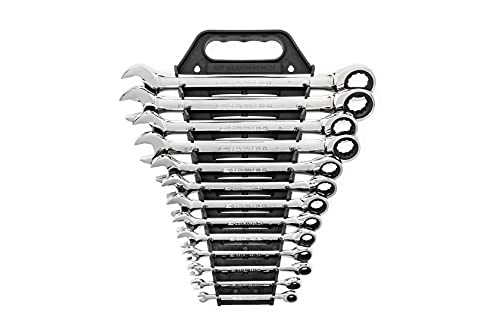


Product prices and availability are accurate as of the date/time indicated and are subject to change. Any price and availability information displayed on Amazon.com at the time of purchase will apply to the purchase of this product.
Nuts and bolts where a socket won't fit and a plain wrench only gets a few degrees of swing.
Nuts on 3/8 in. threaded rod and strut channel, run up or down a rod in a ceiling where there's no room to swing.
Mounting bolts on a well pump, expansion tank bracket or seismic strap, often against a wall.
Closet bolt nuts and carrier bolts low behind the bowl, where a stubby wrench fits and a long one hits the floor.
Clamp bolts on a row of pipe, where each nut sits inches from the next.
Use a pipe wrench on pipe and fittings and a basin wrench on faucet nuts. A ratcheting box end is for hex nuts and bolt heads.
A ratcheting wrench moves the nut once the handle travels far enough to catch the next tooth. More teeth means less travel.
Craftsman CMMT87220 20-piece ratcheting combination wrench set, SAE and metric
Prices and availability are accurate as of the time shown and may change.
You want one case with both SAE and metric, and the smallest swing of the full sets here.
You need 7/8 or 1 in. for heavy hanger rod and brackets. The GEARWRENCH 9312 goes to 1 in.
This is the set I'd put in a plumber's van first. Craftsman lists a 12-point box end with a 90-tooth gear, which gives a 4 degree arc swing. That's a degree less than the 72-tooth sets here, and in a ceiling full of rod and pipe, a degree is real room.
It's 20 wrenches, split evenly. The SAE side runs 1/4, 5/16, 11/32, 3/8, 7/16, 1/2, 9/16, 5/8, 11/16 and 3/4 inch. The metric side runs 6, 8, 10, 12, 13, 14, 15, 16, 17 and 18 mm. Amazon's listing includes a case.
For plumbing, the SAE side does most of the work. A standard nut on 3/8 inch hanger rod takes a 9/16 wrench, and a 1/2 inch nut takes a 3/4, under the ASME hex nut dimensions. Both are in this set, so a strut rack or a trapeze hanger is covered.
The metric half earns its place on equipment. Imported pumps, tankless water heaters and some fixture brackets use metric hardware, and a 10 or 13 mm wrench gets you through most of it without a second trip to the truck.
Craftsman says the wrenches meet or exceed ASME specifications and have a chrome finish for corrosion resistance. The 12-point box end lets you set the wrench on the nut every 30 degrees, which matters when the handle can only sit at one angle.
What's missing: there's no 13/16 or 7/8 inch, and the metric side skips 7, 9 and 11 mm. The listing doesn't mention a reversing lever, so you flip the wrench to back a nut off. Craftsman backs it with a full lifetime warranty, and Amazon sells it directly.
Craftsman also calls out large size markings for quick identification. In a dim crawlspace with a dozen chrome wrenches in the bag, that saves pulling three of them to find the 9/16.
GEARWRENCH 9312 13-piece 72-tooth ratcheting combination wrench set, SAE
Prices and availability are accurate as of the time shown and may change.
Your work is mostly SAE hardware and you need the bigger sizes for 1/2 and 5/8 in. rod and bolts.
You work on metric equipment. Add the Craftsman or the 85206 stubbies for metric.
If your hardware is SAE and some of it is big, this is the set. GEARWRENCH's 9312 runs 13 sizes: 1/4, 5/16, 3/8, 7/16, 1/2, 9/16, 5/8, 11/16, 3/4, 13/16, 7/8, 15/16 and 1 inch. No other set here reaches past 7/8.
Those top sizes matter on bigger hangers. Under the ASME hex nut dimensions, a standard 5/8 inch nut takes a 15/16 wrench, and heavy hex nuts run one size larger than standard. That's where a 3/4-max set runs out.
GEARWRENCH says the 72-tooth box end needs only 5 degrees to move a fastener, against 30 degrees for a standard wrench. It's the same math as any ratchet: 360 degrees divided by 72 teeth is 5 degrees per click.
The box end uses what GEARWRENCH calls off-corner loading. The wrench pushes on the flats of the nut instead of the corners, which GEARWRENCH says gives better grip and less rounding. On a painted or rusted hanger nut, that's the difference between turning it and stripping it.
The head and beam are thin for tight spaces, and the size is stamped on both ends of the beam. The open end sits at a 15 degree offset. GEARWRENCH lists alloy steel with a full polish chrome finish and says the set meets or exceeds ASME and ANSI specifications.
It comes on a wrench rack, which keeps the sizes in order on a shelf or in a drawer. With the rack, the set weighs 5.96 lb. GEARWRENCH backs it with a full lifetime warranty, and Amazon sells and ships it.
GEARWRENCH lists the 9312 as not reversible. To back a nut off, you lift the wrench and flip it over. If you'd rather switch direction on the nut, the DeWalt and Capri sets reverse without coming off.
GEARWRENCH 85206 14-piece 72-tooth stubby ratcheting combination wrench set, SAE and metric
Prices and availability are accurate as of the time shown and may change.
You work low behind toilets, inside vanities and under equipment where a full-length wrench won't swing.
You want one set for everything. Start with the Craftsman, then add these.
Stubbies are the second set, not the first, but they earn their space. GEARWRENCH says the 85206 has a stubby beam length for when clearance is limited, with the same 72-tooth box end as its full-length wrenches.
Think of the nut on a carrier bolt behind a wall-hung bowl, or a bracket bolt under a water heater stand. A full-length wrench hits the floor or the wall before it clicks. A stubby clears it and still gets its 5 degree swing.
The sizes cover the middle of the range. SAE runs 3/8, 7/16, 1/2, 9/16, 5/8, 11/16 and 3/4 inch, and metric runs 10, 11, 12, 13, 14, 15 and 18 mm. GEARWRENCH lists 3/8 inch and 10 mm as the smallest and 3/4 inch and 18 mm as the largest.
Like the 9312, it uses GEARWRENCH's off-corner loading on the box end to grip the flats and cut down on rounding. The head and beam are thin, the open end sits at a 15 degree offset, and the finish is full polish chrome over alloy steel.
The tradeoff is leverage. A shorter handle means more effort for the same torque, so a rusted nut is a job for a full-length wrench or a socket. Use the stubby once the nut is moving, or where nothing else fits.
The set comes in a compression rack and weighs 3.74 lb by GEARWRENCH's catalog figure. GEARWRENCH says it meets or exceeds ASME and ANSI specifications and backs it with a full lifetime warranty. Amazon sells it directly.
GEARWRENCH lists the 85206 as not reversible and not a flex head, so you flip the wrench to change direction. In the tight spots stubbies are made for, that's easier than it sounds, since the short beam turns over in less room.
Capri Tools CP15800-8ST 8-piece 120-tooth long series ratcheting wrench set, SAE
Prices and availability are accurate as of the time shown and may change.
You want the most leverage and the least swing, and a reversing switch so you never flip the wrench.
You need metric or bigger SAE sizes. The Craftsman or GEARWRENCH 9312 cover more.
Capri's long series answers two complaints at once. Its 120-tooth gear needs just 3 degrees of swing, per Capri, and the wrenches are 20% longer than standard for more leverage. Most sets give you one or the other.
The 3 degree figure is the same math as the others: 360 degrees divided by 120 teeth. That's 40% less travel than a 72-tooth wrench. In a joist bay with a nut against the framing, it can be the difference between a click and no click.
These are reversible, with a directional switch, per Capri. You flip direction without pulling the wrench off the nut, which is handy on a long run of hanger nuts where you tighten one and back off the next.
The box end is 12-point with what Capri calls WaveDrive, which it says spreads torque evenly and grips the nut from the sides. The box end sits at a 15 degree offset for knuckle clearance. The open end has an anti-slip design Capri says helps grip rounded bolts.
Sizes are 5/16, 3/8, 7/16, 1/2, 9/16, 5/8, 11/16 and 3/4 inch, in a mechanic's tray about 15.5 inches long. Capri lists chrome vanadium steel made in Taiwan, a 2.65 lb set weight and a lifetime warranty. It's not impact rated, so never put a cheater bar on it.
Amazon showed low stock with more on the way on the day of the update, so look at the stock note next to the price. If it's gone, the Craftsman's 4 degree swing is the closest substitute.
Capri says the offset design keeps your hands clear of fastener edges and nearby obstacles. With the box end set at 15 degrees and a longer handle, your knuckles sit farther from the joist or wall you're working against.
12-piece reversible ratcheting combination wrench set, SAE

Prices and availability are accurate as of the time shown and may change.
You want a reversible SAE set that reaches 13/16 and 7/8 in. without stepping up to 1 in.
You want metric in the same case. The Craftsman has both.
DeWalt's set sits between the Craftsman and the GEARWRENCH 9312. It's SAE only, like the 9312, but it's reversible, and it runs 12 sizes: 1/4, 5/16, 11/32, 3/8, 7/16, 1/2, 9/16, 5/8, 11/16, 3/4, 13/16 and 7/8 inch.
DeWalt lists 72 teeth for a 5 degree arc swing, the same as GEARWRENCH. The page calls the set reversible, so you can switch direction instead of flipping the wrench over, which saves a move on every nut in a tight row.
The box end uses what DeWalt calls DirectTorque technology, which it says helps prevent rounding fasteners. The open end sits at a 15 degree offset, which DeWalt says gives more range of swing in tight spaces.
The handles have a stamped hashmark pattern for extra grip points, which helps with wet hands under a sink or in a crawlspace. Sizes are stamped twice on both sides of the handle, so you can read the size whichever way the wrench lies in the bag.
DeWalt lists a full polish chrome finish and says the stamped markings stay visible over time, since they aren't printed on. That's a small thing until you're hunting for the 9/16 among a dozen chrome wrenches.
For plumbing, the 13/16 and 7/8 inch wrenches matter on bigger hardware. Under the ASME hex nut tables, a heavy hex nut on 1/2 inch rod takes a 7/8 wrench, which the Craftsman set doesn't include.
DeWalt's page doesn't list a rack or case for this set, so plan on a tool roll or a drawer to keep the sizes in order. What you give up is metric and the very largest sizes. There's no 15/16 or 1 inch, and no metric at all. DeWalt backs it with a full lifetime warranty, and Amazon sells it directly.
| Set | Pieces | Sizes | Teeth / swing | Length | Reversible | Storage |
|---|---|---|---|---|---|---|
| Craftsman CMMT87220 | 20 | SAE 1/4–3/4, metric 6–18 mm | 90 / 4° | Standard | Not listed | Case |
| GEARWRENCH 9312 | 13 | SAE 1/4–1 in. | 72 / 5° | Standard | No, flip it | Rack |
| GEARWRENCH 85206 | 14 | SAE 3/8–3/4, metric 10–15, 18 mm | 72 / 5° | Stubby | No, flip it | Compression rack |
| Capri CP15800-8ST | 8 | SAE 5/16–3/4 in. | 120 / 3° | 20% longer | Yes, switch | Tray |
| DeWalt DWMT19232 | 12 | SAE 1/4–7/8 in. | 72 / 5° | Standard | Yes | Not listed |
Hanger rod and bolt sizes map to fixed wrench sizes. This chart pairs common plumbing hardware with the sets that cover it.
| Rod or bolt | Standard hex nut | Heavy hex nut | Sets that have the standard size |
|---|---|---|---|
| 1/4 in. | 7/16 in. | 1/2 in. | All five |
| 5/16 in. | 1/2 in. | 9/16 in. | All five |
| 3/8 in. (common hanger rod) | 9/16 in. | 11/16 in. | All five |
| 1/2 in. | 3/4 in. | 7/8 in. | All five |
| 5/8 in. | 15/16 in. | 1-1/16 in. | GEARWRENCH 9312 only |
Nut widths are across the flats, from the ASME B18.2.2 hex nut tables. Heavy hex nuts run 1/16 or 1/8 in. wider than standard ones, so check the nut before you grab a wrench. Hardware on imported equipment is often metric, which is why a mixed set like the Craftsman helps.
For most hanger and strut work, you need 9/16 and 3/4. Every set here has both. The reasons to buy a bigger set are 5/8 in. rod, heavy hex nuts and big bracket bolts, which need 15/16 or larger.
If you keep only one or two wrenches on your belt for a day of hanging pipe, make them the 9/16 and the 3/4. A ratcheting box end on a 3/8 in. rod nut is the single most common use of these wrenches in plumbing.
Swing arc is 360 degrees divided by the tooth count. Here's what that means for each set.
| Teeth | Swing to move a nut | Sets here | Clicks per full turn |
|---|---|---|---|
| Standard wrench | 30°, per GEARWRENCH | — | 12 repositions |
| 72 | 5° | GEARWRENCH 9312, 85206, DeWalt | 72 |
| 90 | 4° | Craftsman CMMT87220 | 90 |
| 120 | 3° | Capri CP15800-8ST | 120 |
A smaller swing helps only when space is what limits you. On an open nut, a 72-tooth wrench turns it just as fast. Between joists, behind a tank or under a bracket, every degree you save is more handle travel that counts.
More teeth also means smaller teeth. None of the makers here publish a torque rating, so for breaking a seized nut loose, use a standard wrench or a socket first and finish with the ratcheting wrench.
Length is a trade between room to swing and force on the nut.
| Length | Set | Best for | Watch out for |
|---|---|---|---|
| Stubby | GEARWRENCH 85206 | Behind toilets, inside vanities, under stands | Less leverage on a tight nut |
| Standard | Craftsman, GEARWRENCH 9312, DeWalt | Most hanger, strut and bracket work | — |
| Long | Capri CP15800-8ST | Tight nuts that need more force | Needs room to swing |
Leverage scales with handle length, so Capri's 20% longer wrenches put about 20% more torque on the nut for the same push. That's the set to reach for on a bolt that's tight but not seized.
Stubbies cost you that leverage. They're for places where the nut is loose enough to turn and a full-length wrench simply can't move. Most plumbers who own a stubby set own it as a second set.
Two small features that change how fast you work through a row of nuts.
| Feature | What it does | Sets here |
|---|---|---|
| Reversing switch | Change direction without taking the wrench off | Capri (directional switch), DeWalt |
| Flip-over | Turn the wrench over to reverse | GEARWRENCH 9312, 85206 |
| 12-point box end | Fits the nut every 30° | All five |
| Off-corner or anti-round box end | Pushes on the flats to cut rounding | GEARWRENCH, Capri WaveDrive, DeWalt DirectTorque |
A flip-over wrench works fine. You lift it, turn it over and set it back on, which takes a second. On one nut that's nothing; on twenty clamp nuts on a strut rack, a reversing switch saves real time.
A 12-point box end can be set on the nut at 12 angles in a full turn, one every 30 degrees. That's twice as many as a 6-point. When the handle can only sit one way, a 12-point is much more likely to land.
Hanger rod and strut nuts are mostly 9/16 and 3/4 in. Bigger rod and heavy hex nuts need 15/16 or more.
If you work on pumps, tankless heaters or imported equipment, buy a set with metric, like the Craftsman.
72 teeth swings 5°, 90 swings 4° and 120 swings 3°. Fewer degrees helps only in tight spots.
Standard for most work. Add stubbies for behind fixtures, or long wrenches for leverage.
A thumb switch saves a flip on every nut. It matters most on long rows of clamps.
All five carry a lifetime warranty. A rack, case or tray keeps the sizes in order.
If you're buying one set, buy the Craftsman CMMT87220. It has the sizes most plumbing hardware takes, metric for equipment and a 4 degree swing. Add the GEARWRENCH 85206 stubbies when you find yourself fighting a nut behind a toilet.
Go with the GEARWRENCH 9312 instead if you hang 1/2 or 5/8 in. rod or deal with heavy hex nuts. The Capri is the pick if you want reversing and leverage in one wrench and can live with SAE only.
The ratchet gear is the weak point. Crack a rusted nut loose with a standard wrench or a socket, then switch.
Capri lists its set as not impact rated, and no maker here rates its wrenches for an extension bar.
Striking a wrench isn't what these are made for. Use a striking wrench or a breaker bar.
A box end is for hex nuts and bolts. Pipe and fittings take a pipe wrench; faucet nuts take a basin wrench.
For plumbing, the Craftsman CMMT87220: 20 wrenches in SAE and metric with a 90-tooth, 4° swing. For SAE up to 1 in., the GEARWRENCH 9312.
90 teeth needs a 4° swing and 72 needs 5°, since swing is 360° divided by the tooth count. The 90-tooth wrench helps in tight spots; on an open nut, both work the same.
None of these makers publish a torque rating. For a seized nut, break it loose with a standard wrench or socket first, then use the ratcheting wrench.
Both carry a full lifetime warranty. Craftsman's CMMT87220 has more teeth and metric sizes; GEARWRENCH's 9312 reaches 1 in. and uses off-corner loading on the box end.
A standard 3/8 in. hex nut takes a 9/16 in. wrench, per the ASME B18.2.2 tables. A heavy hex nut on the same rod takes 11/16 in.
Yes, for hanger, strut and bracket nuts. GEARWRENCH says its 72-tooth box end moves a nut in 5° against 30° for a standard wrench.
Mostly no, but pumps, tankless water heaters and imported equipment often use metric hardware. A mixed set like the Craftsman covers both.
Tight spots where a full-length wrench can't swing, like behind a toilet or under a stand. GEARWRENCH's 85206 stubbies keep the 72-tooth box end.
They're faster on rows of nuts, since you switch direction without lifting the wrench. Capri and DeWalt sets here are reversible; the GEARWRENCH sets flip over.
Every set here is 12-point, which fits the nut every 30° instead of every 60°. That helps when the handle can only sit at one angle.
No. Box ends are for hex nuts and bolts. Use a pipe wrench on pipe and fittings and a basin wrench on faucet nuts.
All five sets here do. Craftsman, GEARWRENCH and DeWalt list a full lifetime warranty, and Capri lists a lifetime warranty.
I'm Isaac Daniels, a licensed journeyman plumber in Georgia (license #JP507711). I picked these for the nuts and bolts plumbers turn: hanger rod, strut, clamps and brackets. Sizes, tooth counts and warranties come from each maker's product page.