
Avalon A7
$227.99 at Amazon
Check it on AmazonPrice as of Nov 6, 2026, 5:30 AM EST
Details ↓
Four plumbed hot-and-cold water coolers compared from the makers’ manuals, and whether each will hook up to your line.

As an Amazon Associate I earn from qualifying purchases.
Get the Avalon A7: UV cleaning, published output and gallon-rated filters. For reverse osmosis: Avalon A5-RO.
All four are freestanding hot and cold coolers that connect to a cold water line instead of a 5-gallon bottle. All were sold by Amazon, new and in stock on Oct 24, 2026, and each scores 7.0 or higher.


Product prices and availability are accurate as of the date/time indicated and are subject to change. Any price and availability information displayed on Amazon.com at the time of purchase will apply to the purchase of this product.
Hot water from these coolers is near boiling: iSpring warns its hot water can reach 201°F, and Brio says to supervise children at the hot tap. Use the child lock, keep the cooler plugged into a grounded outlet, and connect only to a cold water line.
Five checks from each maker’s manual and product page, equal weight. Rules and inputs are in the method section.
All four have leak protection. The two Avalons lead because they pair UV cleaning with published hot and cold output: the A7 rates its filters in gallons, and the A5-RO filters in four stages including reverse osmosis. Brio’s manual gives no temperatures, and a detail the maker doesn’t publish scores 0.
The differences are in what the makers tell you: Brio rates every filter in gallons and cleans itself with UV, Avalon publishes the fullest performance table, and iSpring gives exact hot and cold settings with four filters but no automatic cleaning.
My call: for a home or small office, decide on the hookup first. A cooler that matches your supply line and pressure is an afternoon job; one that doesn’t means a trip to the hardware store.
What each maker’s manual says, what it means at install, and where each lost points.
Self-cleaning bottleless water cooler with press paddles, white (A7BOTTLELESS)
Prices and availability are accurate as of the time shown and may change.
You want to tee into an existing refrigerator water line, or you want filter changes counted in gallons with a light that tells you when.
Your water needs more than sediment and carbon filtering; the A5-RO adds a reverse osmosis membrane.
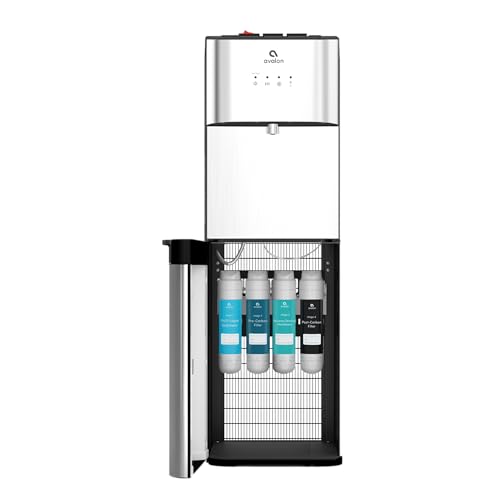
Avalon’s A7 is my top pick, and I’ve used it. Its manual covers installing off a refrigerator water line with a three-way plastic adapter, as well as an under-sink ⅜-inch valve.
Avalon’s tech specs: hot water 4 liters an hour at 185°F or more, from a 1.16-liter tank, and cold water 2.5 liters an hour at 47°F or below, from a 3.6-liter tank. The manual says the heater stops at 185°F and the cooler at 47°F.
It runs on 115 volts with a compressor, rated 420 watts heating and 100 watts cooling, 520 watts total. It’s 13 by 12 by 41 inches and weighs 39.7 pounds.
Avalon lists an applicable water pressure of 0.1 to 0.4 MPa, about 14.5 to 58 psi, on tap water. Filtration is two stages, sediment then carbon block; the listing names them A5FILTER and A4FILTER.
On NSF’s own listings (read Oct 24, 2026), the A4FILTER is certified to NSF/ANSI 42 and 53 for chlorine, taste and odor, Class I particulates, cysts and lead, as the filter in Avalon’s A4 system; the A5FILTER is listed only as a component, with no reduction claims.
The manual rates filter life at 1,450 gallons or 5.5 months. When that comes up, the green filter light goes out and the red change-filter light comes on.
Its leak detector shuts off the water intake on a possible leak, then blinks three lights and beeps, per the manual. The kit includes the ⅜-inch compression adapter with a valve, the three-way adapter, a flushing adapter and 20 feet of ¼-inch tubing.
You dispense with press paddles, the hot side has a child safety lock, and a nightlight shows the spouts after dark.
Avalon’s product page and the listing photo show hot and cold spouts; the manual’s feature page also mentions room-temperature water, so check the listing if you need a third tap.
Where it lost points: two filter stages scored 6.
My call: if you tap a fridge line, check that the existing ¼-inch tube is in good shape before you cut it in.
Reverse osmosis bottleless water cooler, stainless (A5-RO)
Prices and availability are accurate as of the time shown and may change.
You want reverse osmosis water from a freestanding cooler and have a drain line within reach of the tubing.
There’s no drain nearby; RO sends waste water to a drain, and the A7 needs none.
Avalon’s A5-RO is the bottleless cooler I’d pick for the most filtering, and I’ve used it. It puts a four-stage reverse osmosis system in the cabinet of a freestanding cooler.
The four stages, per Avalon’s spec sheet and manual: a sediment filter for rust, dirt and sediment; a pre-carbon block; an RO membrane, which Avalon says removes organic impurities such as bacteria, viruses and heavy metals (NSF’s listings show no A5-RO certification, read Oct 24, 2026); and a post carbon block for color, odor and residual chlorine.
It needs a drain. The manual has you run PE tubing from the waste water outlet on the back to your drain line, and the listing says a drain line is required for the RO waste water. Avalon doesn’t state how much water goes to the drain.
Hot water is 4 liters an hour at 185°F or more and cold water 2.5 liters an hour at 50°F or below, per the spec sheet; the manual says the heater stops at 185°F and the cooler at 47°F. Avalon notes the flow rate may drop because of the RO process.
It uses the same 0.1 to 0.4 MPa (about 14.5 to 58 psi) range, 115 volts, and 420 watts heating and 100 watts cooling as the A7. Avalon’s spec sheet gives 36.15 pounds net and the manual 42.8.
Its leak detector shuts off the water intake on a possible leak, and a UV LED runs the self-cleaning cycle; the spec sheet rates the LED for more than 10,000 hours.
The filter light blinks red near the end of filter life, by water flow or 6 months. The spec sheet also lists a 1,500-gallon figure without saying which filter it applies to, so I didn’t count it as a gallon rating for every filter.
Where it lost points: filter life by flow or months, without a gallon figure for each filter, scored 6.
Avalon’s warranty is 1 year, activated by registering within 30 days of purchase.
My call: route the drain tube where you can see it from the cabinet door, so a loose connection shows up early.
Brio 520 Series 4-stage UV self-cleaning bottleless water cooler, black (CLPOU520UVF4)
Prices and availability are accurate as of the time shown and may change.
You want to know when each filter is due by gallons, not guesswork, and you want the cold tank sanitized automatically.
Your house pressure runs over 58 psi and you won’t add a regulator; Brio rates its filters for 14.5 to 58 psi.
Brio’s 520 Series 4-stage cooler is the bottleless unit I’d pick for planned filter changes, and I’ve used it. Brio’s page calls it part of the 500 Series, with hot, cold and room-temperature water on demand.
Its manual lists four filters: sediment, carbon, ultrafiltration and post carbon. The sediment, carbon and post-carbon filters are each rated 950 gallons and 0.8 gpm, and the ultrafiltration filter 1,425 gallons at 0.5 gpm. The listing rates the membrane at 0.1 microns.
Brio’s replacement schedule is 6 months or 950 gallons for the sediment and carbon filters, 9 months or 1,425 gallons for ultrafiltration, and 6 months or 950 gallons for post carbon. Every filter is rated for 14.5 to 58 psi and 33 to 100°F water.
The UV cycle runs automatically; Brio says it sanitizes the cold water tank and protects against biofilm, with no chemicals.
It has leak detection: the manual says that if all three lights flash, a leak was detected, and to check every connection. The hot tap has a 2-step child lock.
The kit includes a feed water adapter with an extra nut for a ⅜-inch or ½-inch supply line and a 7-foot tube with a shut-off valve, per the manual. Brio says to keep the back of the cooler at least 8 inches from the wall.
Where it lost points: the manual gives no hot or cold water temperatures or cooling capacity, which scored 0. Brio’s page lists a 1-year warranty.
The listing says it’s UL listed and gives a 9.61-inch dispense height. It also claims NSF/ANSI 372 lead-free materials, but NSF’s own listings show no entry for the 520 or its filters (read Oct 24, 2026), so I don’t count that claim.
My call: flush the new filters for the full 10 minutes the manual asks, and switch the heater on only after the tanks have filled.
Bottleless water dispenser with built-in 4-stage filtration, stainless
Prices and availability are accurate as of the time shown and may change.
You want four stages of filtration and want to know exactly how hot and cold the water will be.
You want the cooler to sanitize itself; iSpring’s manual describes manual cleaning and draining.
iSpring’s DS4S is the bottleless cooler I’d pick when the numbers matter, and I’ve used it. iSpring’s manual gives a heating temperature of about 194°F and a cooling temperature of 41 to 48°F.
It draws 500 watts heating and 85 watts cooling, takes inlet water from 40 to 100°F, and measures 11.8 by 14.1 by 41.7 inches. iSpring’s page lists 41.4 pounds.
The manual says the cold control leaves the factory set to 4 to 8°C (39 to 46°F) for Energy Star compliance and can be turned colder with a dial at the back. The hot water temperature is factory set and can’t be adjusted.
Filtration is four stages: an FPDS polypropylene sediment filter (3 to 6 months), an FGKDS granular carbon and KDF compound filter that iSpring says reduces chlorine, lead and hydrogen sulfide (6 to 12 months), an FCDS carbon block (6 to 12 months) and an FTDS post carbon filter (6 to 12 months).
It has a leak-detect sensor; the manual’s troubleshooting table says a beeping dispenser means it detected water, and to remove and dry the sensor before resetting.
The kit includes 20 feet of ¼-inch tubing and an AFW43 feed adapter that fits ½-inch NPT and ⅜-inch compression supplies, plus an inline ball valve, per iSpring.
Where it lost points: the manual describes manual cleaning and draining, with no automatic UV or ozone cycle, which scored 0, even though the listing title says self-cleaning. Filter life in months only scored 6.
iSpring warns that hot water can reach 94°C (201°F) and lists a 1-year warranty.
My call: change the sediment filter on the short end of its 3-to-6-month range if you’re on well water; it protects the three filters behind it.
From the makers’ manuals and pages. Scroll sideways on a phone.
| Pick | Photo | Spec score | Filters | Hot | Cold | Self-clean | Leak protection | Pressure range | Buy |
|---|---|---|---|---|---|---|---|---|---|
| Avalon A7 | | 9.2 | 2 stages, 1,450 gal | ≥185°F, 4 L/h | ≤47°F, 2.5 L/h | UV | Shuts off intake | 0.1–0.4 MPa | Check it on Amazon |
| Avalon A5-RO | | 9.2 | 4 stages incl. RO | ≥185°F, 4 L/h | ≤50°F, 2.5 L/h | UV | Shuts off intake | 0.1–0.4 MPa; drain needed | Check it on Amazon |
| Brio 520 (4-stage) | | 8.0 | 4 stages, gallon-rated | Not stated | Not stated | UV | Leak alert | 14.5–58 psi (filters) | Check it on Amazon |
| iSpring DS4S | | 7.2 | 4 stages | About 194°F | 41–48°F | Manual cleaning | Leak sensor | Not stated | Check it on Amazon |
All four need a grounded outlet and a cold water supply; the A5-RO also needs a drain. Green marks a strength and amber a gap.
Pick your connection, enter your water pressure and the distance. It checks each kit.
Check pressure before you buy. Brio rates its filters for 14.5 to 58 psi, so measure your house pressure first. My call: if it reads higher, a water pressure regulator on the main, or a small one on the cooler line, brings it into range.
My call: put the cooler’s own shut-off valve where you can reach it without moving the cooler. Our under-sink shut-off valve guide covers the valves that hold up.
From each maker’s manual.
| Cooler | Stage | What it does | Change it |
|---|---|---|---|
| Brio 520 | Sediment | Sediment, dirt and rust | 6 months or 950 gal |
| Brio 520 | Carbon | Taste and impurities | 6 months or 950 gal |
| Brio 520 | Ultrafiltration | Suspended solids, bacteria, colloidal silica, pyrogens, large organics | 9 months or 1,425 gal |
| Brio 520 | Post carbon | Taste and impurities | 6 months or 950 gal |
| Avalon A7 | Sediment, then carbon block | A4FILTER NSF/ANSI 42 and 53; A5FILTER a listed component only | 1,450 gal or 5.5 months |
| Avalon A5-RO | Sediment | Rust, dirt and sediment | Light blinks by flow or at 6 months |
| Avalon A5-RO | Pre-carbon, RO membrane, post carbon | Odor, chlorine, organics; Avalon says the membrane removes bacteria, viruses and heavy metals | Light blinks by flow or at 6 months |
| iSpring DS4S | PP sediment (FPDS) | Sediment, dirt, sand, silt, rust, scale | 3–6 months |
| iSpring DS4S | GAC + KDF (FGKDS) | Chlorine, lead, hydrogen sulfide, odors | 6–12 months |
| iSpring DS4S | Carbon block (FCDS) | Chlorine, odor, taste | 6–12 months |
| iSpring DS4S | Post carbon (FTDS) | Chlorine, odor, taste | 6–12 months |
A bottleless cooler is only as clean as its filters. My call: mark the install date on each filter with a marker, and replace by the date or the gallon count, whichever comes first. For whole-sink filtration instead of one cooler, see our under-sink water filter guide.
How each maker keeps the tanks clean.
| Cooler | Automatic cleaning | Manual cleaning in the manual |
|---|---|---|
| Brio 520 | UV cycle sanitizes the cold tank | Vinegar solution through the tanks |
| Avalon A7 and A5-RO | Self-cleaning UV function | Rinsing, cleaning and draining steps |
| iSpring DS4S | None described | Drip tray, exterior and reservoir draining |
UV sanitizing helps keep biofilm down in the tank, but it doesn’t replace filter changes or occasional draining. Brio’s manual gives a cleaning solution of 0.3 gallons of vinegar and 0.3 gallons of hot tap water. My call: drain and rinse any of these after a week of non-use.
The common steps across the four manuals.
At the sink stop or fridge-line valve you’ll tap.
⅜ in. compression or ½ in. NPT; Avalon also tees into a fridge line.
Tubing from the waste water outlet to a drain line.
Cut square, push fully into the fittings.
Brio: 1.5 to 3 gallons, about 10 minutes.
Fill the tanks before switching on hot and cold.
The manuals warn against turning on the heater before the tank is full. iSpring says to let the cooler stand upright before plugging it in if it was laid down in transit, and Brio says never to tilt it more than 45 degrees.
From the makers’ specs.
| Cooler | Heating | Cooling | Size (L × W × H) | Weight |
|---|---|---|---|---|
| Brio 520 | Not stated | Not stated | See manual drawing | Not stated |
| Avalon A7 | 420 W | 100 W | 13 × 12 × 41 in. | 39.7 lb |
| Avalon A5-RO | 420 W | 100 W | 13 × 12 × 41 in. | 36.15 lb (spec sheet) or 42.8 lb (manual) |
| iSpring DS4S | 500 W | 85 W | 11.8 × 14.1 × 41.7 in. | 41.4 lb |
My call: give a cooler its own outlet rather than a power strip; heating elements this size can trip a shared circuit. Brio asks for 8 inches behind the cooler for ventilation.
The trade-off, in plain terms.
Water comes from the line, filtered at the cooler.
Brio, iSpring and the A5-RO use four stages; the A7 two.
Within reach of the kit’s tubing, or you add tubing.
Better for rentals where you can’t tap a line.
For instant hot water at the sink instead of a freestanding cooler, see our instant hot water dispenser guide.
From each maker’s troubleshooting section.
| Cooler | What you see | What it means | What the manual says to do |
|---|---|---|---|
| Brio 520 | All three lights flash | Leak detected | Check every connection, then reset |
| Avalon A7 and A5-RO | Three lights blink and it beeps | Possible leak; water intake shut off | Find and fix the leak before resetting |
| Avalon A7 | Green filter light off, red light on | Filters at 1,450 gallons or 5.5 months | Replace the filters |
| Avalon A5-RO | Filter light blinks red | Filters near end of life (by flow or 6 months) | Replace the filters |
| iSpring DS4S | The dispenser beeps | The leak sensor detected water | Remove and dry the sensor, then reset |
My call: on a new install, check first that every tube is pushed fully into its fitting. Shut the supply valve, pull the tube, cut a fresh square end, and push it in until it seats past the O-ring. Then dry the base before you reset, or the sensor trips again.
If the alert comes back with dry fittings, check the feed adapter at the supply stop. My call: a compression nut that was only snugged by hand can weep under house pressure, and that drip runs down the tube to the cooler’s base. On the Avalon, the intake stays shut until you reset it, so a dry floor doesn’t mean the leak is fixed.
From each maker’s page.
| Cooler | Warranty | Condition |
|---|---|---|
| Brio 520 | 1 year | Brio’s page; using another type of filter voids it, per the manual |
| Avalon A7 and A5-RO | 1 year limited; 2-year extended sold | Register within 30 days of purchase |
| iSpring DS4S | 1 year | Unauthorized parts or modifications void it, per the manual |
These came up on Amazon on Oct 24, 2026.
| Cooler | What we found | Why it’s out |
|---|---|---|
| Avalon A5 (A5BOTTLELESS) | Sold by Amazon.com; same two filters as the A7 | Scores 8.4: its manual gives filter life by flow or 6 months, not gallons |
| Brio 520 2-stage (CLPOU520UVF2) and Brio 420 2-stage | In stock | Two filters; the 4-stage Brio 520 covers the line |
| Avalon countertop B8 and A12 | In stock | Countertop units, a different kind |
| Oasis POU1ACTHSK Aquarius | In stock (reseller) | Countertop; no maker spec sheet read |
| Elkay ezH2O bottle fillers | In stock | Wall-mounted fountains, a different kind |
| Primo bottom-load coolers | In stock | Bottled, not bottleless |
| Clover D7A | Ships with no filter; listing names no filter life, temperatures, self-clean or leak protection | Scores 0.0 on listing data |
| Clover D16A | Listing gives 185°F hot and 50°F cold; no filter stages, filter life, self-clean or leak protection | Scores 2.0 on listing data |
| Clover ICON D25-B-TL | Cold and room temperature only; one carbon stage, UV tank | Scores 2.6 on listing data; no hot water |
| SimzLife bottleless cooler | Not found on Amazon | Ranks on Google from Target; no Amazon listing to link |
| Question | If yes | If no |
|---|---|---|
| Tapping an existing fridge line? | Avalon A7 | Keep going |
| Want reverse osmosis, with a drain nearby? | Avalon A5-RO | Keep going |
| Want filters you can schedule by gallons? | Brio 520 | Keep going |
| Need to know the exact hot and cold settings? | Avalon A7 or iSpring DS4S | Keep going |
| Want the tank cleaned automatically? | Either Avalon or Brio 520 | iSpring DS4S |
A water cooler that connects to a cold water line and filters the water itself, so there’s no 5-gallon bottle.
With ¼ in. tubing from a feed adapter on a ⅜ in. compression or ½ in. supply; Avalon can also tee into a fridge line.
The kits are built for DIY install; if you’re not comfortable shutting off and tapping a line, hire a plumber.
Avalon lists 0.1 to 0.4 MPa, about 14.5 to 58 psi; Brio rates its filters for the same range.
Avalon: 185°F or more; iSpring: about 194°F, and it warns it can reach 201°F. Brio doesn’t state a figure.
Avalon: 47°F or below on the A7, 50°F or below on the A5-RO; iSpring: 41 to 48°F, adjustable colder.
Brio: 6 to 9 months or 950 to 1,425 gallons; iSpring: 3 to 12 months by stage; Avalon A7: 1,450 gallons or 5.5 months; A5-RO: at the light, by flow or 6 months.
Yes, for heating and cooling; plug into a grounded outlet.
They can if a fitting fails; all four have leak detection, and Avalon’s shuts off the water intake.
It sanitizes the tank between uses to limit biofilm; it doesn’t replace filter changes.
They avoid buying bottles; you pay for filters and electricity instead.
The makers list tap water; on well water, test first and change sediment filters sooner.
It includes filters, but it also heats and chills water for dispensing.
Near a cold water line and a grounded outlet, with room behind for air; Brio asks for 8 in.
Not on the iSpring; its hot temperature is factory set.
The Avalon A5-RO, with four stages including a reverse osmosis membrane. The Brio 520 and iSpring DS4S also have four stages, without RO.
I’m Isaac Daniels, a licensed journeyman plumber in Georgia (license #JP507711), and I’ve used all four picks. Specs come from Avalon’s, Brio’s and iSpring’s own manuals, spec sheets and pages, read Oct 24, 2026. My own advice is labeled as my call.
Each check scores 0 to 10 and counts one fifth. It’s our score from maker documents, not a customer rating.
| Check (weight) | How it’s scored |
|---|---|
| Filter stages (⅕) | 10 for 4 stages; 8 for 3; 6 for 2; 3 for 1; 0 when not stated |
| Filter capacity stated (⅕) | 10 when every filter has a gallon rating; 6 for months or a light only; 0 when filter life isn’t stated |
| Automatic self-clean (⅕) | 10 for an automatic UV cycle the maker describes; 0 for none described |
| Temperatures published (⅕) | 10 when the maker gives hot and cold water temperatures; 0 when not |
| Leak protection (⅕) | 10 when the manual describes leak detection; 0 when not |
| Total | Average of the checks, to one decimal |
| Ties | A cooler that needs no drain line is listed first, because it installs without one; that puts the A7 ahead of the A5-RO |
| Pick | Stages | Capacity | Self-clean | Temps | Leak | Score |
|---|---|---|---|---|---|---|
| Avalon A7 | 6 (2) | 10 (1,450 gal) | 10 (UV) | 10 | 10 | 9.2 |
| Avalon A5-RO | 10 (4) | 6 (flow or 6 mo) | 10 (UV) | 10 | 10 | 9.2 |
| Brio 520 | 10 (4) | 10 (gallons) | 10 (UV) | 0 | 10 | 8.0 |
| iSpring DS4S | 10 (4) | 6 (months) | 0 | 10 | 10 | 7.2 |