
Korky Beehive Mini 94-4A
$23.96 at Amazon
Check it on AmazonPrice as of Oct 24, 2026, 5:30 AM EDT

Find where the clog sits, then use the right tool in the right order.
As an Amazon Associate I earn from qualifying purchases.
In a shower, tub or bathroom sink, pull the hair out first with a hair tool. Then plunge with a sink plunger, the overflow covered. If neither works, the clog is past the trap: clean the trap or feed a 1/4 in. drum cable.
Pick the drain and what it’s doing. The finder gives the likely spot and the order to work in.
The order matters more than the tool. A plunger and a hair tool cost little and take minutes. Pulling a trap means a bucket and some mess. A drum cable is the last homeowner step, because it reaches past the trap where the first three can’t.
Toilets are their own job, with their own plunger and auger: see how to unclog a toilet. A sink that’s slow but not stopped has its own guide too: slow-draining sink.
Almost every fixture drains the same way: a short drop, a U-shaped trap that holds water, and an arm into the wall.
| Fixture | Smallest trap (IPC Table 709.1) | What usually clogs it |
|---|---|---|
| Bathroom sink (lavatory) | 1-1/4 in. | Hair, soap and toothpaste at the stopper |
| Shower, up to 5.7 gpm | 1-1/2 in. | Hair and soap at the strainer |
| Bathtub | 1-1/2 in. | Hair on the stopper linkage |
| Kitchen sink, with or without a disposal or dishwasher | 1-1/2 in. | Grease and food in the trap and arm |
Those sizes matter for the cable. RIDGID rates the Power Spin for lines up to 1-1/2 in., so every trap in the table is inside its range. A bathroom sink’s 1-1/4 in. trap is the tightest, and it’s also where the hair tool does most of the work.
The code also limits the drop from the fixture to the trap to 24 inches. That’s why most clogs you can reach are within arm’s length of the fixture: the trap is right there under it. If the trap size by fixture is new to you, that guide has the full table.
Three tools cover almost every sink, shower and tub clog. I’ve used every tool in this kit.

Product prices and availability are accurate as of the date/time indicated and are subject to change. Any price and availability information displayed on Amazon.com at the time of purchase will apply to the purchase of this product.
| Tool | Key specs | Pick it if | Skip it if |
|---|---|---|---|
| Korky 94-4A Beehive Mini | 5.5 in. cup, 9 in. T-handle, non-marking rubber, made in the USA. This listing is a 2-pack | You need a plunger that seals on a flat sink, tub or shower drain. | It’s a toilet. A sink cup won’t seal in a bowl; use a flanged toilet plunger. |
| FlexiSnake Drain Weasel DWPSK5A | 18 in. micro-hook wands on a spinning handle, wands snap in and out | Hair is the problem: a shower, tub or bathroom sink that slowed over weeks. | It’s a kitchen sink. Grease and food don’t hook. |
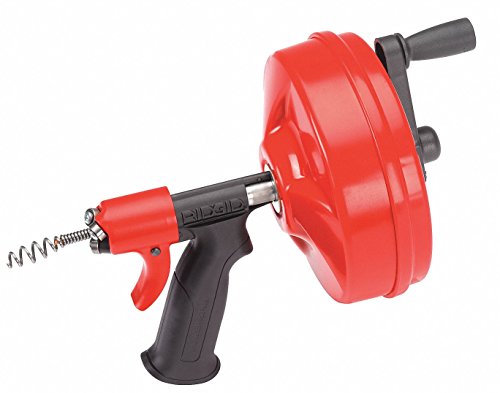
| RIDGID Power Spin 41408 | 1/4 in. × 25 ft MAXCORE cable, lines up to 1-1/2 in., hand crank or drill at 500 rpm max | The plunger and trap didn’t clear it, and the clog is in the arm or wall. | It’s a toilet. RIDGID says the Power Spin isn’t recommended for toilets. |
Two notes from the listings. Korky’s page lists 94-4A as an alternate part number for the 94-4 Beehive Mini, and this listing sells two, which is handy with one for the kitchen and one for the bathroom. Amazon’s Drain Weasel listing says five refill wands, while the maker’s page for the same DWPSK5A kit says six. Count what arrives.
The RIDGID listing calls the Power Spin a toilet auger. RIDGID’s own manual says it’s made for sinks, tubs and showers and is not recommended for toilets, so I go by the manual. For a toilet, the toilet auger vs drain snake guide covers the right tool.
Other things you’ll want on hand: a bucket, rags, an old toothbrush, rubber or leather gloves, safety glasses and a flashlight. Channel locks help on a stubborn slip nut, but most come off by hand.
Every extra gallon is water you’ll have to bail out or catch in a bucket.
If anyone poured a chemical cleaner in, don’t plunge. Drano’s label says never use a plunger during or after use, because the cleaner may still be there.
RIDGID’s manual calls for safety glasses and gloves, because drains can hold chemicals and bacteria.
Empty it and set a bucket and rags under the trap before you touch anything.
A flashlight down the drain often shows hair or a lost cap you can just pull out.
That chemical step is the one that hurts people. A plunger stroke can push a cleaner back up out of the drain and onto your hands or face. If a cleaner is in there and the drain is still stopped, let the water sit, ventilate the room and read the product’s label before doing anything else.
From Korky’s instruction sheet for the Beehive Mini. The covers are what most people skip.
Korky says to put a wet rag over the sink overflow, the dishwasher vent and the other side of a double sink. Air escaping through any of them takes the push with it.
There should be enough water in the sink to cover the base of the plunger.
Tip the plunger in at an angle so the head fills with water, then set it flat over the drain.
Pump in an even up-and-down motion for 10 to 15 seconds, then break the seal.
Do it again until the water drains.
Once it’s clear, run hot tap water to carry the loose debris away.
Why water and not air: water doesn’t compress, so each stroke moves the clog. A cup full of air mostly squeezes the air. That’s why Korky has you tip the cup in to fill it.
On a tub, the overflow is the round plate under the faucet. Hold a wet rag over it with your free hand, or have someone press it. On a shower, the drain usually has no overflow, so you only need to cover a second drain if there is one.
My call: give it three rounds. If the water hasn’t moved after three honest tries, the clog isn’t one a plunger will push, and the next step will get further.
Hair doesn’t dissolve in water and it doesn’t push well either. You pull it out.
On a bathroom sink, loosen the pivot nut behind the drain and pull the rod, then lift the stopper. RIDGID’s manual shows the same step: remove the lift rod and drain plug.
Most of the hair is wrapped on it. Pull it off and rinse it.
On a shower, the strainer pops out or comes off with one or two screws.
Push the wand in, spin the handle so the hooks catch, then pull straight up.
Keep going until a pass comes up clean.
Then put the stopper or strainer back.

The Drain Weasel’s wands are thin and flexible on purpose. They follow the bend under a shower drain where a straight rod stops. The maker sells refill packs, because a wand full of hair is easier to throw out than to clean.
If the stopper itself won’t lift or close, that’s a separate fix: bathroom sink stopper not working. To stop the hair before it gets in, the shower drain size and hair catcher fit guide matches a catcher to your drain.
Under a sink, the trap is held by two slip nuts. If the clog is in the trap, this clears it for sure.
It’s full of water, and anything above it comes down too.
Turn them by hand, counterclockwise as you look from below. Use channel locks only if they won’t budge.
Lower it into the bucket and look inside. Grease, food, hair or a lost ring usually comes out here.
Look into the arm toward the wall with a flashlight. If you see the clog, it’s past the trap: go to the cable.
Each slip joint seals on a plastic or rubber washer. Wipe it clean, seat it flat and replace any that’s cracked.
Hand-tighten the nuts, run water for a minute and feel every joint for drips.
The code allows slip joints only at the trap’s inlet, outlet and within the seal, and they have to seal on a gasket (IPC 2024 section 1002.2). That gasket is what keeps the joint dry. A nut cranked down hard on a crooked washer leaks; a washer seated flat seals hand-tight.
The trap has to refill with water before you’re done. That water seal is what stops sewer gas from coming into the room. Running the tap for a minute does it.
Some older houses have metal traps, which can be thin with age. If a slip nut won’t turn by hand, hold the trap steady while you turn it so you don’t twist the pipe in the wall.
From RIDGID’s Power Spin operator’s manual. Go slow: a cable that’s forced kinks or breaks.
On a sink, take the stopper out or pull the trap. On a tub, take off the overflow plate, never the drain. On many showers, the cable fits through the strainer’s cross bars.
RIDGID says to keep the drum within 4 inches of the drain so the cable has support.
Pull the AUTOFEED trigger and turn the drum clockwise. With a drill, use a low speed under 500 rpm.
If the cable stops turning, stop. Back it off a little, then feed again.
Stop turning before the cable tip leaves the drain, so it doesn’t whip.
Run water down the drain. RIDGID says to flush the cable, drum and AUTOFEED with water after every use.
The tub rule is worth a second look. RIDGID says going through a tub drain will damage the cable. The overflow opening gives the cable a straight shot down to the tub’s trap.
RIDGID rates the Power Spin for up to 25 feet of line up to 1-1/2 in. That covers the run from a fixture to the branch in the wall. A clog further out, in a 3 in. or 4 in. line, is a job for a bigger machine; the drain cleaning machine guide covers those. For the difference between cable types, see types of drain snakes.
A kitchen clog is usually grease and food, and the double bowl gives the push a way out.
| Set-up | Before you plunge | Watch out for |
|---|---|---|
| Double bowl | Plug or hold a wet rag over the other drain | The push goes up the other side if it’s open |
| Dishwasher hooked to the sink | Cover the dishwasher vent on the deck, as Korky’s sheet says | Dirty water forced back toward the dishwasher |
| Disposal on one side | Plunge with the disposal side covered | Never run the disposal with a chemical cleaner in it; Drano says it can splash back |
| Single bowl | Make sure there’s water over the drain | Grease in the arm, past the trap |
Korky’s Beehive Mini is listed for sinks with or without garbage disposals. If the disposal itself hums or won’t turn, that’s a disposal problem first: garbage disposal not working. If the dishwasher is the one leaving water behind, see dishwasher not draining.
My call on grease: it goes in the trash, not the drain. Hot grease runs down fine and sets up cool in the trap and arm, and that’s where kitchen cables keep finding it.
What the pipe maker and the cleaner’s own label say, before you pour anything.
| What people pour | What the source says | My call |
|---|---|---|
| Boiling water | Charlotte Pipe rates ABS and PVC to 140°F; Drano says flush with hot, not boiling, water | Hot tap water only. Most house drains today are plastic |
| Hot tap water | Korky’s sheet ends with running hot water after the clog clears | Good for flushing loose debris after the clog is gone |
| Gel drain cleaner | Drano: 16 oz, wait 15 to 30 minutes, never plunge during or after, not in toilets | A slow drain only, never a stopped one you might plunge |
| Mixing two cleaners | Drano: don’t mix with other cleaners or chemicals; hazardous fumes or a violent reaction can result | Never |
| Baking soda and vinegar | No maker rating found | Fine for a smell, but I don’t count on it for a real clog |
The 140°F figure is in Charlotte Pipe’s plastics technical manual as the maximum operating temperature for ABS and PVC. Boiling water is 212°F at sea level, well over that. On an old cast iron or galvanized drain, heat isn’t the worry, but the plastic trap under the sink usually is plastic anyway.
Chemical cleaners have a place on a slow drain you won’t be opening. For which ones work and how they differ, see the best drain cleaners, does Drano work and enzyme vs chemical drain cleaner.
One slow fixture is a fixture clog. Two or more at once points downstream, and the homeowner tools stop there.
| What you see | Where it likely is | Next step |
|---|---|---|
| One sink, tub or shower is slow | That fixture’s stopper, trap or arm | The steps above |
| Tub gurgles when the sink next to it drains | The branch the two share | Cable from the sink; if it doesn’t clear, call a plumber |
| Water comes up in the tub when the toilet flushes | The main drain or the bathroom branch | Stop using water and call a plumber |
| Every drain on the lowest floor is slow | The building drain or sewer | Find the main cleanout; this is past a 1/4 in. cable |
A small cable fed from a sink won’t reach or turn a clog in a 3 in. or 4 in. main. The clogged drain vs main line guide walks through the signs, drain cleanout locations shows where the access is, and cost to unclog a main drain gives price ranges.
| Mistake | What happens |
|---|---|
| Plunging with the overflow open | The push escapes up the overflow and the clog doesn’t move |
| Plunging after a chemical cleaner | Drano says never; the cleaner can come back up at you |
| Pouring boiling water into a plastic drain | Over the 140°F rating Charlotte Pipe gives ABS and PVC |
| Feeding a cable down a tub drain | RIDGID says it damages the cable; use the overflow |
| Running a drill fast on a drum cable | RIDGID limits the Power Spin to 500 rpm |
| Cranking slip nuts tight on a crooked washer | The trap leaks under the cabinet |
| Using a sink plunger on a toilet | It can’t seal in the bowl’s outlet |
That’s past the fixture. Stop using water until it’s cleared.
Don’t plunge or open the trap. Tell the plumber what was poured in.
Don’t force it. A stuck cable can kink, and pipes in poor shape can be damaged.
The same clog every few weeks often means a problem further down the line.
RIDGID’s manual says piping in poor condition may be damaged by drain cleaning, and suggests a camera to check it. That’s a plumber’s tool. If you’d rather hand off the whole job, the plumbing cost estimator gives a range for your area.
| Drain | What to do |
|---|---|
| Shower and tub | Fit a hair catcher and empty it after showers |
| Bathroom sink | Pull and rinse the stopper every few months |
| Kitchen sink | Scrape plates into the trash and keep grease out of the drain |
| Any drain after a clear | Run hot tap water for a minute to carry the loose bits away |
A hair catcher does more than any cleaner, because it stops the hair before it reaches the trap. Keep the plunger under the sink where you’ll find it, so the first slow drain gets plunged before it becomes a stopped one.
A sink plunger with the overflow covered and enough water to cover the cup. If it’s hair in a shower or bathroom sink, a hair tool is just as fast. Both take a few minutes.
Work in order: plunge, pull the trap and clean it, then run a 1/4 in. drum cable into the arm. If water comes up in another drain, stop: the clog is in the main line.
Pulling it out works better than dissolving it. A hair tool with small hooks lifts it out of a shower or sink drain in a pass or two. Chemical gels are sold for hair, but Drano’s label says never to plunge during or after using them.
A plunger, a hair tool for hair clogs and a drum cable for clogs past the trap. For a main line, a bigger machine and a camera.
Not safely on plastic pipe. Charlotte Pipe rates ABS and PVC to 140°F, and boiling water is 212°F. Even Drano says to flush with hot, not boiling, water. Use hot tap water.
No. Drano’s label says never to use a plunger during or after use, because the cleaner may still be in the drain if it didn’t clear.
Lift the strainer and pull the hair out with a hair tool. If the water still stands, plunge it with any second drain covered. If that fails, feed a 1/4 in. cable through the strainer.
I’m Isaac Daniels, a licensed journeyman plumber in Georgia (license #JP507711). I’ve used every tool in the kit. The steps and numbers come from Korky, RIDGID, Drano and Charlotte Pipe documents and the 2024 International Plumbing Code, read on Oct 22, 2026.