
RIDGID K-6DH
$89.34 at Amazon
Check it on AmazonPrice as of Oct 23, 2026, 5:30 AM EDT

Find out whether it’s the flush, the paper or something stuck, and fix that.
As an Amazon Associate I earn from qualifying purchases.
A toilet that clogs often has a weak flush or a partial blockage. Weak swirl? Clean the rim holes and check the water level. Strong flush that still clogs? Something is stuck: run a toilet auger.
Answer four questions. The finder points to the most likely cause and the fix.
| What you see | Most likely cause | Go to |
|---|---|---|
| Slow, weak swirl; bowl drains lazily | Mineral-blocked rim and jet holes | Weak flush |
| Tank water well below the overflow pipe | Low water level | Weak flush |
| Handle has to be held down to flush fully | Flapper closing too soon or too much chain slack | Flapper |
| Clogs since switching toilet paper | Paper that doesn’t break down | Paper test |
| Strong flush, still clogs, plunger barely helps | Object stuck in the trapway | Auger |
| Tub or sink gurgles when the toilet flushes | Drain line or vent | Drain line |
| Order | Check | Time | Cost |
|---|---|---|---|
| 1 | Paper jar test (Kohler) | 2 minutes | None |
| 2 | Tank water level and refill tube (Fluidmaster, Kohler) | 10 minutes | None |
| 3 | Flapper chain slack and setting (Fluidmaster) | 10 minutes | None, or a new flapper |
| 4 | Rim and jet holes (Fluidmaster, Kohler) | Overnight soak | A bottle of lime cleaner |
| 5 | Auger the trap | 15 minutes | A toilet auger |
| 6 | Drain line or vent | Plumber | A service call |
Kohler’s first answer to frequent clogging isn’t the toilet at all.
Put tap water in a quart mason jar.
Drop in a single-ply sheet of the toilet paper you use.
Shake moderately for about 10 seconds, the length of a typical flush.
The paper that dissolves or shreds most will flush best and clog least, Kohler says.
Kohler explains why paper matters: some grades contain lanolins, dyes and other compounds that add softness, fragrance or strength but keep the paper from breaking down in flowing water. Paper makers also use different pulp, so two rolls that feel alike can behave very differently in a toilet.
Try two or three brands side by side in jars. If yours stays in a sheet while another shreds, switching paper is the easiest fix on this page. Wipes, even ones sold as flushable, are worth keeping out of a toilet that already clogs often.
Fluidmaster says minerals and rust building up in the rim feed and jet holes are a common cause of a weak or incomplete flush.
Turn off the supply valve and hold the flapper open to let most of the water out.
Fluidmaster pours 1–2 cups of a toilet bowl cleaner such as Lime-A-Way down the flush valve opening, holding the flapper open. Don’t let it spill into the tank.
Leave it several hours or overnight; Kohler says 8–24 hours. It works into the channels and dissolves the buildup.
Work a wire hanger, paper clip or finishing nail in and out of the holes under the rim to break up hard deposits.
Bend a small hook in a wire hanger and fish out any paper or waste trapped in the jet hole at the bottom of the bowl.
Turn the water back on and flush several times to clear the cleaner and loosened deposits.
Kohler adds a detail for stubborn rim holes: block them with wet paper towels held by plumber’s putty so the cleaner stays in the rim channel. Kohler also notes that bits of vitreous china can shake loose during shipping and lodge in a new toilet’s rim holes, one reason a brand-new toilet can flush weakly.
Next, check the water level. Fluidmaster says that if the water is more than 1 in. below the top of the overflow pipe, there may not be enough for a good flush. Raise it to within 1 in. of the top with the adjustment screw on the fill valve, or by raising the fill valve.
Fluidmaster warns against in-tank drop-in cleaners containing bleach or chlorine: they damage tank parts, may cause flooding and void its warranty.
If the water level is right and the flush is still short, the flapper may be dropping before enough water leaves the tank. Fluidmaster says most toilets need only about 1/2 in. of slack in the flapper chain; too much and the flapper doesn’t lift far enough.
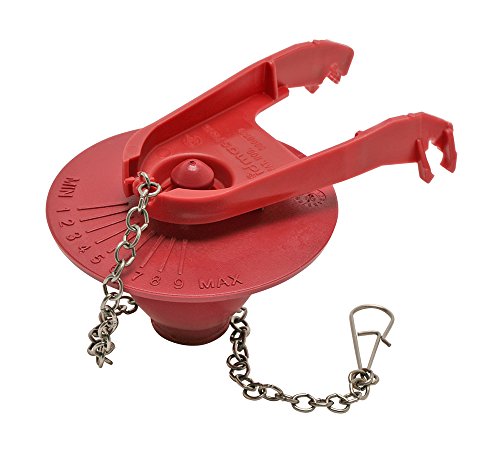
On toilets that use 1.6 or 1.28 gallons per flush, Fluidmaster’s adjustable flappers let you set how long the flapper stays open. The Fluidmaster 502P21 fits most 2 in. flush valve toilets from 1.28 to 3.5 gallons per flush, per its listing, and carries a five-year warranty. Toilets that use 5.0 gallons or more should use a non-adjustable flapper, Fluidmaster says.
The number in front of the chain on top of the flapper is the current setting, from 1 (closes fastest) to 9 (stays open longest).
Drop 2–3 pieces of toilet paper in the bowl and flush.
If the bowl clears, lower the setting by one and flush again.
When the bowl stops clearing, go back up one setting. That’s the most water-efficient setting that still clears.
For a toilet that keeps clogging, I’d set it one notch higher than that, trading a little water for a margin on heavy flushes. For a 3 in. flush valve, Fluidmaster points to its 3 in. flush valve kits instead of the 2 in. 502.
Look for the water line marked inside the tank, or measure down from the top of the overflow pipe.
Fluidmaster’s rule: the water should sit within 1 in. of the top of the overflow pipe.
Turn the adjustment screw or clip on the fill valve to raise the float, or raise the whole fill valve on its shank.
Let it refill and check again. Water should never run into the overflow pipe; if it does, lower it slightly.
| Rule | Gallons per flush | Source |
|---|---|---|
| Federal maximum, gravity tank toilets (since 1994) | 1.6 | 10 CFR 430.32 |
| Federal maximum, blowout bowls | 3.5 | 10 CFR 430.32 |
| WaterSense labeled toilets | 1.28 or less | EPA WaterSense |
| Older toilets EPA calls inefficient | Up to 6 | EPA WaterSense |
EPA is candid about the history. It says the low-flow toilets of the 1990s were sometimes linked to performance problems, such as needing a double flush, and that makers have since redesigned them. When EPA wrote the WaterSense criteria it added a test of how well a toilet clears waste from the bowl, and those performance criteria have since been adopted into the national plumbing standard, ASME A112.19.2/CSA B45.1.
So a modern 1.28 or 1.6 gallon toilet that clogs every week isn’t doing what it was tested to do. Before blaming the low flow, run through the paper, rim, water level and flapper checks; one of them usually brings the flush back.
EPA describes the reduced flush on a dual-flush toilet as a smaller volume of water for liquid waste. Using the reduced button for solids is a common cause of clogs on these toilets. Use the full flush for paper and solids.
Many dual-flush toilets use a canister or tower flush valve instead of a flapper, so the flapper steps above don’t apply. Fluidmaster has separate guidance for dual flush toilets that don’t work properly, and Kohler’s support guide branches by canister and flapper valves for the same reason.
EPA says household leaks can waste 180 gallons a week, toilets are often the culprit, and most toilet leaks come from old or worn-out flappers. A flapper that leaks lets the tank drop between flushes, which means a lower water level and a weaker flush when you need it.
If you hear the tank refill on its own, or the water level in the tank creeps down, replace the flapper. EPA calls it an inexpensive part that’s quick and easy to replace.
The tank refills on its own between flushes, you hear a hiss, or the water line in the tank drops overnight.
The tank stays full and silent between flushes, and the water sits at the same line in the morning.
The bowl’s standing water is part of the flush: it helps start the siphon that pulls waste through the trap. Kohler says that if the bowl water level is low, check that the rim feed hose is connected to the flush valve.
The rim feed hose, often called the refill tube, runs from the fill valve and directs water into the bowl while the tank refills. Kohler says it goes into the top of the flush valve, also called the overflow tube, sometimes held with a clip, and should not point out into the tank. If it’s loose, the tank refills but the bowl stays low, and the next flush is weaker.
Refill tube clipped into the top of the overflow tube; water runs into the bowl while the tank refills.
Refill tube loose in the tank or pointing into the tank water; the bowl level stays low.
A tank that doesn’t refill to its line gives a short flush next time. Fluidmaster says the main reason is the fill valve: debris in the valve, supply line or shutoff restricts the flow, and valves in use 7 years or more start to wear out.
Turn off the supply and flush the tank empty.
Hold the float cup and the shaft all the way up so the valve doesn’t turn.
On Fluidmaster’s 400A, turn the cap and arm counterclockwise 1/8 turn and lift it off.
Hold a cup upside down over the opening and turn the water on full for 10–15 seconds to blow out debris.
Lock the cap back on. If it still fills slowly, Fluidmaster’s next step is a new seal or a new fill valve.
A plunger moves water. An auger goes through the trapway and hooks or breaks up what’s caught.
If a strong flush still clogs every few days, the usual story is a partial blockage in the trapway: a comb, a toy, a pen cap or a wad of wipes that lets water pass but catches paper. Plunging pushes the paper through each time, and the object stays put.
RIDGID says 3 ft of auger cable reaches completely through the toilet, and its 6 ft K-6DH can clear beyond it. The RIDGID K-6DH cranks by hand or with a battery drill under 500 rpm, has a drop head for toilets where the outlet sits low, and carries RIDGID’s full lifetime warranty.
Seat the auger’s bend in the bowl outlet so the cable, not the metal tube, touches the porcelain.
Push the cable in while cranking clockwise until you feel it catch or pass through.
Keep cranking as you retract. Hooked objects come back with the cable.
Drop a few sheets in and flush. If it clears cleanly, the trap is open.
A hard object that won’t pass or hook may need the toilet lifted and pushed out from below.
The toilet auger guide compares drop-head, bulb-head and short augers, and toilet auger vs drain snake explains why a regular drain snake isn’t the right tool for a toilet.
A flat sink plunger won’t seal on a toilet’s outlet. A flange or beehive plunger does. The Korky BeehiveMAX 97-5A has a beehive head with a 6 in. cup and a 16 in. collapsible T-handle, and Korky says it fits all toilet makers, including high-efficiency bowls.
Seat the plunger, push gently first to push out the air, then work it with firm strokes while keeping the seal. Enough water in the bowl to cover the cup makes the stroke move water instead of air. The toilet plunger guide compares flange and beehive heads.
A tub or shower backs up when the toilet flushes, several drains are slow, or toilets on the lowest floor clog first.
Drains gurgle, the bowl water level bounces when another fixture drains, and the flush feels weak with no mineral buildup.
The codes require every trap to be protected from siphonage and back pressure by venting. A blocked vent starves the drain of air, so water slows and the toilet’s flush loses its pull. Vents usually run through the roof, so clearing one is a plumber’s job.
The IPC sets every fixture trap’s water seal at 2 to 4 in. deep. A toilet is unusual in the code: it’s treated as self-siphoning, and the IPC doesn’t limit how far its trap can sit from the vent fitting. That’s why a toilet tolerates odd vent layouts better than a sink, and why gurgling at a toilet usually means a real blockage downstream.
A main line clog shows up first at the lowest fixture. The clogged drain vs main line guide explains how to tell, and why the main drain keeps clogging covers the line itself.
Four items cover the fixes above. Each was new and in stock on the day of the update. Prices come from Amazon with the time they were read.


Product prices and availability are accurate as of the date/time indicated and are subject to change. Any price and availability information displayed on Amazon.com at the time of purchase will apply to the purchase of this product.
| Tool or part | Key specs | Pick it if | Skip it if |
|---|---|---|---|
| RIDGID K-6DH | 6 ft cable, drop head, hand crank or drill under 500 rpm, lifetime warranty | A strong flush still clogs, or plunging barely helps. | You only get the occasional clog that a plunger clears. |
| Korky BeehiveMAX 97-5A | Beehive head, 6 in. cup, 16 in. T-handle, holder | You need a plunger that seals on modern bowls. | You already own a flange plunger that seals well. |
| Fluidmaster K-400H-039 | PerforMAX fill valve plus adjustable 2 in. flapper | The tank fills slowly and flushing the valve didn’t help, or the fill valve is 7+ years old. | Your fill valve is new and the tank fills fine. |
| Fluidmaster 502P21 | Adjustable 2 in. flapper, 1.28–3.5 gpf toilets, 5-year warranty | The flush is short and the flapper drops fast. | Your toilet has a 3 in. flush valve or a canister valve. |
I’ve used each of these. If I could keep only one, it would be the auger: it’s the only tool here that removes what causes a repeat clog instead of pushing the latest one through.
| Habit | Why | Source |
|---|---|---|
| Use paper that passes the jar test | Some papers don’t break down in flowing water | Kohler |
| Clean the rim holes when the swirl slows | Mineral buildup weakens the flush | Fluidmaster, Kohler |
| Keep the tank water within 1 in. of the overflow top | Low water means a short flush | Fluidmaster |
| Keep 1/2 in. slack in the flapper chain | Too much slack closes the flapper early | Fluidmaster |
| Skip bleach drop-in tank tablets | They damage tank parts | Fluidmaster |
| Flush twice for heavy loads | Gives the trap two clear pulls | Practice |
| What people try | What happens |
|---|---|
| Chemical drain cleaner in the bowl | It can’t remove an object caught in the trap, which is what causes most repeat clogs. |
| A regular sink snake | A toilet auger is built for the trapway; see the auger vs drain snake guide for why. |
| Bleach tablets in the tank | Fluidmaster says they damage tank parts and can cause flooding. |
| Holding the handle down every flush | It works around a flapper problem instead of fixing it. |
| A new toilet as the first fix | A new toilet won’t clear a blocked drain line or vent. |
A main line clog needs a longer machine and someone who can find the cleanout.
Pulling and resetting the toilet means a new wax ring and a careful lift.
Clearing a roof vent is a ladder job.
Usually a weak flush (blocked rim holes, low water level, early-closing flapper), toilet paper that doesn’t break down, or an object partly blocking the trap. Other slow drains point to the line or vent.
Check the flush first: a slow swirl means mineral-blocked rim holes or a low water level. If the flush is strong, auger the trap for a stuck object.
None of the makers we cite recommend it. A flange plunger for an everyday clog and a toilet auger for a repeat one are the tools that work on what’s actually stuck.
Nothing in the tank: Fluidmaster warns that bleach and chlorine drop-ins damage tank parts. Use paper that breaks down in Kohler’s jar test, and keep the rim holes clean.
Clean the rim and jet holes with a lime cleaner, set the tank water within 1 inch of the overflow top, and adjust the flapper chain or flapper setting so it stays open long enough.
Some 1990s low-flow toilets did, EPA says. Modern WaterSense toilets must pass a waste-removal test that’s now part of the national standard, so frequent clogs point to a fixable problem.
Often the reduced flush is being used for solids; EPA describes it as meant for liquid waste. Use the full flush for paper.
Fluidmaster says within 1 inch of the top of the overflow pipe. More than an inch below can mean too little water for a good flush.
Kohler says to check that the rim feed hose (refill tube) is clipped into the top of the overflow tube. If it points into the tank, the bowl doesn’t refill fully.
Fluidmaster says debris in the fill valve, supply line or shutoff is the usual cause, and fill valves wear after about 7 years. Flush the valve, then replace the seal or valve if needed.
Gurgling while other fixtures drain points to the drain line or the vent, not the toilet itself. If tubs or sinks back up too, call a plumber to clear the line.
Clear it with a flange or beehive plunger, then run a toilet auger all the way through the trap to remove anything caught there. If it still clogs, check the flush: rim holes, water level and flapper.
Not first. Paper, rim holes, water level, flapper and a stuck object cover most cases, and a new toilet won’t fix a drain line or vent problem.
I’m Isaac Daniels, a licensed journeyman plumber in Georgia (license #JP507711). I’ve used every tool and part listed here. The steps come from Kohler’s and Fluidmaster’s own support guides and RIDGID and Korky product documents, read Oct 23, 2026.