simplehuman BT1085
$33.99 at Amazon
Check it on AmazonPrice as of Oct 24, 2026, 5:30 AM EDT
Details ↓
Three toilet plungers that seal modern bowls, scored on the makers’ own specs, and how to use them.
As an Amazon Associate I earn from qualifying purchases.
Get the simplehuman BT1085: a narrow flange for modern low-flow toilets, a cover that catches drips, and a 5-year warranty. For under-sink storage, the Korky BEEHIVE Max Hideaway. For a classic flange cup, the Clorox.
Three toilet plungers with holders, all flange or beehive heads made to seal a toilet outlet. All three were new and in stock on Amazon when I re-checked on Oct 22, 2026, 10:04 PM EDT.


Product prices and availability are accurate as of the date/time indicated and are subject to change. Any price and availability information displayed on Amazon.com at the time of purchase will apply to the purchase of this product.
Each card gives the maker’s own facts, what the holder does, and who should buy a different plunger.
Prices and availability are accurate as of the time shown and may change.
Your toilet is a newer 1.28 or 1.6 gallon model, the plunger will live out in the bathroom, and you want to carry it to the bowl without dripping on the floor.
You want it out of sight under a sink. The Korky’s handle folds down and its case fits a vanity.
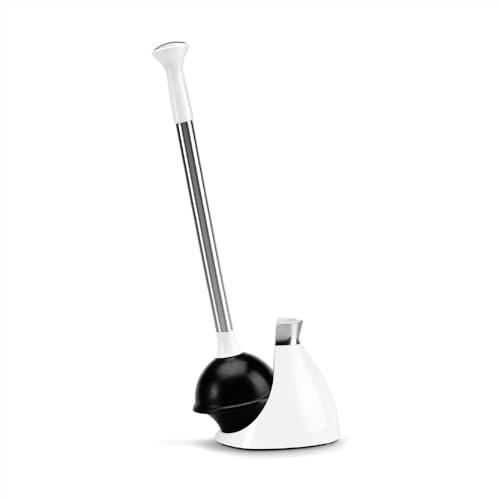
The simplehuman BT1085 is the plunger I’d put next to most toilets in a newer house. It scored highest here because it does well on four of our five checks, and simplehuman is the only maker on this page that puts a multi-year warranty in writing.
The head is the part that matters first. simplehuman says the flange has a narrow profile designed to work more efficiently with modern low-flow toilets. That’s the toilet most of us have now: EPA’s WaterSense program says the federal limit is 1.6 gallons per flush, and labeled toilets use 1.28 or less.
The cover is the reason people buy it. A magnetic collar on the stainless steel rod locks the dome-shaped cover to the plunger, so you lift both together and carry them to the bowl without a drip hitting the floor. simplehuman says the large opening at the back of the cover makes the plunger easy to detach when you need it.
When it’s put away, the dome hides the head. simplehuman’s drawing shows it 23.1 in. tall standing in its cover, on a base about 7.9 by 7.1 in., so it tucks beside the toilet or behind it on most floors.
The rod is stainless steel, and simplehuman says it resists rust and corrosion. That matters on a tool that goes back into its holder wet. The trade is that simplehuman publishes only the overall height, not the handle length, so it gets half marks on our handle check.
The warranty is 5 years on simplehuman’s product page. Its terms say the period can vary by model and by the store you buy from, that it covers home use only, and that a dated proof of purchase may be needed. Keep your Amazon order email. It also comes in black as the BT1086, and as a set with simplehuman’s toilet brush.
My call: buy this one for a newer toilet in a bathroom where the plunger stays in sight. I’ve used it, and the magnetic cover is the cleanest way I know to get a plunger from the corner to the bowl and back.
Prices and availability are accurate as of the time shown and may change.
You want a straightforward flange plunger with a real handle length on the box, and a caddy that opens when you lift it and closes when you drop it back.
Your toilet is a newer low-flow bowl with an oblong outlet. The simplehuman and Korky heads are made for that shape.
The Clorox hideaway plunger is a plain flange cup in a smart caddy. Clorox’s tool line is made by Bradshaw Home under license, and its product page and the Amazon listing describe the same set word for word.
The head is a flange cup: a rubber bell with a smaller sleeve that folds out of the bottom and drops into the toilet outlet. Clorox calls it heavy duty and says it can be used with all toilets. It doesn’t claim a shape for newer oblong outlets, so it scores 5 of 10 on that check.
The handle is where it beats the top pick on paper. Clorox lists a 15.5 in. handle with an ergonomic grip, a real number you can hold against the bowl before you buy, and it’s the reason the Clorox gets full marks on our handle check.
The caddy is a clamshell. Clorox says it opens automatically when you pull the plunger out and closes when you set it back, and an internal drip tray lets the head dry while keeping water off the floor. A rubber base keeps the caddy from tipping or sliding next to the toilet.
Clorox also says the plunger cup is treated with an antimicrobial against odor-causing bacteria, mold and mildew, and that the treatment won’t wash off. That’s a maker claim about odor in storage, and the plunger still needs a rinse after each use.
Two numbers need a note. The caddy measures 6.5 by 6.5 in. at the base, and Clorox’s own page gives the height as both 16.5 and 19.5 in. Plan for the taller one. Clorox’s page lists the set as SKU 620027 while Amazon lists model 620116; the text and photos match, so I treat them as the same set. Clorox’s warranty is 1 year from purchase.
My call: a good buy for an older round-outlet toilet, or anyone who wants the familiar flange shape. I’ve used it, and the caddy that shuts itself is a nice touch in a shared bathroom.
Korky 97-5A BEEHIVE Max Hideaway toilet plunger and holder
Prices and availability are accurate as of the time shown and may change.
You’d rather keep the plunger under the vanity or in a closet, or your toilet is a newer high-efficiency bowl and you want the head Korky built for it.
You want a warranty in writing. Korky’s own warranty table lists none for any of its plungers.
The Korky BEEHIVE Max Hideaway is the beehive plunger in a carry case. Korky lists it as part 97-4A, with 97-5 among the alternate numbers, and the Amazon listing is Korky’s own white-holder version sold as 97-5A.
The beehive head is Korky’s answer to newer bowls. Korky says toilet drains have changed from round to oblong outlets, and that standard plungers can’t seal them. Its head is a stack of rings, stiff at the top and flexible at the bottom, that squeezes into the outlet. Korky says it fits Kohler, TOTO, American Standard and all other brands, old and new.
The handle is the feature this pick is for. It’s a 16 in. T-handle that collapses, so the whole plunger drops into its holder and the holder fits under a sink or vanity or in a closet. Korky says the case also makes it easy to carry to the bowl. The T-shape gives you two hands’ worth of grip for the push.
The cup is 6 in. across and made of non-marking rubber, so it won’t leave black scuffs on the porcelain. Korky makes it in the USA, like the rest of its toilet parts.
So why the lowest score of the three? Two checks. Korky’s warranty table lists “No Warranty” against every plunger it sells, this one included. And while Amazon’s listing title says the holder allows a drip-free carry, Korky’s own page only says the case is for transport and storage, so I gave half marks for drips. It lands right at our 7.0 floor.
If you’ve read other reviews, the bare BEEHIVE Max 99-4A, the same head without a holder, is a common top pick. It showed as unavailable on Amazon when I checked, and without a holder it scores lower on our formula anyway. The Hideaway gets you that head with somewhere to put it.
My call: the pick for a newer high-efficiency toilet when you want the plunger out of sight. I’ve used it, and the beehive head seats in an oblong outlet more easily than a plain flange cup.
Every fact comes from the maker’s page or drawing. Scroll sideways on a phone. Prices are in each card and the picks above.
| Pick | Spec score | Photo | Head | Handle | Holder | Warranty | Pros / cons | Buy |
|---|---|---|---|---|---|---|---|---|
| simplehuman BT1085 Modern low-flow toilets | 9.0 | | Narrow flange | Stainless rod; 23.1 in. overall | Magnetic dome cover | 5 years | Drip-free carry / No handle length | Check it on Amazon |
| Clorox hideaway Classic flange cup | 8.0 | | Flange cup | 15.5 in. | Self-closing caddy, drip tray | 1 year | Self-closing caddy / No modern-outlet claim | Check it on Amazon |
| Korky 97-5A Under-sink storage | 7.0 | | Beehive, 6 in. | 16 in. T, collapses | Carry case | None listed | Folds away / No warranty | Check it on Amazon |
Green marks a strength and amber a trade-off. All three come with a holder, and all three makers say their plunger works on toilets of any brand.
Tell it how much water your toilet uses per flush and where you’ll keep the plunger. It names the pick and says why.
| Your toilet | Kept out | Kept under a sink |
|---|---|---|
| 1.28 gpf or less | simplehuman BT1085 | Korky BEEHIVE Max Hideaway |
| 1.6 gpf | simplehuman BT1085 | Korky BEEHIVE Max Hideaway |
| More than 1.6 gpf | Clorox hideaway | Korky BEEHIVE Max Hideaway |
| Not sure | simplehuman BT1085 | Korky BEEHIVE Max Hideaway |
To find your flush rate, look on the bowl behind the seat hinge or inside the tank for a number followed by GPF or LPF. EPA’s WaterSense page says older toilets can use as much as 6 gallons per flush, while the federal standard is 1.6 and WaterSense-labeled models use 1.28 or less.
Why does it matter for a plunger? Korky says toilet drains have changed from round to oblong outlets as toilets got more efficient, and that a plunger made for the old round hole may not seal the new one. If the plunger can’t seal, it can’t push.
Plungers look alike from across the aisle. The bottom of the head decides which drain they can seal.
| Type | What the head looks like | Use it on | Picks here |
|---|---|---|---|
| Cup plunger | Flat rubber cup with an open rim | Sinks, tubs and shower drains with a flat floor | None: it can’t seal a toilet outlet |
| Flange plunger | Rubber bell with a soft sleeve that folds out of the bottom | Toilets | Clorox, simplehuman |
| Beehive plunger | Stacked rubber rings, stiff on top, soft at the tip | Toilets, old and new bowl shapes (Korky) | Korky 97-5A |
| Bellows (accordion) | Ribbed plastic body that squeezes water, often with a nozzle | Toilets; some models add a sink nozzle | Left out (see below) |
A flange plunger is the toilet plunger most people mean. The sleeve on the bottom drops into the outlet at the bottom of the bowl, and the bell above it pushes water down the trap. Fold the sleeve up inside the bell and it works like a cup on a flat sink drain.
A cup plunger is the sink tool. On a toilet, its flat rim sits on a curved, sloped bowl and can’t seal the hole, so most of your push goes back up as splash. If you only own one plunger, make it a flange or beehive.
Korky makes a strong claim here: that accordion plungers, rubber cups and most flange plungers perform poorly on newer oblong outlets. That’s the maker of the beehive talking, so weigh it, but it matches what the shape of a modern outlet suggests.
Fits most toilets, and the sleeve folds away for the odd sink job. The Clorox and simplehuman are both flange types.
Korky’s rings squeeze into an oblong outlet. Korky says it fits all bowl shapes, old and new.
Keep a separate small cup plunger for the sink. Korky sells one, the BEEHIVE Mini, for sinks and drains.
Master Plunger says its 500 series moves 8 cups of water per stroke and uses an air relief valve to limit overflow.
A plunger is a simple tool, but the holder has hinges, magnets and doors. A written warranty is the maker saying how long they should last.
Read the fine print before you count on one. simplehuman’s terms say the warranty covers home use, that its length can vary by model and by store, and that a dated proof of purchase may be needed.
Clorox’s covers defects for 1 year from purchase under normal household use. OXO promises to replace or refund for defects but gives no number of years. Korky’s table says “No Warranty” for every plunger it sells.
Measure the gap beside your toilet, or inside the vanity, before you buy. Only two makers publish the holder size.
| Plunger | Holder footprint | Height | Where the number comes from |
|---|---|---|---|
| simplehuman BT1085 | 7.9 × 7.1 in. | 23.1 in. with the plunger in it | simplehuman’s dimension drawing |
| Clorox hideaway | 6.5 × 6.5 in. | 16.5 or 19.5 in. | Clorox’s page gives both |
| Korky 97-5A | About 6 in. across | About 17.5 in., handle folded | Amazon’s item size; Korky gives the 6 in. cup and 16 in. handle |
Height matters most under a sink. The space under a bathroom vanity is often shorter than you think once the drain trap and supply lines are in it, so measure from the cabinet floor to the bottom of the trap. Only the Korky’s handle folds, which is why it’s the under-sink pick.
Out in the open, the footprint matters more. The simplehuman’s dome is the widest of the three. The Clorox caddy is the narrowest and has a rubber base, which helps on a tile floor that gets wet.
The right plunger only works if it seals and you push water, not air. This is the order I’d follow.
If the bowl is filling toward the rim, turn the shutoff valve behind the toilet clockwise to stop more water coming in. Another flush only adds water.
Lay an old towel around the base and put on rubber gloves. Lift the plunger straight out of its holder.
On a flange plunger, let the sleeve hang out of the bell and set it into the outlet at the bottom of the bowl. A beehive just presses in. The head should sit under water; add some from a bucket if the bowl is low.
The first stroke pushes out the air trapped in the cup. Push gently so it doesn’t spray out around the rim.
Keep the seal and work the handle down and up firmly. The pull matters as much as the push: it rocks the clog back and forth until it breaks loose.
Lift the plunger. If the water drops away with a gurgle, flush once with the lid down to test. If not, do another round or two.
If a few rounds don’t move it, stop. Something solid may be stuck in the trap, like a toy or a wad of wipes, and a plunger can pack it in tighter. That’s a job for a toilet auger; see our best toilet auger picks and toilet auger vs drain snake for why a sink snake is the wrong tool.
For the whole process, including clogs that come back, read how to unclog a toilet. If more than one fixture backs up at once, the clog is likely past the toilet; clogged drain vs main line shows how to tell.
These are known names that scored under our 7.0 floor on the same five checks, or that weren’t available. Here’s why.
| Plunger | Spec score | What held it back | What it does well |
|---|---|---|---|
| OXO Good Grips 12241700 with canister | 6.0 | No outlet shape claimed beyond “all toilets”; no handle length published; guarantee with no set term | Canister doors spring open and stay open; drip tray with drainage holes |
| Master Plunger MP1600-TB | 5.0 | No handle length or warranty published by the maker; no drip feature stated | Funnel nose made for 1.6 gallon toilets; air relief valve; made in USA |
| Korky BEEHIVE Max 96-8A, no holder | 3.0 | No holder; no handle length or warranty listed for this part | Same beehive head with a telescoping T-handle |
| Master Plunger MP500-B | 4.0 | All-purpose bellows with a sink nozzle; no handle length or warranty published | 8 cups of water per stroke, per the maker; air relief valve |
| Korky BEEHIVE Max 99-4A | Not picked | Unavailable on Amazon when checked | Same beehive head, 15 in. T-handle |
The OXO is a well-made set, and The Spruce rates it highly. On our checks it loses points because OXO publishes so little: its product page gives a SKU and a description, with no handle length and no outlet shape. If you already own one, keep it. Master Plunger’s bellows design is a different way to push water, but its site gives no warranty or sizes to score.
| Check | How to find it | What it points to |
|---|---|---|
| Your toilet’s flush | GPF number on the bowl or inside the tank | 1.6 or less: simplehuman or Korky. Older: any of the three |
| Where it’s stored | Next to the toilet, or under a sink | Under a sink: the Korky, whose handle folds |
| Head shape | Sleeve under the bell, or stacked rings | Never a flat cup on a toilet |
| Holder and warranty | Drip tray or sealed cover; years in writing | Longest warranty: simplehuman, 5 years |
Most bathrooms end at the simplehuman. Pick the Korky when it has to live in a cabinet, and the Clorox for an older toilet or if you like the classic flange cup. Keep a small cup plunger for the kitchen sink; using the toilet plunger there spreads germs to where you cook. For sink clogs, see how to unclog a drain.
A flange plunger or a beehive plunger. Both have a soft tip that drops into the toilet outlet and seals it. A flat cup plunger is for sinks and tubs; on a toilet it can’t seal the hole.
A plunger with a soft rubber sleeve, the flange, that folds out of the bottom of the bell. The flange fits into the toilet outlet so the bell can push water down the trap. Fold it up inside and it works on a flat sink drain.
Usually it isn’t sealing. Korky says newer toilets have oblong outlets that standard plungers can’t seal. Make sure you’re using a flange or beehive head, that the head sits under water, and that the first stroke is gentle so it pushes out air.
Korky, which makes the beehive, says it seals better in all bowl shapes and needs less effort. On older round outlets a good flange plunger also seals well. On a newer high-efficiency bowl, the beehive or simplehuman’s narrow flange is the safer bet.
Not well. A flat cup can’t seal the curved toilet outlet. Keep the two separate anyway, so the toilet plunger never goes in the kitchen sink.
Make sure the head is under water, push the first stroke slowly to let the air out, and keep the seal while you work the handle. Laying a towel around the base catches what does splash.
After a few rounds, switch to a toilet auger. It can reach or pull out solid things in the trap that a plunger only packs tighter.
In a holder that catches drips. The Clorox caddy has an internal drip tray, the simplehuman’s cover locks on with a magnet, and the Korky folds into a case. Rinse the head in the bowl with a flush before you put it away.
Gallons per flush. EPA’s WaterSense page says the federal standard is 1.6 gpf, WaterSense-labeled toilets use 1.28 or less, and older toilets can use as much as 6.
Some do. simplehuman lists 5 years on its plunger and Clorox 1 year. Korky’s warranty table lists none for its plungers, and OXO’s guarantee covers defects without a set term.
I’m Isaac Daniels, a licensed journeyman plumber in Georgia, and I’ve used every plunger on this page. Every fact here comes from the makers’ own pages, drawings and warranty terms, read on Oct 22, 2026, and every Amazon listing was matched to the maker’s product the same evening.
Each check scores 0 to 10 and counts one fifth. It rewards a head made for the outlets on today’s toilets, a handle length you can check before you buy, a holder that comes in the box and keeps drips off the floor, and a warranty in writing. It’s our score from the makers’ documents, not a customer rating or a home test.
The same five checks put the OXO 12241700 at 6.0 (5, 0, 10, 10, 5), the Master Plunger MP1600-TB at 5.0 (10, 0, 10, 5, 0), the MP500-B at 4.0 (5, 0, 10, 5, 0) and Korky’s holder-less 96-8A at 3.0 (10, 0, 5, 0, 0). All are under our 7.0 floor, so they’re in the left-out table rather than the picks.
| Check (weight) | How it’s scored |
|---|---|
| Fits modern outlets (⅕) | 10 when the maker says the head is shaped for modern low-flow, high-efficiency or oblong outlets; 5 for a flange cup sold only as fitting all toilets |
| Handle length (⅕) | 10 when the maker publishes a handle length of 15 in. or more; 5 when it gives only the overall height; 0 when it gives neither |
| Holder (⅕) | 10 when a holder or cover comes in the box; 5 for a handle that only collapses for storage; 0 for neither |
| Drip control (⅕) | 10 when the maker says the holder catches or locks in drips; 5 for a holder with no drip feature stated; 0 with no holder |
| Warranty (⅕) | 10 for a written warranty of 5 years or more; 5 for 1 to 4 years or a defects guarantee with no term; 0 when none is listed |
| Total | Average of the checks, to one decimal |
| Pick | Fits modern outlets | Handle length | Holder | Drip control | Warranty | Score |
|---|---|---|---|---|---|---|
| simplehuman BT1085 | 10 | 5 | 10 | 10 | 10 | 9.0 |
| Clorox hideaway | 5 | 10 | 10 | 10 | 5 | 8.0 |
| Korky 97-5A | 10 | 10 | 10 | 5 | 0 | 7.0 |