As an Amazon Associate I earn from qualifying purchases. Disclosure.
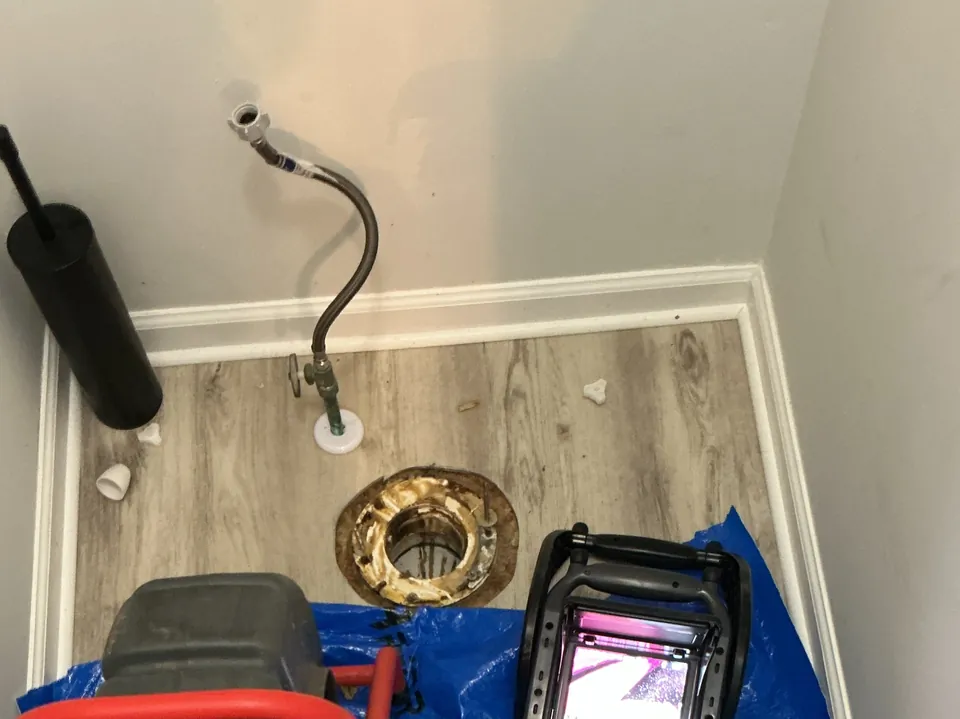
A sewer camera set up at a pulled toilet flange on one of my jobs.
The short answer
Run one fixture and watch the others. One slow fixture is a local clog you can clear yourself. Two or more backing up, a toilet that gurgles when the sink runs, or water rising in the tub when you flush means the main line: stop running water.
The difference matters more than almost any other call you’ll make about your plumbing. A local clog is fifteen minutes and a hand snake. A main line backup that you keep running water into can put sewage on your floor.
The good news is that telling them apart takes about two minutes and costs nothing. Here’s the test I’d have you run before you touch a single tool.
Water always takes the lowest opening it can find. That single fact is what makes this diagnosable from your own bathroom, and it’s the logic behind everything below.
If the blockage is past the point where all your drains join together, the water backing up has to surface somewhere — and it will pick the lowest drain in the house, not the one you were using.
Do this, in order:
1
Run the bathroom sink for 30 seconds. Watch the sink itself, and listen to the nearby toilet.
2
Flush the toilet once. Watch the tub or shower in the same bathroom.
3
If you have a basement or a lower floor, check the lowest drain down there — a floor drain, a basement shower, a laundry standpipe.
Now read the result:
What you see
What it means
Only the fixture you used is slow. Everything else is fine.
Local clog. In that fixture’s trap or branch.
You run the sink and the toilet gurgles
Air is being pulled through the trap — a restriction downstream, or a vent issue.
You flush the toilet and water rises in the tub or shower
Main line. Those two share a drain and it isn’t clearing.
Two or more fixtures back up at once
Main line.
Anything comes up in a lower-floor or basement drain
Main line, and it’s past the point of DIY.
The Five Signs It’s the Main Line
Any one of these on its own is enough. You don’t need all five.
1
More than one fixture is affected.
A single clog in a single trap cannot make two separate fixtures misbehave. If the kitchen sink and a bathroom toilet are both unhappy, the problem is downstream of both.
2
Using one fixture causes a reaction in another.
Flushing the toilet and watching the shower fill is the classic version. So is the washing machine draining and the toilet bubbling. That’s water hitting a blockage and backing up into the nearest lower opening.
3
The toilet gurgles.
A gurgle is air being dragged through the water in a trap because it can’t get through the pipe normally. Sometimes that’s a blocked vent rather than a clog — either way it’s not a local problem.
4
Sewage — not just water — comes up.
Grey or black water in a tub, shower, or floor drain means you’re seeing what’s already in the line coming back at you. Stop running water immediately.
5
It’s the lowest drain in the house.
Basement floor drains, basement showers, and laundry standpipes are the first places a main line backup surfaces. If that’s where it’s showing up, it was never a local clog.
The Three Signs It’s Just a Local Clog
1
One fixture, and only one.
Everything else in the house drains normally.
2
It got worse gradually.
Local clogs build — a bathroom sink that’s been getting slower for a month is hair and soap in the trap. Main line problems more often arrive suddenly, or come back on a cycle.
3
Nothing else reacts.
You can run the sink, flush the toilet, and start the washing machine without any of them affecting each other.
Most homes have a cleanout — a capped pipe, usually 3–4 inches across, either just outside the house near the bathroom wall or in a basement/crawlspace. It’s the access point to your main line.
You don’t need to open it to learn something from it. But if you do, and it’s standing full of water, the blockage is past the cleanout — out toward the street or the septic tank. That’s the far end of the problem and firmly a professional job. Where those cleanouts are supposed to be in the first place is set by code — see drain cleanout locations.
If it is the main line, the next question is always what and where — roots, a belly, or a cracked joint — and guessing at that is how people end up paying to dig up the wrong twenty feet of yard. A camera answers it in ten minutes. Any plumber worth hiring will scope the line before quoting a repair; if you would rather look yourself first, a sewer inspection camera with a locator is the tool for that.
Knowing where your cleanout is before you have an emergency is worth five minutes on a dry afternoon. It’s the first thing anyone you call will ask for, and a plumber who has to hunt for it is a plumber charging you to hunt for it.
The machine for each answer
The diagnosis decides the machine. A small drum cable fits one slow fixture. A toilet or a main line needs a bigger drain machine.
I handle a tub drain with the smaller machines, the hand spinners like the RIDGID Power Spin. For a larger drain, such as a toilet or a main line, you definitely want a K-400 at minimum. The K-60 and K-400 have been go-tos for me. For grease, you typically want a mini jetter or a large jetter, depending on the size of the drain, what it serves, and how much grease.
I’ve used all three machines below. They are listed from the smallest drain to the longest run.
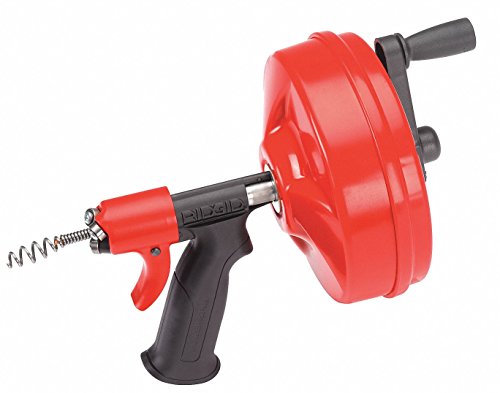
Product photo from Amazon.
RIDGID Power Spin 41408
For a local clog in a sink, tub or shower
Best for
One slow sink, tub or shower drain the plunger didn’t clear. RIDGID rates it for drain lines up to 1-1/2 in. and up to 25 ft long.
Skip it if
Two or more fixtures are backing up, or it’s a toilet. RIDGID’s manual says the Power Spin is not recommended for toilets, even though the Amazon listing calls it a toilet auger.
Specs
1/4 in. × 25 ft MAXCORE cable, AUTOFEED trigger, hand crank or a drill at up to 500 RPM.
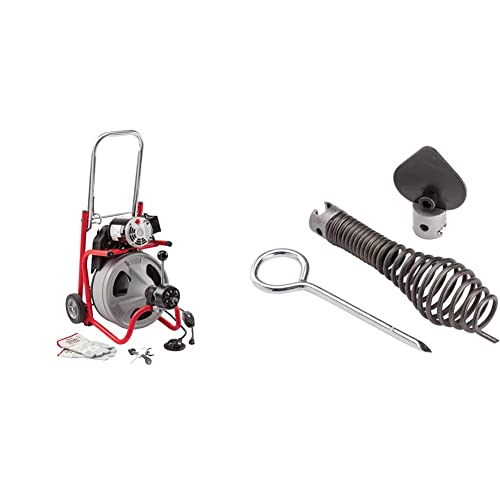
The two-minute test points at the main line, or a toilet line is past what the small machines reach. RIDGID’s catalog rates the K-400 for 1-1/2 in. to 4 in. lines.
Skip it if
One sink, tub or shower is slow and nothing else reacts. That’s a Power Spin job.
Specs
Drum machine on a transport cart with a 1/3 HP motor and a cable control system. This bundle has 75 ft of 3/8 in. C-32 cable and the T-240 tool set (bulb auger, spade cutter, pin key), and the listing says it has AUTOFEED. RIDGID’s chart puts 3/8 in. cable on 1-1/2 to 3 in. lines and 1/2 in. cable on 3 to 4 in. lines.
A main line or a roof vent stack with a long run. The cable goes in 15 ft sections, so you carry only what the run needs, and the rear handle lets it go up a ladder.
Skip it if
It’s one slow fixture. With this cable kit the machine is set up for 2 to 4 in. lines.
Specs
Sectional machine, 1/2 HP motor turning the cable at 600 RPM, clutch handle and forward/off/reverse switch. The SE kit adds the A-61 tool kit and the A-62 cable kit: five 7/8 in. × 15 ft C-10 sections (75 ft). The listing gives reach through 150 ft.
Clear it yourself. Pull the stopper and the hair, plunge it, snake it, or clean the P-trap. Skip the chemical drain cleaner — it can damage older pipes and usually only opens a channel through the clog so it comes back fast.
If it’s the main line
Work down this list in order.
1
Stop using water. Every fixture, everyone in the house. Each flush adds to what has to go somewhere.
2
Don’t pour anything down it. Chemical cleaner sitting in a full line is a hazard to whoever opens that pipe next — including you.
3
Don’t rent a big machine on your first attempt. A powered drum auger in untrained hands can wrap the cable, damage an older line, or injure you. If you’re determined to try, know what your pipe is made of first.
4
Find your cleanout so it’s ready to point at.
5
Call someone — and if sewage is already coming up, treat it as urgent rather than something to sleep on.
If it keeps happening: clearing a main line and fixing a main line are two different jobs, and a clog that returns on a schedule is telling you something specific about the pipe. → Why Your Main Drain Keeps Clogging
When to Stop and Call
Call a plumber — same day — if:
Sewage is backing up into any fixture
More than one fixture is backing up at once
You can smell sewer gas through the house
The cleanout is standing full
You cleared it and it came back within days
That last one matters more than people give it credit for. A clog that returns quickly was never really cleared — something down there is still catching debris, and each cycle is a little worse than the last.
One thing worth knowing before you pour anything in: on a main-line blockage neither type of cleaner will reach it. enzyme vs chemical drain cleaner covers what each one can and cannot do.
Frequently Asked Questions
How do I know if my main line is clogged or just one drain?
Run one fixture and watch the others. If only the fixture you’re using is slow, it’s a local clog. If two or more back up, if the toilet gurgles when you run a sink, or if water rises in the tub when you flush, the blockage is in the main line.
Why does my toilet gurgle when I run the sink?
Air is being pulled through the toilet’s trap because it can’t move through the pipe normally. That’s either a blocked vent or a developing main line restriction — not a local clog.
Is sewage coming up in my shower an emergency?
Treat it as one. It means the main line is blocked and the contents are surfacing at the lowest drain. Stop running water everywhere in the house and call a plumber.
Can I clear a main line clog myself?
Sometimes, but it’s the job I’d least recommend DIYing. Main lines need a powered auger or a jetter, older pipe damages easily, and if the blockage is past the cleanout it’s outside your reach anyway. The diagnosis above is worth doing yourself; the clearing usually isn’t.
What machine clears a main line clog?
For a toilet or a main line, you definitely want a K-400 at minimum. The K-60 and K-400 have been go-tos for me. One slow sink, tub or shower is a job for a small drum cable like the Power Spin. The machine for each answer has all three.
Where is my main line cleanout?
Usually a capped 3–4 inch pipe outside the house near the bathroom wall, or in the basement or crawlspace. Find it before you need it — it’s the first thing a plumber will ask for.
What’s the difference between a clogged drain and a clogged sewer line?
A clogged drain is a blockage in one fixture’s own pipe and affects only that fixture. A clogged sewer line is a blockage in the shared pipe leaving your house, so it affects everything draining into it.
How I put this guide together
Who wrote it
In my 7 years of experience, these are the products I’d install.
Picks follow the method in How I pick: maker documents, parts availability and fit, never commission rates.
What I checked
Machine specs from RIDGID’s K-400 and K-60SP catalog pages and the Power-Spin operator’s manual.
Each listing on Amazon on Nov 11, 2026: new, in stock, and the RIDGID model named on the card.
The CPSC recall list on Nov 11, 2026: no recall on these three machines.
RIDGID, “K-400 Drum Machine” catalog page: specifications and recommended line size chart.
RIDGID, “K-60SP Sectional Drain Cleaning Machine” catalog page, with the A-61 tool kit and A-62 cable kit.
RIDGID, Power-Spin Drain Cleaner operator’s manual: description and specifications.
U.S. Consumer Product Safety Commission recall list (saferproducts.gov), searched Nov 11, 2026 for RIDGID, drain cleaner, drum machine, Power Spin and sectional: no recall on these three machines.
Listing details for the RIDGID Power Spin 41408, K-400 bundle and K-60SP-SE 66497, read from Amazon’s product data on Nov 11, 2026.