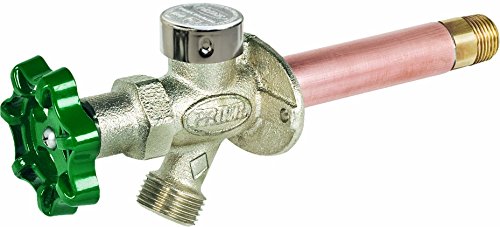
PRIER C-144D10
$49.97 at Amazon
Check it on AmazonPrice as of Oct 24, 2026, 5:30 AM EDT · low stock then

Match the valve to your wall, water use and freeze risk.
As an Amazon Associate I earn from qualifying purchases.
Sillcock and hose bibb usually name the same outdoor faucet, and neither name means frost-free. A boiler drain empties equipment. For a 10-inch threaded or sweat wall fit, pick the PRIER C-144D10; for a push inlet, the SharkBite 24629LF.
These are examples of different valve designs. The two long-body models need suitable wall geometry; the short hose bibb needs freeze and backflow protection addressed separately.


Product prices and availability are accurate as of the date/time indicated and are subject to change. Any price and availability information displayed on Amazon.com at the time of purchase will apply to the purchase of this product.
| Valve | Key specs | Pick it if | Skip it if |
|---|---|---|---|
| PRIER C-144D10 | C-144D10, 10-inch insertion, 1/2-inch D inlet, 125 psi, Integral backflow protection | The 10-inch insertion geometry puts the valve in heated space and the D threaded or sweat inlet matches the supply. | You need a push connection, the inlet would remain in an unheated cavity, or a hose timer keeps the valve on beyond its permitted use. |
| SharkBite 24629LF | 24629LF, 10-inch nominal, 1/2-inch push inlet, 3/4-inch MHT outlet, Integrated vacuum breaker | A 10-inch frost-free body suits the wall and the exposed supply pipe meets the instructions for this push inlet. | The shutoff would remain in cold space, the pipe type is uncertain, or the connection cannot be inspected and installed as instructed. |
| SharkBite 24620LF quarter-turn 90-degree hose bibb | 24620LF, 90-degree body, Quarter-turn, 1/2-inch push inlet, 3/4-inch MHT outlet, NSF 61 and 372 listed | A short quarter-turn hose connection is suitable and the installation separately meets freeze and backflow requirements. | You need the remote inlet shutoff of a frost-free wall faucet or are relying on the product name to prove backflow protection. |
No overall performance score combines equipment drains with frost-free wall faucets. Match the installation to the documented valve design.
A 10-inch frost-free wall hydrant with a D inlet: ½-inch male thread or ½-inch sweat at the supply end.
My call: choose the C-144D10 when a 10-inch insertion length and a 1/2-inch threaded or sweat inlet match the wall. PRIER prints this exact ordering example in its C-144-Y sheet. The D identifies the inlet; 10 identifies the insertion length. Those two checks matter more than the word sillcock.
The D inlet combines 1/2-inch male pipe threads with a 1/2-inch sweat connection. Those are alternatives at the supply end, not two separate hose outlets. The garden hose attaches outside. Do not assume a C-144 with a different inlet letter connects to the same supply fitting.
PRIER adds an anti-siphon vacuum breaker and a backflow check valve. Its current specification lists a 125 psi pressure rating. Those features address different questions from the installation length: backflow protection concerns reverse flow, while the long body lets the shutoff sit inside the heated structure.
The flange has drainage pitch built into its shape, but the installed barrel still needs to slope toward the spout. PRIER also requires the spout to point down. A crooked wall surface or unsuitable inlet position can defeat the intended drain path even when the flange looks neatly fastened.
Remove the hose during freezing weather. PRIER describes a short drain-down after closing as normal operation, so do not keep tightening the handle simply because water briefly leaves the barrel. Persistent dripping needs a different check, especially when the flow never stops after the barrel should have emptied.
The maker says not to leave the valve on for more than 12 continuous hours. Check that before attaching a timer or another closed downstream device. A licensed plumber should assess concealed connections and uncertain isolation; a heated inlet, correct pitch and a matching D connection are all required for this recommendation.
A 10-inch frost-free sillcock that joins the supply with a ½-inch push-to-connect fitting.
My call: choose the 24629LF when the wall needs a 10-inch frost-free faucet and the supply suits its 1/2-inch push inlet. SharkBite identifies this model in its size table. The 3/4-inch garden hose outlet is a different connection from the inlet, so a familiar hose size does not confirm the supply fit.
The push inlet changes how the valve joins the pipe. It does not change the need to put the shutoff in suitable heated space or let water leave the barrel. SharkBite places the shutoff at the inlet and describes drainage as the feature that protects the valve in freezing conditions.
An integrated vacuum breaker addresses backflow at the hose connection. Keep that distinction clear when comparing it with the short 24620LF hose bibb. A mounting flange and a push connector appear on both designs, but those visible features alone do not establish the same freeze or backflow protection.
SharkBite lists compatible pipe families on its product page, including PEX and copper. Match the exact pipe and the instructions included with the faucet before buying. A push connector still needs the correct pipe preparation and full engagement; uncertain or damaged pipe is a reason to involve a licensed plumber.
The 10-inch designation is the maker’s nominal length, not permission to match a tape measurement taken from the handle tip. Check the dimension drawing and the actual supply location. Replacing a long faucet with another nominally equal model can fail if the two makers measure from different reference points.
The listing’s 10-inch length and 1/2-inch push-to-connect inlet match the maker’s 24629LF size table. Keep the installation sheet for that model generation with the valve. Remove attachments as instructed before freezing weather, and have the connection inspected for leakage before the wall is closed. Pressure and temperature limits must come from that sheet.
A short quarter-turn hose bibb with a 90-degree body, for a spot where freeze and backflow are handled separately.
My call: the 24620LF fits a short, quarter-turn hose connection where freeze exposure and backflow protection have already been addressed. SharkBite specifies a 1/2-inch push inlet and a 3/4-inch male hose-thread outlet. The listing title reads quarter turn, 1/2 x 3/4 in. MHT, matching SharkBite’s 24620LF quarter-turn 90-degree hose bibb.
The quarter-turn handle describes operation. It does not tell you how the faucet drains in winter or which backflow device the installation needs. The maker’s product page lists NSF/ANSI/CAN 61 and 372, but those listings should not be treated as a freeze-resistance claim or an integral vacuum-breaker claim.
The 90-degree body directs the hose connection away from the supply axis. SharkBite also describes a mounting flange. That gives you a recognizable outdoor-faucet shape, yet the shape is not enough to distinguish its protection from another valve behind a similar flange. Read the model number before selecting the replacement.
If the pipe is in a freezing location, consider how the entire short valve and exposed supply section will be emptied. Boshart describes a winterizing arrangement with an interior drain-equipped shutoff. Its usefulness depends on the actual pipe route; closing an inside valve alone does not prove the outside section has drained.
Backflow protection needs its own decision. A hose end can reach a bucket or other contaminated water, and the installation must meet the applicable protection requirement. Ask a licensed plumber about the right device when a timer, sprayer or other downstream attachment changes how the hose connection stays pressurized.
Check pipe suitability and follow the included push-connection instructions before installation. Stop if the pipe material or condition is uncertain, or if the fitting cannot be accessed and inspected. Check that the 24620LF inlet can be fully engaged and the mounting flange properly supported. Choose a frost-free model when the wall design calls for a heated inlet shutoff.
Match the inlet and protection to the installation. Sort by maximum pressure to compare the documented ratings; check the exact SharkBite generation’s instructions for its limits.
| Model and photo | Connections | Protection | Maximum pressure (psi) | Ahead for the job | Buy |
|---|---|---|---|---|---|
| PRIER C-144D10 10-inch threaded/sweat wall fit | 1/2-inch MPT or sweat; hose outlet; 10-inch insertion | Vacuum breaker and check valve; heated placement; 12-hour operation limit | 125 | Threaded or sweat frost-free wall fit | Check it on Amazon |
| SharkBite 24629LF 10-inch push-inlet wall fit | 1/2-inch push; 3/4-inch MHT; 10-inch nominal | Integrated vacuum breaker; inlet shutoff and drainage | Check model sheet | Push-inlet frost-free wall fit | Check it on Amazon |
| SharkBite 24620LF Separately protected short fit | 1/2-inch push; 3/4-inch MHT; short body | No freeze or integral backflow claim on cited page | Check model sheet | Short connection with separate protection | Check it on Amazon |
MPT means male pipe thread. MHT means male hose thread. Identical nominal fractions do not make hose threads and pipe threads interchangeable.
| Name on the shelf | What it usually describes | What it cannot prove |
|---|---|---|
| Hose bibb | A valve used for a hose connection | Freeze resistance, backflow protection or suitability for every water system |
| Sillcock or wall hydrant | A wall-mounted faucet; often a long-body model | That the particular model is frost-free or correctly installed |
| Boiler drain | A valve used to empty equipment or a system | That outdoor use is prohibited, or that drinking-water use is permitted |
A hose bibb can be sold under more than one name. Boshart notes that hose-bibb faucets may also be called sediment faucets or boiler drains. That overlap makes an exact model number more useful than an argument about which shelf label is technically correct.
For sillcock vs hose bibb, start with the construction. A long barrel can place the closing valve inside the building, while a traditional short faucet closes near the exposed body. The long-body arrangement still depends on where the valve ends up and whether the barrel can drain.
For boiler drain vs hose bib, start with intended use. Watts expressly allows sillcock applications for LFBD-QT. A legacy NIBCO multi-turn sheet excludes potable drinking-water service for its covered products. Those statements concern specific documented products; neither should be stretched into a rule about every boiler drain.
| Model | Listing title and connection | Maker model match |
|---|---|---|
| SharkBite frost-free sillcock, ASIN B076FY4R71 | SharkBite 10 Inch Frost Free Sillcock, 1/2 x 3/4 Inch MHT, Push to Connect | The 10-inch length and 1/2-inch push inlet match 24629LF in SharkBite’s model table. |
| SharkBite quarter-turn 90-degree hose bibb, ASIN B076FX1M5Z | SharkBite 1/2 x 3/4 Inch MHT 90 Degree Hose Bibb, Quarter Turn, Push To Connect | The listing title reads quarter turn, 1/2 x 3/4 in. MHT. That matches 24620LF in SharkBite’s quarter-turn 90-degree hose-bibb table. |
| Watts LFBD-QT 1/2 | 1/2-inch combination threaded/solder inlet; 3/4-inch hose outlet | The 1/2-inch model is code 0123631. LFBD-QT 3/4 has a different inlet, despite the shared family name. |
Match the inlet as well as the hose outlet. The SharkBite examples have 1/2-inch push inlets and 3/4-inch MHT outlets; the Watts 1/2-inch example uses a threaded/solder combination inlet.
The long stem lets you turn an outside handle while the seat shuts water off inside. After closing, the water beyond that seat needs an open route out through the spout. PRIER requires a heated valve location, slight downward pitch and a downward-facing spout.
The phrase frost-free describes a design that can drain under the required installation conditions. It does not establish that your wall cavity stays above freezing. An unheated garage wall or a poorly located supply connection can leave the closing valve outside the protected area.
A hose left attached can prevent the intended drainage. PRIER tells owners to remove it during freezing temperatures. Treat a nozzle or another attachment as something to check against the faucet instructions too; do not assume a closed accessory preserves an open drain path.
| Check at the wall | Acceptable basis | Reason to stop |
|---|---|---|
| Location of closing valve | Maker drawing places it in heated space | Only the handle and flange location are known |
| Drain path | Installed barrel slopes toward a downward spout | Wall surface or pipe alignment creates a low pocket |
| Attachments in freezing weather | Hose removed as instructed | Hose remains connected with water trapped |
Check freeze protection as an installation question before replacing one brand with another. A 10-inch PRIER and a 10-inch SharkBite share a nominal number, but their connection references still need checking. Neither a familiar brand nor an insulated cover proves the valve seat is in heated space.
For a traditional short bibb, Boshart describes an interior shutoff with a drain arrangement that empties the outside valve and supply line. That is a different winterizing method from a self-draining long-body faucet. Have a plumber assess a supply run whose low points or hidden routing prevent you from confirming drainage.
| Feature or marking | Question it answers | Question still open |
|---|---|---|
| Integral vacuum breaker | Does the maker include a backflow feature? | Is its permitted use suitable for the connected equipment? |
| NSF/ANSI/CAN 61 and 372 | What drinking-water and lead-content listings are stated? | Does the installation have required backflow and freeze protection? |
| Frost-free body | Can the barrel drain with a suitable heated inlet? | Which backflow protection is included or required? |
| Equipment-drain application | Is the connection intended only to drain a tank or vessel? | Does local code permit the relevant exception for that actual use? |
A hose makes a connection that can reach contaminated water. Backflow protection addresses unwanted reverse flow through that connection. Freeze resistance addresses trapped water and cold exposure. A faucet can need both, and satisfying one does not establish the other.
The 2021 International Plumbing Code, section 608.16.4.2, addresses protection for hose connections and includes an exception for specified tank or vessel drains. The key is the use of the installed connection. Buying a valve named boiler drain does not make a garden-watering connection a tank-draining connection.
Local adoption and amendments control your installation. Ask the local authority or a licensed plumber which protection applies, especially if a hose timer or other equipment leaves downstream pressure in place. Do not remove a vacuum breaker to solve a drainage problem.
For device selection, read vacuum breaker vs anti-siphon valve. Keep the exact faucet and the downstream use in view when comparing device types.
This substitution matrix separates features that a hose-thread outlet cannot establish. “Not claimed” means the cited document does not establish the feature.
| Model or family | Freeze requirement | Integral backflow | Use or pressure limit | Substitution decision |
|---|---|---|---|---|
| PRIER C-144D10 | Heated valve; downward pitch; hose removed in freezing weather | Vacuum breaker and check valve | 125 psi; maximum 12 continuous hours of operation | For matching D inlet and 10-inch wall geometry |
| SharkBite 24629LF | Inlet shutoff and drainage; follow the included installation sheet | Integrated vacuum breaker | Exact-generation pressure and temperature limits need confirmation | For a suitable 10-inch push-inlet wall installation |
| SharkBite 24620LF | No freeze claim on cited page | Not claimed on cited page | Do not transfer long-body-model ratings | Only with freeze and backflow requirements addressed separately |
| Watts LFBD-QT 1/2 | No freeze claim in cited sheet | Not claimed in cited sheet | 200 psi maximum; 250°F maximum | Maker permits boiler-drain and sillcock use; exact job still controls |
| Legacy NIBCO multi-turn boiler drains | No freeze claim in cited sheet | Not established by cited sheet | Sheet excludes potable drinking-water service for covered products | Do not substitute into potable service based on matching hose threads |
Read across the entire row before substituting a valve. The Watts row gives an example of intended-use flexibility, while the PRIER row gives an example of documented wall-faucet protection. Neither row authorizes copying one component’s limits or approvals to another.
The 24620LF mounting flange and quarter-turn handle do not establish an integral vacuum breaker. Its cited product page does not specify one. If your hose connection requires backflow protection, choose a documented device suitable for the connected equipment and local requirements.
The matrix also prevents a repair mistake: replacing a long-body faucet with a short drain valve simply because the hose still screws on. Before considering that change, the installer must reassess the supply connection, drainage, backflow protection and exposure at the new closing valve location.
| Measurement or marking | Where to check | Example of a wrong match |
|---|---|---|
| Supply size and inlet type | Rear connection and maker inlet code | Ordering PRIER D when the existing connection needs a different inlet |
| Nominal wall or insertion length | Maker dimension drawing and installed supply location | Treating total handle-to-inlet length as a 10-inch insertion measurement |
| Replacement stem length | Exact model, generation and maker repair chart | Ordering a stem solely because the wall faucet was sold as 10 inches |
| Outlet thread | Hose connection and maker specification | Treating 3/4-inch hose thread as 3/4-inch NPT |
Start with photographs of the handle, body markings and accessible rear connection. A decorative handle may have been changed, so it is weak evidence by itself. The model marking and inlet arrangement give the installer a better starting point for finding the correct drawing.
For PRIER C-144D10, the D code identifies the 1/2-inch MPT by 1/2-inch sweat inlet, and 10 identifies insertion length. Do not buy the next length up as a general rule. The selected size must place the valve in heated space and meet the actual supply connection without forcing the pipe.
For SharkBite 24629LF, use the maker’s nominal-length table and the instructions included with the exact generation. A replacement-stem dimension is not automatically the same as the listed faucet length. Keep a repair order tied to the model and generation rather than a number remembered from an old purchase.
If the rear joint is concealed, do not twist the outside faucet to identify it. Stop and have a licensed plumber expose or assess the connection; the supply must be isolated and pressure relieved before disassembly under the applicable maker instructions.
| Evidence | What it supports | What it does not support |
|---|---|---|
| Watts LFBD-QT maker sheet | Specific family permits boiler-drain or sillcock use | Universal approval of every boiler drain outdoors |
| Lead-free brass; quarter-turn ball valve (Watts LFBD-QT) | Material and operation stated in the maker sheet | Proof of freeze resistance, integral backflow protection or suitability for every appliance |
| Legacy NIBCO multi-turn sheet | Covered products have a potable-use exclusion | A restriction on unrelated modern lead-free models |
| 250°F Watts maximum | A published component temperature limit | Safe handling of hot discharge or permission to service a live boiler |
The words boiler drain cover products with different restrictions. Check whether the water system is potable and whether the exact component is permitted there. A hose thread, brass body or familiar handle does not establish drinking-water suitability.
The legacy NIBCO multi-turn boiler-drain sheet contains a drinking-water exclusion for its covered products after January 3, 2014. Use that as a model-specific warning, not a statement that NIBCO or boiler drains generally lack potable-use options. Check current documentation for any proposed replacement.
For a hydronic boiler, appliance compatibility remains separate from drinking-water suitability. The Weil-McLain Ultra Series 2 manual requires electrical disconnection and cooling before maintenance. A qualified heating contractor must confirm drain suitability and follow the actual appliance manual for shutdown, isolation and return to service. The Watts 250°F component limit does not make hot discharge safe.
Treat the outlet as one connection check. Confirm exact model, intended system and inlet before selecting the valve.
Do not remove or open a drain as an identification test. A qualified heating contractor must follow the appliance shutdown, electrical-disconnection and cooling instructions.
Stop if isolation or rear access is uncertain. A licensed plumber should assess the connection before the outside faucet is loosened.
Consider PRIER C-144D10 only when its D inlet and 10-inch insertion place the valve in heated space with the required outward drainage.
Consider SharkBite 24629LF. Match the exact pipe and included instructions; an easy connector does not settle heated placement or drainage.
Consider 24620LF only after the installation separately addresses freeze exposure and backflow. Its cited page does not claim the long-body faucet features.
Check continuous-pressure and operating limits before choosing. PRIER limits the C-144 to 12 continuous hours of operation; other products need their own documentation.
For a straight replacement, matching the old model is helpful only after you confirm the old installation was suitable. A frost-free faucet that repeatedly traps water needs a drainage and heated-placement check. Buying the same nominal length can reproduce the same problem.
For a change of connection method, compare the rear fitting first. A PRIER threaded or sweat inlet and a SharkBite push inlet solve different connection jobs. The available straight pipe, access and wall position determine which can be installed correctly; the outdoor handle style should come later.
For a repair rather than replacement, identify the exact maker parts chart. A leak from the vacuum breaker can require a different part from persistent outlet dripping. Keep those diagnoses separate from a split barrel or a leaking rear joint, which may require opening the wall and replacing the faucet.
Read the model markings and its operating instructions. For PRIER C-144, confirm the installed spout faces down and the inlet valve reaches heated space. Have a plumber check an inaccessible rear connection.
Follow the model instructions for hose removal and attachments. PRIER requires hose removal during freezing temperatures; a connected closed hose can interfere with drainage.
PRIER describes a brief barrel drain-down after closing. Allow that drainage rather than applying extra handle force to stop it. Persistent flow needs diagnosis.
Do not loosen a valve or fitting under pressure. Follow the actual maker’s isolation and pressure-relief instructions before any repair, with a licensed plumber for concealed or uncertain connections.
These are use and inspection checks for an outdoor wall faucet. They do not authorize boiler servicing or removal of a pressurized valve. For a boiler, the actual appliance manual controls cooling, electrical disconnection and the qualified technician’s work.
For a soldered connection, PRIER requires the hydrant fully open during soldering, while Woodford warns about heat damage to internal parts and factory joints. A plumber must follow the exact model’s heat precautions and jobsite fire protection; a generic handle-position rule is insufficient.
Keep the model number and the relevant dimension sheet after installation. That record makes the next stem or vacuum-breaker order easier and avoids treating every 10-inch faucet as identical. If the faucet behaves differently after a hose timer or other attachment is added, check the permitted operating arrangement.
The names often overlap for outdoor faucets. Neither name proves a specific construction. Compare the model number, location of the closing valve, backflow protection and drainage requirements. A short hose bibb and a long frost-free wall faucet can both accept a garden hose while needing different winter protection.
No. Boshart identifies traditional short-body hose bibbs as non-frost-free. A frost-free wall design places the closing valve at the inlet so its barrel can drain. Correct heated placement and the maker’s required pitch still matter; a familiar handle or mounting flange does not establish freeze resistance.
Some specific models permit that use. Watts expressly lists boiler-drain or sillcock applications for LFBD-QT. That is not universal permission for other drains. Confirm potable-water suitability where needed, required backflow protection and a suitable freeze strategy for the actual installation.
Record visible maker and model markings and photograph the accessible inlet. Compare them with the maker’s drawing and repair chart. The handle alone is not enough. Do not loosen a concealed connection to identify it; have a licensed plumber assess isolation and rear access first.
Use the maker’s dimension reference and the real supply location. PRIER C-144D10 identifies a 10-inch insertion length; SharkBite 24629LF is listed as a 10-inch model. Neither designation should be replaced by an overall handle-to-inlet measurement. The closing valve must reach suitable heated space without compromising the connection or drainage.
Yes, freeze resistance and backflow protection answer different problems. Some frost-free models include a vacuum breaker, including the two long-body examples here. Match the exact protection to the permitted use and locally adopted rules. Do not infer a required backflow feature solely from the words frost-free.
For PRIER C-144, the maker requires removing the hose during freezing temperatures. A connected hose can interfere with barrel drainage. Check the exact faucet instructions for other models and attachments; do not assume a closed nozzle or an outdoor cover makes an attached hose acceptable.
The design depends on its installation and use. The inlet valve can be outside heated space, the barrel can lack outward drainage, or an attached hose can retain water. PRIER’s requirements address heated placement, downward pitch and hose removal together. Persistent leakage or suspected barrel damage needs a plumber’s inspection.
PRIER’s C-144 sheet says not to leave the valve on for more than 12 continuous hours. Follow that model-specific wording when considering timers or equipment connected downstream. Do not turn this into a universal rule for every outdoor faucet; other models have their own pressure and operating limits.
Sometimes, when the exact model’s repair chart identifies a suitable part and the body remains serviceable. A stem repair and a vacuum-breaker repair address different symptoms. Isolate the supply and relieve pressure under the maker’s instructions before disassembly; use a licensed plumber when isolation, concealed leakage or body damage is uncertain.
Isaac Daniels is the responsible author and a licensed journeyman plumber in Georgia. The fit recommendations use the specific PRIER and SharkBite documents named below. Watts documentation explains why a boiler-drain label or matching hose threads cannot establish suitability for every installation.
We read the maker’s model tables and installation requirements, then match the inlet, wall geometry and intended use. Two frost-free wall faucets and a short hose bibb are different designs, so they’re listed by the job each one fits, with no score. Same-day Amazon offer records establish the recorded seller, condition and availability; they do not replace maker specifications.
| Selection check | Evidence used | Decision rule |
|---|---|---|
| Connection match | Maker’s exact inlet code and model table | Reject a known mismatch; do not infer an inlet from the hose outlet |
| Freeze suitability | Seat location and drainage instructions | Require a suitable heated location and an open outward drain path |
| Backflow suitability | Integral features and applicable local requirements | Assess separately from freeze protection and lead-content listings |
| Intended use | Exact maker application statement | Do not generalize a permission or exclusion to every brand |
| Offer identity | Amazon Creators API product record, Oct 20 and Oct 22, 2026, 2:40 AM EDT | Use the genuine branded candidate; exclude look-alike replacement listings |
| Ranking method | Two frost-free sillcocks and one hose bibb, different designs | List them by job; no combined score and no invented test result |