
Hoffman FT015H‑3
$453.42 at Amazon
Check it on AmazonPrice as of Nov 6, 2026, 5:30 AM EST · low stock then
Why it’s my pick ↓
Three 15 psi float and thermostatic traps scored on maker data, and how to size one.

As an Amazon Associate I earn from qualifying purchases.
For a low-pressure steam main drip or unit heater, get the Hoffman FT015H‑3: 15 psi, four ports, 1,600 lb/h at 15 psi. Barnes & Jones and Spirax Sarco make equal F&T traps.

Product prices and availability are accurate as of the date/time indicated and are subject to change. Any price and availability information displayed on Amazon.com at the time of purchase will apply to the purchase of this product.
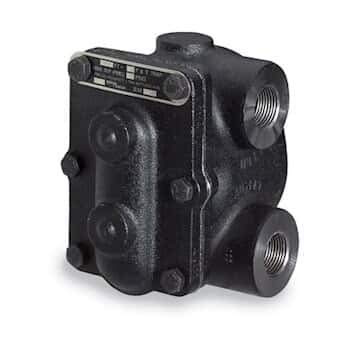
Hoffman Specialty (Bell & Gossett) FT015H‑3 3/4 in. float and thermostatic steam trap, 15 psi, part 404200
Prices and availability are accurate as of the time shown and may change.
You’re draining a low-pressure steam main, riser or unit heater and want spare ports for a vacuum breaker, air vent or test valve.
The system runs above 15 psi. Hoffman makes 30, 75, 125 and 175 psi seats in the same body.
The Hoffman FT015H‑3 is the float and thermostatic trap I’d put on a low-pressure steam drip. It scores 9.0, tied for the top of this page, because Hoffman publishes everything from capacity to sizing steps.
It’s a Series H trap. Hoffman’s catalog lists it as part 404200: 3/4 in. NPT, a 15 psi seat differential rating, a 250 psi body design rating and 11.7 lb. The same body comes in 1 in. and 1-1/4 in. with the same ratings.
Capacity is in Hoffman’s table: 390 lb/h of condensate at 1/4 psi differential, 680 lb/h at 1 psi, 1,100 lb/h at 5 psi and 1,600 lb/h at 15 psi, through a 0.253 in. orifice.
The feature I value most is the four-port body. Hoffman says the second inlet is a place for a vacuum breaker or a separate air vent, and the second outlet takes a test valve, which saves a trap test chamber. Hoffman adds that vacuum breakers are required with a modulating temperature valve, and external air vents when the trap discharges into a wet return.
Service is simple. Hoffman says the cover assembly can be replaced without disturbing the piping. The internals are stainless: valve pin and seat, float, lever and the thermostatic air vent, which Hoffman says prevents air binding.
Hoffman lists the Series H as resistant to water hammer and corrosion, with a seat below the condensate level to stop steam leaking through, and as meeting military spec WW-T-696-E.
One listing note: the Amazon title calls the trap plastic. Hoffman’s catalog lists a cast iron body and cover, so I take half a point off the listing match. The part number, 404200, matches Hoffman.
Hoffman’s sizing steps are worth following: find the differential across the trap, use 1/2 psi where a modulating valve controls the steam, then multiply the load by 1.5 as a safety factor. The sizer below uses that rule.
1 in. H-pattern float and thermostatic steam trap, 15 psig, Series 2000
Prices and availability are accurate as of the time shown and may change.
You maintain older steam systems and want a trap you can rebuild by swapping the head, without unthreading the piping.
Your line is 3/4 in.. Barnes & Jones makes the FT2015‑3 for that (a genuine listing exists on Amazon); this pick is the 1 in..
The Barnes & Jones FT2015‑4 also scores 9.0. It’s the 1 in. size of Barnes & Jones’s Series 2000 float and thermostatic trap, rated 15 psi and built for steam heating, unit heaters, coils and low-pressure mains and risers.
The repair story is the reason to choose it. Barnes & Jones says all working parts mount on the cover casting, and its repair kit is a complete factory-assembled head that bolts on. No pipe connections need to be broken except on 2 in. models.
The body is an H-pattern: two inlet and two outlet connections, which Barnes & Jones says permit multiple piping options. That gives the same flexibility as Hoffman’s four ports.
Barnes & Jones publishes two capacity tables. The gross table, in line with ANSI/ASME PTC 39.1, gives the FT2015‑4 1,050 lb/h at 10 psi and 1,129 lb/h at 15 psi. The SHEMA table, which Barnes & Jones says needs no safety factor, rates it at 550 lb/h at 10 psi and 575 lb/h at 15 psi.
Use the right one. SHEMA ratings come from the Steam Heating Manufacturers Association standard for low-pressure F&T traps, which Barnes & Jones says provides for continuous air elimination at maximum rating. Gross ratings need your own safety factor.
Materials are listed: cast iron ASTM A278 Class 30 body, grade 5 bolting, stainless float, valve plug and seat, and a phosphor bronze and Monel thermostatic element in the air vent. The 3/4 in. and 1 in. body weighs 11 lb.
Barnes & Jones lists the Series 2000 as meeting MIL spec WW-T-696, with a PMO of 15 psi at 250°F and a PMA of 250 psi at 450°F for the 15 psi model.
It misses one check: the sheet gives no install steps. The Amazon listing carries the FT2015‑4 part number, which matches Barnes & Jones’s table.
3/4 in. cast iron float and thermostatic steam trap, parallel configuration, 15 psig, part 50926
Prices and availability are accurate as of the time shown and may change.
You want a well-documented F&T trap with step-by-step install rules on the data sheet.
You need a spare port for a vacuum breaker or test valve. Hoffman and Barnes & Jones have four.
The Spirax Sarco FT‑15 scores 8.3. Spirax is one of the biggest names in steam, and its data sheet for the FT series is the clearest on how to install the trap.
Spirax describes how it works: a float valve modulates to discharge condensate continuously at steam temperature, while a separate balanced-pressure thermostatic air vent releases air and other non-condensable gases.
The ratings: 15 psi maximum operating pressure for the FT‑15, a pressure shell rated 125 psi at 450°F, and a cast iron ASTM A126 Class B body and cover with stainless internals. The 3/4 in. and 1 in. sizes weigh about 9 lb.
Spirax’s capacity sheet gives the 3/4 in. FT‑15 279 lb/h of hot condensate at 1/4 psi, 489 lb/h at 1 psi, 785 lb/h at 5 psi and 1,075 lb/h at 15 psi, through a 0.218 in. orifice.
The install rules are the best part. Spirax says to put a strainer ahead of any steam trap, full-port isolating valves for servicing, and to mount the trap below the drainage point with a collecting leg before it. The float arm must be horizontal so the float rises and falls vertically, and flow must follow the arrow on the body.
Maintenance doesn’t disturb the piping. Spirax says to isolate the supply and return, then disassemble the trap periodically to clean the valve head and seat, mechanism and air vent. It sells a replacement module with the air vent and float mechanism on a new cover.
Spirax lists typical uses as process equipment with modulating valves, unit heaters, air heating coils, heat exchangers and steam main drip stations. Its spec text says the air vent withstands up to 450°F and resists water hammer.
It scores lower than the other two because the body has only the two main ports, no military spec is listed and the capacity basis is described only as hot condensate, without a named test standard.
| Trap | Spec score | Photo | Size | Rating | At 15 psi | Ports | Weight | Buy |
|---|---|---|---|---|---|---|---|---|
| Hoffman FT015H‑3 | 9.0 | | 3/4 in. | 15 psi seat | 1,600 lb/h | 4 | 11.7 lb | Check it on Amazon |
| Barnes & Jones FT2015‑4 | 9.0 | | 1 in. | 15 psi PMO | 1,129 gross / 575 SHEMA | 4 | 11 lb | Check it on Amazon |
| Spirax Sarco FT‑15 | 8.3 | | 3/4 in. | 15 psi PMO | 1,075 lb/h | 2 | 9 lb | Check it on Amazon |
| Trap | Spec score | What held it back | What it does well |
|---|---|---|---|
| Unbranded and import F&T traps | 1.5 | No capacity table, materials or maker sheet matched to the listing | Ball float design |
| Barnes & Jones FT2015‑3 (3/4 in.) | Not compared | A genuine Barnes & Jones FT2015‑3 listing (B08ZSQ7VK5) was new and in stock; I kept the 1 in. FT2015‑4 as the pick. Two other FT2015‑3 listings show the brand as Unknown or blank | 3/4 in. size, same ratings as the FT2015‑4 |
| Watts WTD600 listings | Not compared | Thermodynamic, a different kind; seller lists other brands’ replacement parts | High pressure |
| Hoffman 17C / 8C, Barnes & Jones 122S / 134A | Not compared | Radiator thermostatic traps, a different kind | Two-pipe radiator outlets |
Enter the condensate load and the pressure difference across the trap. The sizer applies Hoffman’s 1.5 safety factor to each maker’s gross table (Barnes & Jones: its PTC 39.1 gross table, not SHEMA).
The differential is the inlet pressure minus the outlet pressure across the trap, not the boiler pressure. Hoffman says that where a modulating temperature regulator controls the steam, size the trap at a 1/2 psi differential, because the pressure ahead of the trap can drop that low.
A steam trap lets condensate and air out of a steam line while holding the steam in. Barnes & Jones explains the float type plainly: when water collects, the float rises and opens the valve; when the level drops, the float’s weight closes it again, and the valve always sits below the water so steam can’t blow through.
Air is the other job. Spirax says its F&T traps release air and other non-condensable gases through a separate thermostatic air vent, and Hoffman says its thermostatic element eliminates air binding.
| Type | How it works | Typical uses (makers) | Example |
|---|---|---|---|
| Float and thermostatic (F&T) | Float valve drains condensate; separate air vent | Unit heaters, coils, heat exchangers, steam main drips | Hoffman FT015H, Spirax FT‑15 |
| Thermostatic (balanced pressure) | Balanced-pressure element; sub-cools condensate (Hoffman 8C) | Institutional and commercial heating | Hoffman 8C (to 25 psi) |
| Inverted bucket | Cast iron bucket trap, fully repairable (Hoffman) | Steam mains, laundry, process, lift in discharge | Hoffman Series B |
| Thermodisc (thermodynamic) | Stainless disc is the only moving part; audible cycle (Hoffman) | High-pressure drips, tracer lines, outdoor lines | Hoffman TD, Spirax TD52 |
For low-pressure steam heat, the makers list F&T traps for main drips and unit heaters: they drain continuously and vent air in one body. Hoffman lists thermodisc traps for high-pressure drips and tracer lines, operating from 2 to 600 psi, and freeze resistant when piped vertically; its inverted bucket traps suit lines that need a lift in the discharge.
| Term | Meaning | Example |
|---|---|---|
| PMO | Maximum operating pressure the valve can open against | 15 psi for all three picks |
| PMA / body rating | Maximum pressure the body can hold | Hoffman 250 psi; Spirax 125 psi; Barnes & Jones 250 psi |
| Differential | Inlet minus outlet pressure across the trap | 1/2 psi with a modulating valve (Hoffman) |
| Gross capacity | Continuous discharge at steam temperature | Barnes & Jones: apply a safety factor |
| SHEMA capacity | Low-pressure rating with continuous air removal | Barnes & Jones: no safety factor needed |
Barnes & Jones says its float is designed with enough buoyancy to overcome the pressure difference across the valve; above the trap’s rating, it can’t. That’s why each maker sells the same body with different seats: Hoffman’s FT015H, FT030H and FT125H share a body but open against 15, 30 and 125 psi.
| Hoffman model | NPT | Part | Seat rating | Body rating | Weight |
|---|---|---|---|---|---|
| FT015H‑3 | 3/4 in. | 404200 | 15 psi | 250 psi | 11.7 lb |
| FT015H‑4 | 1 in. | 404210 | 15 psi | 250 psi | 11.7 lb |
| FT015H‑5 | 1-1/4 in. | 404220 | 15 psi | 250 psi | 11.7 lb |
| FT015H‑6 | 1-1/2 in. | 401626 | 15 psi | 175 psi | 22 lb |
| FT030H‑3 | 3/4 in. | 404202 | 30 psi | 250 psi | 11.7 lb |
| FT125H‑3 | 3/4 in. | 404206 | 125 psi | 250 psi | 11.7 lb |
| Spirax FT‑15 size | Orifice | At 1/4 psi | At 2 psi | At 15 psi |
|---|---|---|---|---|
| 3/4 and 1 in. | 0.218 in. | 279 lb/h | 650 lb/h | 1,075 lb/h |
| 1-1/4 in. | 0.312 in. | 600 lb/h | 1,240 lb/h | 2,340 lb/h |
| 1-1/2 in. | 0.500 in. | 1,100 lb/h | 3,300 lb/h | 7,600 lb/h |
| 2 in. | 0.625 in. | 2,300 lb/h | 4,650 lb/h | 10,900 lb/h |
When the load outgrows a 3/4 in. trap, step up the body, not the pressure rating. Spirax’s capacity sheet shows the jump: the 1-1/4 in. FT‑15 more than doubles the 3/4 in. at 15 psi, and the 2 in. passes ten times as much.
Spirax lists the 3/4 and 1 in. FT‑15 with the same orifice and capacity, just as Hoffman and Barnes & Jones rate their 3/4 and 1 in. bodies the same, so pick between those two sizes by pipe, not by load. Hoffman’s FT015H runs from 3/4 to 2 in., and Barnes & Jones’s FT2015 from 3/4 to 2 in., with the same 15 psi rating in each size.
| Hoffman F&T series | Max capacity | NPT sizes | Layout |
|---|---|---|---|
| Series H | 9,800 lb/h | 3/4 to 2 in. | 4-port; cover replaces in line |
| Series I | 2,340 lb/h | 3/4 to 1-1/4 in. | Inline; maximum return line elevation |
| Series C | 60,000 lb/h | 1-1/4 to 2-1/2 in. | Inlet and outlet in the cover |
| Series X | 24,000 lb/h | 2 in. | Inlet and outlet in the cover |
Hoffman’s inline Series I is worth knowing about where the return line sits high: Hoffman says inline piping provides maximum return line elevation. For most residential and light-commercial drips, the four-port Series H in this page’s picks covers the load.
Spirax: install a pipeline strainer ahead of any steam trap.
Full-port valves on both sides so the trap can be serviced.
Mount the trap below the equipment with a collecting leg before it.
The float arm must be horizontal so the float moves straight up and down.
Pipe it in the flow direction marked on the body.
Hoffman: vacuum breaker or air vent on the extra inlet; test valve on the extra outlet.
Steam systems are hot and pressurized. Isolate the supply and return before opening any trap, as Spirax instructs, and leave boiler and piping work to someone trained in steam. If the trap drains to a wet return, Hoffman says an external air vent is required.
| Maker | Repair part | Piping disturbed? |
|---|---|---|
| Hoffman | Replaceable cover assembly | No |
| Barnes & Jones | RK2015‑3 repair kit head assembly (3/4 to 2 in.) | No, except 2 in. models |
| Spirax Sarco | Replacement module, valve mechanism, air vent and gasket kits | No |
All three makers designed these traps to be rebuilt in line. Spirax recommends periodic disassembly to clean the valve head and seat, mechanism and air vent, and replacing worn parts with complete assemblies. Barnes & Jones notes its repair kits also fit other makers’ F&T traps in many cases; ask the maker for the match.
It drains condensate and vents air from a steam line while holding steam in. Float traps open as water raises the float and close as it falls.
A float valve drains condensate continuously at steam temperature, and a separate thermostatic air vent releases air and other gases, per Spirax Sarco.
Size by condensate load and pressure difference, not pipe size. Hoffman says to multiply the load by 1.5 and use 1/2 psi differential with a modulating valve.
PMO is the most pressure the valve can open against; PMA is what the body can hold. A trap must have a PMO at or above the system pressure.
Yes. Hoffman, Barnes & Jones and Spirax Sarco all sell cover or head assemblies that replace the working parts without breaking the piping.
Makers list float and thermostatic traps for unit heaters, sized to the heater’s condensate load with a safety factor.
Spirax Sarco says a pipeline strainer should be installed ahead of any steam trap.
The spec score uses the same eleven checks for every trap, scored from each maker’s catalog or data sheet and the Amazon listing. Capacity numbers aren’t scored because each maker rates them on a different basis. It’s my score from those documents, not a bench test.
| Check (points) | How it’s scored |
|---|---|
| Pressure rating stated (1) | The maker states the operating and body pressure ratings |
| Capacity table published (1) | The maker publishes a capacity table |
| Capacity basis or sizing method stated (0.5) | Full points for a named test standard or sizing method; half for a general description |
| Materials list published (1) | The maker lists body and internal materials |
| Dimensions and weight published (1) | The maker publishes dimensions and weight |
| Serviceable without breaking piping (1) | The maker says the working parts can be replaced in line |
| Extra ports (H or 4-port pattern) (1) | The body has extra inlet and outlet ports |
| Air vent described (1) | The maker describes the air vent |
| Military spec listed (0.5) | The maker lists a military specification |
| Listing matches the maker (1) | Full points when the listing’s part and description match the maker; half for a mismatch |
| Install instructions published (1) | Full points for install steps on the data sheet; half for scattered guidance |
| Total (10) | Sum of the checks |
| Trap | Pressure rating stated | Capacity table published | Capacity basis or sizing method stated | Materials list published | Dimensions and weight published | Serviceable without breaking piping | Extra ports (H or 4-port pattern) | Air vent described | Military spec listed | Listing matches the maker | Install instructions published | Score |
|---|---|---|---|---|---|---|---|---|---|---|---|---|
| Hoffman FT015H‑3 | 1 | 1 | 0.5 | 1 | 1 | 1 | 1 | 1 | 0.5 | 0.5 | 0.5 | 9.0 |
| Barnes & Jones FT2015‑4 | 1 | 1 | 0.5 | 1 | 1 | 1 | 1 | 1 | 0.5 | 1 | 0 | 9.0 |
| Spirax Sarco FT‑15 | 1 | 1 | 0.25 | 1 | 1 | 1 | 0 | 1 | 0 | 1 | 1 | 8.3 |
| Unbranded F&T (left out) | 0.5 | 0 | 0 | 0 | 0 | 0 | 0 | 0.5 | 0 | 0.5 | 0 | 1.5 |
I’m Isaac Daniels, a licensed journeyman plumber in Georgia (license #JP507711). I’ve used every trap picked here. The specs come from Hoffman Specialty’s HS-900 catalog, Barnes & Jones’s Series 2000 data sheet and Spirax Sarco’s TI-P021-03-US and TI-P038-07-US, read Oct 23, 2026.