
Apollo 59LF
$181.83 at Amazon
Check it on AmazonPrice as of Oct 24, 2026, 5:30 AM EDT · low stock then
Details ↓
Three lead-free bronze Y strainers scored from the makers’ spec sheets, plus a picker for yours.
As an Amazon Associate I earn from qualifying purchases.
Get the Apollo 59LF: lead-free, 400 psi, 350°F. Ahead of a PRV or backflow preventer, use the Zurn Wilkins SXL. For blowdown, the Watts LF777SI.
All three are ¾ in. female NPT, lead-free bronze or brass with a stainless screen, for potable water lines. All were new and in stock on Amazon on Oct 23, 2026, and each scores 7.0 or higher.

Product prices and availability are accurate as of the date/time indicated and are subject to change. Any price and availability information displayed on Amazon.com at the time of purchase will apply to the purchase of this product.
Five checks from each maker’s spec sheet, equal weight. The rules and every input are in the method section near the end.
All three are well-documented potable-water strainers. They differ on the details a plumber checks: how much pressure and heat the body is rated for, which lead-free standard is named, whether you can order a finer screen, and whether the cap is tapped so you can blow debris out without opening it.
Apollo publishes the widest set of options. Zurn names NSF/ANSI 61 but tops out at 180°F. Watts gives a tapped cap and the most heat headroom but doesn’t name the NSF standard on its sheet.
What each maker publishes, what it means on your water line, and where each one lost points.
Series lead-free bronze Y strainer, ¾ in. FNPT, 20 mesh (59LF00401)
Prices and availability are accurate as of the time shown and may change.
You want the most published options: finer mesh, tapped caps or a blow-off ball valve, in a USA-made body.
You want blowdown on this exact part number. Order a tapped-cap version (-02, -P2 or -06).
Apollo’s 59LF is the Y strainer I’d put on most water lines, and I’ve used it. Apollo’s submittal sheet calls the 59LF-300 a heavy-pattern strainer with a large-area screen, designed to protect piping and equipment with minimum pressure loss.
The ratings are the strongest here: 400 psi cold working pressure, 125 psi steam working pressure, and 350°F maximum. Apollo lists NSF/ANSI 372 for lead free and says it’s 100% factory pressure tested.
Options are where it pulls ahead. Apollo lists 20, 60, 80 and 100 mesh screens, a plain cap, a tapped cap, a tapped cap with plug, and a tapped cap with a ball valve for blow-off in ¾ to 2 in. sizes.
The ¾ in. size (59LF-304 on the sheet) is 4.00 in. long, with a ½ in. NPT cap tapping when tapped, 6.7 sq in of net screen area, and a 304 stainless screen. The gasket is PTFE.
Apollo says it’s 100% cast, machined and assembled in the USA, with a self-aligning screen design so the screen seats square when you refit the cap. It also lists ARRA compliance and a Canadian registration number (CRN), and the ¾ in. weighs 1.21 lb. Apollo’s ball-valve cap option (-06) comes in ¾ to 2 in. only.
Where it lost points: this listing’s part number ends in -01, Apollo’s code for a plain cap, so there’s no blowdown port on this exact part. That scored a 7 on the cap check.
The listing shows a 5-year domestic warranty and calls the body cast bronze with a 304 stainless screen, matching Apollo’s sheet.
My call: if the strainer will sit somewhere hard to reach, spend the effort to find the tapped-cap version and add a ball valve. Blowing a strainer down beats taking it apart.
Cast bronze Y-type strainer, ¾ in. FNPT
Prices and availability are accurate as of the time shown and may change.
You’re installing a pressure-reducing valve or backflow preventer and want the strainer its maker designed for that job.
The line runs hot, like a boiler or a hot water recirculation loop. Take the Apollo or Watts.
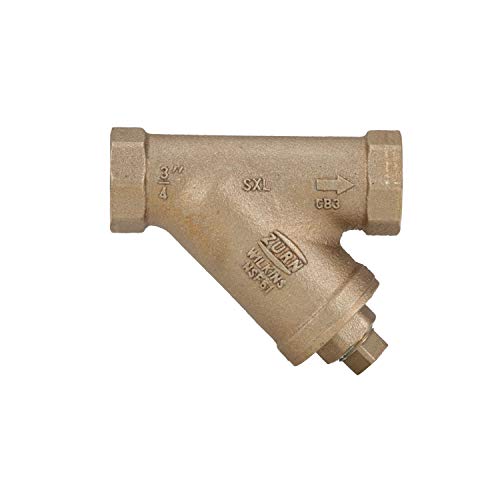
The Zurn Wilkins SXL is the strainer I’d put in front of a pressure-reducing valve or a backflow preventer, and I’ve used it. Zurn’s spec sheet says that’s what it’s for: protecting delicate equipment like regulators and backflow preventers from sediment that could cause premature failure.
Zurn recommends it for potable water service lines, residential and commercial domestic water, and irrigation, and states it meets NSF/ANSI/CAN 61.
The body and the access cover with plug are cast bronze to ASTM B806. The screen is 20 mesh, 300 series stainless steel, and the O-ring is Buna nitrile. Threaded ends are FNPT to ANSI B1.20.1, and Zurn supplies a brass closure plug.
It’s rated 300 psi WOG and 180°F. The ¾ in. size is about 3⅞ in. long with a ⅜ in. NPT cap port, and weighs about 1¼ lb, per Zurn.
Where it lost points: 180°F is the lowest temperature rating here, so it scored 7 on that check, and Zurn’s sheet lists only the 20 mesh screen, which scored 7 on mesh options. Zurn also offers ¾ in. and 1 in. versions with copper sweat ends.
None of that matters for a cold water main ahead of a PRV, which is exactly where it belongs. Zurn’s own sheet draws the SXL upstream of its Model 500XL pressure-reducing valve and its 975XL2 reduced pressure backflow assembly, and says to provide drainage if it’s installed below grade.
The Amazon listing is sold by Amazon.com, the only one of the three, and the brand-written text repeats the low-lead law and NSF/ANSI 61 claims.
My call: pair the strainer with the PRV from the same family if you can. Our PRV replacement guide lists the brands.
Lead-free wye-pattern cast strainer, ¾ in. FNPT, tapped retainer cap
Prices and availability are accurate as of the time shown and may change.
You want to blow debris out through the cap without opening the strainer, on hot or cold water.
Your inspector needs an NSF listing on the spec sheet. The Zurn names NSF/ANSI 61.
The Watts LF777SI is the blowdown pick, and I’ve used it. Watts’ spec sheet lists a tapped retainer cap and closure plug, so you can thread in a valve and flush debris out of the screen without taking the cap off.
The body and cap are a lead-free cast copper silicon alloy. Watts says the wetted surface that contacts drinking water has less than 0.25% lead by weight, and that it complies with state codes requiring reduced lead content.
The ratings are high: 400 psi WOG at 210°F and 125 psi WSP at 353°F for sizes up to 2 in. The gasket is EPDM, and the standard screen is 20 mesh, 304 stainless steel.
Watts adds a detail the others don’t: a flared screen opening on the upstream end for unrestricted flow. Its sheet also includes a flow curve of gpm against pressure drop with the standard 20 mesh screen.
The ¾ in. LF777SI is 3³⁄₁₆ in. long and weighs 0.6 lb, the most compact of the three. The closure plug is lead-free brass. Watts also makes the LFS777SI with solder ends in ½ to 2 in., and its 2½ and 3 in. sizes drop to 300 psi WOG.
Where it lost points: the sheet says lead free but doesn’t name an NSF standard, so it scored 7 on that check. And this part comes with the standard 20 mesh screen; Watts sells a 100 mesh version (LF777M1-100) as a separate listing, which scored 7 on mesh options.
This listing is sold by a third-party seller, eFaucets, rather than Amazon. The price line shows the seller.
My call: the tapped cap is worth it anywhere sediment is heavy, like a well system. A quarter-turn valve on the cap turns cleaning into a ten-second job.
From each maker’s spec sheet. Scroll sideways on a phone. Prices are in each card and the picks above.
| Pick | Photo | Spec score | Pressure | Max temp | Lead-free | Mesh | Cap | Buy |
|---|---|---|---|---|---|---|---|---|
| Apollo 59LF | | 9.4 | 400 psi CWP | 350°F | NSF/ANSI 372 | 20–100 options | Plain on this part | Check it on Amazon |
| Zurn Wilkins 34-SXL | | 8.8 | 300 psi WOG | 180°F | NSF/ANSI 61 | 20 | Cover with plug | Check it on Amazon |
| Watts LF777SI | | 8.8 | 400 psi WOG | 353°F WSP | Lead free, no NSF named | 20 | Tapped with plug | Check it on Amazon |
Green marks a strength and amber a gap. WOG and CWP are cold working pressures; WSP and SWP are steam working pressures.
Pick what the strainer is protecting. It answers from each maker’s ratings and options.
| Job | Pick | Why |
|---|---|---|
| General water line | Apollo 59LF | Highest ratings, most options |
| Ahead of a PRV or backflow preventer | Zurn Wilkins 34-SXL | Zurn designed it for that, NSF/ANSI 61 |
| Hot water or boiler line | Apollo 59LF or Watts LF777SI | 350°F and 353°F ratings |
| Fine sediment | Apollo 59LF, finer screen | 60 to 100 mesh options |
| Well water with grit | Watts LF777SI | Tapped cap for blowdown |
Mesh is openings per inch: a higher number is a finer screen that catches smaller particles and clogs sooner.
| Mesh | Available from | Use it for |
|---|---|---|
| 20 (standard) | All three | Pipe scale, rust, sand chips; protecting valves and meters |
| 50 | Apollo (½ in. size) | Smaller sizes’ standard screen |
| 60 | Apollo option | Finer sediment |
| 80 | Apollo option | Finer still |
| 100 | Apollo option; Watts LF777M1-100 | Fine sand ahead of sensitive equipment |
My call: start with 20 mesh. A finer screen catches more but plugs faster and adds pressure drop, so only go finer when the equipment downstream needs it.
A Y strainer isn’t a sediment filter. For very fine particles, a cartridge filter does that job; our sediment filter micron guide covers it.
My call on the steps, with each maker’s connection details.
Before the PRV, backflow preventer, meter, pump or valve, as Zurn describes.
The cast arrow on the body shows flow direction.
Zurn calls a horizontal run with the strainer cap facing down the preferred orientation, though it says the strainer protects in any orientation.
Use a sealant rated for potable water on the male threads; the strainers are FNPT.
You need space to unscrew the cap and pull the screen.
Zurn supplies a brass closure plug in the cap, and Watts a closure plug in its tapped retainer cap. Apollo offers a tapped cap with plug as a part-number option. Any of those plugs can be swapped for a small valve to blow the screen down.
Isolate the strainer with shutoff valves on both sides if you can. Cleaning it otherwise means shutting off the whole line.
Match the strainer to the pipe size. From Apollo’s and Watts’ dimension tables.
| Size | Apollo 59LF length | Apollo cap tapping | Apollo screen area | Watts LF777SI length | Watts weight |
|---|---|---|---|---|---|
| ½ in. | 2.75 in. | ¼ NPT | 3.2 sq in (50 mesh) | 2¾ in. | 0.5 lb |
| ¾ in. | 4.00 in. | ½ NPT | 6.7 sq in | 3³⁄₁₆ in. | 0.6 lb |
| 1 in. | 4.75 in. | ¾ NPT | 10.8 sq in | 3¾ in. | 1.1 lb |
| 1¼ in. | 5.25 in. | ¾ NPT | 13.5 sq in | 4⁷⁄₁₆ in. | 1.9 lb |
| 1½ in. | 6.00 in. | 1 NPT | 19.0 sq in | 4⅞ in. | 2.4 lb |
| 2 in. | 7.25 in. | 1¼ NPT | 27.6 sq in | 5¹⁵⁄₁₆ in. | 4.4 lb |
Apollo’s heavy pattern is longer and heavier than Watts’ at every size, and it publishes net screen area: 6.7 sq in at ¾ in. More screen area means the strainer can hold more debris before flow drops. Apollo’s ¾ in. weighs 1.21 lb against 0.6 lb for the Watts.
All three makers cover ⅜ in. or ½ in. up to 3 in. My call: use a strainer the same size as the pipe. A smaller strainer adds pressure drop, and a bigger one needs reducers for no gain.
All three picks are female NPT. Each maker also sells a solder version for copper.
| Maker | Threaded model | Solder model | Solder sizes |
|---|---|---|---|
| Apollo | 59LF (female NPT) | 59FL300 lead-free solder | ½ to 3 in. |
| Zurn Wilkins | SXL (FNPT, ANSI B1.20.1) | SXLC copper sweat | ¾ and 1 in. |
| Watts | LF777SI | LFS777SI | ½ to 2 in. |
Threaded is easier to swap later and needs no torch near the screen. On a copper line, a pair of male adapters gets you there. If you solder one in, Apollo markets its body as EZ-Solder lead-free bronze; my call is to pull the screen and cap first so the heat can’t harm the gasket.
On PEX, a threaded strainer with PEX-to-male adapters is the simple route.
Zurn’s spec sheet shows the SXL in two typical installs.
| Install | What Zurn shows | What it protects |
|---|---|---|
| Ahead of a PRV | SXL upstream of a Model 500XL pressure-reducing valve | The PRV seat and diaphragm |
| Ahead of a backflow preventer | SXL upstream of a Model 975XL2 reduced pressure assembly, outdoors in a protective enclosure | The check valves and relief valve |
| Below grade | Zurn: provide drainage so the device can’t be submerged | The whole assembly |
Zurn says local codes govern the install and points to the Uniform Plumbing Code. Other common spots, in my call: ahead of a water meter, a well pump’s pressure switch line, a tankless heater’s cold inlet, or a solenoid valve on an irrigation line. If the downstream part has small passages, it’s worth a strainer.
Our backflow preventer guide covers the valves themselves.
The three common shapes of pipeline strainer, in general terms.
| Shape | How it looks | Good for |
|---|---|---|
| Y (wye) | Screen in an angled leg off the main body | Water lines, ahead of valves and meters; works horizontal or vertical |
| Basket | A larger pot with a lift-out basket and lid | Heavier debris and bigger flows, mostly horizontal lines |
| Inline or tee | Screen in line or in a tee body | Tight spaces; varies by maker |
For a home or light commercial water line, the Y shape is the common choice, which is why all three picks are Y strainers. A sink basket strainer is a different part entirely; our sink basket strainer guide covers that one.
My call on the routine, using the cap and plug each maker supplies.
| Method | Steps | When |
|---|---|---|
| Blowdown | Open the valve on a tapped cap into a bucket for a few seconds | Routine flushing on dirty water |
| Pull the screen | Isolate, relieve pressure, unscrew the cap, rinse the screen, refit with its gasket | When pressure drops downstream |
| Replace the gasket | Fit a new cap gasket or O-ring if it’s flattened or torn | If the cap weeps after cleaning |
The sign a strainer needs cleaning is a pressure drop downstream: lower flow at fixtures, or a PRV that can’t hold its setting. Always relieve the pressure before you open the cap.
These came up on Amazon and in Google’s results. Here’s what kept each off this list.
| Strainer | What we found | Why it’s out |
|---|---|---|
| NIBCO T-221-A bronze | Threaded bronze strainer | Not listed as lead-free; 1 in. only in stock |
| Midline Valve 322U256 | Lead-free cast brass, NSF/ANSI 61/372 per listing, 150 psi SWP | Lesser-known brand; no maker spec sheet read |
| Hayward and Spears PVC Y strainers | PVC bodies, socket or thread | A different material and pressure class; 1 left |
| Mueller Steam Specialty stainless | Cast stainless, 1 in. | Different material; 2 left |
| Unbranded brass Y strainers | Many listings | No lead-free certification or spec sheet |
| Question | If yes | If no |
|---|---|---|
| Is it drinking water? | Lead-free only: any of the three | Other materials may suit |
| Is the line hot? | Apollo 59LF or Watts LF777SI | Keep going |
| Is it protecting a PRV or backflow preventer? | Zurn Wilkins 34-SXL | Keep going |
| Do you want blowdown? | Watts LF777SI, or an Apollo tapped cap | Apollo 59LF |
My call for most water lines: the Apollo 59LF. It has the highest published ratings and the most options. Choose the Zurn ahead of a PRV, and the Watts where you’ll blow it down often.
It catches debris like scale, rust and sand in a pipe before it reaches a valve, meter, pump or regulator. Zurn designs its SXL to protect regulators and backflow preventers.
Both. Watts calls the LF777SI a wye-pattern strainer; Zurn calls the SXL a Y type strainer.
With the flow arrow. Zurn calls a horizontal run with the cap facing down the preferred orientation.
20 mesh is the standard on all three picks. Apollo offers 60, 80 and 100 mesh for finer sediment.
Use a lead-free one. Zurn names NSF/ANSI/CAN 61, Apollo NSF/ANSI 372, and Watts says wetted surfaces are under 0.25% lead.
Apollo and Watts rate their ¾ in. strainers at 400 psi cold; Zurn at 300 psi WOG.
Apollo rates the 59LF to 350°F and Watts the LF777SI to 353°F steam. Zurn’s SXL is rated to 180°F.
When downstream pressure drops, or on a routine for dirty water. A tapped cap with a valve makes it quick.
A valve threaded into the cap so you can flush debris out without opening the strainer. Watts and Apollo offer tapped caps.
Zurn says its SXL protects in any orientation. My call on a vertical pipe: run the flow downward so debris falls into the screen leg.
A Y strainer has its screen in an angled leg; a basket strainer has a larger lift-out basket for heavier debris.
Zurn recommends its SXL to protect regulators from sediment that could cause premature failure.
I’m Isaac Daniels, a licensed journeyman plumber in Georgia (license #JP507711), and I’ve used all three picks. Every spec here comes from Apollo’s, Zurn Wilkins’ and Watts’ own spec sheets, read Oct 23, 2026. Where I add advice of my own, it’s labeled as my call.
Each check scores 0 to 10 and counts one fifth. It’s our score from maker documents, not a customer rating or a lab test of our own.
| Check (weight) | How it’s scored |
|---|---|
| Pressure rating (⅕) | 10 when the maker publishes a cold working pressure of 300 psi or more; 7 for less; 5 when none |
| Lead-free standard named (⅕) | 10 when the maker names NSF/ANSI 61 or 372; 7 for a lead-free statement without a named standard |
| Mesh options (⅕) | 10 when the maker lists more than one screen mesh for the model; 7 for one |
| Blowdown cap (⅕) | 10 when this part has a tapped cap or cover with plug; 7 for a plain cap |
| Temperature rating (⅕) | 10 for 210°F or more; 7 for less |
| Total | Average of the checks, to one decimal |
| Pick | Pressure | Lead-free | Mesh | Cap | Temp | Score |
|---|---|---|---|---|---|---|
| Apollo 59LF | 10 (400 CWP) | 10 (NSF 372) | 10 (20–100) | 7 (plain, -01) | 10 (350°F) | 9.4 |
| Zurn Wilkins 34-SXL | 10 (300 WOG) | 10 (NSF 61) | 7 (20) | 10 (plug) | 7 (180°F) | 8.8 |
| Watts LF777SI | 10 (400 WOG) | 7 (statement) | 7 (20) | 10 (tapped) | 10 (353°F) | 8.8 |