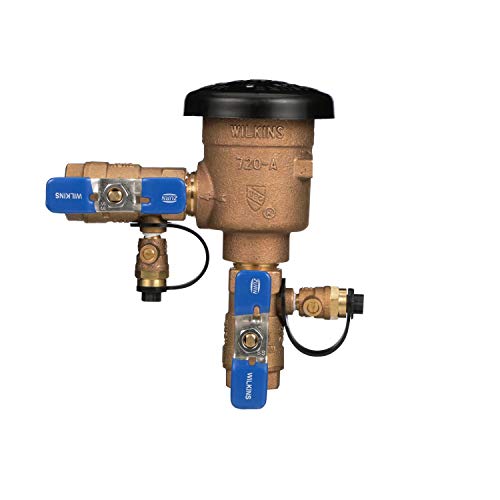
Choose an irrigation backflow preventer by protection type first. I’d start with the Zurn Wilkins 720A where a PVB is approved, or the 975XL where the design needs backpressure protection.
As an Amazon Associate I earn from qualifying purchases. How this site earns
Written by: Isaac Daniels, Licensed Journeyman Plumber (JP507711)
In my 7 years of experience, these are the products I’d install.
Updated November 15, 2026 · Restored the RPZ behavior notes, maker listings and related guides.
Photo from the Amazon listing.
The short answer
For an approved irrigation PVB installation, choose the 720A in the matching connection size. Its tradeoff is the required elevation and lack of backpressure protection. [1]
Buy it if You have a three-quarter-inch irrigation connection and your water authority accepts a PVB. [1]
Skip it if Backpressure can occur, the assembly cannot stand above every downstream outlet, or water spilling from its vent could cause damage where it sits. [1]
What sets it apart The bronze body and bonnet suit a serviceable irrigation assembly. Zurn supplies it with full port ball valves, and the entire assembly stays accessible for maintenance and testing without removing it from the line. [1]
Maker listings Per the Zurn sheet, the 720A is ASSE 1020 listed, UPC listed and CSA B64.1.2 certified, and approved by the Foundation for Cross-Connection Control. [1]
The tradeoff Elevation is part of the installation; a convenient low mounting spot is not enough. [1]
Buy it if Your irrigation connection is one inch and the approved design calls for a PVB. [1]
Skip it if You need backpressure protection or a drinking-water assembly. [1]
What sets it apart It keeps the same protection type while matching the larger nominal connection, with the same full port ball valves and in-line service access as the ¾-inch size. [1]
Maker listings Same 720A family listings per the Zurn sheet: ASSE 1020, UPC and CSA B64.1.2, with approval from the Foundation for Cross-Connection Control. [1]
The tradeoff A larger connection does not change the PVB’s protection type. [1]
Buy it if Your approved non-potable irrigation design needs backsiphonage and backpressure protection. [2]
Skip it if The connection supplies drinking water or you cannot provide drainage for relief discharge. [2]
What sets it apart The reduced pressure design covers both reverse-flow conditions. Zurn supplies it with full port ball valves, and the first and second checks can be serviced without removing the relief valve or taking the assembly out of the line. [2]
Maker listings Per the Zurn sheet, the 975XL is ASSE 1013 listed, cUPC listed, CSA B64.4 certified and AWWA C511 compliant, and approved by the Foundation for Cross-Connection Control. [2]
The tradeoff The relief valve needs a suitable discharge location, access and drainage. [2]
A pressure figure is the working-pressure maximum. Hydrostatic test-pressure figures in a specification sheet are not permission to operate at that pressure.
How a reduced pressure assembly behaves
The 975XL above is one reduced pressure design. The Febco 825Y family works the same way, and Febco’s sheet for it explains the behavior I plan around. The 825Y holds the zone between its two check valves at least 5 psi below the inlet pressure. If that difference drops to 2 psi, the relief valve opens and discharges water to hold the zone down. [3]
Two planning points come with that design. Febco offers a flood sensor for the relief valve that can send an alert when it dumps, but the alerts need an add-on connection kit, and Febco says the sensor does not replace proper drainage. Febco’s sheet also says it is illegal to use the standard 825Y in the United States in any system that provides water for drinking or dishwashing, so I keep this family on irrigation. [3]
Check the PVB elevation
For the 720A, Zurn’s installation drawing places the assembly at least 12 inches above the highest downstream piping or outlet, unless otherwise specified. [1]
Measure from the reference in the maker’s drawing. A low sprinkler near the assembly is not enough if another downstream outlet is higher.
The formula is assembly elevation minus highest downstream elevation. This checks only that difference; it cannot approve the hazard, flow capacity or installation.
How to choose before ordering
I would take the assembly identification, connection size and site measurements to the installer together. A replacement that looks similar can still be the wrong protection type.
Ask for the exact approved model and configuration. Manufacturer approval statements do not replace a current local acceptance check.
A double check is a separate approval decision. Do not pick one simply because a PVB cannot fit the available height. Have the authority decide whether that type is suitable for the connection.
Pressure behind the assembly matters too. Febco warns that thermal expansion or water hammer downstream can raise pressure, and that the excess pressure should be eliminated to avoid damage. On a house service, see why pressure climbs behind a check or backflow device. [3]
Ask the water authority what protection the connection requires. A model’s working-pressure rating does not choose the hazard classification for you.
2
Check the connection and water use
Match the nominal connection and the assembly identification. The 720A and 975XL sheets specify non-potable applications. [1][2]
3
Measure from the correct reference
For the 720A, the maker shows a minimum of 12 inches above the highest downstream piping or outlet, unless otherwise specified. [1]
4
Provide a discharge route
For the 975XL, the maker shows 12–30 inches above adequate drainage, unless otherwise specified. Keep the assembly accessible and out of submergence. [2]
5
Plan for cold weather
The 720A drawing calls for winterization. Arrange a suitable winterization plan rather than treating the bronze body as freeze protection. [1]
6
Arrange installation and testing
Have a licensed plumber confirm the layout and ask the authority about acceptance testing and the required testing schedule. Do this before buying an assembly for a new connection.
Questions buyers ask
Can a pressure vacuum breaker handle backpressure?
No. The 720A sheet excludes installations where backpressure could occur. Have your installer select protection for the actual conditions. [1]
Can these models supply drinking water?
These selected assemblies are for non-potable applications. The 975XL sheet explicitly restricts it to non-potable use; choose a locally accepted drinking-water assembly for household supply. [2]
Does a one-inch PVB protect differently from a three-quarter-inch PVB?
The listed sizes belong to the same 720A pressure-vacuum-breaker family. Choose the connection for the approved design; do not treat pipe size as a different protection category. [1]
Can I put the assembly in a low box?
The 975XL needs adequate drainage, side clearance and protection from submergence. A low box is not automatically a suitable location for relief discharge and service access. [2]
Does a reduced pressure assembly need drainage?
Yes. The 975XL sheet requires adequate drainage and space for relief discharge. It also specifies an air-gap adapter for indoor installations. [2]
Should I buy a test kit with the preventer?
An assembly and a test instrument solve different jobs. Choose the approved assembly first, then arrange testing with a qualified person. See the separate backflow test-kit guide.
Why does my RPZ dump water?
That is the relief valve doing its job. Febco says its 825Y relief valve opens and discharges when the pressure difference between the supply and the zone between the checks drops to 2 psi, under no flow or reversed flow. If yours keeps dumping, a tester or plumber needs to find out why. [3]
When to call a plumber
Call before changing assembly type, moving the installation or connecting a new irrigation branch. Have the water authority confirm the hazard classification and the accepted configuration.
Before you buy, call the water utility or the building department. Ask which type they require for your connection, whether a permit is needed, and who may install and test it. A sprinkler line with a fertilizer or chemical injector is a different connection from a plain lawn line, and the authority may require a different assembly for it.
Get help if the chosen location can flood, cannot drain relief discharge or cannot meet the maker’s elevation drawing. Keep a leaking or damaged assembly accessible for service rather than enclosing it to hide the discharge.
Ask about required field testing after installation and service. The exact schedule and accepted tester belong to the authority responsible for the connection.
Maintaining an existing Wilkins assembly? Match the casting model and marked valve size in the Wilkins 975XL2 repair-kit guide before choosing a kit; it also separates 975XL3 and 375-family part numbers.
How I chose
I compared three models using the Zurn Wilkins 720A and 975XL maker specification sheets, with each selected connection size matched to its listing. The selection follows protection type, water use, installation space and service access.
I kept the two 720A sizes separate so a buyer can follow the exact connection to its listing. They share a protection design; they are not separate performance rankings.
I also considered the Febco 825Y, LF850, 765 and Watts LF007. The selected Zurn models give this comparison a clear route from the maker’s non-potable requirements to the named size.
Before choosing, confirm local acceptance, the exact model and its installation drawing with your installer. Product availability and Amazon’s price can change; each button opens the named listing.