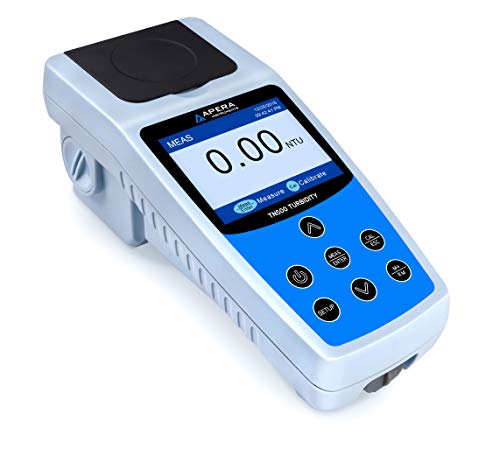
Apera TN500
$997.00 at Amazon
Check it on AmazonPrice as of Nov 6, 2026, 5:30 AM EST
Details ↓
Three portable turbidimeters compared from the makers’ spec sheets, and which test method fits your water.

As an Amazon Associate I earn from qualifying purchases.
Get the Apera TN500: EPA 180.1 method, ±2% accuracy, five standards and a 200-reading log. Ratiometric optics: LaMotte 2020t. Colored samples: Apera TN480.
All three are portable nephelometric turbidimeters that read 0 to 1,000 NTU from a glass sample vial. All were new and in stock on Amazon on Oct 24, 2026, and each scores 7.0 or higher.


Product prices and availability are accurate as of the date/time indicated and are subject to change. Any price and availability information displayed on Amazon.com at the time of purchase will apply to the purchase of this product.
Five checks from Apera’s and LaMotte’s spec sheets, equal weight. Rules and inputs are in the method section.
All three meet a published standard: the TN500 and 2020t follow EPA method 180.1 with a tungsten lamp, and the TN480 follows ISO 7027 with an infrared light. The TN500 leads because it pairs the EPA method with five calibration standards, a 200-reading log and a rechargeable battery. The TN480 matches it on everything but the battery.
The method matters more than the score. Pick EPA 180.1 for drinking water reporting and ISO 7027 for colored water.
What each maker’s sheet says, what it means for testing, and where each lost points.
Apera Instruments TN500 portable white light turbidity meter with data logger, EPA 180.1 (AI483)
Prices and availability are accurate as of the time shown and may change.
You test drinking water or treated water and need readings by the EPA method, stored with a date and time.
Your samples are tinted with color, like tannin-stained well water; the infrared TN480 is Apera’s pick for color.
Apera’s TN500 is the turbidity meter I’d carry for drinking water, and I’ve used it. Apera says it uses a tungsten filament lamp and the 90 degree scattering method, fully compliant with U.S. EPA 180.1, for tap water, drinking water, wastewater and environmental samples.
It reads 0 to 1,000 NTU with automatic ranges: 0.01 to 19.99, 20.0 to 99.9, and 100 to 1,000 NTU. Accuracy is ±2 percent of reading plus stray light, repeatability is ±1 percent or 0.02 NTU, whichever is greater, and stray light is 0.02 NTU or less.
Apera says the tungsten lamp is especially good for low-range water under 10 NTU, and that the lamp is user-replaceable.
The kit includes AMCO polymer standards at 0, 20, 100, 400 and 800 NTU. Apera calls them EPA-approved, NIST-traceable and non-toxic, with a guaranteed one-year shelf life, and says to store them at room temperature and never let them freeze.
Its TruRead mode takes several readings in a row and shows the average, minimum and maximum, which helps with samples that settle. It has zero-point calibration with an error reminder.
The TN500 stores 200 sets of readings with a real-time clock and calibration history, and exports them over USB with Apera’s PC-Link software. The rechargeable 3.7 V lithium battery runs up to 20 hours.
The housing is IP67, the vials are 25 by 60 mm borosilicate glass holding 18 mL, and Apera lists a 2-year limited warranty. It scored 10 on every check.
The kit includes the meter, the five standards, six sample vials, silicone oil, a microfiber wipe, a USB charger and cable, the PC-Link software on a flash drive and a carrying case. The color screen shows guides in English, Spanish and Chinese, and the meter powers itself off when idle.
My call: oil the vial with the silicone oil in the kit and wipe it with the cloth every time. EPA Method 180.1 says sample tubes must be kept clean inside and out and never handled where the light strikes them.
Portable turbidity meter kit, tungsten (code 1974-T)
Prices and availability are accurate as of the time shown and may change.
You measure clear drinking water and want ratiometric optics that LaMotte says minimize stray light and color interference.
You need a five-point calibration set in the box; the 2020t kit ships with three standards.
LaMotte’s 2020t is the turbidity meter I’d pick when I want ratio readings, and I’ve used it. LaMotte says the 2020t meets the U.S. EPA design criteria in EPA 180.1, Rev. 2.0 (1993), and Standard Methods 2130 B-2001.
Its design is ratiometric. LaMotte says the multi-detector optics assure long-term stability and minimize stray light and color interference, and the meter can read in ratio (NTRU), plain nephelometric (NTU) or attenuation units.
In ratio mode it reads 0 to 1,000 NTRU. Resolution is 0.01 up to 10.99, 0.1 up to 109.9 and 1 above that, and the detection limit is 0.05.
LaMotte lists accuracy as ±0.05 from 0 to 2.5 NTRU, ±2 percent from 2.5 to 100, and ±3 percent from 100 to 1,000, and calls the meter ideally suited for low-level drinking water applications.
The kit comes with 0, 1 and 10 NTU standards, a sample bottle, six sample tubes, a USB cable and a wall adapter in a carrying case. Stored results can be viewed on the meter, and it has a backlit display; LaMotte’s page lists seven user-selected languages in one place and eight in another.
It’s waterproof to IP67 and runs on a rechargeable lithium-ion battery.
It also reads the brewing units ASBC and EBC: up to 17,500 ASBC and 250 EBC in ratio mode, per LaMotte, which makes it useful beyond plumbing for anyone checking beer or wort clarity.
Below 11 NTU it resolves 0.01, and its detection limit of 0.05 NTU is the figure to look at when you’re checking finished drinking water.
Where it lost points: ±3 percent above 100 NTU scored 9, and three standards instead of five scored 8. The infrared version, the 2020i, follows ISO 7027 and ships with 0, 10 and 100 FNU standards.
My call: for clear, treated water, the 1 and 10 NTU standards are the ones that matter. Calibrate close to the range you actually test.
Apera Instruments TN480 portable turbidity meter with GLP data logger, infrared, ISO 7027 (AI486)
Prices and availability are accurate as of the time shown and may change.
Your samples have color, like tannin-stained or brown well water, and you want readings stored with a date and time.
You report drinking water results by the EPA method; the TN480 follows ISO 7027 instead.
Apera’s TN480 is the turbidity meter I’d hand someone testing colored water, and I’ve used it. Apera says it uses an infrared light source and the 90 degree scattering method, compliant with ISO 7027, and calls infrared especially ideal for samples with color.
EPA’s own method explains why color matters. Method 180.1 says true color, from dissolved substances that absorb light, makes a white-light turbidity reading low, though it adds the effect is generally not significant in drinking water.
It reads 0 to 1,000 NTU (FNU) with automatic ranges, the same as the TN500. Accuracy is ±2 percent of reading plus stray light, repeatability is ±1 percent or 0.02 NTU, whichever is greater, and stray light is 0.02 NTU or less.
The kit has AMCO polymer standards at 0, 20, 100, 400 and 800 NTU, six sample vials, a USB cable, silicone oil, a microfiber wipe, Apera’s PC-Link software on a flash drive and the manual, all in a rugged carrying case.
It stores 200 sets of readings with a real-time clock and a calibration date check, and sends them over USB to a Windows PC. It also powers itself off and warns when the batteries run low.
Its TruRead mode takes several readings in a row and reports them, which helps with samples that settle. The detector is a silicon photovoltaic cell, per Apera.
It runs on four AA alkaline batteries. The housing is IP67, it works from 32 to 122°F, the meter measures 90 by 203 by 80 mm and weighs 385 grams, and Apera lists a 2-year limited warranty from delivery.
Where it lost points: AA batteries instead of a rechargeable pack scored 7. Every other check scored 10, which ties it with the LaMotte.
Apera’s TN400 is the same infrared meter without the log and without TruRead; it’s in the left-out table with its score.
My call: keep a spare set of AA batteries in the case, and check the calibration date on screen before a day of testing.
From the makers’ spec sheets. Scroll sideways on a phone.
| Pick | Photo | Spec score | Method | Light | Range | Accuracy | Standards | Data log | Buy |
|---|---|---|---|---|---|---|---|---|---|
| Apera TN500 | | 10.0 | EPA 180.1 | Tungsten | 0–1,000 NTU | ±2% of reading | 5 | 200 readings | Check it on Amazon |
| LaMotte 2020t | | 9.4 | EPA 180.1 | Tungsten, ratiometric | 0–1,000 NTRU | ±0.05 NTRU below 2.5 | 3 | Stored results | Check it on Amazon |
| Apera TN480 | | 9.4 | ISO 7027 | Infrared | 0–1,000 NTU | ±2% of reading | 5 | 200 readings | Check it on Amazon |
Green marks a strength and amber a gap. NTRU is LaMotte’s ratio turbidity unit.
Three questions about your samples. It points to one meter and says why.
Most people testing a well, a filter or a cistern are measuring clear water and want to know if it’s getting cloudier. For that, either tungsten meter works. The infrared TN480 earns its place when the water is brown or tea-colored; EPA Method 180.1 says color that absorbs light makes a white-light reading low.
My call: test the same sample twice before you trust a change. EPA Method 180.1 notes that fine air bubbles can read high and fast-settling sediment can read low.
From the makers’ descriptions.
| EPA 180.1 | ISO 7027 | |
|---|---|---|
| Light source | Tungsten lamp at 2,200–3,000 K, per EPA 180.1 | Infrared |
| Angle | 90° scattered light | 90° scattered light |
| Strength | Low-range water under 10 NTU, per Apera | Colored samples, per Apera and LaMotte |
| Units | NTU | FNU (Apera lists NTU (FNU) on the TN480) |
| Meters here | Apera TN500, LaMotte 2020t | Apera TN480 |
Both methods shine light through the sample and measure what scatters at 90 degrees. The difference is the light. Apera says its tungsten models suit drinking, ground, surface and saline waters, and lists EPA 180.1 for drinking water work. My call: if a lab or a permit names a method, buy the meter that matches it.
From the makers’ kit lists.
| Item | Apera TN500 | LaMotte 2020t | Apera TN480 |
|---|---|---|---|
| Calibration standards | 5 (0–800 NTU) | 3 (0, 1, 10 NTU) | 5 (0–800 NTU) |
| Sample vials | 6 | 6 tubes plus a sample bottle | 6 |
| Silicone oil and cloth | Yes | Not listed | Yes |
| Power | USB charger and cable | USB cable and wall adapter | Runs on 4 AA; USB cable for data |
| Software | PC-Link on a flash drive | USB port | PC-Link on a flash drive |
| Case | Carrying case | Carrying case | Carrying case |
My call: buy a spare set of vials with any of these. EPA Method 180.1 says to discard sample tubes once they’re scratched or etched, and the kit’s six won’t last forever.
How finely each meter reads at each level.
| Meter | Low range | Middle range | High range | Other units |
|---|---|---|---|---|
| Apera TN500 | 0.01–19.99 NTU, 0.01 | 20.0–99.9 NTU, 0.1 | 100–1,000 NTU, 1 | FNU |
| LaMotte 2020t | 0–10.99 NTRU, 0.01 | 11.0–109.9 NTRU, 0.1 | 110–1,000 NTRU, 1 | NTU, ASBC, EBC, AU |
| Apera TN480 | 0.01–19.99 NTU, 0.01 | 20.0–99.9 NTU, 0.1 | 100–1,000 NTU, 1 | FNU |
| Meter | Accuracy near 1 NTU | Stray light or detection limit | Maker’s low-range note |
|---|---|---|---|
| Apera TN500 | ±2% of reading plus stray light | Stray light ≤0.02 NTU | Tungsten lamp suited to water under 10 NTU |
| LaMotte 2020t | ±0.05 NTRU from 0 to 2.5 | Detection limit 0.05 | Ideally suited for low-level drinking water |
| Apera TN480 | ±2% of reading plus stray light | Stray light ≤0.02 NTU | Infrared, aimed at colored samples |
The two makers state accuracy differently, so line them up at a real number. At 1 NTU, Apera’s ±2% plus up to 0.02 NTU of stray light works out to about ±0.04 NTU, and LaMotte’s figure is ±0.05 NTRU. On paper the meters are close at the low end, and neither sheet shows one clearly ahead.
All three switch ranges on their own. In nephelometric (NTU) mode, LaMotte’s 2020t reads up to 50 NTU; its ratio mode is what carries it to 1,000.
From Apera’s spec sheets.
| Condition | Apera TN500 and TN420 | Apera TN480 |
|---|---|---|
| Operating temperature | 0 to 50°C (32 to 122°F) | 0 to 50°C (32 to 122°F) |
| Humidity | 0–90% at 30°C, 0–80% at 40°C, 0–70% at 50°C, no condensation | 0–90% at 30°C, 0–80% at 40°C, 0–70% at 50°C, no condensation |
| Sealing | IP67 | IP67 |
EPA Method 180.1 says to let samples come to room temperature before reading if you can, and Apera’s limits say no condensation. My call: when you pull cold well water on a warm day, let the vial sit until the outside stays dry before you read it.
What comes in each kit.
| Meter | Standards in the kit | Type | Care |
|---|---|---|---|
| Apera TN500 | 0, 20, 100, 400, 800 NTU | AMCO polymer, EPA-approved, NIST-traceable | One-year shelf life; room temperature; never freeze |
| LaMotte 2020t | 0, 1, 10 NTU | Supplied standards | Per LaMotte’s instructions |
| Apera TN480 | 0, 20, 100, 400, 800 NTU | AMCO polymer, EPA-approved | One-year shelf life |
Apera says its AMCO standards don’t settle out of suspension and lists a one-year shelf life. My call: write the opening date on each vial, and replace the set when the year is up, even if the readings still look fine.
The steps that keep the number honest.
Then fill to the line.
Don’t touch it where the light passes.
EPA 180.1: it masks minor flaws.
Same orientation every time.
It averages samples that settle.
EPA Method 180.1 says finely divided air bubbles can cause high readings, and to wait until they disappear before pouring the sample into the tube. Its procedure mixes the sample first so the solids are spread evenly. Apera’s TruRead mode takes several readings in a row for samples that won’t hold still.
Where the number is useful.
A jump in NTU after rain is worth a look at the well cap and casing.
Test before and after the filter to see if it’s still working.
A logged history shows trends you won’t see by eye.
Clear water can still carry bacteria or chemicals; test those separately.
Turbidity tells you how cloudy water is, not what’s in it. For a broader picture, pair it with a water test kit, and if the cloudiness is sediment, see our well water filter guide.
From the makers’ spec sheets.
| Meter | Power | Housing | Meter size and weight |
|---|---|---|---|
| Apera TN500 | 3.7 V rechargeable lithium, up to 20 h, USB charging | IP67 | Not listed separately for the TN500 |
| LaMotte 2020t | Rechargeable lithium ion, USB and wall adapter | IP67 | Not listed on the page |
| Apera TN480 | 4 × AA alkaline | IP67 | 90 × 203 × 80 mm, 385 g |
All three are IP67, so a splash or a drop in shallow water won’t end the day. My call: for a meter that lives in a truck, rechargeable is easier; for one that sits in a drawer for months, AA batteries you can swap are easier.
The model names are close; the differences are the light, the log and the battery.
| Model | Method and light | Data log | Power | On this page |
|---|---|---|---|---|
| TN400 | ISO 7027, infrared LED | None | 4 × AA | Left out (8.4) |
| TN420 | EPA 180.1, tungsten lamp | None | Rechargeable, 20 h | Left out (9.0) |
| TN480 | ISO 7027, infrared | 200 sets, USB, clock | 4 × AA | Pick |
| TN500 | EPA 180.1, tungsten lamp | 200 sets, USB, clock | Rechargeable, 20 h | Top pick |
All four share the 0 to 1,000 NTU range, the ±2% accuracy, the five AMCO standards and the IP67 housing, per Apera. My call: decide on the light first, because color in your water decides it, then decide whether you need the log. If you’ll hand results to an inspector or a lab, the log with its clock and calibration history saves you a notebook.
From each maker’s page.
| Meter | Warranty |
|---|---|
| Apera TN500 | 2-year limited (Apera Instruments, USA) |
| LaMotte 2020t | Not stated on the product page; ask the seller |
| Apera TN480 | 2-year limited from delivery (Apera Instruments) |
These came up on Amazon on Oct 24, 2026.
| Meter | What we found | Why it’s out |
|---|---|---|
| Apera TN420 | 5 left; EPA 180.1, no logger; scored 9.0 | The TN500 is the same meter with a 200-reading log |
| Apera TN400 | In stock; ISO 7027, no logger; scored 8.4 | The TN480 is the same infrared meter with a 200-reading log and TruRead |
| Extech TB400 | In stock; ±5% FS or ±0.5 NTU, 2 standards | No standard method named; scored 5.6 |
| LaMotte 2020i | 1 left | Infrared version; only one in stock |
| Hanna HI98703 | 1 left | Only one in stock |
| Hach 2100Q | Accessories only on Amazon | Meter not listed new |
| Question | If yes | If no |
|---|---|---|
| Are your samples colored or tinted? | Apera TN480 | Keep going |
| Do you also read beer or wort in ASBC or EBC? | LaMotte 2020t | Keep going |
| Do you need dated, stored readings? | Apera TN500 | Keep going |
| Does a permit name EPA 180.1? | Apera TN500 or LaMotte 2020t | Any of the three |
How much light the particles in water scatter, reported in NTU or FNU.
Nephelometric turbidity unit: the scattered light at 90 degrees compared with a standard.
Both are scattered-light units; LaMotte uses FNU for its infrared 2020i, and Apera lists NTU (FNU) on its meters.
The U.S. EPA turbidity method using a tungsten lamp and 90° scattered light.
The international turbidity method using an infrared light source.
An infrared ISO 7027 meter like the Apera TN480.
The Apera meters list ±2% of reading plus stray light; the LaMotte lists ±0.05 NTRU below 2.5.
Follow the maker; and calibrate near the range you test.
Apera’s AMCO standards have a one-year shelf life; never freeze them.
EPA 180.1 says fine bubbles read high and settling sediment reads low; let bubbles clear and use TruRead.
Yes; it shows cloudiness changes, but not bacteria or chemicals.
No; TDS is dissolved solids, turbidity is suspended particles that scatter light.
Yes; use the maker’s glass vials, 25 × 60 mm for the Apera meters.
The TN500 and TN480 store 200; the LaMotte stores results.
All three are IP67.
Apera lists 2 years; LaMotte’s page doesn’t state one.
I’m Isaac Daniels, a licensed journeyman plumber in Georgia (license #JP507711), and I’ve used all three picks. Methods, ranges and accuracy come from Apera’s and LaMotte’s own spec sheets, read Oct 24, 2026. My own advice is labeled as my call.
Each check scores 0 to 10 and counts one fifth. It’s our score from maker documents, not a customer rating.
| Check (weight) | How it’s scored |
|---|---|
| Standard method (⅕) | 10 when the maker names EPA 180.1 or ISO 7027; 4 when no method is named |
| Accuracy (⅕) | 10 for ±2% of reading across the range; 9 when it widens to ±3% at the top; 6 for ±5% of full scale |
| Calibration standards (⅕) | 10 for five points in the kit; 8 for three; 6 for two |
| Data storage (⅕) | 10 when readings are stored on the meter; 5 when not |
| Battery (⅕) | 10 for rechargeable; 7 for disposable batteries |
| Total | Average of the checks, to one decimal |
| Pick | Method | Accuracy | Standards | Storage | Battery | Score |
|---|---|---|---|---|---|---|
| Apera TN500 | 10 | 10 | 10 | 10 | 10 | 10.0 |
| LaMotte 2020t | 10 | 9 | 8 | 10 | 10 | 9.4 |
| Apera TN480 | 10 | 10 | 10 | 10 | 7 | 9.4 |
| Apera TN420 (left out) | 10 | 10 | 10 | 5 | 10 | 9.0 |
| Apera TN400 (left out) | 10 | 10 | 10 | 5 | 7 | 8.4 |
| Extech TB400 (left out) | 4 | 6 | 6 | 5 | 7 | 5.6 |