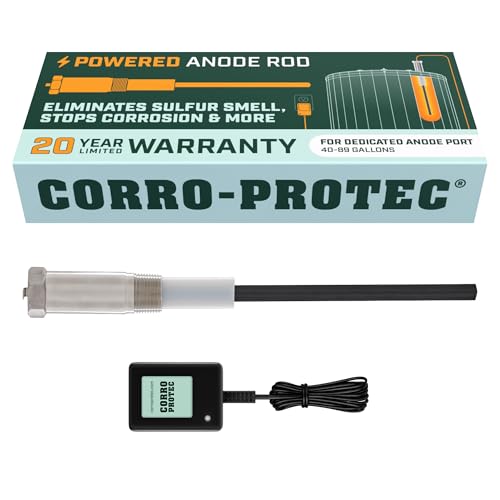
Corro-Protec powered anode
$179.95 at Amazon
Check it on AmazonPrice as of Oct 24, 2026, 5:30 AM EDT

Find the source, then fix the drain, heater or well.
As an Amazon Associate I earn from qualifying purchases.
Smell a glass of water in another room. No smell? It’s the drain. Hot only: the heater’s anode. Well water, hot and cold: groundwater. Gas in the air? Leave, call the gas company.
Run the hot and cold taps at a sink you haven’t used for a few hours, then answer.
The finder leans on one split. Minnesota’s Department of Health says to smell the hot and cold taps after you’ve been away for a few hours. The smell builds up in still water, so the first run tells you the most.
Hot only points to the tank, since cold water never passes through it. Both points upstream, to the well, the main or a filter. A smell at one sink that isn’t in a glass points to the drain under that sink.
Springfield Utility Board’s test takes a minute and rules out the most common false alarm.
Use the sink where you notice the smell, before anyone has run water there for a while.
Run the cold tap and fill a clean glass.
Take the glass to another room, away from any drain.
No smell in the glass, but a smell at the sink, means the drain is the source.
Fill a second glass from the hot tap and smell it away from the sink too.
If the glasses smell, check a tap on another floor to see if it’s the whole house.
| What you find | What it points to | Go to |
|---|---|---|
| Smell at the sink, not in either glass | Gas from that drain | Drain smells |
| Hot glass smells, cold glass doesn’t | The water heater | Water heater |
| Both glasses smell, well water | The well or groundwater | Well water |
| Both glasses smell, city water | The supply, a softener or a filter | City water |
| Smell in the room air, not the water | Possible gas leak | Gas or water |
Why the walk matters: drain gas is heavier than air and sits in the drain until running water pushes it out, the utility explains. Standing over the sink, you smell the drain and blame the water. In another room, the glass only smells of what’s in it.
Natural gas and propane are made to smell like rotten eggs on purpose. That smell in the air is a different problem.
| Sign | Likely water smell | Possible gas leak |
|---|---|---|
| Where you smell it | Only when a tap runs, at the faucet or in a glass | In the room air, with no water running |
| Near what | Sinks, tubs, showers | Water heater, furnace, range, dryer or gas meter |
| Gets stronger | At the first run of hot water | Near the appliance or a gas line |
| Do this | Use this page | Leave, don’t touch switches, call the gas company from outside |
Bradford White’s gas water heater manual says it plainly: the odorant added to natural gas and propane is what most people know as a sulfur or rotten egg smell. It also warns about odorant fade, where the smell weakens, so a faint whiff near a gas appliance still counts.
My call: if you can’t tell, treat it as gas. Leave, and call the gas company from outside or a neighbor’s phone, as Bradford White says. A false alarm costs you a visit. Guessing wrong costs a lot more.
Every one of these makes the same gas. Where it’s made decides the fix.
| Source | Tell-tale sign | First fix | Who it fits |
|---|---|---|---|
| Drain gas | Smell at one sink, not in a glass | Hot water and a little bleach down the drain | Anyone |
| Water heater anode rod | Hot water only, strongest at first run | Powered or aluminum rod; disinfect the tank | City or well |
| Sulfur bacteria in well, pipes or softener | Hot and cold; slime in the toilet tank | Shock chlorination of the well and pipes | Mostly wells |
| Hydrogen sulfide in the groundwater | Hot and cold, every time, from day one | Test the level, then treat at the point of entry | Wells |
| Sewage or other pollution | Smell plus other changes; rare | Test for coliform and nitrate now | Wells |
Minnesota’s health department lists the same sources: decay and reactions with soil and rock, sulfur bacteria in the groundwater, well or plumbing, the water heater, and rarely pollution. USGS adds that the gas forms when groundwater filters through organic matter or minerals such as pyrite.
Signs that back up the smell: black stains on silverware and fixtures, and corroded metal parts. Slime that’s white, grey, black or reddish brown points to sulfur bacteria, the department says.
This is the most common case. The fix is inside the tank, not in the water supply.
Most tank water heaters come with a magnesium anode rod that corrodes so the steel tank doesn’t. Penn State Extension explains that the magnesium can chemically reduce sulfate in the water to hydrogen sulfide. Rheem’s own manual says sulfate and the anode’s protection process can make a rotten egg odor in heated water.
That’s why a brand-new heater can start to smell. The water hasn’t changed; the rod has started working on it. Corro-Protec notes that many heater makers say softened water can wear a sacrificial rod faster.
| Fix | What it does | Catch |
|---|---|---|
| Powered anode (titanium) | Protects the tank with a small current instead of a rod that dissolves | Needs an outlet; protection pauses in a power outage |
| Aluminum or aluminum/zinc rod | Still a sacrificial rod, but doesn’t feed the reaction the same way | Penn State says it should stop the smell; it still wears out |
| Chlorinate and flush the tank | Kills sulfur bacteria in the tank | MDH: the smell can return within weeks |
| Heat the tank to 160 °F for several hours | Kills sulfur bacteria; flush after | Scald risk; check the relief valve and turn it back down |
| Remove the rod | Stops the reaction | Rheem: shortens tank life and excludes warranty coverage |
Rheem is blunt about the last one. Its manual says not to remove the anode except to inspect or replace it, because running without it will greatly shorten the life of the glass-lined tank and will exclude warranty coverage. Penn State and Minnesota warn about the same trade.
My call: a powered anode is the fix I’d put in for good. It doesn’t dissolve, so there’s no rod to keep feeding the smell or to replace every few years. An aluminum rod costs less and works for many homes; it’s still a wear part.
| Powered anode | Aluminum rod |
|---|---|
| Titanium; Corro-Protec says it doesn’t degrade | Wears away like magnesium, more slowly in some water |
| Plugs into a wall outlet on a 12 ft cord | No power needed |
| Corro-Protec: smell gone within 24 hours in most cases | Penn State: should stop the smell; flush the tank too |
| 20-year warranty if registered within 90 days | No long warranty; replace as it wears |
| Separate model for Bradford White and hot-outlet anodes | Hex-head or combination rods by heater |
Pulling the old rod is the hard part either way. Corro-Protec’s kit carries 1-1/16 in. and 1-3/16 in. sockets for common rod heads; add a breaker bar. The anode rod replacement guide walks through the swap. For rod lengths, threads and aluminum versus magnesium, see anode rod size and type.
Comparing powered anodes from different makers? The powered anode rod guide lines them up.
Turn the breaker off, or set a gas heater to pilot, before you open the tank.
Shut the valve on the cold line into the heater and open a hot tap to relieve pressure.
Drain enough that water won’t spill out of the anode port when the rod comes out.
Break the old rod loose, tape the new one’s threads and snug it in the same port.
Refill with a hot tap open until water runs steady, then restore power or gas.
Run each hot tap for a few minutes; the old, smelly water has to clear out.
One warning from Rheem’s manual if the heater has sat for two weeks or more: hydrogen gas can build up in the tank, and it’s extremely flammable. Open the kitchen hot tap for several minutes before you use anything electric on the hot water, and keep any flame away. A sound like air escaping means gas was there.
The gas is in the water before it reaches the house, or bacteria live in the well or pipes.
Start with a safety test, not a filter. Minnesota’s health department says the smell usually isn’t a sign of unsafe water, but in rare cases it comes from sewage. To be safe, test the well for coliform bacteria and nitrate. The water test kit guide covers home kits and certified labs.
Penn State adds where it shows up most: wells drilled into acidic bedrock such as shale and sandstone. A softener can rarely host the bacteria too.
| Test | Why | How |
|---|---|---|
| Coliform bacteria | Rules out a sanitary problem | Certified lab sample |
| Nitrate | Rules out pollution from septic or fields | Certified lab sample |
| Hydrogen sulfide | Picks the treatment | On site, with a fresh sample |
| Sulfate | Over 250 ppm needs treating for drinking (UGA) | Lab test package; ask for sulfate |
| Iron and manganese | Changes which filter fits | Lab test package |
Hydrogen sulfide needs its own test at the tap. UGA Extension says it escapes from water so fast that it may be gone by the time a sample reaches a lab. Penn State says to test in the home, or have the lab stabilize the sample first.
That’s what the strips in the kit are for. The ITS 481167 reads 0 to 2 ppm in 20 seconds, and the ITS 481068 reads 5 to 80 ppm for strong wells. ITS says to test a fresh sample right away.
The level of hydrogen sulfide, in mg/L (the same as ppm), decides what works and what it costs to run.
| Level | Treatment that fits | Source | Upkeep |
|---|---|---|---|
| Under 1 mg/L | Activated carbon filter | MDH | Replace the carbon |
| Under and over 1 mg/L | Oxidizing media filter (manganese greensand) | MDH | Backwash and regenerate |
| Under and over 1 mg/L | Aeration, then filtration | MDH; UGA calls it the lowest cost | Keep the air working |
| Any level; most used over 6 mg/L | Continuous chlorination, then filtration | Penn State | Refill chlorine, backwash, replace carbon |
| Any level | Ozone, then filtration | MDH | Equipment service |
Penn State gives the details on chlorination: a small pump feeds chlorine into a tank or coil sized for at least 20 minutes of contact, and a carbon filter after it takes out leftover chlorine. It calls the upkeep significant: refilling, backwashing and replacing carbon.
My call: get the number before you buy anything. A carbon filter sold for a 5 mg/L well won’t keep up, and a chlorination system for 0.5 mg/L is more machine than you need. Filter picks for wells are in the well water filter guide and the iron filter guide.
If bacteria live in the well or pipes, shock chlorination comes first. Minnesota says sulfur bacteria are hard to remove once they’re established. Scrubbing the casing and special chemicals may be needed first, especially with iron bacteria, and that’s work for a licensed well contractor. For a softener or filter, ask its installer or maker how to disinfect it.
A smell in hot and cold city water is worth one phone call before you change anything at home.
| Step | Why |
|---|---|
| Call the water utility | They test the supply and know about main work or flushing nearby |
| Ask neighbors | If they smell it too, it’s the supply, not your house |
| Bypass the softener or filter | Bacteria can grow in treatment equipment; see if the smell stops |
| Check the heater | If cold clears and hot doesn’t, go back to the anode |
USGS suggests calling your local health department about an odor too, and testing at a state-certified lab if it doesn’t clear. A city supply is tested before it reaches you, so a house-wide smell that the utility can’t find usually points to something inside: a softener, a filter or the heater.
The glass test cleared the water. The smell lives in the drain under that sink.
Lift out the sink stopper and clean the gunk off it.
Close the drain and fill the sink with hot water.
Springfield Utility Board says a few ounces of chlorine bleach in the hot water.
Pull the plug and let the hot, chlorinated water flush the drain.
Clean a kitchen disposal the same way, with the water running.
A floor drain or spare shower can dry out and let sewer gas in; run water in it.
Never mix bleach with a drain cleaner or vinegar; pick one and flush it through. If the smell comes from many drains at once or from the floor, it’s sewer gas, not a sink. That has its own causes, covered in sewer smell in the house. A smelly kitchen disposal has its own guide: garbage disposal smells.
Usually it’s a nuisance, not a health risk. A few cases need care.
| Question | What the sources say | My call |
|---|---|---|
| Can I drink it? | Penn State: no drinking standard; it tastes bad well before it’s harmful. MDH: test wells for coliform and nitrate. | Test a well first; then it’s a taste problem |
| Can I shower in it? | MDH: the gas in the air is harmful only at high levels; vent it | Run the fan; fix the source |
| Is it hurting my pipes? | UGA: it corrodes metals, even stainless steel; shortens copper and well casings | Yes, over time; don’t leave it |
| Why did the smell fade? | ITS: at high levels it numbs your sense of smell | Don’t trust your nose; test it |
| Is a well pit with the smell safe? | MDH: only well pros with safety gear should enter | Stay out |
Most people can smell hydrogen sulfide well below 0.5 mg/L, Penn State says, which is why it’s noticed long before it’s a health concern. The real cost is slower: black stains, tarnished silver and corroded fittings. UGA notes it can even react with a softener’s resin bed.
Buy what your test points to. I’ve used every part in this kit.


Product prices and availability are accurate as of the date/time indicated and are subject to change. Any price and availability information displayed on Amazon.com at the time of purchase will apply to the purchase of this product.
| Part | Key specs | Pick it if | Skip it if |
|---|---|---|---|
| Corro-Protec CP-R 40–89 gal | Titanium powered anode for the dedicated anode port; 12 ft cord; 3/4 in. NPT; WQA Gold Seal lead-free; 20-year warranty if registered | Only the hot water smells and the heater has its own anode port on top. | You have a Bradford White or a hot-outlet anode. Corro-Protec sells a separate model. |
| Corro-Protec install kit | 1-1/16 in. and 1-3/16 in. 6-point sockets, 1/2 in. drive, thread tape | You’re fitting a Corro-Protec and don’t own both deep sockets. | You already have the sockets and a breaker bar. |
| ITS 481167 | 30 foil-packed strips; reads 0, 0.3, 0.5, 1 and 2 ppm; 20-second test | You want a number for a faint or medium smell before you buy a filter. | Your well smells strong from across the room. Use the high range. |
| ITS 481068 | Bottle of 50; reads 0 to 80 ppm in steps; 1-second dip, read in under 30 seconds | Your well smells strong and you’re pricing chlorination or aeration. | The smell is hot-only. Fix the heater first. |
Smaller tank? The Corro-Protec 10–39 gallon model is the same titanium rod sized for smaller heaters. Corro-Protec says it works with city or well water, softeners and filters, and with electric, gas and hybrid tanks.
It draws less power than a night-light, about $3 a year, by Corro-Protec’s numbers. Leave it plugged in; protection pauses only while the power is out.
| What you find | Who to call | Why |
|---|---|---|
| Anode rod won’t break loose | Plumber | Forcing it can twist the tank fitting |
| Heater has no anode port you can reach | Plumber | It may need a hot-outlet or combination rod |
| Well needs shock chlorination | Licensed well contractor | Prework and safe handling; MDH says so |
| Coliform or nitrate in the test | Well contractor and health department | It’s a safety problem now, not a smell |
| Gas smell near an appliance | Gas company first | Possible leak; leave the house |
Swapping an anode is a fair job for a handy homeowner with a good socket and room above the heater. MDH suggests leaving it to a plumber unless you know your heater well, and I’d agree if the rod is old or the tank is in a tight closet. For a price range, try the plumbing cost estimator.
It’s hydrogen sulfide gas. It comes from the water heater’s anode rod, sulfur bacteria in a well or pipes, gas in the groundwater, or gas from a drain that only seems to come from the water.
The water heater is the source. A magnesium anode rod can turn sulfate in the water into hydrogen sulfide. A powered or aluminum rod, plus a flush, usually stops it.
Usually it’s a taste and odor problem, not a health risk. On a well, test for coliform bacteria and nitrate first, since a rare case comes from sewage.
In most homes, yes. The gas is harmful in the air only at high levels, so run the bathroom fan and fix the source.
Call one if the anode rod won’t come out or the heater has no reachable port. A well that needs shock chlorination is a job for a licensed well contractor.
Bacteria in the drain make gas that running water pushes up. Fill a glass and smell it in another room. If the glass is clean, flush the drain with hot water and a little bleach.
Heater makers say softened water can wear an anode rod faster, and in rare cases a softener hosts the bacteria. Check the heater’s rod, and ask the softener’s maker how to disinfect it.
Not if you want to keep the tank. Rheem says running without the rod greatly shortens tank life and excludes warranty coverage. Swap it instead.
I’m Isaac Daniels, a licensed journeyman plumber in Georgia (license #JP507711). I’ve used every part in the kit. The causes, tests and treatments come from state health and extension guides, USGS, a water utility, and Rheem, Bradford White, Corro-Protec and ITS documents, read on Oct 22, 2026. My own opinions are marked “My call.”