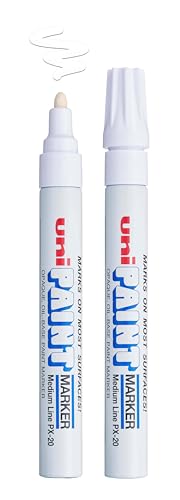
Uni Paint PX-20 white
$9.99 at Amazon
Check it on AmazonPrice as of Oct 24, 2026, 5:30 AM EDT · low stock then
Read the fit and limits
Match the mark to the pipe.
As an Amazon Associate I earn from qualifying purchases.
Choose white Uni Paint PX-20 for visible marks on clean, dry dark metal. Pick Markal Fine for smaller marks and Markal Oily Surface for oily steel. Wet or plastic pipe needs its own check.
Start with a safe, cool, accessible exterior surface. White and black serve different pipe finishes. Three are for clean, dry metal and one marks through oil. None is approved for a prepared joint or wet pipe.


Product prices and availability are accurate as of the date/time indicated and are subject to change. Any price and availability information displayed on Amazon.com at the time of purchase will apply to the purchase of this product.
Prices and availability are accurate as of the time shown and may change.
You need a visible white reference on clean, dry dark metal and have confirmed the finish permits it.
You need a verified wet/oily formula, an exact fine width or an unconfirmed plastic application.
My call: choose the white PX-20 when the main problem is seeing a reference mark on dark metal. A white mark and a black-painted steel surface give you a sensible contrast pairing. This recommendation assumes the pipe is cool, clean and dry, and that its finish allows the marker.
The linked offer is a two-count white pack. That suits keeping one marker near the cutting station and another with the layout tools. Keep the two-count pack distinct from the other PX-20 assortments and colors; a shared family name alone does not identify the pack.
Uni identifies PX-20 as an oil-based paint marker with an acrylic bullet nib. That gives the broad exterior reference mark a different role from a tiny measurement tick. If adjacent marks must remain distinct, start with the Markal Fine option and check the line on suitable scrap before making the working mark.
The PX-20 width needs care: the listing says 1.8–2.2 mm, while Uni’s own page also gives 2.2–2.8 mm. Neither figure is a promised line on your curved pipe.
For a narrow reference, compare the conflicting nib specifications in the width table before choosing the PX-20. The actual line must leave the intended measurement edge clear.
An exterior reference mark is also different from coating the end of a tube. Keep the joint’s sealing or bonding surfaces under the pipe-system instructions. For press work, a correctly measured depth mark helps check insertion, as Viega instructs. An arbitrary white line cannot establish depth, and no mark alone proves a sound joint.
Skip this white pack if the actual surface is light enough that the line becomes hard to see. Black PX-20 is the contrasting choice in this guide. Also stop short of treating the word permanent as proof of survival through cleaners, direct flame or long outdoor exposure. Those conditions need their own evidence.
Prices and availability are accurate as of the time shown and may change.
You need the maker-stated fine format for small marks on a permitted exterior surface.
You need a documented through-oil formula or a broad identification stroke.
My call: choose Markal Pro-Line Fine white when the mark must identify a small reference point rather than cover a broad area. Markal now calls this family Paint-Riter Fine. Its maker-stated fine mark size is 1/16 inch, or 1.5 mm. The Amazon offer retains the Pro-Line name and contains twelve white markers.
The useful distinction is the fine valve-actuated tip. Small numerals near a cut reference can become hard to interpret when the line covers the space between them. A finer stated mark size gives you a reason to start here, although hand pressure and the actual surface still need a scrap check.
Markal lists steel and iron, pipes and tubes among the family’s surface uses. Its stated marking range is 0°F to 150°F. That range concerns application; it does not certify a finished mark through soldering. It also does not make touching a hot pipe safe or authorize work on a leaking system.
The twelve-pack format makes sense when the same white reference color is used at several work positions. It is a less direct match for someone who needs several colors for identification. Check that the received pens match the white Fine family rather than a similarly named Oily Surface or Wet Surface product.
Do not move a claim across those Markal families. A fine tip alone does not show that paint will pass through an oil film, and the product page’s generic plastic entry does not identify an approved PEX or CPVC formulation. The pipe maker’s compatibility requirements still control the exact marking job.
Use a clearly defined edge of the reference mark when the system’s procedure depends on position. If the line pools or the tip starts skipping, check the label’s handling directions rather than repeatedly widening the working line. Choose this pack for its documented fine format, with no promise that twelve pens will last a particular number of jobs.
Prices and availability are accurate as of the time shown and may change.
You need a contrasting black reference on clean, dry light metal.
The surface is dark, or the pipe maker has not cleared your plastic or coating application.
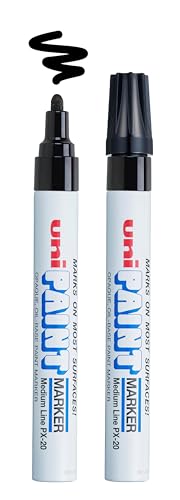
My call: choose black PX-20 for a clean, dry light-metal exterior where the white pen would be difficult to read. The black and white packs share the PX-20 family, so the decision here is contrast. It is not evidence that the black formula lasts longer or produces a more accurate line.
This offer contains two black markers. Keep that count separate from a twelve-count catalog or another seller’s assorted set. The photo and buy row identify the selected pack. If the received label gives another color or model, settle that mismatch before relying on the pen for pipe references.
On bright copper, decide where you will read the mark after the next operation. A cut reference and a press insertion reference answer different questions. The first locates the planned cut; the second records a depth established by the fitting instructions. A useful black mark does not replace either measurement.
For closely spaced references, keep the black location line separate from the written dimension so the intended edge remains visible. Compare the Markal Fine format if a medium stroke would cover adjacent references. The PX-20 width conflict is detailed in the table below.
A pale surface can be plastic, painted steel or bare metal. Similar color does not make their compatibility requirements interchangeable. The recommendation for black on a light background is a readability choice. It grants no approval for oil-based paint on PEX, CPVC or a specialty pipe coating.
Skip black on a dark cast-iron surface if you cannot distinguish the line at the normal working position. Change the contrast or the marking method permitted by the pipe maker. Also avoid using a black paint stroke to cover the original pipe identification. Keep material and size information available for the person checking the work.
Prices and availability are accurate as of the time shown and may change.
The pipe still has cutting oil or grease on it and you need a readable white mark on the outside.
The pipe is plastic without its maker’s approval, or it’s wet rather than oily.
My call: pick Markal’s Paint-Riter+ Oily Surface when the pipe still carries cutting oil or grease, such as black steel just off a threader. Markal says its paint penetrates oils and greases, dries quickly and leaves a bold, permanent mark that resists wear, weather and fading. None of the other three picks makes an oily-surface claim.
The linked pack is model 96960: twelve white pens. Markal makes the same pen in yellow, red, black, blue, green, orange and more, so a crew can keep one formula across a color key. Markal lists a metal barrel and nib and xylene-free paint, made in the USA.
Markal’s marking range is −50°F to 150°F (−46°C to 66°C). That covers a cold crawlspace or a summer attic run. It’s an application range, not a rating for a mark that will sit next to a torch.
Markal names steel and iron, aluminum, pipes and tubes, plastic, and rubber among its surface uses. Plastic on that list is generic. It isn’t approval from a PEX, PVC or CPVC maker, so the plastics section below still applies.
The listing and the maker don’t say quite the same thing. The Amazon text adds wet, soapy and coated surfaces; Markal’s own page says oily and greasy. Markal sells a separate Paint-Riter+ Wet Surface pen, so for pipe that’s wet rather than oily, look at that family instead.
Tip size is the other gap. The listing’s “Bold Mark Size 1.8″” can’t be an inch figure on a pocket pen, and Markal’s page gives no mark size, so our score counts it as unpublished. Draw a test line on scrap before you mark a measured spot.
Mark the outside of the pipe only. A line through oil helps you find a cut or a hanger spot; it doesn’t clean the threads. Prepare the joint area the way the fitting maker says before sealant or tape goes on.
Start with contrast and the mark’s purpose. Pack count changes how many pens you receive; it says nothing about adhesion or writing life. The number column can be sorted on desktop.
| Marker and photo | Spec score | Use | Markers per pack | Tip evidence | Useful point | Limit | Amazon |
|---|---|---|---|---|---|---|---|
| Uni Paint PX-20 white | 7.8 | For white marks on dark metal | 2 | Medium; width disputed | White for a contrasting dark-metal reference | Maker’s nib figures conflict | Check it on Amazon |
| Markal fine-tip white | 8.8 | For small reference marks | 12 | 1/16 in. (1.5 mm), maker stated | Maker states a 1/16-inch fine mark size | Twelve of one color | Check it on Amazon |
| Uni Paint PX-20 black | 7.8 | For black marks on light metal | 2 | Medium; width disputed | Black choice for light-metal references | Poor starting choice on dark finishes | Check it on Amazon |
| Markal oily-surface white | 9.0 | For cut, oily steel pipe | 12 | None from maker; listing figure unclear | Marks through oil and grease, per Markal | Listing’s wet claim isn’t on Markal’s page | Check it on Amazon |
A black cast-iron pipe and a bright copper tube present different backgrounds. Choose the mark where you can actually see it from the normal reading position. The contrast illustration shows why a white pen is the starting point for dark metal, while a black pen belongs in the light-metal choice.
A painted pipe needs two decisions: whether the finish permits the marker and whether the line is readable. A successful mark on bare metal does not settle adhesion to a coating. Keep the same finish on the trial piece if you need to judge visibility before making a reference on the installed pipe.
For identification, write a plain destination such as “laundry cold” next to any color you use. That is an organizational example, not a universal pipe-color code. A second person should be able to understand the reference without knowing which pen happened to be in your pocket.
| Background | Starting contrast | Before marking |
|---|---|---|
| Dark steel or cast iron | White exterior mark | Check surface condition and whether loose material prevents a readable line |
| Bright copper or light metal | Black exterior mark | Check the exact location against the fitting procedure |
| Painted or coated pipe | Contrast to the actual finish | Confirm the coating permits that exact marker |
| Clear, white or colored plastic | No automatic product choice | Obtain the pipe-system compatibility guidance first |
A line can be easy to see and still be ambiguous as a measurement. Decide which edge identifies the reference before you draw it. Markal Fine has the clearest stated fine size among these choices, but a nib specification cannot remove the need to check the line you actually make.
Separate a location mark from its written note. Place the text where it will remain readable, rather than tracing over the location repeatedly. If the planned operation removes part of the note, move the explanation to a permitted nearby exterior area before work starts.
For insertion depth, the fitting system supplies the measurement. Viega’s ProPress manual requires the proper exterior depth mark and a visual insertion-depth check using that mark. The tube end must contact the stop. A mark taken from the wrong system or size cannot establish the correct depth.
| Mark purpose | What must remain clear | What the marker cannot establish |
|---|---|---|
| Cut reference | The chosen reference edge and waste side | The correct finished length or cut allowance |
| Insertion reference | A correctly measured depth mark helps check insertion | Joint soundness; an arbitrary line does not establish depth |
| Branch note | The actual destination in readable words | Required contents labels or material certification |
Match the exterior surface, its condition and the mark location. “Check first” means exact-application permission is unconfirmed; a readable line alone cannot establish material compatibility.
| Pipe or job | Surface condition | Starting decision | Mark location and restriction | Evidence |
|---|---|---|---|---|
| Dark steel exterior | Clean, dry and cool | White PX-20; Fine for a small reference | Exterior only; confirm the finish allows paint | Uni PX-20 and Markal Fine maker pages; editorial contrast choice |
| Copper exterior | Clean, dry and cool | Black PX-20 when the background is light | Keep joint preparation under the fitting instructions | Uni maker page; Viega §4.8 |
| Cast-iron exterior | Rough, wet or rusty | Check first; no wet/rough winner established here | Do not infer rough-surface performance from white color | Maker evidence gap for the linked picks |
| Steel exterior | Cutting oil or grease | Markal Oily Surface | Exterior only; it doesn’t clean or prepare the joint | Markal Paint-Riter+ Oily Surface maker page |
| Uponor PEX identification | Exterior | Check the exact formulation | General marker permission does not name these picks | Uponor installation guide, printed p.96 |
| PVC or CPVC | Exterior | Check the exact pipe brand and formulation | Generic plastic or Sharpie wording is not exact-SKU approval | Maker scope limits; Lubrizol compatibility topic |
| PE gas electrofusion | Prepared fusion area | Qualified operator’s approved marking procedure | Do not substitute these picks | PPI TR-49/2020 §7 |
For oily pipe, Markal’s Paint-Riter+ Oily Surface is the one pick whose maker says it marks through oil and grease. The oil-based paint in the other pens is a formulation, not a surface claim. Don’t carry the oily-surface claim over to Markal Fine, and don’t read it as a wet-surface claim; Markal sells a separate Wet Surface pen.
On cast iron, decide whether you need an identification note or a precise reference. A rough exterior adds a surface question before the contrast question. If these linked liquid pens have no evidence for the actual condition, keep that uncertainty visible rather than assume that more pressure or repeated strokes will solve it.
Our picks stop at the evidence boundary. When the surface cannot be made suitable under the pipe maker’s instructions, postpone the mark or use the system-approved marking method. A product selection should not push you toward opening, heating or treating a live pipe just to make a pen work.
Uponor allows markers for identification and separately permits latex and acrylic-based paint. That does not identify these exact picks as approved.
Lubrizol recommends Sharpie markers generally. Its cited statement does not name the oil-based medium set, so do not extend it to every Sharpie formula.
PPI requires a suitable fast-drying contrasting marker without oils or ingredients that could contaminate prepared PE. Gas electrofusion belongs to a trained, qualified operator.
For a plastic pipe, identify the brand and system before asking which marker to use. “Works on plastic” on a paint-marker page describes a broad surface group. It cannot resolve every resin, coating or joining method. The pipe system is the more specific authority for what touches its exterior and prepared areas.
After resolving PEX or CPVC formulation compatibility, use suitable scrap to check visibility and handling. Check the reference at the angle and position from which it will be read, especially where the pipe’s curved surface carries both a line and a written note.
Uponor’s guide addresses pipe tapes, adhesive tapes and markers as separate identification formats. Its permission concerns Uponor products and does not establish approval for every flexible pipe or paint formulation.
| Question to ask the pipe maker | Why it changes the choice |
|---|---|
| Does this exact marker family and color have permission? | A brand name can cover ink, solid sticks and several paint formulations |
| Is permission for exterior identification or joint preparation? | A suitable label location can differ from a prepared joining area |
| Are cleaning or removal products restricted? | Removing an unwanted mark introduces a separate chemical choice |
| Product | Listing | Maker evidence | Decision used here |
|---|---|---|---|
| Uni PX-20 white and black | 1.8–2.2 mm medium line | Description: 2.2–2.8 mm acrylic nib. Attributes: 1.8–2.2 mm nib. | Medium only; no guaranteed line width or calculated precision ranking |
| Markal Pro-Line Fine | Pro-Line Fine; 1/16-inch bullet tip | Current page calls family Paint-Riter Fine; 1/16 inch (1.5 mm) | Use the current maker family and stated fine size; do not substitute Oily Surface claims |
| Markal Paint-Riter+ Oily Surface | Oily, wet, soapy or coated surfaces; “Bold Mark Size 1.8″” | Oily and greasy surfaces; no mark size listed | Oily surfaces only; mark size treated as unpublished |
The two PX-20 ranges appear on the same uni page. That leaves no single maker number to prefer with confidence. We show the conflict instead of smoothing it into one specification. If a drawing requires an exact marking width, get the regional product specification before assigning this pen to that operation.
Tip size and line size also describe different things unless the maker explicitly defines them. Markal states a fine mark size; uni labels a nib size in its attributes. We do not convert either into a measured line on a curved or rough pipe, or calculate a percentage accuracy advantage between products.
| Temperature claim | What it can describe | What it does not prove |
|---|---|---|
| Markal Fine: 0°F to 150°F | Maker’s stated marking/application range | A safe touch temperature or dried-mark survival through hot work |
| Uni PX-20: qualitative heat resistance | A general maker claim without a numeric rating in the cited page | A soldering or welding survival temperature |
| Markal Oily Surface: −50°F to 150°F | Maker’s stated marking range | A safe touch temperature or dried-mark survival through hot work |
A maximum application temperature answers a different question from whether a dried mark survives heating. Do not move a product’s marking range into a soldering instruction. If the mark matters after hot work, the trained person doing that work needs an appropriate documented method.
Keep paint pens and their vapors away from ignition sources as their safety instructions require. OSHA’s hot-work rule calls for fire precautions, and welding or cutting equipment belongs with trained personnel. Moving a marker out of the way is only one part of controlling that work area.
Before opening a paint pen, read its exact label and safety data sheet. Markal’s Oily Surface page carries a California Proposition 65 warning for toluene. Sanford’s Sharpie oil-based all-colors SDS, revision March 30, 2023, requires outdoor use or good ventilation, protective gloves and eye/face protection, and separation from heat, sparks and flame. Confirm the current sheet for your pack. Stop if those conditions cannot be met.
Decide whether this is a cut reference, insertion reference or identification note. Use the pipe/fitting instructions for any measured location. This guide covers exterior marking, not opening or repairing the system.
Work only on a safely accessible, cool exterior. Do not reach near exposed energized equipment. A qualified electrician must control that situation under OSHA’s electrical work rules. Gas work and leaking or hot pressurized systems need a qualified professional.
Confirm the exact formulation is permitted by the pipe or finish maker. Follow that marker’s ventilation and PPE requirements. Do not add solvent cleaners or removal chemicals merely to help a paint pen adhere.
Follow the specific package sequence. Sharpie’s oil-based medium, for example, directs an upright tip release, recapping and shaking, then tip presses. Use suitable scrap to establish paint flow and check the line before touching the measured location.
Make the intended mark without building a wide patch over it. Allow drying under the product directions before handling the line. Recheck visibility from the place the next operation will be performed, then cap the pen.
If the work changes from exterior marking to cutting, opening or replacing a pipe, stop and use the system’s repair instructions. Have the professional identify the required supply shutoff, energy isolation, cooling and depressurization steps. There is no universal safe sequence for an unknown water, steam or gas line.
Do not diagnose a leak with a marker. Active moisture can mean condensation, a splash or a system problem; the pen choice cannot decide which. Resolve an unsafe condition before trying to create a dry writing surface. Keep paint and cleaning products away from the pipe interior and prepared joining areas.
| Format | Format distinction | Scope limit |
|---|---|---|
| Liquid paint pen | A contrasting exterior reference or note, using an opaque paint format | Exact surface condition, formulation and tip behavior |
| Permanent ink marker | Ink is a separate marking medium from the liquid paint in these four picks | A general marker permission does not identify every ink formulation |
| Solid paint stick | Solid paint is a different format from a valve-actuated liquid pen | A stick’s surface claims do not transfer to liquid-paint families |
| Pipe identification label | Contents or flow identification is a separate task from a cut reference | A pen color does not establish compliance with identification requirements |
A branch name needs readable text, while an insertion reference needs a system-specific position. These marks answer different questions even when the same paint pen makes both.
Pipe identification can require contents or flow information beyond a simple paint stroke. A private layout note does not by itself establish compliance with those requirements.
For the preparation that follows a reference mark, use the tool matched to the material. Our pipe cutter guide separates cutting choices, and the PEX cutter guide covers flexible tubing. A marker does not replace a square cut or the required deburring step.
White PX-20 is our starting choice for a visible exterior reference on clean, dry dark metal. Markal Fine is the alternative when a small reference matters more, and Markal’s Oily Surface pen is the one for pipe that still has cutting oil on it. Confirm the finish first.
On oily pipe, one of them: Markal says its Paint-Riter+ Oily Surface paint penetrates oils and greases. The other three make no oily-surface claim, and oil-based doesn’t mean it marks through oil. For wet pipe, Markal sells a separate Wet Surface pen, and Sharpie’s Mean Streak stick makes its own wet-surface claim. Follow the pipe maker’s instructions either way.
Choose a contrasting reference on an approved exterior location. Black PX-20 can suit a light-metal background; Markal Fine offers a stated fine format. For a press insertion mark, use the fitting maker’s specified depth and procedure. We do not claim a universal copper-corrosion approval for these formulations.
Check the exact PEX system and marker formulation. Uponor permits markers for identification and separately permits latex and acrylic-based paints. Its cited guide does not name these picks. A readable scrap mark does not establish chemical compatibility.
Lubrizol’s compatibility topic recommends Sharpie markers generally, but the cited wording does not name the oil-based medium set. Ask for the exact formulation before using it on that system. Permission for one marker family should not be extended to every product sharing the brand.
Markal Fine states a 1/16-inch, or 1.5 mm, fine mark size. Uni’s PX-20 page gives conflicting nib ranges, and Markal publishes no mark size for its Oily Surface pen. Those differences do not establish a measured accuracy ranking on your pipe; check a suitable sample line.
No soldering or welding survival claim is established for these picks. An application range is not a dried-mark heat rating. Let trained hot-work personnel select a documented marking method and control fire hazards. Keep marker solvents and paint pens away from ignition sources.
Get the pipe and finish maker’s approved removal method for the exact formulation. Do not apply a general solvent recipe to PEX, CPVC or a coating. If removal would affect a joint or a required factory label, leave the decision to the responsible professional.
Do not substitute these picks for the approved procedure. PPI TR-49 requires a fast-drying contrasting marker without oils or ingredients that could contaminate prepared PE. A trained, qualified operator must follow the exact joining instructions. This is different from an ordinary exterior identification note.
A color set can support your written destination key, but color alone does not establish compliance with required contents or flow identification. Write readable words beside your private layout reference. Follow the building’s applicable identification requirements for permanent labels.
Isaac Daniels is a licensed journeyman plumber in Georgia. We read marker-maker information alongside pipe-system instructions so a paint specification does not become an unsupported joining claim.
We select by documented format, contrast and the mark’s purpose. These are research-based recommendations, not marker durability test results. Every pick carries our spec score, worked out below. Manufacturer surface claims and Amazon pack identity answer different questions.
Each check scores 0 to 10 and counts one fifth. It rewards a maker that names pipe as a surface, claims oily surfaces, and publishes a marking range, one mark size and wear claims. It’s our score from the makers’ pages, not a customer rating or a durability test.
The top pick isn’t the top score. The Uni PX-20 white comes two to a pack for a one-off job on clean, dry metal. Markal’s pens score higher because Markal publishes more, but they come twelve to a box. Both Uni colors score the same; color is a contrast choice, not a spec.
| Check (weight) | How it’s scored |
|---|---|
| Pipe named (⅕) | 10 when the maker lists pipes and tubes as a surface; 8 when it lists metal only; 5 when it lists neither |
| Oily surface (⅕) | 10 when the maker says the paint marks through oil or grease; 7 when it makes no surface-condition claim |
| Marking range (⅕) | 10 for a published marking temperature range; 6 for a word claim such as “heat resistant”; 3 for none |
| Mark size (⅕) | 10 for one published mark or nib size; 8 when the maker’s own figures conflict; 5 when the maker gives none |
| Wear claims (⅕) | 10 when the maker states water or weather and fade resistance; 7 when it says only “permanent” |
| Total | Average of the checks, to one decimal |
| Pick | Pipe named | Oily surface | Marking range | Mark size | Wear claims | Score |
|---|---|---|---|---|---|---|
| Uni Paint PX-20 white | 8 | 7 | 6 | 8 | 10 | 7.8 |
| Markal fine-tip white | 10 | 7 | 10 | 10 | 7 | 8.8 |
| Uni Paint PX-20 black | 8 | 7 | 6 | 8 | 10 | 7.8 |
| Markal oily-surface white | 10 | 10 | 10 | 5 | 10 | 9.0 |
| Check | Selection rule |
|---|---|
| Purpose | A visible reference, a smaller mark or a mark on oily pipe must explain the choice |
| Identity | The linked pack must match its branded family, color and quantity |
| Surface | Do not turn generic plastic or water-resistance wording into exact pipe-system approval |
| Measurements | Show conflicting width figures and distinguish application temperature from heat survival |
| Offers and photos | Match the branded model, color and pack to the Amazon offer and product photo |
| Limits | No numerical durability ranking, outdoor lifespan or universal removal method without evidence |
Three picks cover clean, dry exterior marking and one covers oily pipe. Wet pipe stays open, because none of the four makers claims it for these exact pens. The pack-count chart is a quantity visual; the spec score is worked out below.
Offer identity and availability were read on Oct 22, 2026, 12:27 PM EDT; availability can change. The buttons let you check the current Amazon offer. If a size, color or pack changes, recheck it against the job before purchase. The current product label and the pipe-system instructions remain the practical checks before use.