
Hyde 06308
$8.35 at Amazon
Check it on AmazonPrice as of Oct 24, 2026, 5:30 AM EDT · low stock then
Why it's my pick ↓
For wax rings, old putty and caulk.
As an Amazon Associate I earn from qualifying purchases.
Hyde's stiff 2-inch 06308 for wax and old putty. On acrylic? Red Devil's plastic set.


Product prices and availability are accurate as of the date/time indicated and are subject to change. Any price and availability information displayed on Amazon.com at the time of purchase will apply to the purchase of this product.
Plumbing leaves sticky, stubborn messes. A putty knife is how you get back to a clean surface before the new seal goes on.
Scrape the old wax off the closet flange and the toilet horn before a new ring goes on.
Clean dried putty off a sink drain opening before you set a new basket strainer.
Lift old beads around tubs, showers and sinks so the new bead sticks.
Spread patching compound after you open a wall to reach a valve or a pipe.
Steel scratches acrylic, fiberglass and chrome. Switch to plastic on those.
Prices and availability are accurate as of the time shown and may change.
You pull toilets, swap basket strainers and scrape old seals off metal and porcelain flanges.
Most of your scraping is on acrylic tubs or fiberglass showers. Use the plastic set or the razor scraper with plastic blades.
Hyde's 06308 is my top pick because a plumber's scraping is mostly wax, putty and old sealant, and Hyde built this blade for that. Hyde says the Pro Stainless stiff scrapers are made for demanding scraping and excel at removing paint and putty.
Stiff matters on wax. A flexible blade bends and rides over an old wax ring. A stiff one pushes under the wax and lifts it off the flange in strips, so you're not smearing it around.
The blade is stainless steel, which Hyde says is hardened for durability. Stainless is the right call for plumbing, since the knife spends its life around water and wet wax. A plain carbon blade left damp in a bucket starts to rust.
Two inches is a useful width for a toilet flange. It's wide enough to clear the flat face of a flange in a few passes and narrow enough to fit between the closet bolts.
The grip is Hyde's rust-resistant overmold, and the butt has a HammerHead that Hyde says is for setting nails and screws. On a plumbing call, that end sets a nail in a drywall patch.
Hyde makes the same stiff scraper in 1-1/4, 1-1/2, 3 and 4 inches: catalog numbers 06258, 06158, 06408 and 06579. If you want a narrower one for a basket strainer opening, the 1-1/2 inch 06158 is the same tool.
The one place I wouldn't use it is a finished surface. Hardened steel is harder than the gloss on an acrylic tub or a chrome trim ring, so it can leave marks. Switch to plastic there.
The listing gives China as the country of origin. Hyde's page for this line doesn't state a warranty, so I've left that out.
It was sold by Amazon.com and in stock on the day of the update. If you carry one putty knife in a plumbing bag, make it this one.
The surface under the mess decides the blade. Here's how each blade material lines up against the surfaces plumbers scrape.
| Surface | Stainless or carbon steel | Brass | Plastic | Razor, plastic blade | Razor, steel blade |
|---|---|---|---|---|---|
| Cast iron or PVC closet flange | Safe | Safe | Safe, slow | Safe | Safe |
| Vitreous china toilet or sink | Careful | Safe | Safe | Safe | Careful |
| Acrylic or fiberglass tub and shower | Avoid | Careful | Safe | Safe | Avoid |
| Chrome or polished brass trim | Avoid | Careful | Safe | Safe | Avoid |
| Ceramic tile and glazed grout lines | Careful | Safe | Safe | Safe | Careful |
| Stainless steel sink | Careful | Careful | Safe | Safe | Avoid |
My call, based on blade hardness. Hyde says its brass scrapers are for tight areas where preserving the underlying material matters; Titan says to use its plastic blades so the finish isn't harmed. Test in a hidden spot first.
The rule of thumb is simple. The blade should be softer than the surface you want to keep. Steel is harder than the gloss on an acrylic tub or a chrome finish, so it leaves marks. Plastic is softer than almost everything in a bathroom, which is why it's the safe default on finished surfaces.
"Careful" means it can work if you hold the blade low and let the edge do the work instead of pushing hard. When in doubt, start with plastic and only step up to metal if the plastic won't move the mess.
Prices and availability are accurate as of the time shown and may change.
You work on acrylic tubs, fiberglass showers, china fixtures or chrome, where a steel blade would leave marks.
You only scrape metal and PVC flanges. A stiff stainless blade does that faster.
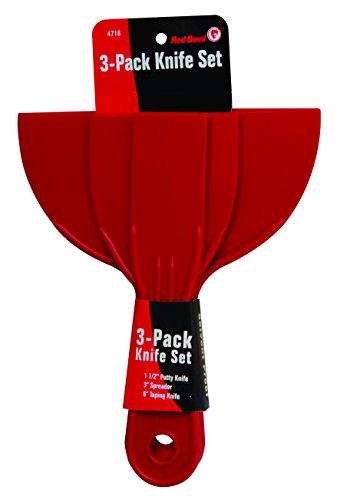
Red Devil's 4718 is the set I'd keep for any surface you can't afford to scratch. It's three plastic knives: a 1-1/2 inch putty knife, a 3 inch spreader and a 6 inch taping knife, per Red Devil's catalog.
Plastic is the safe choice on acrylic and fiberglass tubs and showers. Those surfaces are softer than steel, so a metal putty knife can leave scratches that show every time light hits the tub. A plastic edge is softer than the finish.
Red Devil's catalog puts these in its 4700 Economy Series and says its plastic putty knives and scrapers are ideal for most home repair projects. The Amazon listing adds that the plastic gives strength and flexibility, and that the knives are disposable once the project is done.
Each size has a plumbing job. The 1-1/2 inch fits around a drain flange or a faucet base. The 3 inch spreader clears a strip of old caulk along a tub edge. The 6 inch taping knife smooths patching compound over an access hole.
Disposable is a feature with wax and old silicone. Some messes aren't worth cleaning off a tool. When the plastic edge is caked or chewed up, toss it and use the next one.
The trade-off is speed. Plastic is slow on hard, dried putty, and the edge wears as you push. On a tough spot, soften the old material first, or switch to a razor scraper with a plastic blade for a sharper edge.
Don't pry with these. A plastic blade bent sideways snaps, and the broken edge can gouge the surface you were trying to protect.
Red Devil's catalog doesn't list a warranty for this set. It was sold by Amazon.com and in stock on the day of the update.
A stiff blade scrapes. A flexible blade spreads and smooths. Here's how the picks split.
| Knife | Blade | Material | Best job |
|---|---|---|---|
| Hyde 06308 | Stiff | Stainless steel | Scraping wax and putty |
| Hyde 06321 | Stiff | Brass | Scraping where steel could mar or spark |
| Red Devil 4204 | Flex | High-carbon steel, lacquered | Spreading putty and filler |
| ALLWAY UX2F | Flex | Stainless steel, one piece | Spreading and patching in wet areas |
| Red Devil 4718 | Flexible plastic | Plastic | Gentle scraping and spreading |
| Titan 17013 | Razor blade | Plastic or #20 steel blades | Lifting caulk and sealant |
Blade type and material from Hyde's product pages, Red Devil's 2024 catalog, ALLWAY's product page and Titan's listing text, read Oct 19, 2026.
If you buy one stiff and one flexible blade, you've covered most plumbing jobs. The stiff one cleans the surface, and the flexible one puts the new material down smoothly.
4-inch mini razor scraper with plastic and steel blades
Prices and availability are accurate as of the time shown and may change.
You redo caulk around tubs, showers and sinks and need to lift the old bead cleanly without scratching.
You mostly scrape wax off flanges. A stiff putty knife is faster for that.
Titan's 17013 is the tool for old silicone caulk. Titan's listing says it cleanly removes caulk, sealant and putty. A razor edge gets under a cured bead in a way a putty knife's thick edge can't.
What makes it right for bathrooms is the blade choice. The kit comes with 10 non-marring plastic blades and 11 #20 steel blades, per Titan. Titan says to use the plastic blades to make sure the surface or finish isn't harmed.
So the plastic blades go on acrylic tubs, fiberglass showers and chrome. The steel blades are for glass, glazed tile and other hard surfaces where you need a sharper edge and a scratch won't show.
The body is tough polypropylene with a TPR comfort sleeve, per Titan. A set screw holds the blade, and you twist it to tighten or loosen when you swap blades.
A protective safety cap covers the blade between jobs, and two resealable containers hold the spare plastic and steel blades. Keep the cap on in the bag; a loose razor edge is how hands get cut.
For a caulk job, my order is simple. Cut along both edges of the old bead, lift it with the plastic blade, then clean the leftover film before the new bead goes on. New silicone won't stick well to old silicone.
The plastic blades matter most in a bathroom. Acrylic tub walls and fiberglass shower pans show every scratch, and a scratched finish is hard to hide. With ten spare plastic blades, you can swap to a fresh edge as soon as one starts to chew up on a stubborn bead.
A razor blade isn't a putty knife, and that's the trade-off. It can't spread filler and won't push a thick wax ring. Keep it as a second tool for caulk and labels.
It was sold by Amazon.com and in stock on the day of the update.
Width decides where the knife fits: between closet bolts, inside a drain opening, or across a wall patch.
| Job | Width that works | Pick |
|---|---|---|
| Toilet flange between the bolts | 2 in. | Hyde 06308 |
| Inside a sink drain opening | 1-1/2 in. | Red Devil 4204 or the 4718's small knife |
| Along a tub or shower edge | Razor or 3 in. plastic | Titan 17013 or Red Devil 4718 |
| Patching a wall access hole | 2 in. to 6 in. | ALLWAY UX2F, then the 4718's 6 in. knife |
My call for plumbing work.
A 2-inch blade is the plumber's middle size. It clears a toilet flange quickly, still fits around closet bolts, and spreads a small patch. Go narrower for drain openings and wider only for wall patches.
Prices and availability are accurate as of the time shown and may change.
You spread epoxy putty, plumber's putty or filler in tight spots and want a narrow blade with some give.
You need to scrape off hard, old material. Take a stiff blade like the Hyde 06308.
Red Devil's 4204 is the narrow, flexible blade for small spreading jobs. It's 1-1/2 inches wide with a flex blade, part of Red Devil's 4200 Professional Series, per the 2024 catalog.
Red Devil says the blade is high-carbon, precision-ground steel, lacquered to prevent rust, and that it extends through the handle. A blade that runs through the handle won't work loose when you lean on it.
The handle is black nylon, which Red Devil calls solvent-resistant. The Amazon listing describes it as shatterproof polypropylene, so the two sources differ on the plastic. Both say it resists solvents.
On the butt, there's a brass-plated solid steel nail setting head. Red Devil says it's for setting drywall nails and other hammering jobs.
In plumbing, the narrow flex blade suits small, precise spreading. Pressing epoxy putty around a pinhole leak, smoothing filler at the edge of a small patch, or working putty into a tight corner all go better with a blade that bends a little.
It's also narrow enough to clean the inside lip of a sink drain opening before a new strainer goes in. For that job, the flex lets the blade follow the curve.
For wax rings, I'd leave this one in the bag. A flex blade bends over a wax ring instead of getting under it, which is why the stiff Hyde 06308 is my top pick and this is a second knife. Together they cover scraping and spreading.
Carbon steel is the catch for wet work. Red Devil lacquers it against rust, but I'd still wipe it dry after a wet job.
Red Devil's catalog doesn't list a warranty. It was sold by Amazon.com and in stock on the day of the update.
Plumbing tools live wet. The blade material decides whether the knife rusts in the bucket and what it scratches.
| Knife | Blade material | Rust protection | Extra end |
|---|---|---|---|
| Hyde 06308 | Hardened stainless steel | Stainless | HammerHead |
| Hyde 06321 | Brass | Brass doesn't rust | Die-cast hammer head, per the listing |
| Red Devil 4204 | High-carbon steel | Lacquered | Brass-plated nail setting head |
| ALLWAY UX2F | Stainless steel, one piece | Stainless, no rivets | Built-in hammer end |
| Red Devil 4718 | Plastic | Doesn't rust | None |
| Titan 17013 | Plastic or #20 steel razor blades | Replaceable blades | Safety cap |
From Hyde's product pages and listing text, Red Devil's 2024 catalog, ALLWAY's product page and Titan's listing text, read Oct 19, 2026.
For a plumbing bag, stainless or brass is worth it. A knife that gets wiped on a rag and tossed back in a wet bucket will rust if it's plain carbon steel. Red Devil's lacquer helps, but a scratched coating lets rust in at the edge.
One-piece stainless flex putty knife, 2 in.
Prices and availability are accurate as of the time shown and may change.
You want a spreading knife that lives in a wet bucket and wipes clean, and you patch walls after opening them for repairs.
You need a scraper for wax and old putty. The stiff Hyde 06308 is the better tool.
ALLWAY's UX2F is the knife I'd pick for wet work. ALLWAY says it's made entirely from mirror-polished stainless steel, in a single piece that forms both the blade and the handle.
That one-piece build is the point. There's no plastic handle to crack and no rivets where water sits and rust starts. ALLWAY says the unibody construction is easy to clean and resists corrosion.
The blade is flexible and professionally ground, per ALLWAY, and the listing says that gives a high level of control for applying and spreading putty. ALLWAY lists scraping, spreading spackle and applying adhesive as uses.
The handle is contoured and rivet-free. ALLWAY's listing says the small size suits tight areas and awkward angles, and the contoured handle reduces hand fatigue.
There's a built-in hammer end. ALLWAY says it sets nails in drywall or drives in loose or extended nails.
For plumbing, I'd use it on the patch after the repair. When you open drywall to reach a valve or a leak, this 2-inch blade spreads compound in the corners of the patch. It wipes clean in the same bucket you rinse your hands in.
The polished blade helps with cleanup. ALLWAY says the one-piece build is easy to clean. A smooth stainless face gives compound and putty little to grip, so a rag usually clears it before it dries on.
Two inches matches the Hyde 06308. If you carry both, you have a stiff blade and a flexible blade at the same width: scrape with the Hyde, then spread with the ALLWAY.
It's also a good blade for spreading a thin layer of plumber's putty or adhesive, where a stiff blade would gouge instead of smooth.
ALLWAY's page doesn't list a warranty or where it's made. It was sold by Amazon.com and in stock on the day of the update.
Push a rag into the flange opening so wax and sewer gas stay out of the room.
Hold a stiff 2 in. blade low and push under the wax. Lift it off in strips.
Lay the toilet on its side on a towel. Scrape the wax off the horn and outlet.
Wipe the leftover film with a rag so the new ring seats on a clean surface.
Look for cracks or a broken bolt slot before the new ring goes on.
Remove the rag from the drain before you set the toilet back down.
My call. Follow the instructions that come with your wax ring and toilet.
The rag in the drain is the step people skip. It keeps chunks of wax from dropping into the line, and it blocks sewer gas while the toilet is off. Just don't forget to pull it out. For the seal that goes back on, see our plumber's putty picks and our guide to putty vs silicone.
Prices and availability are accurate as of the time shown and may change.
You scrape where a steel tool could spark, or on fixtures and tile where you want something gentler than steel.
You want the fastest scraper for wax on a PVC or cast iron flange. The stainless Hyde 06308 is quicker.
Hyde's 06321 is a 2-inch brass scraper. Hyde says the Pro Project brass scrapers are ideal for scraping paint and removing putty in tight areas where the material underneath needs protecting.
Hyde also says the brass is designed for non-sparking applications, and calls it safe for volatile environments. A steel scraper striking metal or stone can throw a spark. Brass is far less likely to.
Where would a plumber care? Scraping near a gas meter, around a gas appliance, or in a space where fumes from solvent cement or a cleaner might hang. Ventilate first; a non-sparking tool is a backup, not a fix.
The other reason is gentleness. Brass is softer than hardened steel, so it's kinder to glazed tile, china and brass drain bodies. It's still harder than plastic, so test it before you use it on acrylic or chrome.
The blade is stiff, which Hyde says allows precise removal in tight or delicate areas. The handle is Hyde's overmold comfort grip. The Amazon listing adds a die-cast hammer head on the end. The listing also mentions carbon steel blades, which conflicts with Hyde's page; I go by Hyde's page, which calls it brass.
One limit to be plain about: if you smell gas, no hand tool makes the job safe. Leave the building and call the gas utility from outside. Brass is for routine work near gas lines, not for working through a leak.
Hyde makes the same brass scraper in 1-1/4 inches as the 06081. The 2-inch is the more useful width on a toilet flange or around a fixture base.
The trade-off is wear. A soft brass edge dulls and rolls faster than hardened stainless, so it's a second scraper for special cases, not the one you use every day.
It was sold new by a third-party seller, 502 Distribution, not Amazon.com, and in stock on the day of the update. Hyde's page doesn't list a warranty for this line.
| Knife | Best for | Width | Blade | Material | Hammer end | Sold by |
|---|---|---|---|---|---|---|
| Hyde 06308 | Wax and old putty | 2 in. | Stiff | Stainless | Yes | Amazon.com |
| Red Devil 4718 | Finished surfaces | 1-1/2, 3, 6 in. | Flexible | Plastic | No | Amazon.com |
| Titan 17013 | Old caulk | 4 in. tool | Razor | Plastic or steel blades | No | Amazon.com |
| Red Devil 4204 | Spreading in small spots | 1-1/2 in. | Flex | Carbon steel, lacquered | Yes | Amazon.com |
| ALLWAY UX2F | Wet work and patching | 2 in. | Flex | Stainless, one piece | Yes | Amazon.com |
| Hyde 06321 | Non-sparking scraping | 2 in. | Stiff | Brass | Yes, per listing | Third party |
From Hyde's product pages, Red Devil's 2024 catalog, ALLWAY's product page and Titan's listing text, read Oct 19, 2026. All six were sold new and in stock on the day of the update.
| Job | Use instead | Why |
|---|---|---|
| Prying off a stuck escutcheon or trim ring | A trim puller or a pry bar | Prying bends or snaps a putty knife blade |
| Cutting through cured caulk | A utility knife or razor scraper | A putty knife edge isn't sharp enough |
| Cutting drywall for an access hole | An oscillating tool or drywall saw | A putty knife can't cut |
| Hard mineral crust inside a toilet | A pumice stone made for toilets | Metal blades scratch china glaze |
| Thread sealing | Tape or pipe dope | Putty isn't a thread sealant |
My call for plumbing work.
A putty knife scrapes and spreads. When the job is cutting, reach for a blade: see our utility knife picks. When you need a hole in a wall, see our oscillating multi-tool picks.
| If you mostly… | Look for | My pick |
|---|---|---|
| Pull toilets and swap strainers | A stiff 2 in. stainless blade | Hyde 06308 |
| Work on acrylic, fiberglass or chrome | Plastic | Red Devil 4718 |
| Redo caulk around tubs and showers | A razor scraper with plastic blades | Titan 17013 |
| Spread epoxy or putty in small spots | A narrow flex blade | Red Devil 4204 |
| Patch walls and work wet | One-piece stainless flex | ALLWAY UX2F |
| Scrape where sparks matter | Brass | Hyde 06321 |
If I could carry only one, it's the Hyde 06308. A stiff stainless 2-inch blade handles wax rings and old putty, which is most of the scraping a plumber does. Add the Red Devil 4718 plastic set for finished surfaces, and you're covered for nearly every bathroom job.
For laying the new bead once the old one's gone, see our caulk gun picks.
Hyde's 06308, a stiff 2-inch stainless steel scraper. Hyde says the stiff blade excels at removing paint and putty, and stainless suits wet work.
A stiff 2-inch metal blade like the Hyde 06308. It pushes under the wax instead of bending over it, and 2 inches fits between the closet bolts.
Plastic on acrylic, fiberglass, chrome and other finishes you can't scratch. Metal on flanges, cast iron and PVC, where it scrapes faster.
The picks here come from Hyde, Red Devil, ALLWAY and Titan. Each publishes its blade material and design, which is how I compared them.
A blade that suits the job (stiff to scrape, flexible to spread), a rust-resistant material, and a blade that runs through the handle or a one-piece build.
A flexible blade. For small spots, the 1-1/2 inch Red Devil 4204. For wall patches, the 2-inch ALLWAY UX2F or the 6-inch knife in the Red Devil 4718 set.
Stiff for scraping wax, putty and old sealant. Flexible for spreading putty, filler and patching compound. A plumbing bag benefits from one of each.
Use a razor scraper with a plastic blade, like the Titan 17013. Titan says to use its plastic blades so the finish isn't harmed.
A steel blade can mark the glaze if you push hard at a steep angle. Use plastic, or hold a metal blade low and let it glide.
Scraping where steel could spark or mar the surface. Hyde says its brass scrapers are designed for non-sparking applications and delicate areas.
Buy stainless, brass or plastic for wet work. For carbon steel, wipe the blade dry after each job.
Yes, but hands work better for rolling a putty rope. Use a flexible blade to press it into place or clean up the squeeze-out.
I'm Isaac Daniels, a licensed journeyman plumber in Georgia (license #JP507711). I picked these for plumbing messes: wax rings, old putty, silicone caulk and wall patches after a repair.