
Oatey Stain-Free 31177
$4.54 at Amazon
Check it on AmazonPrice as of Oct 24, 2026, 5:30 AM EDT
Details ↓
Picked from the makers’ data sheets and matched to the surface you’re sealing.
As an Amazon Associate I earn from qualifying purchases.
For most sinks, get Oatey Stain-Free 31177. It’s oil-free, rated for granite, marble, quartz, Corian and PVC, and keeps 2 years. On stainless with a metal strainer, regular Oatey putty works. Skip putty on ABS, threads and toilets.
Six putties in three groups: oil-free for stone and plastic, regular for metal and stainless, and a bulk tub. Each was the genuine brand, new and in stock when the offers were read on Oct 21. Sellers vary, and each card names the one Amazon showed. Prices come from Amazon and show the time they were read.


Product prices and availability are accurate as of the date/time indicated and are subject to change. Any price and availability information displayed on Amazon.com at the time of purchase will apply to the purchase of this product.
Prices and availability are accurate as of the time shown and may change.
Your sink, counter or shower base is stone, quartz, Corian or a plastic other than ABS, or you want one tub that’s safe on most of the house.
Your drain or tub is ABS plastic. Oatey says this putty isn’t for ABS; the wrong-product table below covers what to use.
Oatey Stain-Free 31177 is my pick for most sinks. Oatey’s data sheet calls it a professional grade, non-staining putty made for the natural surfaces in sinks, counters, strainers and shower bases: granite, marble, quartz and sandstone, and Corian. It’s oil-free, and that’s the point of it.
Oil is what makes regular putty a risk on stone. Oatey’s regular data sheet says never to use it on marble, granite, limestone or any dimensional stone, and Oatey’s FAQ says there’s no proven way to get an oil stain out of stone. This tub takes that risk off the table.
It covers plastics too. Oatey says it’s safe with PVC and most other plastics, but not ABS. That gives you one tub for a granite kitchen sink and a PVC shower drain. Oatey lists bath wastes, shower drains, faucets and basket strainers as its jobs.
The shelf life is the quiet win. Oatey lists 2 years from the date it’s made, against 1 year for its regular putty, and its sell sheet says it stays flexible through that time. Keep the lid on. Oatey’s FAQ says putty hardens with long exposure to air.
The tub is small at 9 oz. With a specific gravity of 1.75, that’s about 3¾ ft of ½ in. rope by my math, enough for a few strainers or drains. Oatey’s cautions: never mix it with regular putty, since staining may occur, and test unusual materials first.
The Amazon listing says it’s safe on any surface. Oatey’s data sheet says not on ABS, so I go with Oatey. There’s no cure time, so you can run water right after you tighten the fixture. My call: if you buy one tub for the house, buy this one. It was new, in stock and sold by Amazon.com when I checked.
Prices and availability are accurate as of the time shown and may change.
You’re setting a drain in cultured marble, fiberglass, tile or a stone shower base, or you want one sealant for fixtures and for gaps around pipes.
You’re only setting a metal strainer in a stainless sink. Regular Oatey putty covers that job and handles like the putty you know.
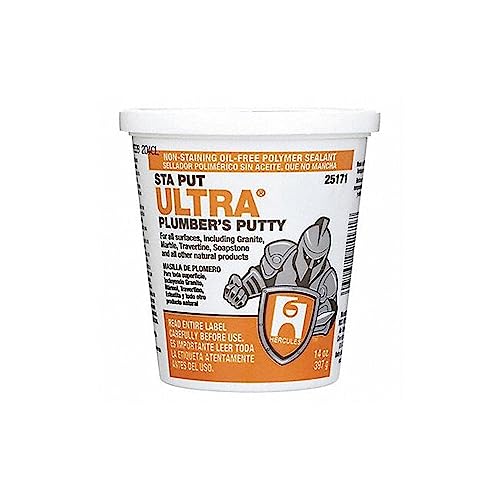
Sta Put Ultra is the stain-free putty from Hercules, an Oatey brand. Its data sheet calls it an oil-free polymer sealant and lists the widest set of surfaces on this page: marble, granite, natural or synthetic stone, cultured marble, plastics except ABS, rubber, fiberglass, ceramic, enameled surfaces, wood, concrete, grout and all plumbing metals.
That list is why it’s here. Oatey Stain-Free names granite, marble, quartz, Corian and PVC. Ultra adds cultured marble, fiberglass, ceramic and grout, which covers most molded vanity tops and shower bases. Hercules says it works on porous surfaces with no pre-treatment.
It handles differently from regular putty. Hercules calls it viscoelastic with real tack: it softens as you work it, then sticks to dry surfaces, even vertical ones. The maker says to scoop it out with a putty knife. Because it’s tacky, the bead can go on the fixture or on the frame.
It has a second job. Hercules says it works as a soft, non-pressurized water, air or gas sealant in gaps around wires, pipes and vents, indoors or outdoors, where temperatures stay under 300°F. It resists vegetable and petroleum oils and can come out years later, per the data sheet.
One honest caution from the maker. Hercules says some staining may occur on very porous surfaces directly under the putty, hidden once the fixture is set, and suggests testing a sample for 30 minutes. As with the Oatey version, never mix it with regular putty. The data sheet lists no shelf life.
At a specific gravity of 1.95, the 14 oz tub makes about 5¼ ft of ½ in. rope by my math. My call: buy Ultra for cultured marble, fiberglass or tile, or for a drain in a stone shower base. It was new and in stock from Onkata, a third-party seller, when I checked.
Prices and availability are accurate as of the time shown and may change.
You’re setting a basket strainer, faucet or sink frame on a stainless steel sink, and nothing the putty touches is stone or plastic.
Any part of the job is stone, quartz, Corian or plastic. Get Oatey Stain-Free 31177 instead.
This is the plain putty most people mean when they say plumber’s putty. Oatey’s data sheet calls it a waterproof seal between two rigid surfaces, for setting frames, faucets and basket strainers. It meets Federal Specification TT-P-1536A, and Oatey says it stays flexible and won’t harden, shrink, crack or crumble.
It’s oil-based, and the data sheet lists what’s in it: hydrocarbon oils, limestone, talc, clays and blown canola oils. The oil keeps it soft. It’s also why Oatey says not to use it on marble, granite, limestone or any other dimensional stone.
Plastics are the other no. The data sheet says don’t use it on ABS or other plastics. Oatey’s blog is looser and lists PVC as fine. I go with the data sheet. The stain-free tub is rated for PVC, so there’s no reason to gamble on a plastic drain.
Where it belongs is a metal strainer, faucet or frame on a sink that isn’t stone or plastic. A stainless steel kitchen sink is the common case. The Amazon listing for the 3 lb size says it’s compatible with stainless steel fixtures, and nothing on the data sheet says otherwise.
Shelf life is 1 year from the date it’s made, half the stain-free’s. At Oatey’s specific gravity of 2.0, a 14 oz tub makes about 5 ft of ½ in. rope by my math. That’s several sinks’ worth, the right size for a homeowner. It has a mild petroleum smell.
My call: for a stainless kitchen sink with a metal strainer, this is all you need. If anything on the job is stone or plastic, buy the stain-free tub instead. It was new and in stock from MaxWarehouse, a third-party seller, when I checked.
Stainless plumbers putty 25101, 14 oz
Prices and availability are accurate as of the time shown and may change.
You set metal strainers and faucets on stainless sinks and want a putty that rolls clean without sticking to your fingers.
Your sink is ceramic, stone or a manufactured stone substitute. Hercules says to use Sta Put Ultra there.
Sta Put is the regular putty from Hercules, and the name is the pitch: it stays put. The data sheet calls it a sealing and caulking compound for setting fixtures, bowls, faucets, basin cocks, strainers, plugs and sink frames. It meets Federal Specification TT-P-1536.
The handling is why I’d pick it over plain Oatey. Hercules says it won’t stick to fingers or hands, has the same smooth texture from the top of the tub to the bottom, and is flexible and stretchable. It rolls into rings or shapes to fit the part. The smell is a very mild vegetable oil.
Read its limits closely, because they’re stricter than Oatey’s. Hercules says not to use Sta Put in direct contact with marble, granite or other porous stone, ceramics or manufactured substitutes, and to use Sta Put Ultra there instead. It also says no ABS. Oatey’s regular data sheet doesn’t list ceramics as a no.
So this is a putty for metal parts on stainless or other metal sinks: a basket strainer in a stainless kitchen sink, or a faucet on a stainless deck. Hercules says the seal is gas proof, fume proof, odor proof, insect proof and watertight, and that it won’t harden, crumble, crack or shrink.
Its directions match Oatey’s: roll it into a cord, lay it on the surface, overlap the ends, set and tighten the fixture, then wipe off what squeezes out. Hercules also lists toilet perimeters as a use. Oatey’s own FAQ says not to put putty under a toilet base, so I’d leave it off toilets.
The 14 oz tub makes about 5 ft of ½ in. rope by my math, at a specific gravity of 2.00 to 2.05. Hercules sells the same putty in 3, 5 and 7 lb sizes, the last in a pail with a handle.
My call: pick it if putty stuck to your fingers drives you nuts. It was new and in stock from Fat Boy Tools, a third-party seller, when I checked.
Prices and availability are accurate as of the time shown and may change.
You have one strainer or faucet to set on a stainless or metal sink and don’t want a big tub drying out in a drawer.
The sink or counter is marble or any other stone. Black Swan says it isn’t for marble; get Oatey Stain-Free.
Black Swan Manufacturing makes plumbing compounds, and Stay Soft is its regular putty. The catalog calls it a plastic putty that will not harden, crack or crumble, for setting closet bowls, sink strainers and many other jobs. It meets Federal Specification TT-P-1536A, the same spec as Oatey’s regular putty.
The reason it’s here is the size. This listing is a 7 oz tub, the smallest of the six. Most homeowners set one strainer or faucet, then the tub sits under the sink for years. Oatey’s FAQ says putty that has dried out can’t be brought back, so a small tub wastes less.
Black Swan’s catalog calls it a stainless putty with excellent adhesive qualities, and says plainly: not for use on marble. It doesn’t publish ingredients or say yes or no on other stones or plastics. My call: treat it like regular putty and keep it off granite, quartz and plastic drains.
Black Swan doesn’t publish a specific gravity or a shelf life either, so it can’t go on the rope chart or the shelf-life table below. If you want numbers you can check, the Oatey tubs list both. This tub was sold by Black Swan Mfg. Co. itself.
The listing goes further than the maker. It says the putty stays soft even under high temperatures, works as fountain and HVAC putty, and fixes leaks as well as preventing them. Black Swan’s catalog makes none of those claims. Putty isn’t a leak repair; for a leaking pipe, see our epoxy putty guide.
Black Swan also lists closet bowls as a use. As with Sta Put, Oatey’s FAQ says no putty under a toilet base, so I wouldn’t. My call: buy it for one strainer, faucet or drain on a metal or stainless sink. It was new and in stock from Black Swan Mfg. Co. when I checked.
Prices and availability are accurate as of the time shown and may change.
You set strainers, faucets and drains every week, on a service truck or across a set of rentals, and you’ll use it up within a year.
You set a sink or two a year. The 14 oz tub is plenty, and the rest of a 3 lb tub may outlast its shelf life.
The 31170 is the same Oatey putty as the 31166, in a 3 lb tub. Oatey’s data sheet covers both under one product, so the ingredients, the TT-P-1536A rating and the cautions are the same. It’s for someone who sets fixtures every week, not once a year.
By my math, 3 lb at a specific gravity of 2.0 makes about 17½ ft of ½ in. rope, a bit over three times the 14 oz tub. Oatey’s instruction sheet says clean excess can be blended back into the container, so the leftover rope from each job goes back in the tub.
Shelf life is the limit. Oatey lists 1 year from the date it’s made. Its FAQ says putty stays pliable when it isn’t exposed to air but hardens with long exposure, and dried putty can’t be brought back. Keep the lid tight, and keep grit out of the clean putty, as Oatey’s instructions say.
The Amazon listing says it’s compatible with stainless steel fixtures and doesn’t stick to hands. The data sheet doesn’t make the hands claim. The listing also calls it military spec TTP-1536A. The real name is Federal Specification TT-P-1536A, per Oatey’s sheet.
Everything that’s off limits for the 14 oz tub is off limits here: marble, granite, limestone or any dimensional stone, and ABS or other plastics. On a truck, carry a small tub of Oatey Stain-Free next to it for stone tops and PVC drains.
Oatey also makes a 5 lb tub, the 31174, but its listing showed a future ship date when I checked. My call: the 3 lb is the right size for a service truck or a rental turnover kit. It was new, in stock and sold by Amazon.com when I checked.
Every fact here comes from the maker’s data sheet or catalog, named in the sources. Scroll sideways on a phone. Prices are in each card and the picks above.
| Pick | Spec score | Photo | Stone tops | Plastics | Shelf life | Short pros / cons | Buy |
|---|---|---|---|---|---|---|---|
| Oatey Stain-Free 31177 Most sinks, stone too | 9.0 | | Granite, marble, quartz | PVC and most; no ABS | 2 years | Safe on most / 9 oz | Check it on Amazon |
| Hercules Sta Put Ultra Widest surface list | 9.0 | | Natural and synthetic | Yes; no ABS | Not listed | Cultured marble, tile / Tacky | Check it on Amazon |
| Oatey 31166 Stainless sinks | 8.8 | | No | No | 1 year | Metal and stainless / No stone | Check it on Amazon |
| Hercules Sta Put Won’t stick to hands | 8.3 | | No | No ABS | Not listed | Clean handling / No ceramics | Check it on Amazon |
| Black Swan Stay Soft One small job | 7.3 | | Not marble | Not listed | Not listed | 7 oz tub / Few published specs | Check it on Amazon |
| Oatey 31170, 3 lb Trucks and rentals | 8.8 | | No | No | 1 year | Most rope per tub / Use within a year | Check it on Amazon |
Green marks a strength and amber marks a limit. “Not listed” means the maker doesn’t publish it.
This is the question most buyers are really asking. Find your surface in the first column and read across. Every cell comes from that maker’s own data sheet or catalog, and “Not listed” means the maker says nothing either way.
| Surface | Oatey Stain-Free | Sta Put Ultra | Oatey regular | Sta Put | Black Swan |
|---|---|---|---|---|---|
| Stainless steel sink, metal strainer | Yes | Yes | Yes | Yes | Yes |
| Granite or marble | Yes | Yes | No | No | Not for marble |
| Quartz or other engineered stone | Yes | Yes | No | No | Not listed |
| Corian or solid surface | Yes | Yes | No plastics | No | Not listed |
| Cultured marble | Not listed | Yes, named | No, per Harvey’s page | No | Not for marble |
| Fiberglass | Not listed | Yes, named | No plastics | Not listed | Not listed |
| Ceramic or vitreous china | Not listed | Yes | Not excluded | No ceramics | Not listed |
| PVC drain | Yes | Plastics, yes | No | Not listed | Not listed |
| ABS drain or ABS tub | No | No | No | No | Not listed |
| Acrylic tub or shower drain | Silicone, per Oatey | Silicone, per Oatey | Silicone, per Oatey | Silicone, per Oatey | Not listed |
| Tile, grout, wood or concrete | Not listed | Yes | Not listed | Not listed | Not listed |
From the Oatey Stain-Free, Oatey Plumber’s Putty, Harvey, Hercules Sta Put and Sta Put Ultra data sheets, Oatey’s putty FAQ and the Black Swan catalog, read Oct 19, 2026. Hercules is an Oatey brand, so I apply Oatey’s FAQ to it too.
The pattern is simple once you see it. The oil in regular putty is what can stain stone, so every regular putty here says no to marble, and the Oatey and Hercules ones say no to all natural stone. The two oil-free putties are the ones the makers rate for stone.
Plastics split the other way. Oatey’s regular data sheet says no plastics at all, Oatey Stain-Free says PVC and most plastics, and Ultra says plastics except ABS. Nobody here approves ABS. If you can’t tell what your drain is made of, the label is often molded into the plastic. For more on that, see our guide to telling tub drains apart.
Putty is a gasket you shape by hand for a fixture that sits on a surface. It isn’t a glue, a thread sealant or a leak repair. These come from the makers’ own instructions.
| Job | Putty? | What to use instead |
|---|---|---|
| Sink strainer, faucet base, pop-up or tub drain flange | Yes | Putty that’s rated for the surface; see the chart above |
| Disposal sink flange with no rubber gasket | Yes, a ½ in. rope, per InSinkErator | Stain-free putty on a stone sink |
| Any other garbage disposal connection | No, per InSinkErator | The gaskets that come in the box |
| Threaded pipe joints | No; not for threads, per Oatey | PTFE tape or pipe dope |
| Anything under water pressure | No; non-pressurized only, per Oatey | The fitting’s own seal, tape or dope |
| Under a toilet base | No, per Oatey’s FAQ | A wax or foam toilet ring for the seal |
| Acrylic tub or shower drain | No, per Oatey’s FAQ | 100% silicone, per Oatey |
| Windows or doors | No, per Oatey’s FAQ | An exterior caulk |
| A fixture that ships with its own gasket | Follow the fixture maker | Usually the gasket alone |
| A leaking pipe | No; putty doesn’t repair leaks | Epoxy putty or a repair clamp |
The disposal rule surprises people. InSinkErator’s Badger and Evolution manuals both say not to use plumber’s putty on any disposal connection other than the sink flange, and not to use thread sealant or pipe dope on it either. Use putty only under the flange, and only when there’s no rubber gasket.
For thread jobs, our tape vs dope vs putty guide sorts out which goes where, and our pipe dope guide covers the picks. For a leaking pipe, see our epoxy putty guide.
Tubs are sold by weight, but you use putty by length. A lighter putty gives more rope per ounce, so a 9 oz tub isn’t simply 9/14 of a 14 oz one. I turned each maker’s weight and specific gravity into feet of the ½ in. rope Oatey’s instructions call for.
Here’s the math, so you can check it. Weight divided by specific gravity gives volume. A ½ in. round rope holds about 0.196 cubic inches per inch of length. So 14 oz of Oatey’s regular putty, at a specific gravity of 2.0, is about 12.1 cubic inches, or about 62 in. of rope.
Real use runs higher than a perfect rope, because the excess that squeezes out gets wiped off. Oatey says clean excess can go back in the tub, so you lose less than it looks. My call: a 9 oz or 14 oz tub covers a homeowner’s sinks and tubs for years, and the 3 lb tub only pays off with steady use inside its shelf life.
Putty doesn’t last forever in the tub. Here’s what each maker publishes, plus every size in each line, so you can buy only what you’ll use.
| Putty | Formula | Specific gravity | Shelf life | Sizes the maker lists |
|---|---|---|---|---|
| Oatey Stain-Free | Oil-free | 1.75 | 2 years | 9 oz (31177) |
| Hercules Sta Put Ultra | Oil-free polymer | 1.95 | Not listed | 14 oz (25171), 3 lb (25173) |
| Oatey Plumber’s Putty | Hydrocarbon oils, limestone, talc, clays, canola oils | 2.0 | 1 year | 14 oz (31166), 3 lb (31170), 5 lb (31174) |
| Harvey Plumber’s Putty | Same data sheet as Oatey’s | 2.0 | 1 year | 14 oz (43010), 3 lb (43050), 5 lb (43105) |
| Hercules Sta Put | Non-hardening, mild vegetable oil odor | 2.00 to 2.05 | Not listed | 14 oz (25101), 3 lb (25103), 5 lb (25105), 7 lb pail (25110) |
| Black Swan Stay Soft | Not published | Not listed | Not listed | 7 oz on this listing |
From each maker’s data sheet or catalog, read Oct 19, 2026. Shelf life counts from the date the putty was made, not the date you open it. Harvey is also an Oatey brand.
All the regular putties here meet the same federal putty spec, TT-P-1536 or its A revision. That spec is why they handle so much alike. Harvey’s product page on oatey.com goes a step further than the data sheet: no marble, synthetic marble, other porous surfaces or plastic lavatories and fixtures.
Oatey’s FAQ says putty stays pliable as long as it isn’t left open to the air. If the tub has gone hard or crumbly, toss it and buy fresh. Oatey says there’s no way to bring dried putty back.
These are Oatey’s own steps, the same for every putty here. The two that people skip are cleaning off the old putty and checking the fitting again in the cold.
| Step | What to do |
|---|---|
| 1. Clean | Get the surfaces dry and free of old hardened putty, dirt, wax, oil and grease. A scraper or wire brush helps. |
| 2. Take what you need | Scoop out enough for the job and put the lid back on, so grit can’t get into the clean putty. |
| 3. Knead and roll | Knead it in your hands until it’s soft, then roll a rope roughly ½ in. thick. |
| 4. Ring the flange | Lay the rope around the underside of the flange and blend the two ends together where they meet. |
| 5. Set and tighten | Set the strainer, drain or faucet and tighten it. Excess putty should squeeze out all the way around. |
| 6. Wipe | Wipe the excess off with a plastic putty knife and a cloth. |
| 7. Recheck in the cold | In a cold room or with cold putty, wait 10 minutes and see if the fitting needs a little more turn. |
| 8. Save the clean excess | Clean excess can go back in the tub. Anything with grit in it goes in the trash. |
A full ring of putty squeezing out is how you know the seal is complete. If it doesn’t squeeze out on one side, pull the part and start again with a thicker rope.
Don’t crank it down to force the seal; Oatey’s guidance is to tighten the fixture properly, not as hard as you can. A plastic knife keeps you from scratching the finish, and our putty knife guide has picks.
There’s no cure time, so you can run water right away to check for drips. Whenever a fixture comes apart, scrape off the old putty and use fresh. If you’re replacing the whole drain, our pop-up drain guide and tub drain removal tool guide cover the parts and tools.
This is one of the most common reasons people buy putty. The disposal makers are specific about where it goes.
| Situation | What the manual says |
|---|---|
| Flange comes with a rubber gasket | Press the gasket and flange into the sink opening, per InSinkErator |
| Flange has no rubber gasket | Apply an even ½ in. rope of putty around the flange, then press it in and wipe off the excess |
| Any other disposal connection | No putty, no thread sealant, no pipe dope |
| Taking out an old flange | Remove the old putty from the sink with a putty knife before setting the new one |
| Granite, quartz or other stone sink | Use a stain-free putty rated for that surface |
The first four rows come from InSinkErator’s Badger and Evolution manuals. The last row follows from the stone warnings on the regular putty data sheets. If water drips from the flange after a swap, our sink flange replacement guide walks through redoing it, and our under-sink leak guide helps find which joint is leaking.
This is the most common alternative people search for. Here’s the short version from the makers. Our full comparison goes deeper.
| Question | Putty | 100% silicone |
|---|---|---|
| Cure time | None; test right away | Needs time to cure; check the tube |
| Comes apart later | Yes; stays soft | Has to be cut and scraped |
| Acrylic tub drain | No, per Oatey’s FAQ | Yes, per Oatey |
| Stone or quartz | Only an oil-free putty | Check the silicone maker’s label |
| Gaps and joints along a wall | Not its job | Yes, as a caulk |
My call: use putty under strainers and drain flanges on sinks, where you’ll want to take the part apart someday, and silicone where the fixture maker or Oatey says to, such as acrylic tubs. When the fixture’s instructions name a sealant, follow them. Our plumber’s putty vs silicone guide covers the full comparison.
I check every Amazon listing against the maker’s data sheet. These didn’t line up, and here’s what I went with.
| Topic | One source says | Another says | I used |
|---|---|---|---|
| Oatey Stain-Free on ABS | Data sheet and FAQ: not for ABS | Sell sheet graphic: plastic including ABS; Amazon: any surface | No ABS |
| Oatey regular on PVC | Data sheet: no ABS or other plastics | Oatey’s blog: PVC is fine | The data sheet; no plastics |
| Acrylic tubs | Oatey’s FAQ: use 100% silicone | Oatey’s blog: pure acrylic is fine, blends aren’t | The FAQ; silicone |
| Putty around toilets | Sta Put and Black Swan list bowls or toilet perimeters | Oatey’s FAQ: not under a toilet base | No putty under a toilet |
| Black Swan Stay Soft | Catalog: setting putty; not for marble | Listing: fixes leaks, high heat, HVAC putty | The catalog |
| Oatey 31170 spec name | Data sheet: Federal Specification TT-P-1536A | Listing: military spec TTP-1536A | The data sheet |
The makers’ documents don’t show one regular putty sealing better than another, so this page doesn’t rank them on that. It compares what the makers publish and put their names to: which surfaces each one is rated for, what’s in it, how long it keeps and how much is in the tub.
| Question | If yes | If no |
|---|---|---|
| Does the putty touch stone, quartz, Corian or a plastic other than ABS? | Oatey Stain-Free 31177 | Keep going |
| Is it cultured marble, fiberglass, ceramic or tile? | Hercules Sta Put Ultra | Keep going |
| Is it metal on a stainless or other metal sink? | Oatey 31166, Sta Put or Black Swan | Check the wrong-product table |
| Will you use more than 5 ft of rope within a year? | Oatey 31170, 3 lb | A 7 to 14 oz tub |
Most homeowners land on Oatey Stain-Free, because it covers stone, quartz and PVC in one tub and keeps twice as long. Most stainless kitchen sinks do fine with regular Oatey putty. For more of the sealants and compounds plumbers keep on hand, browse our plumbing supplies guides.
For most sinks, Oatey Stain-Free 31177. It’s oil-free, Oatey rates it for granite, marble, quartz, Corian and PVC, and it keeps for 2 years. On a stainless sink with a metal strainer, regular Oatey 31166 works fine.
It depends on the job. On stone, an oil-free putty like Oatey Stain-Free is the safer choice. On an acrylic tub drain, Oatey says to use 100% silicone. On threads, use PTFE tape or pipe dope, since putty isn’t for threads or pressure.
Per Oatey and InSinkErator: not on ABS, not on threads or anything under pressure, not under a toilet base, not on windows or doors, and not on any garbage disposal connection other than the sink flange. Regular oil-based putty also stays off stone.
Use putty under sink strainers and drain flanges you may take apart later; it never cures and stays soft. Use 100% silicone where Oatey or the fixture maker calls for it, such as an acrylic tub drain.
InSinkErator’s manual says to use an even ½ in. rope of putty under the sink flange when it has no rubber gasket. Use putty nowhere else on the disposal. On a granite or quartz sink, use a stain-free putty.
Regular oil-based putty can. Oatey says not to use it on any dimensional stone, and its FAQ says there’s no proven way to remove an oil stain from stone. Oatey Stain-Free is rated for granite, marble and quartz.
Only some. Oatey’s regular data sheet says no plastics. Oatey Stain-Free is rated for PVC and most plastics, and Sta Put Ultra for plastics, but none of the putties here is rated for ABS.
No. Oatey lists no wait time, so you can run water as soon as the fixture is tight. In cold conditions, Oatey says to wait 10 minutes and check whether the fitting needs a little more turn.
In the tub, Oatey lists 1 year from manufacture for its regular putty and 2 years for Stain-Free. Under a fixture, it stays soft. Oatey says to reapply fresh putty whenever the fixture is taken apart.
Oatey’s FAQ says small amounts that get into the drain dissolve and flow through. Wipe off the squeeze-out at the flange anyway, and put clean excess back in the tub.
I’m Isaac Daniels, a licensed journeyman plumber in Georgia (license #JP507711). Every fact here comes from the makers’ data sheets, instruction sheets, FAQs and catalogs, read the same day, plus InSinkErator’s manuals for the disposal flange rules.
Each check scores 0 to 10 and counts one quarter. It rewards a putty its maker approves on more surfaces, a stated federal spec, a printed shelf life and a published data sheet. It’s our score from the makers’ papers, not a customer rating or a seal test.
Your surface still decides first. A high score doesn’t make an oil-based putty safe on marble.
| Check (weight) | How it’s scored |
|---|---|
| Surfaces (¼) | Surfaces marked Yes in the surface chart: 10 for 7 or more; 9 for 4 to 6; 8 for 2 or 3; 7 for 1 |
| Federal spec (¼) | 10 when the maker says it meets TT-P-1536 or TT-P-1536A; 7 when it doesn’t say |
| Shelf life (¼) | Printed shelf life: 10 for 2 years; 8 for 1 year; 6 when none is listed |
| Data sheet (¼) | 10 when the maker publishes the formula and specific gravity; 6 when it doesn’t |
| Total | Average of the checks, to one decimal |
| Pick | Surfaces | Federal spec | Shelf life | Data sheet | Score |
|---|---|---|---|---|---|
| Oatey Stain-Free 31177 | 9 | 7 | 10 | 10 | 9.0 |
| Hercules Sta Put Ultra | 10 | 10 | 6 | 10 | 9.0 |
| Oatey 31166 | 7 | 10 | 8 | 10 | 8.8 |
| Hercules Sta Put | 7 | 10 | 6 | 10 | 8.3 |
| Black Swan Stay Soft | 7 | 10 | 6 | 6 | 7.3 |
| Oatey 31170, 3 lb | 7 | 10 | 8 | 10 | 8.8 |