
Amtrol EX-30
$107.47 at Amazon
Check it on AmazonPrice as of Oct 23, 2026, 5:30 AM EDT
Details ↓
Four hydronic tanks scored on their makers’ documents, a sizer by boiler output, and how to set one up.
As an Amazon Associate I earn from qualifying purchases.
Get the Amtrol Extrol EX-30, 10.0 on our spec score. It fits most baseboard boilers from 75,000 to 150,000 BTU. Small boilers take the EX-15; cast iron needs the EX-60 sooner.
All four are in-line diaphragm tanks for closed hot-water heating, with a 1/2-inch male thread and a 12 psi factory charge. Each was new and in stock on Amazon as of Oct 22, 2026, and each scores 7.0 or higher.
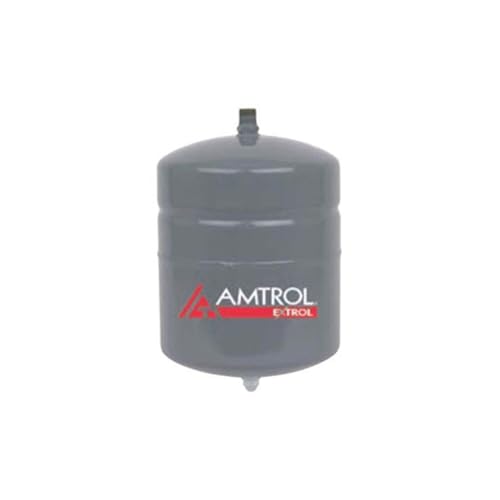


Product prices and availability are accurate as of the date/time indicated and are subject to change. Any price and availability information displayed on Amazon.com at the time of purchase will apply to the purchase of this product.
Six checks from each maker’s own sheets, manuals and warranty terms, equal weight. Every rule and input is in the method section near the end.
These tanks all do one job the same way: a steel shell, a butyl diaphragm, air on one side and boiler water on the other, rated to 100 psi.
So the score splits them on what each maker commits to in writing. That means the warranty, the lowest temperature and pressure it prints, whether it names a tank size for your boiler, whether the Amazon listing matches the maker’s sheet, and whether the tank tells you when it’s done.
Amtrol’s three in-line tanks share one sheet, one manual and one seven-year warranty, so they score close. The EX-60 lost points only because its Amazon listing prints different numbers from Amtrol’s.
What each maker publishes, which boiler each tank suits and where each one lost points.
Amtrol Extrol EX-30 hydronic expansion tank, 4.4 gal, 1/2 in. NPTM, 12 psi factory precharge
Prices and availability are accurate as of the time shown and may change.
You have a residential hot-water boiler on a closed loop, finned baseboard from about 75,000 to 150,000 BTU net output, or radiators up to 75,000.
You have cast iron baseboard over 50,000 BTU or radiators over 75,000. Amtrol’s chart moves those to the EX-60.
The EX-30 is the tank most people mean when they say “a number 30,” and I’ve used it. Amtrol’s submittal lists it at 4.4 gallons, 11 inches across and 15 inches tall, about 9 pounds shipping weight, with a 1/2-inch male pipe thread. It scored a perfect 10.0.
It takes up to 2.5 gallons of expanded water, Amtrol’s maximum acceptance figure for the size. That’s why it covers the middle of Amtrol’s chart. With finned baseboard, it’s the tank from 75,000 to 150,000 BTU net output. With convectors or unit heaters it covers 75,000 to 100,000, and with cast iron radiators 50,000 to 75,000.
Every check went its way. Amtrol’s installation sheet gives the EX models a seven-year limited warranty, a 10. Its brochure and sheet print one rating set, 240°F and 100 psi, so temperature and pressure are both 10s. The chart names the tank by BTU and radiation type, and the sheet prints the acceptance factor, another 10.
The Amazon listing names the EX-30 under the Amtrol brand and prints nothing that disagrees with Amtrol’s sheet, so it gets a 10 for matching. The service aid is the InSight cap on the air valve. Amtrol says it changes color when the tank needs replacing, and also says not to treat the cap as the only sign.
Amtrol ships it at 12 psi, the same fill pressure its chart assumes. Its manual says to check that number with the tank empty, and to charge it to match your boiler’s fill valve. If your fill valve is set higher than 12, raise the tank to match before it goes on.
Amtrol also lists it for propylene glycol mixtures up to 50%, so a loop with antifreeze in it is fine.
My call: this is the tank I’d keep on the truck for a home boiler. Run the sizer below with your boiler’s net output first, though, because cast iron radiation fills a tank much faster than baseboard does.
Amtrol Extrol EX-15 hydronic expansion tank, 2.0 gal, 1/2 in. NPTM, 12 psi factory precharge
Prices and availability are accurate as of the time shown and may change.
Your boiler’s net output is 50,000 BTU or less on baseboard or convectors, or 25,000 BTU or less with cast iron radiators or baseboard.
Your boiler is bigger than that, or you’re not sure. An EX-30 on a small system costs you nothing in performance.
The EX-15 is the smallest Extrol in-line tank, and I’ve used it. Amtrol’s submittal lists it at 2.0 gallons, 8 inches across and 13 inches tall, about 5 pounds shipping weight, with the same 1/2-inch male thread as the EX-30. It also scored 10.0.
It scores the same as the EX-30 because it shares the same paperwork: the seven-year warranty, the 240°F and 100 psi ratings, the sizing chart, a clean Amazon listing and the InSight cap. Six 10s.
Where it differs is how much water it takes. Amtrol’s brochure gives it a maximum acceptance of 1.0 gallon, against 2.5 for the EX-30. That puts it at the top of Amtrol’s chart only. It covers finned baseboard and convectors up to 50,000 BTU net output, and cast iron radiators and baseboard only at 25,000.
That makes it a tank for small loops: a wall-hung boiler on a condo zone, a small cabin, or a system that heats a few rooms. Its size helps there. At about 5 pounds empty it’s easy to hang under an air purger in a tight closet.
It ships at 12 psi, matching Amtrol’s chart. Like every tank here, set the air to your fill valve’s setting with the tank empty, and do it at room temperature. Amtrol’s manual says precharge changes must be made at ambient temperature only.
The catch with a small tank is what happens when it’s too small. Amtrol says that if the relief valve drips after the boiler restarts, the tank may be undersized or charged wrong. A 1-gallon tank on a big cast iron system is the classic case.
My call: buy it when the sizer below says EX-15 with room to spare. If your boiler sits near the 50,000 line, or you plan to add a zone of radiators later, step up to the EX-30.
Amtrol Extrol EX-60 hydronic expansion tank, 6.7 gal, 1/2 in. NPTM, 12 psi factory precharge
Prices and availability are accurate as of the time shown and may change.
You have cast iron radiators at 100,000 to 125,000 BTU, cast iron baseboard at 75,000 to 100,000, or finned baseboard at 175,000 to 200,000.
Your system is smaller. The sizer will say EX-30, which is lighter and easier to hang.
The EX-60 is the biggest Extrol that still carries the InSight cap, and I’ve used it. Amtrol’s submittal lists it at 6.7 gallons, 11 inches across and 20 inches tall, about 13 pounds shipping weight, with the same 1/2-inch male thread. It scored 9.2.
Old cast iron systems are where it earns its place. Radiators and cast iron baseboard hold a lot of water, and all of it grows when it heats. Amtrol’s chart gives the EX-60 to cast iron radiators at 100,000 and 125,000 BTU and to cast iron baseboard at 75,000 and 100,000. It also covers finned baseboard at 175,000 and 200,000 and convectors from 125,000 to 175,000.
Amtrol’s brochure gives it a maximum acceptance of 2.7 gallons. That’s only a bit more than the EX-30’s 2.5, though the tank holds half again as much. Amtrol’s submittal shows why: the EX-60’s acceptance factor is 0.40 against the EX-30’s 0.57. Size it from the chart, not by eye.
It gets the same 10s as the other Extrols on warranty, ratings, sizing data and the InSight cap. The one check it lost is the listing. The Amazon title calls it a 7.4 gallon tank, 23 inches tall, and the bullets say 2.5 gallons of acceptance. Amtrol’s sheet says 6.7 gallons, 20 inches and 2.7. That’s a 5 for listing match, and the reason it’s 9.2 and not 10.
The listing still names the Amtrol 60 Extrol and the 1/2-inch male connection, and it prints 100 psi. So I’m confident it’s the right tank, and I’d trust Amtrol’s numbers over the title when you plan the space.
Weight is the install issue. Amtrol says to mount these tanks hanging straight down and to make sure the piping can carry the whole tank full of water. A full EX-60 is a lot more than its 13 pounds. Strap the pipe it hangs from.
My call: when the sizer lands between EX-30 and EX-60 on a cast iron job, take the EX-60. Spare room in a tank only means a lower pressure swing, while a short tank lets the relief valve do the tank’s job.
Hydronic expansion tank, 4.5 gal, 1/2 in. MNPT, 12 psi factory precharge
Prices and availability are accurate as of the time shown and may change.
Your system was sized on Flexcon’s chart, your old tank is an HTX 30 or one of its cross-references, or the EX-30 is out of stock.
You want the longest warranty and a cap that tells you when to replace it. The Amtrol EX-30 is the same size class with both.
The HTX 30 is Flexcon’s 4.5 gallon in-line hydronic tank, and I’ve used it. Flexcon’s sell sheet lists a 100% butyl diaphragm, a 16-gauge steel shell with appliance-quality paint, a stainless steel connection and a 1/2-inch MNPT thread. It scored 7.4.
In size it’s a match for the EX-30. Flexcon prints a maximum acceptance of 2.5 gallons, the same as Amtrol’s figure for the EX-30, and Flexcon’s own cross-reference lists the HTX 30 against Amtrol’s 30. The tank is about 11 inches across and 14 inches tall, and weighs 10 pounds.
The warranty is five years from the date of manufacture, per Flexcon’s manual. Against Amtrol’s seven, that’s a 7.1. Note the start date too: Flexcon counts from manufacture, so a tank that sat on a shelf has used up part of it.
Temperature cost it the most. Flexcon’s manual and its spec block say 240°F, but the same sell sheet also prints “Max Temp 180°” beside the pressure rating. When a maker prints two numbers, I score the lower one, so that check is a 7.5. Pressure is a clean 10 at 100 psi.
Flexcon publishes a quick sizing chart by BTU and radiation type, plus acceptance volumes, so sizing data is a 10. The listing lost half: Amazon’s offer note calls the connection “1/2 - FIP,” and Flexcon’s sheet says 1/2-inch male. Expect a male thread, as Flexcon says.
There’s no replacement indicator, but Flexcon does say a qualified professional should check the tank every year and replace it at any sign of leaks or rust. That’s a 5 on the service check.
Flexcon’s install rules match Amtrol’s on the big points: supply side of the boiler, suction side of the circulator, never horizontal, and adjust the air only with zero pressure on the system.
My call: a solid tank that lost points on paperwork, not on build. Buy it when you’re replacing an HTX 30, and set the air to your fill pressure like any other.
Size, acceptance, ratings and paperwork, from each maker’s own documents.
| Pick | Spec score | Photo | Volume | Max acceptance | Max temp | Warranty | Indicator | Short pros / cons | Buy |
|---|---|---|---|---|---|---|---|---|---|
| Amtrol EX-30 | 10.0 | | 4.4 gal | 2.5 gal | 240°F | 7 years | InSight cap | Fits most homes / Hangs down only | Check it on Amazon |
| Amtrol EX-15 | 10.0 | | 2.0 gal | 1.0 gal | 240°F | 7 years | InSight cap | Small and light / Small systems only | Check it on Amazon |
| Amtrol EX-60 | 9.2 | | 6.7 gal | 2.7 gal | 240°F | 7 years | InSight cap | Cast iron systems / Listing numbers off | Check it on Amazon |
| Flexcon HTX 30 | 7.4 | | 4.5 gal | 2.5 gal | 180–240°F | 5 years | None | Stainless connection / Shorter warranty | Check it on Amazon |
From Amtrol’s Extrol submittal (MC4400), Extrol brochure (MC2680) and installation sheet (9015-941), and Flexcon’s HTX sell sheet, HTX manual and quick sizing guide, read Oct 22, 2026. All four are rated to 100 psi and ship at 12 psi.
A hot-water heating loop is sealed. The tank is the one place the loop’s water can grow into when the boiler heats it.
Water grows when it heats, and a boiler loop is sealed with no way out but the relief valve. Without a place for that extra water, pressure climbs every heating cycle until the relief valve opens.
The tank holds a cushion of air behind a rubber diaphragm. When the loop is cold, the fill valve keeps it at the fill pressure, and the tank’s air is set to match. As the boiler heats, the growing water pushes into the tank and squeezes the air. As the loop cools, the air pushes it back out.
Both Amtrol and Flexcon size their tanks on the same pair of numbers: a 12 psi fill and a 30 psi relief valve. The tank’s job is to keep the hot loop under that relief setting.
| Part | Its job | What to know |
|---|---|---|
| Fill valve | Feeds water into the loop up to its set pressure | Both makers’ charts assume 12 psi; set the tank’s air to match yours |
| Expansion tank | Takes the extra water as the loop heats | Supply side, hanging down, sized from a chart |
| Air purger and vent | Pulls air out of the moving water | Amtrol recommends hanging the tank under it |
| Circulator | Moves water through the loop | Goes after the tank, pumping away from it |
| Relief valve | Opens if pressure gets too high | Both charts assume 30 psi; Amtrol says it should be checked at least every 3 years |
This page is about heating loops only. The tank on a water heater does a similar job on drinking water, and it has to be built and listed for that. Amtrol says plainly not to put an Extrol on a domestic water system. For that tank, see our water heater expansion tank guide.
Enter your boiler’s net output and what heats the rooms. The sizer reads Amtrol’s and Flexcon’s published charts side by side.
Two things set the size: how big the boiler is and how much water the system holds. Finned copper baseboard holds little water, so it needs the smallest tank for its output. Cast iron radiators hold the most, so they jump sizes first.
Amtrol’s chart assumes a 12 psi fill, a 30 psi relief valve and 180°F average water. Flexcon’s uses the same pressures but a 200°F average. That’s why Flexcon names a bigger tank in a few rows: hotter water grows more.
| Net output (BTU/hr) | Finned baseboard | Convectors, unit heaters | Cast iron radiators | Cast iron baseboard |
|---|---|---|---|---|
| 25,000 | EX-15 / HTX 15 | EX-15 / HTX 15 | EX-15 / HTX 15 | EX-15 / HTX 15 |
| 50,000 | EX-15 / HTX 15 | EX-15 / HTX 30 | EX-30 / HTX 30 | EX-30 / HTX 30 |
| 75,000 | EX-30 / HTX 30 | EX-30 / HTX 30 | EX-30 / HTX 60 | EX-60 / HTX 60 |
| 100,000 | EX-30 / HTX 30 | EX-30 / HTX 30 | EX-60 / HTX 60 | EX-60 / HTX 60 |
| 125,000 | EX-30 / HTX 30 | EX-60 / HTX 60 | EX-60 / HTX 60 | EX-90 / HTX 60 |
| 150,000 | EX-30 / HTX 30 | EX-60 / HTX 60 | EX-90 / HTX 90 | EX-90 / HTX 90 |
| 175,000 | EX-60 / HTX 60 | EX-60 / HTX 60 | SX-30V / HTX 90 | SX-30V / HTX 90 |
| 200,000 | EX-60 / HTX 60 | EX-90 / HTX 60 | SX-30V / HTX 90 | SX-30V / HTX 90 |
Amtrol Extrol installation sheet 9015-941 (07/25), Figure 1, and Flexcon HTX & SXHT quick sizing guide, read Oct 22, 2026. Amtrol first, Flexcon second in each cell. SX and SXHT are floor-standing tanks.
Where the two charts disagree, my call is to take the bigger tank. A tank with spare room just swings the pressure less. A short one sends water out the relief valve.
If you’re replacing a tank that worked for years with no relief valve drips, the same size is a fair bet. If the old one was too small, the dripping relief valve was telling you so.
Most old tanks carry a number like 15, 30, 60 or 90. Flexcon publishes a cross-reference that lines the brands up by size.
| Flexcon | Amtrol | Watts | Elbi | Wilkins | State | Vent-Rite |
|---|---|---|---|---|---|---|
| HTX 15 | 15 (EX-15) | ET-15 | XT-15 | HXT-15 | ET-20 | VR15 |
| HTX 30 | 30 (EX-30) | ET-30 | XT-30 | HXT-30 | ET-5 | VR30 |
| HTX 60 | 60 (EX-60) | ET-60 | XT-60 | HXT-60 | ET-7 | VR60 |
| HTX 90 | 90 (EX-90) | ET-90 | XT-90 | HXT-90 | ET-14 | VR90 |
Flexcon HTX & SXHT competitive cross-reference guide, read Oct 22, 2026, with Amtrol’s EX model names added. Watts’ current product page calls its 4.5 gallon tank the ETX-30.
So a “number 30” from any of these brands is an EX-30 or an HTX 30 today. Read the label on the old tank before you shop: it gives the model and often the precharge it shipped with.
One trap: Amtrol also makes Fill-Trol tanks, FT-109 to FT-112, which carry a fill valve built into the tank. Amtrol says a standard Extrol is not interchangeable with a Fill-Trol tank. If your old tank has a cold water line going into it, it’s a Fill-Trol, and an EX won’t replace it on its own.
| Old tank | Amtrol in-line match | Volume | Max acceptance |
|---|---|---|---|
| Fill-Trol FT-109 | EX-15 plus a separate fill valve | 2.0 gal | 1.0 gal |
| Fill-Trol FT-110 | EX-30 plus a separate fill valve | 4.4 gal | 2.5 gal |
| Fill-Trol FT-111 | EX-60 plus a separate fill valve | 6.7 gal | 2.7 gal |
| Fill-Trol FT-112 | EX-90 plus a separate fill valve | 14.0 gal | 11.3 gal |
Amtrol Extrol brochure MC2680 (09/25), equivalents table and Fill-Trol specifications, read Oct 22, 2026. The volumes match; whether to swap a Fill-Trol for an EX plus a fill valve is a call for your installer.
Both makers say the same thing: match the tank’s air to the boiler’s fill valve setting, with the tank empty, at room temperature.
Read the setting on the boiler’s fill valve, or read the boiler gauge with the system cold. Both makers’ charts assume 12 psi.
With the tank off the system or isolated and drained, take the plastic cap off the air valve and read it with a tire gauge. Flexcon says to adjust only with 0 psi on the water side.
Add air with a hand pump or let some out until the tank reads the fill pressure. Do it at room temperature, which Amtrol and Flexcon both require.
Put the cap back and tighten it flush to the tank. Amtrol warns that a cap that isn’t sealed loses precharge and the tank fails.
Why it matters: if the tank’s air is below the fill pressure, water fills part of the tank before the boiler ever fires, and that room is gone when the expansion comes. If it’s well above, the diaphragm stays pushed against the water side until the loop is hot. Amtrol says improper charge is one reason a relief valve drips.
Every Extrol and HTX here ships at 12 psi. My call: a two-story house often needs more fill pressure than one story to get water to the top radiators, so don’t assume 12 is right for yours. Read the fill valve.
| Tank | Factory precharge | Maker’s rule |
|---|---|---|
| Amtrol EX-15, EX-30, EX-60 | 12 psi | Tank empty; charge to match the boiler fill valve setting; adjust at ambient temperature only |
| Flexcon HTX 30 | 12 psi | Adjust before install with 0 psi on the system; pre-charge to match the boiler fill valve setting |
| Amtrol EX-PRO (radiant) | 15 psi in its chart | Same rule; its sizing assumes a 15 psi fill |
Supply side of the boiler, before the circulator, hanging straight down. Here’s each point and whose rule it is.
| Point | What it says | Source |
|---|---|---|
| Which side | Supply side of the boiler, on the suction side of the heating circulator | Amtrol 9015-941, Flexcon HTX manual |
| Which way | Vertical, hanging downward only; never horizontal | Amtrol 9015-941, Flexcon HTX manual |
| Support | The piping must carry the tank’s full weight with water; add straps, brackets or hangers if needed | Amtrol, Flexcon |
| Where not | Not on a dead-end pipe or anywhere air collects, which can cause corrosion and leaks | Amtrol 9015-941 |
| Air removal | Under an air purger is recommended; some method of air elimination is required | Amtrol EX-PRO sheet 9015-968 |
| Leaks | Fit a drip pan to a drain if a leak could cause damage; keep it from freezing | Amtrol, Flexcon |
Turn off the boiler and let it cool. Drain the boiler or isolate the section where the tank goes, and let the pressure fall to zero.
Do the air-charge steps above with the new tank still dry. You can’t set it properly once it’s full of water.
Seal the 1/2-inch male thread with pipe dope, as Flexcon’s manual calls for, and thread the tank into the tapping under the purger or a tee on the supply.
Let the fill valve bring the loop back to pressure, bleed air, and check every joint for leaks.
Restart the boiler and watch the relief valve through a full heat cycle. Amtrol says a dripping relief valve means the tank may be charged wrong or too small.
The circulator rule is the one people miss. Putting the tank at the pump’s inlet, with the pump “pumping away” from it, is what Amtrol and Flexcon both show. My call: put the tank after the pump instead and the pump can pull the loop’s pressure down at its own inlet, which is where air comes out of the water and noise starts.
Amtrol says these tanks must be installed by a licensed professional, and a boiler loop also has gas or oil and a relief valve in the picture. If you do your own work, the parts that matter most are the precharge and the hanging position.
A failed tank looks fine from outside. The boiler gauge and the relief valve usually tell you first.
| What you see | Likely cause | What to do |
|---|---|---|
| Relief valve drips after the boiler runs | Tank undersized or charged wrong | Amtrol: check the charge and the size |
| Boiler gauge climbs toward 30 psi when hot | Tank full of water or too small | Check the tank’s charge empty (my call) |
| Water comes out when you press the air valve | Torn diaphragm | Replace the tank (my call) |
| Amtrol InSight cap discolored | Tank needs replacing | Amtrol: tank replacement required |
| Rust or weeping on the tank | Corrosion | Amtrol and Flexcon: replace it, don’t adjust the air |
The gauge on the boiler shows pressure and temperature together. My call: with the loop cold it should sit near your fill pressure, and with the loop hot it should rise some but stay well under the 30 psi relief setting. A big swing from cold to hot is the tank failing to take the water.
Checking the air takes the tank off the system’s pressure. Amtrol says to check the precharge only while the tank is isolated and empty, because every check lets a little air out. Our boiler pressure gauge guide covers reading and replacing the gauge, and our pressure relief valve guide covers the valve itself.
A few systems need a different tank or a different setup. Here’s what the makers say.
| Your system | What the maker says |
|---|---|
| Glycol (antifreeze) in the loop | Amtrol lists the EX series for propylene glycol mixtures up to 50% |
| Radiant floor with non-barrier PEX and no air removal | Amtrol: use a Radiant Extrol, not a standard EX |
| Low-temperature radiant or chilled water | Amtrol’s EX-PRO: 200°F max, a plastic liner rated for barrier and non-barrier tubing, sized on a 15 psi fill |
| Domestic hot water | Amtrol and Flexcon: not for potable water; use a potable tank |
| An open heating system | Amtrol: do not install an Extrol on an open system |
| Feet of PEX | 1/2 in. tubing | 3/4 in. tubing | 1 in. tubing |
|---|---|---|---|
| 1,000 | EX-15PRO | EX-15PRO | EX-15PRO |
| 5,000 | EX-15PRO | EX-30PRO | EX-60PRO |
| 10,000 | EX-30PRO | EX-60PRO | Call Amtrol |
| 18,000 | EX-60PRO | Call Amtrol | Call Amtrol |
Excerpt from Amtrol’s Extrol PRO instructions 9015-968 (07/25), Figure 2, radiant sizing by feet of PEX tubing at a 15 psi fill, 30 psi relief and 120°F average, read Oct 22, 2026.
Older houses sometimes have a plain steel tank up in the floor joists with no diaphragm at all, where air and water touch. My call: those work differently.
They’re drained now and then to restore the air, and they rely on fittings that steer air into the tank. Swapping one for a diaphragm tank also means changing how the system handles air, so treat it as a job, not a part swap.
No maker here prints a life expectancy. The warranty is the closest thing, and both makers say to inspect the tank every year.
Amtrol says a professional should check the whole system, tank included, every year and more often as it ages. Flexcon says the same and adds that the tank and its piping will in time leak. Both point to water quality: Flexcon calls for periodic water tests, and Amtrol names chlorine and aggressive water as causes of early failure.
My call: when you replace the boiler, replace the tank too. It’s a small part of the job, and the new boiler’s warranty is better served by a tank that’s charged and sized for it.
These came up in Amazon searches on Oct 22, 2026. Here’s what kept each off the list.
| Tank | Spec score | What we found | Why it’s out |
|---|---|---|---|
| Watts ETX-30 | 4.4 | One-year standard warranty; Watts’ page prints 60 and 75 psi and 4.5 and 4.7 gallons | Under 7.0 on the same six checks |
| Watts ETX-15 | Not picked | Same one-year Watts standard warranty as the ETX-30 | Warranty a seventh of Amtrol’s |
| “Amtrol 90 Extrol” listing | Not picked | Part number 112-1 and Fill-Trol features in the bullets | Can’t tie it to the EX-90 |
| Amtrol #30 (a second listing) | Not picked | Listing says a 5-year warranty; Amtrol says 7 | The EX-30 listing matches Amtrol |
| Honeywell TK30030 | Not picked | Two left in stock; maker documents not checked | Thin stock, unchecked papers |
The Watts ETX-30 is a real Watts tank, and its page gives useful numbers: 11 by 14 inches, 2.5 gallons of acceptance, vertical or horizontal mounting. It lost on the paperwork. Watts’ standard warranty is one year, its max temperature is 220°F, and its own page prints two different pressure ratings, 60 and 75 psi. Scored on the lower ones, it comes to 4.4.
| Question | If yes | If no |
|---|---|---|
| Is it a closed hot-water heating loop, not drinking water? | Pick from this page | Use a potable tank |
| Is the boiler 50,000 BTU or less on baseboard? | Amtrol EX-15 | Next question |
| Is it 75,000 to 150,000 BTU on finned baseboard? | Amtrol EX-30 (or Flexcon HTX 30) | Use the sizer |
| Cast iron radiators or baseboard? | Expect the EX-60 from about 75,000 to 100,000 BTU | Baseboard sizes apply |
| Does your old tank have a water line into it? | It’s a Fill-Trol; plan for the fill valve | Swap like for like by size |
My call for most homes: the Amtrol EX-30 under the air purger, air set to the fill pressure, hanging straight down on the supply side before the pump. Size up for cast iron, and watch the relief valve through the first heat cycle.
The Amtrol Extrol EX-30 for most home boilers, 10.0 on our spec score. Amtrol publishes a BTU sizing chart, a seven-year warranty and an InSight cap that shows when to replace it.
It gives the loop’s water room to grow as it heats. An air cushion behind a diaphragm squeezes as the water expands, so pressure stays under the relief valve setting.
Every closed hot-water heating loop needs some form of expansion control, because heated water has nowhere else to go. Steam boilers and open systems work differently, and Amtrol says not to put an Extrol on an open system.
A relief valve that drips after the boiler runs, a big pressure jump on the boiler gauge, water from the air valve, rust, or a discolored Amtrol InSight cap.
No maker gives a set life. Amtrol and Flexcon say to inspect it yearly and replace it at signs of corrosion or leaks. Warranties run 5 to 7 years.
Go by net output and radiation type. Amtrol’s chart gives finned baseboard the EX-30 from 75,000 to 150,000 BTU; cast iron radiators reach the EX-60 at 100,000.
The same as your boiler’s fill pressure, set with the tank empty and at room temperature. Both Amtrol and Flexcon ship at 12 psi and size on a 12 psi fill.
It’s the common 4.4 to 4.5 gallon size: Amtrol’s EX-30, Flexcon’s HTX 30, and the matching 30-size tanks from Watts, Elbi and Wilkins in Flexcon’s cross-reference.
On the supply side of the boiler, on the suction side of the circulator, hanging straight down, ideally under the air purger. Not on a dead-end pipe.
Amtrol says to mount Extrol tanks vertically, hanging downward only. Flexcon says never to install the HTX horizontally.
Usually the diaphragm has failed or the air charge leaked away, so water fills the space the air should hold. Check the air with the tank empty; water at the valve means replace it.
No. Amtrol and Flexcon both say their hydronic tanks are not for potable water. A water heater needs a tank built and listed for drinking water.
I’m Isaac Daniels, a licensed journeyman plumber in Georgia (license #JP507711), and I’ve used all four picks. Every spec here comes from Amtrol’s and Flexcon’s own documents and Watts’ product and warranty pages, read Oct 22, 2026. Where I add advice of my own, it’s labeled as my call.
Each check scores 0 to 10 and counts one sixth. When a maker prints two values, the lower one is scored. It’s our score from maker documents, not a customer rating or a lab test of our own.
| Check (weight) | How it’s scored |
|---|---|
| Warranty (⅙) | 10 × years ÷ 7, capped at 10 |
| Temperature (⅙) | 10 × lowest printed max °F ÷ 240 |
| Pressure (⅙) | 10 × lowest printed max psi ÷ 100 |
| Sizing data (⅙) | 10 when the maker’s chart names the model by boiler size and it prints acceptance; 5 for one; 0 for neither |
| Listing match (⅙) | 10 when the Amazon listing matches the maker’s sheet; 5 for one conflict; 0 if it can’t be tied to a model |
| Service aid (⅙) | 10 for a built-in replacement indicator; 5 for a maker inspection rule only; 0 for neither found |
| Total | Average of the checks, to one decimal |
| Pick | Warranty | Temp | Pressure | Sizing | Listing | Service | Score |
|---|---|---|---|---|---|---|---|
| Amtrol EX-30 | 10 (7 yr) | 10 (240°F) | 10 (100) | 10 | 10 | 10 (InSight) | 10.0 |
| Amtrol EX-15 | 10 (7 yr) | 10 (240°F) | 10 (100) | 10 | 10 | 10 (InSight) | 10.0 |
| Amtrol EX-60 | 10 (7 yr) | 10 (240°F) | 10 (100) | 10 | 5 (gal, height) | 10 (InSight) | 9.2 |
| Flexcon HTX 30 | 7.1 (5 yr) | 7.5 (180°F) | 10 (100) | 10 | 5 (FIP note) | 5 (yearly check) | 7.4 |
| Watts ETX-30 | 1.4 (1 yr) | 9.2 (220°F) | 6.0 (60) | 5 (acceptance) | 5 (psi) | 0 | 4.4 |