Reotemp PD25H
$12.99 at Amazon
Check it on AmazonPrice as of Oct 24, 2026, 5:30 AM EDT
Details ↓
Find out if your pressure is too high.
As an Amazon Associate I earn from qualifying purchases.
For most homes, buy the Reotemp PD25H. Its red max pointer catches overnight spikes, and its 0 to 160 dial reads house pressure closely. Want a maker spec sheet? Get the Watts IWTG. Code calls for a regulator above 80 PSI.
Three hose-thread test gauges, each with a red max pointer. Each one was the genuine brand, new and in stock on Amazon when I checked. Prices come from Amazon and show the time they were read.

Product prices and availability are accurate as of the date/time indicated and are subject to change. Any price and availability information displayed on Amazon.com at the time of purchase will apply to the purchase of this product.
Gauge accuracy is a percent of the whole dial, not of your reading. Here’s what each maker’s stated grade allows at a typical house reading.
The 0 to 160 dial is why the Reotemp wins this chart. A 3-2-3% gauge is held to 2% of the span in the middle half of the dial and 3% near the ends. On a 160 PSI dial, 45 PSI is in the middle half. On a 200 PSI dial, it’s still in the first quarter, where the looser 3% applies.
Home water pressure test gauge, 0–160 PSI
Prices and availability are accurate as of the time shown and may change.
You want one test that shows your normal pressure and the highest spike overnight, on a dial where 40 to 120 PSI sits in the tight middle half.
You expect readings above 160 PSI, or you want a maker spec sheet with materials and temperature limits. The Watts IWTG has both.
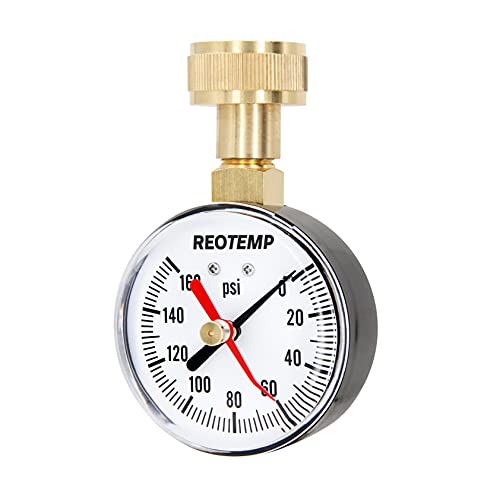
This is the gauge I’d hand a homeowner who asks whether their pressure is too high. The Reotemp PD25H is a 2.5 in. test gauge on a brass 3/4 in. female hose thread fitting. It screws onto an outside hose bibb or a laundry valve by hand.
The red max pointer is the reason it’s my top pick. Reotemp says it shows pressure spikes while you’re away. The black hand shows pressure right now. The red hand stays at the highest point the black hand pushed it to, so you can read last night’s peak in the morning.
Reotemp’s own page explains the setup step most people miss. Before the test, set the red pointer so it rests just above the black one. As pressure climbs, the black hand drags the red one up with it. To reset, turn the red pointer back down to zero, above the black hand.
The listing gives a 0 to 160 PSI dial, and the product photo shows 160 at the top. A reading between 40 and 120 PSI falls in the middle half of that dial. That’s where a 3-2-3% gauge is held to 2% of span, or ±3.2 PSI.
One conflict to know about. Reotemp’s product page describes marks every 10 PSI from 0 to 200 PSI, while the listing title and photo say 0 to 160. I went with the listing and photo, since they describe this exact Amazon item. Either way, 80 PSI sits well inside the dial.
The listing calls it ASME compliant with 3-2-3% accuracy and says home inspectors use it. I couldn’t find a case material or temperature range for this model from Reotemp. My call: bring it inside after the test, since water left in the fitting can freeze.
Reotemp also sells a PD25H2 with the same dial and accuracy, but its listing leaves out the max pointer. For a peak test, check that the title says max pointer before you buy.
My call: this is the one to buy if you want a single answer on whether you need a pressure regulator or an expansion tank. It was sold by REOTEMP, the maker, new and in stock when I checked.
Prices and availability are accurate as of the time shown and may change.
You want a gauge backed by a maker spec sheet, or your only hose-thread outlet near the main is the drain valve on the water heater.
You want the closest reading at normal house pressure. A 0 to 160 dial like the Reotemp’s has a tighter tolerance at 45 PSI.
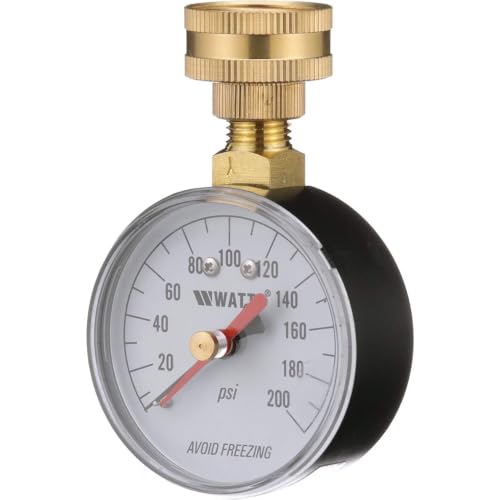
Watts makes pressure regulators, backflow preventers and expansion tanks, and the IWTG is its hose connection test gauge. Watts lists it as ordering code 0069770, and the Amazon listing gives model 0950200. It’s a 2.5 in. dial on a 3/4 in. female hose thread, reading 0 to 200 PSI.
This is the best-documented gauge on the page. Watts publishes a spec sheet, ES-276H300-IWTG, and an instruction sheet, IS-IWTG. Together they give the case, window, tube, accuracy, temperature range, size and weight.
The spec sheet lists a black enamel steel case, a Kostil polymer window, and a copper alloy Bourdon tube with tin alloy welding. Accuracy is ASME Type B, under the ASME B40.100 standard. Working temperature is 40 to 140°F, and the gauge weighs 0.3 lb.
Watts’s instruction sheet says the hose connection attaches to an outside hose bibb or to the drain connection on a water heater.
My call: a heater drain gives you water at tank temperature, and resting the heater doesn’t cool the tank. Use a cold hose bibb when you can. If the drain is your only outlet, follow the heater maker’s shutdown and cooling steps, and confirm the water is under the gauge’s 140°F limit before you connect.
The red hand holds at the highest reading. Watts says that’s for catching thermal expansion surges, and that left on overnight it registers the highest surge in that period. It’s the same overnight test the Reotemp does.
The same sheet has a note for contractors. Watts says pressure regulators should be installed when supply pressure tops 60 PSI. That’s stricter than the code, which calls for one above 80 PSI static. The reading table below shows both.
Two things to know. Watts’s product page lists the IWTG as not lead free, so use it as a test gauge, not a permanent part of a drinking-water line. And the Amazon listing mentions a 0 to 300 PSI scale. That’s the Watts 276H300; the IWTG is 0 to 200.
My call: buy this one if you want the paperwork, or if the water heater drain is your test point. It was sold by Amazon.com, new and in stock when I checked.
CARBO Instruments D25-P-W-200 water test gauge, 0–200 PSI / 0–14 bar
Prices and availability are accurate as of the time shown and may change.
You want a max pointer plus a bar scale, for a shower valve, pump or filter whose manual gives pressure in bar.
You want every spec backed by a maker document. CARBO’s numbers come from its Amazon listing only.
CARBO Instruments sells its gauges through Amazon and other marketplaces. The D25-P-W-200 is a 2.5 in. water test gauge on a brass 3/4 in. female hose thread connector, with a red max pointer. CARBO USA was the seller when I checked.
The dual scale is the reason to pick it. The photo shows PSI in black on the outer ring and bar in red, marked to 14 bar. If a shower valve, pump or filter manual gives its limits in bar, you read the number straight off the dial.
The listing’s accuracy claim is the best on this page: ±2-1-2%, labeled ASME B40.1 Grade A. On a 0 to 200 dial, that’s ±2 PSI in the middle half, from 50 to 150 PSI, and ±4 PSI below 50. The other three gauges here are 3-2-3%.
The catch is the source. I couldn’t find a CARBO datasheet or maker page for this model, so the Grade A claim rests on the listing alone. I’ve kept it in the tables, marked as a listing claim.
The red max pointer works like the others. The listing says it tracks and keeps peak spikes and resets easily. Set it against the black hand before an overnight test.
The case is black plastic, which the listing calls rust-proof. There’s an anti-fog lens and a rubber seal, and the photo shows a hose washer and a roll of thread tape in the box. My call: the rubber washer does the sealing on hose thread, so the tape is optional.
The listing also claims the Bourdon tube is good for 10,000+ cycles and backs the gauge with a lifetime satisfaction guarantee. Neither is in a document from CARBO that I could read.
My call: get this if you want bar on the dial, or the tighter accuracy claim, and you’re fine with a listing as the source. It was sold by CARBO USA, new and in stock when I checked.
The specs that decide which gauge fits your test, from the makers’ documents and the listings. Scroll sideways on a phone. Tap a column with numbers to sort it on a desktop.
| Pick | Spec score | Photo | Top of dial (PSI) | Second scale | Max pointer | Accuracy | ± PSI at 70 | Case | Short pros / cons | Buy |
|---|---|---|---|---|---|---|---|---|---|---|
| Reotemp PD25H Overnight peak test | 9.0 | | 160 | None | Yes | 3-2-3%, ASME (listing) | 3.2 | Not stated | Tightest at 45 PSI / Range conflict | Check it on Amazon |
| Watts IWTG Spec sheet, heater drain | 8.5 | | 200 | None | Yes | ASME Type B | 4 | Black enamel steel | Full maker paperwork / Not lead free | Check it on Amazon |
| CARBO D25-P-W-200 PSI and bar | 8.3 | | 200 | Bar (0–14) | Yes | 2-1-2%, Grade A (listing) | 2 | Black plastic | Best stated grade / Listing is the only source | Check it on Amazon |
From Watts’s IWTG spec sheet and instruction sheet, Reotemp’s product page, and the Amazon listings read through the Creators API, Oct 19, 2026. The ± column is my math from each stated grade and range.
Read the table by the test you want to run. For a one-time check of whether you need a regulator, any of the three works. For the overnight peak test, the tighter error at 45 and 70 PSI is what separates them.
Gauge listings give accuracy as three numbers. Here’s how to turn them into PSI at the readings a house actually shows.
| Gauge | Dial | Stated grade | ± at 45 PSI | ± at 70 PSI | ± at 110 PSI |
|---|---|---|---|---|---|
| Reotemp PD25H | 0–160 | 3-2-3% | 3.2 | 3.2 | 3.2 |
| Watts IWTG | 0–200 | ASME Type B (3-2-3%) | 6 | 4 | 4 |
| CARBO D25-P-W-200 | 0–200 | 2-1-2% (listing) | 4 | 2 | 2 |
My math. Under ASME B40.100, a 3-2-3% gauge is held to 3% of span in the first and last quarter of the dial and 2% in the middle half; 2-1-2% is the tighter Grade A. Watts names ASME Type B, which is the 3-2-3% grade.
Your normal reading should land in the middle half of the dial. On a 0 to 160 gauge that’s 40 to 120 PSI; on a 0 to 200 gauge it’s 50 to 150 PSI.
At 78 PSI on a 3-2-3% 0 to 200 gauge, the true pressure could be 74 to 82. If you’re that close, test again with a second gauge before you buy a regulator.
My call: a test gauge that’s been dropped on concrete or frozen with water in it can read off. Check it against a second gauge.
For a house, accuracy matters most near the code line. If a 3-2-3% gauge reads 65 PSI, you’re fine either way. If it reads 79, the error band crosses 80, and that’s the case where the tighter dial or a second gauge pays off.
One gauge, two readings. The black hand gives your static pressure now. The red hand, left overnight, shows the highest spike.
An outside hose bibb or the water heater drain, per Watts. My call: use the bibb closest to where the water line enters the house.
No faucets, toilets filling, irrigation, ice maker or washer running. Otherwise you’re reading flow pressure, not static.
Check the rubber washer is in the gauge nut. Hand tight is enough on hose thread.
Turn the red max pointer down until it rests just above the black hand, per Reotemp’s instructions.
Read the black hand once it settles. That’s your static pressure.
Watts says the red hand left on overnight registers the highest surge in that period. Read it in the morning, before anyone runs water.
My call: the water heater should be on and the house used normally the evening before, so the test sees the heater’s recovery.
Some water comes out when you unscrew the gauge. Shut the bibb first and keep a rag handy.
Kitchen and bath faucets don’t have hose threads. My call: use a hose bibb, laundry valve or heater drain instead of stacking adapters.
Write down both numbers. The static reading tells you whether the house needs a regulator. The gap between the black and red hands tells you whether pressure climbs when nobody is using water, which is the clue to the problem below. Our page on water pressure spikes at night covers that case in full.
The two numbers that come up in the code and the maker documents are 80 PSI and 60 PSI. Here’s where your reading lands.
| What the gauge shows | What it means | Next step |
|---|---|---|
| Static reading over 80 PSI | Over the code line | A pressure-reducing valve is required; see our regulator guide |
| Static 60 to 80 PSI | Inside code, above Watts’s line | My call: fine for most homes; a regulator is a choice here, not a must |
| Static under 60, red hand climbs well above it overnight | Pressure builds with no water use | Often thermal expansion; see the section below |
| Static over 80 with a regulator already in | The regulator isn’t holding | Check its setting or replace it |
| Static looks normal, one fixture is weak | The problem is at that fixture | See our low shower pressure page |
| Static low everywhere | Supply or main valve issue | See how to fix low water pressure |
The 80 PSI line is from IPC section 604.8, which calls for an ASSE 1003 or CSA B356 pressure-reducing valve with a strainer. The 60 PSI line is Watts’s advice. The next steps are my call; local code can differ.
Georgia’s state plumbing code is built on the IPC with state amendments, and local rules can add more. If you’re over 80 PSI and buying a regulator, read the static number a second time on a different day first. Our guide to raising whole-house pressure covers the opposite problem.
Watts built the IWTG’s red hand to catch one problem in particular. Here’s what it is and what the code says about it.
| Piece of the puzzle | What happens |
|---|---|
| A regulator or check valve on the main | Water can’t push back out to the street |
| The water heater reheats | Heated water takes up more room |
| Nowhere for it to go | House pressure climbs, often while nobody’s using water |
| What the gauge shows | Red hand well above the static reading in the morning |
| What the code requires | A means to control thermal expansion, IPC section 607.3 |
| The usual fix | A water heater expansion tank, sized to the system |
Watts’s spec and instruction sheets say the red indicator hand is there to detect thermal expansion pressure surges. The cause rows describe how heated water expands in a closed system. The fix row is my call, and a plumber should size the tank.
A dripping relief valve on the water heater is the other common clue. If the red hand shows a big jump and the heater’s relief valve weeps at the same time, pressure, not a bad valve, is the likely cause. Our page on pressure relief valves explains what those valves are set to do.
My call: a red hand that jumps only a few PSI isn’t a problem, since pressure on a street main moves a little through the day. It’s a big gap that keeps coming back that points to expansion.
Every gauge here has a 3/4 in. female hose thread. Here are the outlets in a house that take one, and the catch with each.
| Test point | Fits a hose-thread gauge? | Watch for |
|---|---|---|
| Outside hose bibb | Yes; Watts names it | My call: use the bibb nearest the main, before any filter or softener |
| Water heater drain valve | Yes; Watts names it | Tank-hot water; the IWTG is rated to 140°F, so prefer a cold bibb |
| Washing machine valve | Yes, 3/4 in. hose thread | Unhook the washer hose; have a bucket ready |
| Laundry sink faucet | Only if it has hose thread | Check the spout tip before you buy an adapter |
| Kitchen or bath faucet | No hose thread | Use one of the outlets above instead |
| Well tank tee | Usually a 1/4 in. pipe-thread gauge port | See our well tank gauge guide |
Test points from Watts’s IS-IWTG instruction sheet and our washing machine hose guide. The rest is my call from how these outlets are built.
Static pressure is the same at any outlet on the same floor, give or take the height of the pipe. My call: an upstairs laundry valve reads a few PSI lower than a ground-floor hose bibb, since water loses about 0.43 PSI for every foot it climbs. Use the lowest outlet for the number you compare to 80.
The range you pick decides how close the gauge reads at house pressure, and whether a spike can push it off the scale.
| Dial | Tight middle half | Good for | Watch for |
|---|---|---|---|
| 0–100 PSI | 25–75 PSI | Low-pressure systems | An overnight spike can pin the needle |
| 0–160 PSI (Reotemp PD25H) | 40–120 PSI | City water, peak tests | Tops out at 160 |
| 0–200 PSI (Watts IWTG, CARBO) | 50–150 PSI | High-pressure areas | Looser below 50 PSI |
| 0–300 PSI (Watts 276H300) | 75–225 PSI | Commercial or very high mains | Coarse at house pressure |
Middle-half ranges are my math from the dial spans. Watts’s spec sheet lists the 276H300 at 0 to 300 PSI and the IWTG at 0 to 200 PSI.
My call: for a house on city water, 0 to 160 is the sweet spot. It covers the 80 PSI code line with room for a spike, and it puts normal readings in the dial’s tight zone. Pick 0 to 200 if a neighbor or your water utility has told you street pressure runs high.
A top result on this search argues for liquid-filled gauges, and a top Reddit answer agrees. Here’s the trade, from the makers’ own pages.
| Dry with max pointer (Reotemp, Watts, CARBO) | Glycerin filled (Measureman’s stainless model) | |
|---|---|---|
| Overnight peak test | Yes, red hand holds the peak | No max pointer on this model |
| Needle on a shaking line | Can flutter | Damped; dial reads anti vibration |
| Case sealing | Measureman’s dry MA015: IP43 | IP67, per Measureman |
| Lowest working temperature | Watts IWTG: 40°F | Measureman: -4°F |
| Best use | A one-time check at a hose bibb | A gauge that stays on a pump or sprinkler line |
From Watts’s spec sheet and Measureman’s product pages for the glycerin gauge and the MA015, read Oct 19, 2026. The flutter row is my call.
For the test most people are searching for, the max pointer matters more than the fill. You want the peak number, and a glycerin gauge without a red hand can’t give it to you. If you want both, test with a dry max-pointer gauge first, then leave a glycerin gauge on the line you watch.
I check every listing against the maker’s documents. These didn’t line up, and here’s what I went with.
| Product | One source says | Another says | I used |
|---|---|---|---|
| Reotemp PD25H range | Amazon title and photo: 0 to 160 PSI | Reotemp product page: marks every 10 PSI from 0 to 200 | 0 to 160, the item this page links |
| Watts IWTG scale | Amazon bullet: available with a 0 to 300 PSI scale | Watts spec sheet: IWTG is 0 to 200; 276H300 is 0 to 300 | 0 to 200, per Watts |
| Watts IWTG part number | Amazon: model 0950200 | Watts: ordering code 0069770 | Both shown; same gauge |
| Watts IWTG bar figure | Spec sheet: 13.8 bar | Product page: 14 bar | 200 PSI either way |
| CARBO accuracy | Listing: ±2-1-2%, ASME B40.1 Grade A | No CARBO document found | Listing claim, labeled |
The Reotemp row is the one that changes the math. If your gauge arrives with a 200 PSI dial, use the 0 to 200 rows in the accuracy table. The Watts rows are paperwork; the gauge in the photo reads 0 to 200, the same as the spec sheet.
| Question | If yes | If no |
|---|---|---|
| Do you want to catch overnight spikes? | A max pointer: Reotemp, Watts or CARBO | A glycerin-filled gauge for live readings |
| Is your only test point the water heater drain? | Watts IWTG | Keep going |
| Do your manuals give pressure in bar? | CARBO D25-P-W-200 | Keep going |
| Is your house on city water, under about 120 PSI? | Reotemp PD25H, 0 to 160 | A 0 to 200 dial |
Most people land on the Reotemp and stop there, which is the right answer for a one-time check. If the test shows you’re over 80 PSI, our pressure regulator guide is the next step. If the pipes bang when a valve shuts, read up on water hammer arrestors too.
The plumbing code sets the top: IPC section 604.8 calls for a pressure-reducing valve above 80 PSI static. Watts goes further and says regulators should be installed when supply pressure tops 60 PSI. Below that, what feels right at your fixtures is your call.
Screw a hose-thread test gauge onto an outside hose bibb with no water running in the house, open the valve fully and read the needle. Leave a max-pointer gauge on overnight to catch spikes, per Watts’s instructions.
My call is Reotemp for the PD25H’s 0 to 160 dial and max pointer, and Watts if you want a maker spec sheet. Watts publishes the case, tube, accuracy, temperature range and weight for its IWTG.
At 45 PSI, the Reotemp PD25H, by my math: ±3.2 PSI on its 0 to 160 dial. At 70 PSI and up, the CARBO D25-P-W-200, if its listing’s Grade A claim holds: ±2 PSI. CARBO publishes no datasheet I could find.
It’s a max pointer. The black needle pushes it up and it stays at the highest pressure reached. Watts says its IWTG’s red hand catches thermal expansion surges and, left on overnight, records the highest surge.
For a static reading, a minute after the needle settles. For a peak test, overnight, per Watts. Read the red hand in the morning before anyone uses water.
For a live reading on a line that shakes, yes: the fill damps the needle. For a peak test, no, because the Measureman glycerin gauge I checked has no max pointer. Measureman rates its glycerin case IP67.
Not with these gauges. Kitchen and bath faucets don’t have 3/4 in. hose thread. Use an outside hose bibb, a washing machine valve or the water heater drain, which Watts names as a test point.
With a regulator or check valve on the main, water heated in the tank has nowhere to go and house pressure climbs. The code calls for thermal expansion control in IPC section 607.3, usually an expansion tank.
I’m Isaac Daniels, a licensed journeyman plumber in Georgia (license #JP507711). Every spec here comes from the makers’ spec sheets, instruction sheets, product pages and listings, read the same day.
Each check scores 0 to 10 and counts one quarter. It rewards what a homeowner’s pressure test needs: a red hand that holds the night’s peak, a tight reading at house pressure, and specs the maker puts in writing. It’s our score from published facts, not a customer rating or a bench test.
| Check (weight) | How it’s scored |
|---|---|
| Max pointer (¼) | 10 with a resettable red max pointer, which the overnight peak test needs; 0 without one |
| Error at 70 PSI (¼) | Allowed error at a 70 PSI reading, from the stated grade and dial: 10 for ±2 PSI or less; 9 up to ±3.5; 8 up to ±4; 6 up to ±6; 4 above that |
| Error at 45 PSI (¼) | Same scale at a 45 PSI reading, where most city water sits |
| Maker paperwork (¼) | 10 when the maker publishes a spec sheet; 8 for a maker product page only; 5 when only the Amazon listing states the specs |
| Total | Average of the checks, to one decimal |
| Pick | Max pointer | Error at 70 PSI | Error at 45 PSI | Maker paperwork | Score |
|---|---|---|---|---|---|
| Reotemp PD25H | 10 | 9 | 9 | 8 | 9.0 |
| Watts IWTG | 10 | 8 | 6 | 10 | 8.5 |
| CARBO D25-P-W-200 | 10 | 10 | 8 | 5 | 8.3 |