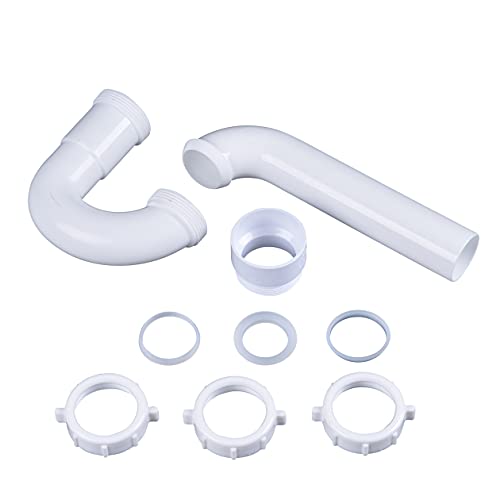
Dearborn P9703BG trap
$10.96 at Amazon
Check it on AmazonPrice as of Oct 23, 2026, 5:30 AM EDT
See fit and limits
Why accordion traps cause trouble, and the rigid trap, extension and washers that reach almost any offset sink drain.
As an Amazon Associate I earn from qualifying purchases.
Skip the accordion trap. Its ribbed inside traps debris, and codes call for a smooth trap. A rigid trap with a swivel J-bend reaches most offsets.
A trap, an extension and the right washers solve most crooked sink drains. They do different jobs, so they aren’t scored against each other.


Product prices and availability are accurate as of the date/time indicated and are subject to change. Any price and availability information displayed on Amazon.com at the time of purchase will apply to the purchase of this product.
Two very different products get called flexible traps. Know which one you’re looking at.
| Type | What it looks like | The concern |
|---|---|---|
| Corrugated accordion tubing | Ribbed plastic tube you bend into a U, sold to bridge a misaligned drain | The ribs give the inside a rough, uneven waterway where hair and grease catch |
| Flexible trap kits sold as a system | Branded kits with flexible sections, sold for tight sink cabinets | Check the kit’s own listing and your local inspector before you rely on it |
| Rigid tubular trap | Smooth J-bend and trap arm joined with slip nuts | Needs the right parts to reach an offset, but the waterway is smooth |
The accordion tube bends to fit anything, which is the appeal, but every rib is a ledge inside the pipe. Grease and hair hang on those ledges, and a trap that’s meant to clear itself with every flush of the sink starts holding debris instead.
Branded flexible kits are a separate question. Some are sold as complete systems for tight cabinets. Whether one is allowed where you live depends on its listing and your inspector, not on the box. When in doubt, a rigid trap is the safe answer.
Here’s the wording from one federal standard we could read in full. Local codes have their own sections; ask your inspector.
| Rule | What 24 CFR 3280.606 says |
|---|---|
| Material and design | Each trap shall be self-cleaning with a smooth and uniform interior waterway |
| Prohibited traps | Full S traps, bell traps, drum traps, crown-vented traps and running traps are prohibited; no double trapping |
| Trap seal | Each P trap shall have a water seal of not less than 2 inches and not more than 4 inches |
| Size | Traps not less than 1-1/4 inches in diameter, and not larger than the waste pipe they connect to |
| Tailpiece | The vertical distance from a trap to the fixture outlet shall not exceed 24 inches |
| Trap arm | Graded 1/4 inch per foot toward the vent, never more than its diameter |
Source: 24 CFR 3280.606, Traps and cleanouts, the federal plumbing standard for manufactured homes (eCFR, read Oct 23, 2026). It applies to manufactured housing; site-built homes follow the state or local plumbing code, which has its own trap sections.
That “smooth and uniform interior waterway” line is the heart of it. A corrugated tube isn’t smooth inside, so it doesn’t meet that wording. The same section bans S traps and requires a 2 to 4 inch water seal, both of which a floppy accordion tube makes easy to get wrong.
The 24 inch tailpiece limit matters for crooked drains too. If you need a lot of length to reach the trap, the fix is to move the trap, not to stretch a tube. Our S-trap vs P-trap guide shows why the trap shape matters, and trap size by fixture covers the 1-1/4 vs 1-1/2 inch question.
Three questions about where your sink tailpiece sits compared with the drain in the wall.
A rigid trap will reach. Swing the J-bend and cut the trap arm to length.
Most crooked sink drains are only a few inches off, and a standard tubular trap handles that easily. The J-bend swivels on its nut, and the trap arm can run at a slight angle into the wall. You cut the arm to length with a hacksaw or tubing cutter.
The checker’s first question is the important one. If the drain in the wall sits higher than the trap’s outlet, no trap will work, flexible or rigid, because the water would have to run uphill. That needs the wall drain lowered.
A 1-1/2 inch plastic tubular P-trap with a reversible J-bend, the piece that replaces the accordion tube.
The P9703BG is a 1-1/2 inch tubular trap for a sink that drains into the wall, and I’ve used it. Dearborn’s listing says it’s polypropylene, with a reversible J-bend, a ground joint (bull nose) on the wall tube, and a threaded PVC adapter for the drain stub. Dearborn calls its nuts super nuts, with full-size wings and longer threads.
The reversible J-bend is what makes it the fix for a crooked drain. It can face left or right, and it swivels on its nut, so the trap lines up with a tailpiece that isn’t centered on the wall drain. The trap arm cuts to length.
It comes with Dearborn’s blue TPR washers and a reducing washer, so it fits a 1-1/2 inch kitchen tailpiece or a 1-1/4 inch bathroom one. Dearborn sells an ABS-adapter version, A9703WBG, for ABS drain lines.
A 1-1/2 by 12 inch slip-joint extension, for a tailpiece that stops short of the trap.
When a new sink or vanity sits higher than the old one, the tailpiece can end above the trap. People reach for flexible tubing here. The rigid fix is an extension tube, and I’ve used this one.
Keeney’s listing describes the PP55-12W as a 1-1/2 by 12 inch plastic slip-joint extension for lavatory or kitchen use, with the nuts and washers included. You slide it over the tailpiece, cut it to length and tighten the slip nut.
Keep the total drop sensible. The federal standard we quoted limits the vertical distance from the trap to the fixture outlet to 24 inches. If you need more than that, move the trap up rather than stacking extensions.
A slip joint only seals with the right washer, facing the right way.
Most slow drips at a sink trap are a washer problem: the wrong size, an old hardened one, or one put in backwards. I’ve used them.
Danco’s listing says the 81086 pack has four washers at 1-1/2 inch outside by 1-1/4 inch inside, and four at 1-3/4 by 1-1/2 inch, all 1/4 inch thick, molded in one piece from polyethylene. That covers a 1-1/4 inch bathroom tailpiece into a 1-1/2 inch trap, and 1-1/2 inch joints throughout. Danco says no brass friction rings are needed.
The beveled side of a slip-joint washer faces the pipe it seals into, with the nut behind it. Hand-tighten, then a little more; plastic nuts crack if you overdo it.
Specs from Dearborn’s, Keeney’s and Danco’s brand-written Amazon listings for P9703BG, PP55-12W and 81086. Offers read through the Amazon Creators API on Oct 23, 2026, 2:18 AM EDT: all three new and in stock.
Match the part to what’s wrong under the sink.
| Part | Key specs | Fixes | Pick it if | Skip it if |
|---|---|---|---|---|
| Dearborn P9703BG trap | 1-1/2 inch, polypropylene, reversible J-bend, PVC adapter | A crooked or worn-out trap | The tailpiece is a few inches off center from the wall drain. | Your drain line is ABS; get the A9703WBG. |
| Keeney PP55-12W extension | 1-1/2 x 12 inch, slip joint, nuts and washers | A tailpiece that’s too short | A new sink left the tailpiece above the trap. | The drop to the trap would pass 24 inches. |
| Danco 81086 washers | 4 at 1-1/2 x 1-1/4, 4 at 1-3/4 x 1-1/2 inch | A drip at a slip nut | A joint drips or you’re reassembling old parts. | A nut or tube is cracked; replace that part. |
About half an hour with a bucket, a tubing cutter or hacksaw, and the parts above.
The trap holds water. Loosen the slip nuts by hand and drain it into the bucket.
Remove it and any adapter. Look at the wall drain stub: is it PVC or ABS, and is it below the sink tailpiece?
Thread or solvent-weld the trap adapter to the wall stub as the trap’s instructions say. Dearborn’s P9703BG includes a threaded PVC adapter.
Hang the J-bend on the tailpiece, swing it toward the drain, and hold the trap arm against the adapter. Mark the arm to length.
Cut the arm square, slide on nuts and washers with the bevels facing the joint, and hand-tighten every nut.
Fill the sink, pull the stopper, and watch every joint with a dry paper towel. Snug any that weep.
These steps are my own advice from the trade. If the wall drain is above the trap outlet, or the trap would sit more than 24 inches below the sink outlet, stop and call a plumber; the drain needs moving. Our kitchen sink leaking underneath guide covers drips that show up after.
Most trap problems under a sink come from a handful of installation errors.
Letting the trap drop into a vertical pipe makes an S trap, which 24 CFR 3280.606 lists as prohibited, and it can siphon the seal dry.
The beveled side faces the joint. Backwards, it won’t seal however tight the nut is.
Plastic slip nuts crack. Hand-tight plus a little more is enough.
The arm should fall slightly toward the wall drain; the federal standard calls for 1/4 inch per foot toward the vent.
A sewer smell from a sink with a new trap usually means the seal is gone: an S trap siphoning, a cracked fitting, or a trap that never holds water because it’s too shallow. The federal standard calls for a 2 to 4 inch water seal. A rigid P-trap set level holds that by design.
Corrugated accordion tubing doesn’t give the smooth, uniform interior waterway that trap rules call for; the federal manufactured-home standard, 24 CFR 3280.606, uses that exact wording. Branded flexible kits depend on their listing and your local inspector.
The ribs catch hair and grease, so the trap stops clearing itself and clogs more often. Rigid tubular traps have a smooth inside.
Use a rigid trap with a swivel J-bend, like the Dearborn P9703BG, and angle and cut the trap arm. For a short tailpiece, add a slip-joint extension tube.
Kitchen sinks usually use 1-1/2 inch; bathroom sinks often have a 1-1/4 inch tailpiece into a 1-1/2 inch trap with a reducing washer. Our trap size by fixture guide has the details.
24 CFR 3280.606 calls for not less than 2 inches and not more than 4 inches.
No. 24 CFR 3280.606 lists full S traps as prohibited, and they can siphon dry. Our S-trap vs P-trap guide explains.
24 CFR 3280.606 limits the vertical distance from the trap to the fixture outlet to 24 inches.
Yes. The beveled side faces the pipe it seals into, with the nut behind it.
Isaac Daniels is a licensed journeyman plumber in Georgia and has used all three parts. The code wording comes from the federal standard text on eCFR, and part specs from each maker’s own listing. Where we give advice from the trade, we say so.
We picked the rigid parts that solve the problem people buy flexible traps for: a trap with a reversible J-bend, an extension for a short tailpiece, and washers to seal it. They do different jobs, so they aren’t scored against each other. Each was new and in stock on Amazon when we checked, Oct 23, 2026, 2:18 AM EDT.