
BrassCraft TBV8
$20.75 at Amazon
Check it on AmazonPrice as of Oct 24, 2026, 5:30 AM EDT
Details ↓
Three 1/2-inch gas ball valves compared from the makers’ specs, and where code says yours goes.
As an Amazon Associate I earn from qualifying purchases.
Get the BrassCraft TBV8: forged brass, made in Italy, listed to the gas valve standards the code names. For a full port valve rated to −40°F, the Dormont 050FV. Easiest to get: Eastman 60009.
All three are 1/2-inch female pipe thread (FIP) by FIP straight brass gas ball valves, the common appliance shutoff. All were new and in stock on Amazon on Oct 23, 2026, and each scores 7.0 or higher.

Product prices and availability are accurate as of the date/time indicated and are subject to change. Any price and availability information displayed on Amazon.com at the time of purchase will apply to the purchase of this product.
My call: if you smell gas, don’t work on the line. Leave the building and call your gas company or 911 from outside. If you’re not sure you can do gas work safely, or your area requires a licensed installer, hire one.
Five checks from each maker’s spec sheet or product page, equal weight. Rules and inputs are in the method section.
The checks are what a gas valve’s paperwork should tell you: which gas valve standards it’s listed to, how cold it’s rated for, whether the stem can’t blow out, whether the bore is full port, and the gas pressure it’s rated for.
BrassCraft documents the most. Eastman documents the least, but it’s the one rated for high-pressure LP lines.
What each maker’s sheet says, what it means behind a range or water heater, and where each lost points.
1/2 in. FIP x 1/2 in. FIP Straight Gas Ball Valve
Prices and availability are accurate as of the time shown and may change.
You’re putting a shutoff behind a range, dryer, water heater or furnace on a normal low-pressure house line.
The line runs above 5 psi, like an LP line before the second-stage regulator; that needs a valve rated for it.
The TBV8 is the gas valve I’d put behind any appliance in a house, and I’ve used it. BrassCraft’s TBV series submittal calls it a gas ball valve for natural, manufactured, mixed, LP and LP-air gas, FIP by FIP.
BrassCraft lists the design: a heavy-duty forged brass body, which it says eliminates the pinhole leaks of cast bodies; a blowout-proof stem assembled from the inside with double O-rings; PTFE seat rings; and a chrome-plated brass ball. It’s approved for indoor and outdoor use and 100% leak tested.
The operating limits are −40 to 150°F and 5 psi maximum. The listings are CSA to ANSI Z21.15 / CSA 9.1, ASME B16.44 and CGA CR91-002, and the country of origin is Italy.
Those two standards matter. The 2021 IFGC’s table of manual gas valve standards lists ANSI Z21.15 and ASME B16.44 for appliance shutoff valves at up to ½ psig, which is what most house lines run at.
Its part number is plain TBV8. The Amazon listing’s UPC, 026613099415, matches BrassCraft’s own product page for the TBV8.
Where it lost points: BrassCraft doesn’t say it’s full port, which scored 7.
Don’t mix it up with the TBV8-8. That BrassCraft part is a ½-inch flare by ½-inch FIP valve for a flare connector, not FIP by FIP.
BrassCraft’s sheet also quotes the fuel gas code: the appliance shutoff goes upstream, within easy reach, within 6 feet of the appliance.
The submittal’s material list fills in the rest: forged brass body and retainer, brass stem, high-temperature rubber O-rings, an aluminum handle and a zinc-plated steel screw. It lists the TBV8 at 1.43 by 1.94 inches for its two drawing dimensions, small enough to fit behind a range.
My call: the T-handle sits flat against a wall behind a range, which is where most of these end up.
1/2 in. FIP x 1/2 in. FIP Full Port Gas Ball Valve
Prices and availability are accurate as of the time shown and may change.
You want a full port valve that won’t restrict flow, for a commercial range, a fryer line or a tankless water heater.
You need a published pressure rating on the paperwork; BrassCraft and Eastman publish theirs.
Dormont makes gas connectors and valves, and its product pages now sit on watts.com. The 050FV is its ½-inch full port valve. I’ve used it.
Dormont’s product page on watts.com calls it a ½-inch two-piece full port ball valve with female threaded ends for commercial and industrial gas use.
Dormont lists a brass body, an adjustable packing gland, a chrome-plated brass ball, virgin PTFE seats and seals, a bottom-loaded blowout-proof stem, a brass adapter and a steel handle. It says each valve is factory tested before it ships.
Its temperature range is the widest here: −40 to 400°F. Dormont lists it as CSA approved and design certified, and UL listed.
Full port means the hole through the ball is the same size as the pipe, so the valve adds almost no restriction. My call: that matters most on high-input appliances like tankless water heaters and commercial ranges.
Where it lost points: Dormont’s page names CSA and UL but no standard number, which scored 8, and it doesn’t state a pressure rating, which scored 7.
Dormont also sells it in its ReliaGuard connector kits, packed with a hose and quick-disconnect. This listing is the valve alone.
Only 2 were left on this listing when I checked. If it’s out, the card stays and the price is hidden until it’s back.
Watts lists lead free as not in scope for this valve. My reading: that’s normal for a gas-only valve, but it means this valve shouldn’t be reused on a drinking water line.
A two-piece body with an adjustable packing gland means the stem packing can be snugged if it ever weeps, rather than replacing the valve.
My call: pair it with a full-size connector, or the full port bore gains you nothing.
1/2 in. FIP Straight Gas Ball Valve with 1/4-Turn Handle
Prices and availability are accurate as of the time shown and may change.
You want one valve from Amazon for an indoor appliance, or an LP line where Eastman’s 175 psi rating fits.
It’s going outdoors where it can freeze; Eastman rates it from 32°F.
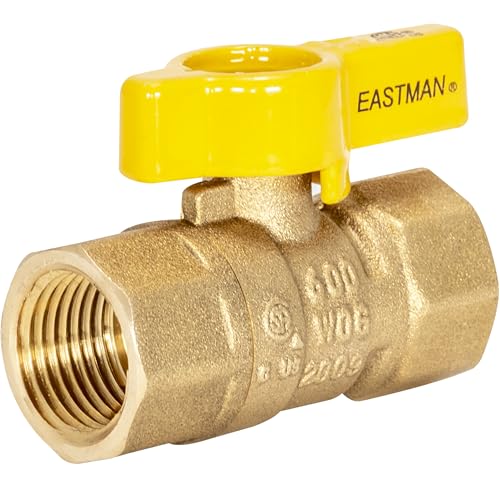
Eastman’s 60009 is the gas valve you’re most likely to find on a store hook, and it was sold by Amazon itself when I checked. I’ve used it.
Eastman’s product page says it’s for LP gas and air mixtures up to 175 psi, with 5 psi for indoor shutoff, and 600 psi WOG. The temperature rating is 32 to 125°F, and it’s CSA certified.
WOG means water, oil and gas, a body pressure rating. My reading: it isn’t the gas shutoff rating, which is why Eastman lists 5 psi separately for indoor shutoff.
The listing adds a quarter-turn aluminum lever and a brass body, and calls it an in-line valve for connecting two pipes running the same way.
Where it lost points: Eastman names CSA but no standard number, which scored 8. Its 32°F minimum scored 7 against the others’ −40°F. It doesn’t mention a blowout-proof stem or full port, which scored 7 each.
It’s the one pick that publishes a high-pressure rating, which scored 10. My call: that’s useful on an LP tank line, but most house lines run at a fraction of 1 psi, where the indoor 5 psi rating is what applies.
One more thing to know: Eastman’s page names LP gas and LP-air mixtures, and I didn’t see natural gas named in the text I read. Eastman markets it for residential heating, industrial and commercial use. My call: check the marks on the valve body for the gases it’s listed for before you put it on a natural gas line.
My call: it’s a fine valve for a water heater or dryer inside a heated house. For a garage that freezes or an outdoor grill, pick one rated below 32°F.
From the makers’ sheets and product pages. Scroll sideways on a phone.
| Pick | Photo | Spec score | Standards | Temperature | Pressure | Stem | Port | Buy |
|---|---|---|---|---|---|---|---|---|
| BrassCraft TBV8 | | 9.4 | Z21.15, B16.44 | −40–150°F | 5 psi | Blowout-proof | Not stated | Check it on Amazon |
| Dormont 050FV | | 9.0 | CSA, UL | −40–400°F | Not stated | Blowout-proof | Full | Check it on Amazon |
| Eastman 60009 | | 7.8 | CSA | 32–125°F | 5 psi indoor; 175 psi LP | Not stated | Not stated | Check it on Amazon |
All three are ½-inch FIP by FIP straight brass gas ball valves. Green marks a strength and amber a gap.
Pick the appliance, the gas pressure and the spot. It answers from the 2021 IFGC and the makers’ ratings.
My call: most houses get natural gas at well under ½ psi after the meter’s regulator. Some newer homes run 2 psi lines with a regulator near the appliances, and LP systems run higher pressure between the tank and the second-stage regulator. If you don’t know your pressure, ask the gas supplier or check with a gas pressure test gauge before you buy a valve.
IFGC Table 409.1.1 says which standard a manual gas valve must meet at each pressure.
| Standard | Appliance shutoff, up to ½ psig | Other valves, up to ½ psig | Up to 2 psig | Up to 5 psig | Up to 125 psig |
|---|---|---|---|---|---|
| ANSI Z21.15 / CGA 9.1 | Yes | — | — | — | — |
| ASME B16.44 | Yes | Yes | If labeled 2G | If labeled 5G | — |
| ASME B16.33 | Yes | Yes | Yes | Yes | Yes |
BrassCraft is the only maker here that names its standards: ANSI Z21.15 and ASME B16.44. Dormont and Eastman say CSA certified, which tells you a lab listed the valve, but not to which standard. My call: read the marks cast or stamped on the valve body, which is what an inspector looks at.
The IFGC also says valves must be compatible with the piping, can’t be in concealed spaces or furnace plenums, and must be placed so they can be reached and won’t be damaged (409.1.1 to 409.1.3).
IFGC 409.5 gives three ways to place it.
| Rule | What it says |
|---|---|
| 409.5.1 Same room | Within 6 feet of the appliance, in the same room, upstream of the union, connector or quick disconnect, with access |
| 409.5.1 Movable appliances | Behind a range or dryer counts as having access |
| 409.5.1 Fireplace firebox | Follows the appliance maker’s instructions |
| 409.5.2 Decorative and room heaters | May be remote with ready access, permanently marked, serving only that appliance |
| 409.5.3 At a manifold | Within 50 feet of the appliance, readily accessible and permanently marked |
| 409.2 Meter | Every meter has a shutoff on its supply side (the gas company’s valve) |
“Upstream of the connector” is the part people get wrong. The valve goes on the hard pipe, and the flexible connector goes after it, so you can shut the gas and change the connector. Connectors themselves are limited to 6 feet long, one per appliance (IFGC 411.1.3.1).
Gas ball valves come with different ends. Match them to what’s on the wall and on the connector.
| Ends | What it connects | BrassCraft example |
|---|---|---|
| FIP × FIP (this page) | Pipe nipple on both sides; the connector screws onto a nipple or adapter | TBV8, TBV12, TBV16 |
| Flare × FIP | Pipe on one side, a flare connector nut on the other | TBV8-8 (½ in. flare × ½ in. FIP) |
| Flare × FIP, other sizes | Larger connectors | TBV10-8 (⅝ in. × ½ in.) |
| Angle (90°) | Turns the line where space is tight | Not covered here |
BrassCraft makes the TBV series FIP by FIP in ½, ¾ and 1-inch sizes (TBV8, TBV12, TBV16). My call: ½-inch covers most ranges, dryers and tank water heaters. Larger tankless heaters and furnaces often want ¾-inch; follow the appliance’s inlet size and the pipe sizing for your house, not the valve.
My call on the order. Many areas require a licensed installer or a permit for gas work.
Turn off the gas upstream, at the meter or the next valve back.
Thread the valve onto the supply nipple with a sealant rated for gas.
The valve is upstream of the union or connector (IFGC 409.5.1).
A capped tee after the valve for water heaters and furnaces (IFGC 408.4).
IFGC 406.6.3 requires a leak check right after gas is turned on.
The sediment trap rule has exceptions: ranges, clothes dryers, decorative vented appliances, gas fireplaces and outdoor grills don’t need one, per IFGC 408.4. My call for the leak check: soapy water on every joint, and a combustible gas leak detector if you have one. Bubbles mean a leak; shut the gas and redo the joint.
Three numbers show up on gas valve paperwork. Here’s what each means.
| Rating | Meaning | On these picks |
|---|---|---|
| Gas pressure (psi) | The gas pressure the valve is listed to shut off | BrassCraft 5 psi; Eastman 5 psi indoor, 175 psi LP |
| WOG (psi) | Body rating for water, oil and gas; not the gas shutoff rating | Eastman 600 psi WOG |
| Temperature range | Where the seals and seats are rated to work | BrassCraft −40–150°F; Dormont −40–400°F; Eastman 32–125°F |
My call: the temperature range matters more than people think. A valve in an unheated garage, crawlspace or by an outdoor grill can sit below freezing all winter. Two of these three are rated to −40°F; Eastman’s starts at 32°F.
How the handle sits decides whether you can reach it behind an appliance.
| Pick | Handle | Good for |
|---|---|---|
| BrassCraft TBV8 | Aluminum handle that BrassCraft’s listing says combines a T-handle and a lever | Tight spots behind ranges and dryers |
| Dormont 050FV | Steel lever | Open spots where you need leverage on a full port valve |
| Eastman 60009 | Aluminum quarter-turn lever | Water heaters and furnaces with room around them |
All three turn a quarter turn. Handle parallel to the pipe is on; across the pipe is off. My call: on a range, make sure the handle can still turn with the range pushed back, or you’ve installed a valve you can’t use.
These came up on Amazon and in Google’s results.
| Valve | What we found | Why it’s out |
|---|---|---|
| BrassCraft TBV8-8 | ½ in. flare × ½ in. FIP | Different ends; see the types table |
| Proline 110-522 | Listing says ½ in.; B&K lists 110-522 as ⅜ in. FIP | Size doesn’t match the maker |
| Midline Y12FIP | UL and CSA claimed on the listing | No maker spec page found |
| BrassCraft PSBV503-8 | Listing gives only the part number and China origin | No maker sheet found |
| Watts Little Firefighter | Earthquake shutoff, ¾ in. | Different kind of valve |
| Unbranded 5- and 10-packs | Many listings | No maker documents |
| Question | If yes | If no |
|---|---|---|
| Smell gas now? | Leave and call the gas company | Keep going |
| Line over 5 psi? | A B16.33 valve; ask your inspector | Keep going |
| Valve in a cold spot or outdoors? | BrassCraft TBV8 or Dormont 050FV | Keep going |
| Want full port for a big appliance? | Dormont 050FV | BrassCraft TBV8 |
A quarter-turn ball valve on the gas line that stops gas to one appliance, so you can service or disconnect it.
Per IFGC 409.5.1: within 6 feet of the appliance, in the same room, upstream of the connector, with access.
In the International Fuel Gas Code, Section 409 covers shutoff valves; Table 409.1.1 lists the valve standards.
Most appliance valves are ½-inch; larger appliances may use ¾-inch. Match the pipe and appliance inlet.
Turn the handle a quarter turn so it’s across the pipe. Parallel to the pipe is on.
Straight FIP by FIP, flare by FIP, angle valves, the meter valve, and automatic types like earthquake valves.
Yes. IFGC 409.5.1 counts a valve behind a range or dryer as accessible.
For water heaters and furnaces, yes unless built in. Ranges, dryers, gas fireplaces and grills are exempt (IFGC 408.4).
My call: no. Use a valve listed for gas to the standard IFGC Table 409.1.1 requires.
A lab listed it. BrassCraft names the standards, ANSI Z21.15 and ASME B16.44; the others don’t on their pages.
A body pressure rating for water, oil and gas. Eastman’s gas shutoff rating indoors is 5 psi.
BrassCraft approves the TBV for indoor and outdoor use and rates it to −40°F.
None of these makers lists a life. My call: replace one that’s stiff, leaks at the stem, or won’t fully close.
I’m Isaac Daniels, a licensed journeyman plumber in Georgia (license #JP507711), and I’ve used all three picks. Specs come from BrassCraft’s submittal, Dormont’s product page on watts.com and Eastman’s product page; code rules from the 2021 IFGC. All read Oct 23, 2026. Where I add advice of my own, it’s labeled as my call.
Each check scores 0 to 10 and counts one fifth. It’s our score from maker documents, not a customer rating or a test of our own.
| Check (weight) | How it’s scored |
|---|---|
| Standards named (⅕) | 10 when the maker names ANSI Z21.15, ASME B16.44 or B16.33; 8 for CSA or UL only |
| Cold rating (⅕) | 10 when rated below 0°F; 7 when the minimum is 32°F or not stated |
| Blowout-proof stem (⅕) | 10 when the maker states it; 7 when not |
| Full port (⅕) | 10 when the maker states it; 7 when not |
| Pressure published (⅕) | 10 when the maker publishes a gas pressure rating; 7 when not |
| Total | Average of the checks, to one decimal |
| Pick | Standards | Cold | Stem | Port | Pressure | Score |
|---|---|---|---|---|---|---|
| BrassCraft TBV8 | 10 | 10 (−40°F) | 10 | 7 | 10 (5 psi) | 9.4 |
| Dormont 050FV | 8 | 10 (−40°F) | 10 | 10 | 7 | 9.0 |
| Eastman 60009 | 8 | 7 (32°F) | 7 | 7 | 10 (175 psi LP) | 7.8 |