
AquaSurge 3000
$415.99 at Amazon
Check it on AmazonPrice as of Nov 6, 2026, 5:30 AM EST
Why it’s my pick ↓
Waterfall and pond pumps scored from the makers’ flow charts.

As an Amazon Associate I earn from qualifying purchases.
For most backyard ponds, the Aquascape AquaSurge 3000: 2,350 GPH at a 10 ft lift on 165 W, with a 3-year warranty. Size the pump to move the pond’s full volume once an hour.
Product prices and availability are accurate as of the date/time indicated and are subject to change. Any price and availability information displayed on Amazon.com at the time of purchase will apply to the purchase of this product.
Aquascape AquaSurge 3000 pond pump, 3,196 GPH, item 91018
Prices and availability are accurate as of the time shown and may change.
Your pond holds roughly 2,000 to 3,000 gallons and the waterfall sits a few feet above the water.
The top of your waterfall is more than about 10 ft above the pond. Look at a pump with more head.
The AquaSurge 3000 scores 10.0, the only perfect score here, and it’s the pump I’d put in most backyard ponds. Aquascape publishes everything on the checklist, and it moves the most water per watt of the three picks.
Aquascape’s flow chart gives 3,196 GPH at no lift, 2,700 at 5 ft and 2,350 at 10 ft, with a 15 ft maximum head. It draws 165 W and 1.4 A on an asynchronous motor, which Aquascape says is energy efficient.
Aquascape says it’s made for continuous use in either a vertical or horizontal position, and that the oil-free design is fish-safe. It won’t corrode or rust, and rubber feet cut noise and vibration.
Hookup is a 1.5 in. MPT discharge with a rotating ball outlet, plus a variety of fittings in the box, and a 20 ft power cord. Aquascape publishes the instruction manual covering models 91017 to 91020, a line drawing and a pump-run-dry troubleshooting sheet.
The warranty is three years, limited, the longest of the picks along with the AquaSurge 2000.
Size it with Aquascape’s rule: the pump should turn over the pond’s full volume once an hour. At 2,350 GPH with a 10 ft lift, it suits a pond of about 2,000 gallons with some headroom; at 5 ft, up to about 2,700.
At 1.4 A it uses less than a tenth of a standard 15 A circuit, which leaves room for lights on the same outdoor outlet.
If your falls are taller, Aquascape’s same chart shows the next size up, the AquaSurge 4000, still giving 3,350 GPH at 10 ft with an 18.5 ft maximum head.
Remember that hose and fittings add friction, so the real lift is more than the waterfall’s height. Aquascape’s calculator counts the length of pipe from the pump to the falls for that reason.
Aquascape AquaSurge 2000 pond pump, 2,193 GPH, item 91017
Prices and availability are accurate as of the time shown and may change.
Your pond is about 1,500 gallons or less and the falls are low.
Your pond is near 2,000 gallons or more. The 3000 moves a third more water for 5 more watts.
The AquaSurge 2000 scores 9.0. It’s the same pump family as the 3000, from the same chart, and the right size for smaller ponds.
Aquascape lists 2,193 GPH at no lift, 1,850 at 5 ft and 1,465 at 10 ft, with a 12.5 ft maximum head. The product text rounds it to a 2,000 GPH maximum. It draws 160 W and 1.3 A.
It loses one point on efficiency: about 13.7 GPH per watt at no lift, against 19.4 for the 3000, because it uses nearly the same power for less water. If your pond is borderline between the two, the 3000 costs about the same to run and gives more flow.
Everything else matches the 3000: continuous duty vertical or horizontal, oil-free and fish-safe, a 1.5 in. MPT discharge with a rotating ball outlet and fittings, rubber feet, a 20 ft cord and a 3-year limited warranty.
Size check: at a 5 ft lift it turns over about 1,850 gallons an hour, so it suits ponds up to roughly that size with a short waterfall. At a 10 ft lift, about 1,465.
At 1.3 A it draws about the same as the 3000 on the same outdoor circuit.
Its curve is gentle: at 10 ft it still makes 1,465 GPH, about two-thirds of its no-lift flow, where the Little Giant F20 keeps about a third at the same height.
Aquascape’s rotating ball outlet lets you aim the discharge toward the hose run, and the rubber feet keep it from buzzing against a liner or vault.
The same manual covers models 91017 to 91020, and Aquascape publishes a line drawing for the 91017.
Pick it over the 3000 only when the pond is small enough that the extra flow would be wasted.
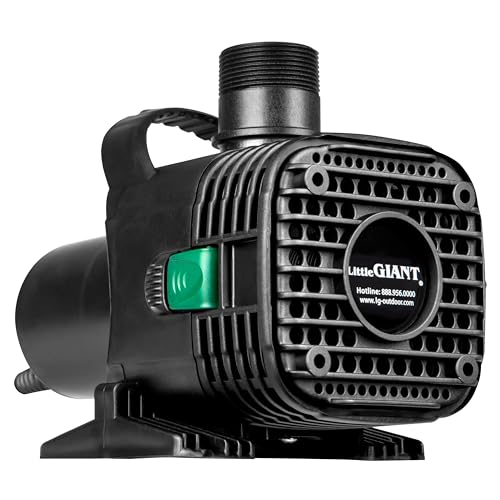
Wet rotor pond pump, 2,770 GPH, 115 V (566725)
Prices and availability are accurate as of the time shown and may change.
Your waterfall or filter sits only a few feet above the water and you want the lowest power draw.
The falls are 8 to 10 ft up. Its flow drops below 1,000 GPH there.
The F20-2700 scores 9.0. It loses one point for a 2-year warranty. It’s the lowest-power pick and the strongest at low lift.
Little Giant’s spec sheet gives 2,770 GPH at 0 ft, 2,705 at 1 ft, 2,095 at 5 ft and 960 at 10 ft, with a 14.9 ft shut-off. It draws 147 W and 1.25 A. That’s about 18.8 GPH per watt at no lift.
Its curve is steeper than the AquaSurge’s. At 5 ft it still moves more than the AquaSurge 2000, but by 10 ft it drops to about two-thirds of the 2000’s flow. Match it to a low waterfall or a skimmer and filter close to the water line.
Little Giant calls it a wet rotor, canned motor pump built without a mechanical seal or oil. It can run submerged or inline, mounted vertically or horizontally, with MNPT threads and fittings built in, and it comes with a pre-filter.
The cord is 20 ft and the discharge and inlet are 1.5 in. MNPT with a spigot. Little Giant’s spec sheet notes performance is measured at 120 V with no intake screen, so expect a little less with the pre-filter on.
The F-Series manual covers installation and service; Little Giant also lists rope or cable loop points for retrieving it from deep water.
At 1.25 A it has the lowest current draw of the three picks, per Little Giant’s table.
The F-Series runs from the F10-1200 (1,295 GPH, 157 W) to the F70-7300 (7,365 GPH, 660 W, 40 ft cord). The next size up, the F30-4000, gives 4,060 GPH on 215 W with a 2 in. discharge.
Pick it over the AquaSurge when the lift is short and power cost matters most.
| Pump | Spec score | Photo | 0 ft | 5 ft | 10 ft | Watts | Warranty | Buy |
|---|---|---|---|---|---|---|---|---|
| AquaSurge 3000 | 10.0 | | 3,196 | 2,700 | 2,350 | 165 | 3 yr | Check it on Amazon |
| AquaSurge 2000 | 9.0 | | 2,193 | 1,850 | 1,465 | 160 | 3 yr | Check it on Amazon |
| Little Giant F20-2700 | 9.0 | | 2,770 | 2,095 | 960 | 147 | 2 yr | Check it on Amazon |
| Pump | Spec score | What held it back | What it does well |
|---|---|---|---|
| Little Giant WGP-80-PW | 6.0 | 675 W for 3,500 GPH (about 5 GPH per watt), 16 ft cord, 12-month warranty | 29 ft shut-off; dual 1-1/4 in. discharges |
| TetraPond DHP3600 | 6.0 | No amps or oil-free statement; 15 ft cord | Passes 1/4 in. debris; 3-year warranty; 199 W |
| Alpine PAL3100 | 4.0 | No flow table, amps or manual from Alpine; listing warranty 1 year; about 11 GPH per watt | 33 ft cord; runs upright or on its side; 21.5 ft max lift, per the listing |
The WGP-80 is the pump for a tall waterfall: Little Giant lists a 29 ft shut-off. But it draws 675 W, about four times the AquaSurge 3000, for a pump that runs around the clock. The Tetra is a good debris-handling pump with a 3-year warranty; it scores lower because Tetra publishes less about it.
The Alpine PAL3100 isn’t on Alpine’s own site, so its only specs are the Amazon listing’s, and that listing gives a 1-year warranty in one place and “5-year manufacturer support” in another.
Enter the pond’s size and how high the waterfall sits above the water. It uses Aquascape’s once-an-hour turnover rule and each maker’s flow at that height.
| Pond (L × W × depth) | Gallons | Pump at a 5 ft lift |
|---|---|---|
| 8 × 6 × 2 ft | 718 | AquaSurge 2000 (1,850 GPH) |
| 12 × 8 × 2 ft | 1,436 | AquaSurge 2000 or F20 (1,850 / 2,095 GPH) |
| 15 × 10 × 2 ft | 2,244 | AquaSurge 3000 (2,700 GPH) |
| 18 × 12 × 2.5 ft | 4,039 | More than these three; look at a larger pump |
Gallons are length × width × average depth × 7.48 gallons per cubic foot. Aquascape’s rule is that the pump should turn the pond over once an hour, and that the waterfall’s height and width and the pipe run all change how much flow you need. Use the height from the pond surface to the top of the falls, then add a little for long hose runs.
A pump’s box number is its flow at zero lift. Every foot of height cuts it, and each pump’s curve is different.
The F20-2700 starts strong, 2,770 GPH at no lift, but loses two-thirds of it by 10 ft. The AquaSurge 3000 keeps 74% of its flow at the same height. That’s why the right pump depends on your waterfall, not the number on the box. Aquascape marks best, maximum and do-not-operate zones on its chart for the same reason.
The four makers here build their pumps four different ways, and it shows in power use and what each pump can swallow.
| Type | Example | What the maker says |
|---|---|---|
| Asynchronous motor | Aquascape AquaSurge | Energy efficient, oil-free and fish-safe, vertical or horizontal |
| Wet rotor, canned motor | Little Giant F-Series | No mechanical seal or oil; submerged or inline; pre-filter included |
| Direct drive | Little Giant WGP series | Sealed motor without oil, thermal overload, high head, high watts |
| Debris handling | TetraPond DHP | Open-face impeller passes 1/4 in. debris; 1/4 in. holes in a large pre-filter cage |
For a pond with a skimmer and filter in front of the pump, a debris-handling impeller matters less, because the skimmer catches leaves first. Without one, Tetra’s design is built to move dirt to an external filter or straight to the falls without clogging. Tetra also lists a ceramic shaft and epoxy-encapsulated motor.
The discharge size sets the hose you can run, and a smaller hose than the outlet costs flow.
| Pump | Discharge (maker) | Hose or tubing |
|---|---|---|
| AquaSurge 2000 / 3000 | 1.5 in. MPT, rotating ball outlet, fittings included | Per the included fittings |
| Little Giant F20-2700 | 1.5 in. MNPT and spigot, inlet and discharge | Spigot or threaded fitting |
| Little Giant WGP-80-PW | Dual 1-1/4 in. FNPT | Two outlets, e.g. falls and filter |
| TetraPond DHP3600 | Ball nozzle | 1-1/2 in. or 1-1/4 in. ID tubing |
Tetra says to cut off the narrow end of its ball nozzle when using 1-1/2 in. tubing, to get the most flow, and to secure tubing with hose clamps, which aren’t included. The same idea applies to any pump: run hose at least as large as the outlet, keep it short, and avoid sharp bends.
Pond pumps run 24 hours a day, so watts matter more than for almost any other pump.
| Pump | Watts (maker) | kWh a year at 24/7 | GPH per watt at 0 ft |
|---|---|---|---|
| Little Giant F20-2700 | 147 | 1,288 | 18.8 |
| AquaSurge 2000 | 160 | 1,402 | 13.7 |
| AquaSurge 3000 | 165 | 1,445 | 19.4 |
| TetraPond DHP3600 (left out) | 199 | 1,743 | 18.5 |
| Little Giant WGP-80-PW (left out) | 675 | 5,913 | 5.2 |
kWh a year is watts × 8,760 hours ÷ 1,000. Multiply by your electric rate to get dollars; the sizer above does it for the three picks. The difference between the WGP-80 and the AquaSurge 3000 is about 4,470 kWh a year, which is why a pump’s watts belong on the shopping list next to its flow.
Every maker here says the same things about power and water.
| Rule | Source |
|---|---|
| Plug into a GFCI-protected circuit; the NEC requires it for pond equipment | Little Giant WGP manual, Tetra manual |
| Use only outdoor-rated extension cords | Tetra manual |
| Don’t lift the pump by its cord; it can’t be replaced | Tetra manual, Little Giant WGP manual |
| Don’t run it dry | Little Giant WGP manual, Tetra manual |
| Set it on a brick or stone, not mud or sand | Little Giant WGP manual |
| Keep water under 95°F for the WGP series | Little Giant WGP manual |
Little Giant says running its WGP pump more than two or three minutes without pumping water damages the shaft. Aquascape publishes a pump-run-dry troubleshooting sheet for its AquaSurge line. My call: put the pump where the water level can’t fall below its intake, usually in a skimmer or the deepest part of the pond.
Placement decides how often you clean the intake and how the pump survives the cold.
A skimmer, a pump vault or the deepest point, away from where debris settles.
On a brick or stone so the intake doesn’t pull in mud (Little Giant).
Tie a rope to the handle; Tetra suggests a rope and float.
Keep it short and with as few bends as you can.
Tetra says to move a pump that runs through winter to shallower water so it doesn’t stir the warmer bottom water where fish rest.
Little Giant says the only routine maintenance on the WGP is cleaning debris from the intake screen.
For the F-series, Little Giant’s manual lists a clogged suction screen as one cause when “the pump runs but does not deliver water,” with the fix “Disconnect power cord. Clean the screen,” and says how often a pump needs cleaning depends on how clean the water is. Our utility pump guide covers draining the pond for a clean-out.
AquaSurge 2000, or the F20 if the falls are low.
AquaSurge 3000.
Little Giant F20-2700, the lowest wattage.
These three fade; look for a high-head pump and check its watts.
If you also run a filter, the pump has to push through it, which adds resistance like extra height. Check the filter maker’s flow range against the pump’s flow at your lift.
Aquascape’s rule is to turn the pond over once an hour: gallons = length × width × average depth × 7.48, and that’s the GPH you need at your waterfall height.
Watts × 8,760 hours ÷ 1,000 gives kWh a year; the AquaSurge 3000 at 165 W uses about 1,445 kWh.
Yes. Aquascape says the AquaSurge is made for continuous use, and Little Giant says the WGP can run continuously as long as it’s pumping water.
Yes. Little Giant’s manual says the National Electric Code requires a GFCI on the branch circuit for pond equipment.
Aquascape says its oil-free AquaSurge design is fish-safe; Little Giant’s F-Series is built without a mechanical seal or oil.
The box number is at zero lift. Height, hose length and a dirty intake all cut flow; the F20-2700 drops from 2,770 to 960 GPH at 10 ft.
Little Giant’s F-Series can be used inline (outside the pond); the AquaSurge and WGP are submersible and shouldn’t run dry.
Three years on the AquaSurge and TetraPond DHP, two on the Little Giant F-Series, and 12 months on the WGP series.
Tetra says its debris-handling pumps pass debris up to 1/4 in. through an open-face impeller; the other picks rely on intake screens or a skimmer.
Match the outlet: 1.5 in. for the AquaSurge and F20, and Tetra’s DHP takes 1-1/2 or 1-1/4 in. ID tubing.
Lift it by the handle, never the cord; Tetra suggests a rope tied to the handle and a float, and Little Giant’s F-Series has a rope loop.
Tetra suggests moving a pump that runs in winter to shallower water so it doesn’t disturb fish resting in the warmer water at the bottom.
The spec score uses the same ten checks for every submersible pond pump in this size range, one point each, from the maker’s product page, spec sheet and manual. It scores what’s published and the efficiency it shows.
| Check (points) | How it’s scored |
|---|---|
| Flow at several heights published (1) | The maker publishes flow at more than one height |
| Max head stated (1) | The maker states maximum head or shut-off |
| Watts stated (1) | The maker states watts |
| Amps stated (1) | The maker states amps |
| Cord 20 ft or longer (1) | The cord is 20 ft or longer |
| Oil-free motor stated (1) | The maker says the motor is oil-free |
| Runs horizontal or inline (1) | The maker says it can run horizontal or inline |
| Warranty 3 years or more (1) | The warranty is 3 years or more |
| Maker’s manual online (1) | The maker posts the manual online |
| 15+ GPH per watt at 0 ft (1) | Flow at 0 ft divided by watts is 15 or more |
| Total (10) | Sum of the checks |
| Pump | Flow at several heights published | Max head stated | Watts stated | Amps stated | Cord 20 ft or longer | Oil-free motor stated | Runs horizontal or inline | Warranty 3 years or more | Maker’s manual online | 15+ GPH per watt at 0 ft | Score |
|---|---|---|---|---|---|---|---|---|---|---|---|
| AquaSurge 3000 | 1 | 1 | 1 | 1 | 1 | 1 | 1 | 1 | 1 | 1 | 10.0 |
| AquaSurge 2000 | 1 | 1 | 1 | 1 | 1 | 1 | 1 | 1 | 1 | 0 | 9.0 |
| Little Giant F20-2700 | 1 | 1 | 1 | 1 | 1 | 1 | 1 | 0 | 1 | 1 | 9.0 |
| Little Giant WGP-80 (left out) | 1 | 1 | 1 | 1 | 0 | 1 | 0 | 0 | 1 | 0 | 6.0 |
| TetraPond DHP3600 (left out) | 1 | 1 | 1 | 0 | 0 | 0 | 0 | 1 | 1 | 1 | 6.0 |
| Alpine PAL3100 (left out) | 0 | 1 | 1 | 0 | 1 | 0 | 1 | 0 | 0 | 0 | 4.0 |
I’m Isaac Daniels, a licensed journeyman plumber in Georgia (license #JP507711). I’ve used every pump picked here. The specs come from Aquascape’s product pages and pump selection guide, Little Giant’s spec sheets and manuals, and TetraPond’s manual and product page; the listing checks from Amazon’s product data on Oct 24, 2026.