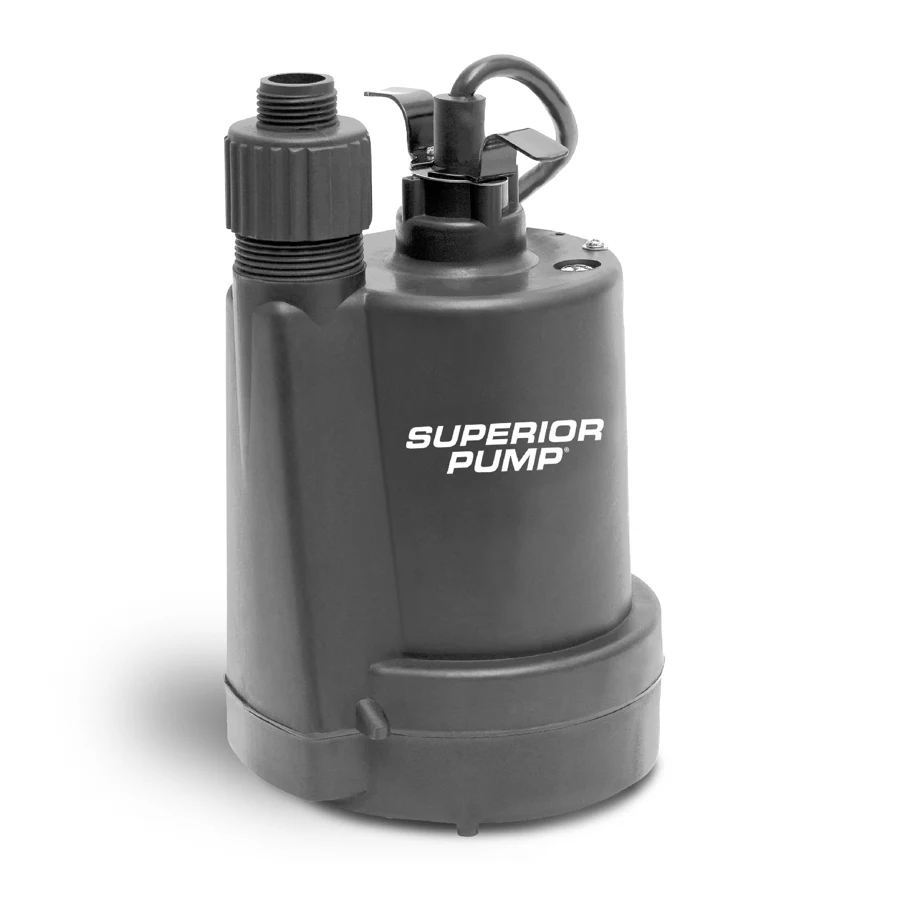
I pick the Superior Pump 91250 for most supervised water removal: up to 1800 GPH and removal down to 1/8 inch. [1] Match the hose lift and the final water depth to the job.
General draining
Superior Pump 91250 is the only linked purchase choice.
These portable pumps need supervision. I carry one to standing water, connect a discharge hose and remove it afterwards. The specification that decides the choice is often how shallow it will pump before it draws air, rather than horsepower. [1][3]
Find your pump
I start with the kind of water and the job. A recurring pit needs a permanent solution.
This finder cannot replace an in-person safety check. If water may be energized or contaminated, keep out and call a professional.
1/4 HP · 1800 GPH at 0 ft, 1200 GPH at 10 ft · 25 ft maximum head · removes water down to 1/8 in of the surface · passes 1/8 in solids · 1-1/4 in NPT discharge with 3/4 in garden hose adapter · 10 ft cord · maker-stated UL, CSA and SSPMA certifications · per Superior Pump’s product page [1]
This is the size that fits the most jobs. Superior lists 1800 gallons per hour at zero lift and 1200 at ten feet, which is the figure that matters when the hose has to climb out of a basement window. Maximum head is 25 feet. [1]
The detail that makes it useful is the bottom suction design with a serviceable intake screen, which Superior lists as removing water down to 1/8 inch of the surface and passing solids up to 1/8 inch. On a flooded floor that is the difference between finishing with a pump and finishing with towels. The discharge is 1-1/4 inch NPT with a 3/4 inch garden hose adapter included, so a standard hose works. [1]
What works
1
Removes water to 1/8 inch of the surface, per Superior Pump. [1]
2
Takes a plain garden hose or a 1-1/4 inch line, adapter included. [1]
3
Fiberglass reinforced thermoplastic body with a non-clogging vortex impeller. [1]
What to watch
1
Manual switch, there is no float, so it will run dry if you leave it. [1]
2
Superior lists a liquid temperature range of 35 to 120°F, so it is not a hot-water tool. [1]
3
1/8 inch solids handling means debris-laden water still needs a screen kept clear. [1]
Verdict: Buy this if you want one pump for cooled hot-tub water, window wells and flooded floors. [1]
Buy it if
I need general supervised water removal and a garden-hose connection.
Skip it if
I need a permanently installed automatic sump system.
The tradeoff
The minimum rated water depth still leaves a layer to finish with a mop.
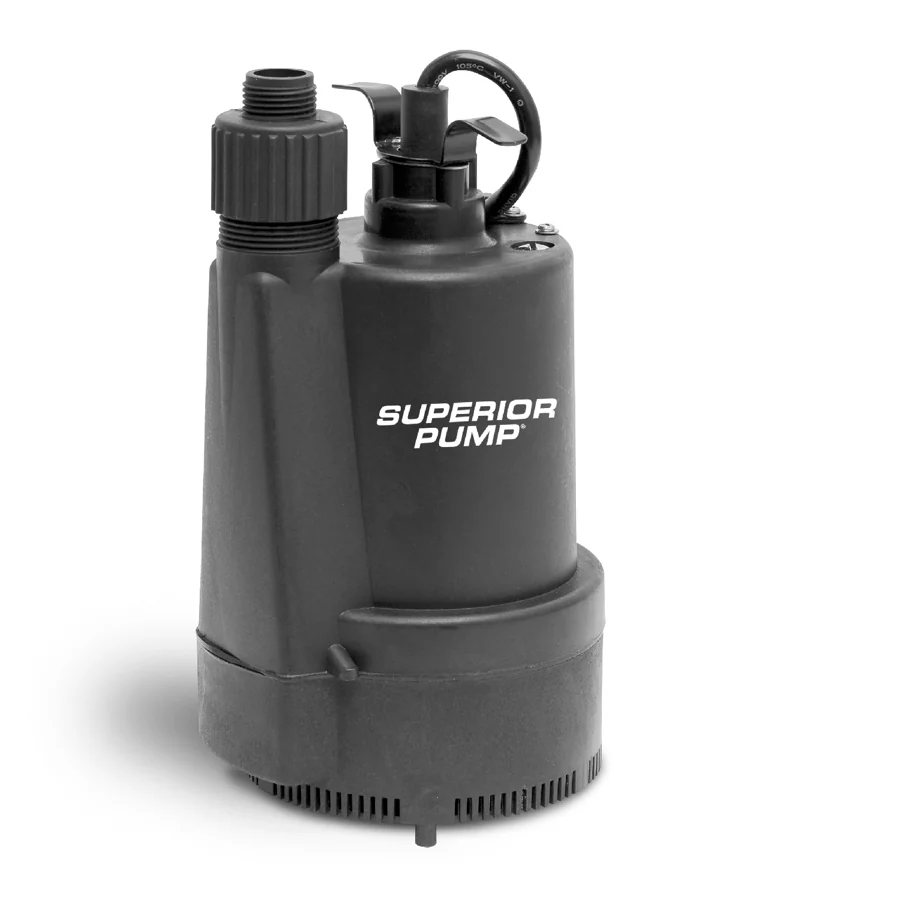
Manufacturer product photo. Comparison model; purchase link withheld.
Higher-flow comparison
Superior Pump 91330 Submersible Utility Pump
Purchase link withheld. I am keeping this model for specification comparison; I am not presenting a verified current offer.
1/3 HP · 2400 GPH at 0 ft, 1680 GPH at 10 ft · 25 ft maximum head · removes water down to 1/2 in of the surface · passes 1/8 in solids · 1-1/4 in NPT discharge with 3/4 in garden hose adapter · 4.1 A · per Superior Pump’s product page [2][1]
Similar thermoplastic construction, with a bigger motor. Superior lists 2400 gallons per hour at zero lift and 1680 at ten feet, against 1800 and 1200 for the 1/4 HP version. On a hot tub, a pond or a flooded crawl space with real depth, that is less pumping time for the same volume, before hose losses. [2][1]
Read the trade-off before you assume bigger is better. Superior lists this one as removing water down to 1/2 inch of the surface, where the 1/4 HP model reaches 1/8 inch. More power, less shallow. If the job ends with a wet floor rather than a drained pit, the smaller pump is the better tool, which is not what the horsepower number suggests. [2][1]
What works
1
2400 GPH at zero lift and 1680 GPH at ten feet, per Superior Pump. [2]
2
Same discharge and adapter as the 91250, so hoses interchange. [2][1]
3
Solid copper windings and dual o-ring motor seals, per Superior Pump. [2]
What to watch
1
Stops at 1/2 inch of water, four times deeper than the 91250. [2][1]
2
Draws 4.1 A, so watch what else is on the circuit. [2]
3
Manual switch again, no float, no automatic shutoff. [2]
My comparison judgment: This is the higher-flow option, with the offer still held.
Compare it if
I am comparing higher-volume draining and can finish the remaining water separately.
Skip it if
I need a linked purchase option or the shallowest finishing depth.
The tradeoff
The higher maker flow rating comes with a deeper minimum removal level.
Spec sheet
Maker ratings, not measured performance on a particular hose. On a phone, swipe the table to compare every model.
A sump pump normally stays in a pit and uses a float or other level control. These comparison models are portable water-removal tools. I do not use one as the permanent answer to a pit that keeps filling. [1][2]
Manufacturers publish two figures that decide this purchase. Flow tells you how fast a volume moves; the shallow-water rating tells you how much is left when it stops. Superior lists 1/8 inch for the 91250 and 1/2 inch for the more powerful 91330. I choose the finishing depth first unless I am emptying something deep. [1][2]
Lift Is Not Free
Every foot the hose climbs costs flow. Superior’s own figures show the 91250 dropping from 1800 gallons per hour at zero lift to 1200 at ten feet, and the 91330 from 2400 to 1680. Measure the real height from the water to where the hose discharges, basement window, driveway, yard, and read the rating at that height rather than the headline. [1][2][3]
What These Pumps Are Good For
I use the maker application lists to distinguish temporary water removal from permanent drainage. Superior lists hot tubs, pools, landscape ponds, standing basement water, job sites and boats. [1][2]
Application examples do not override the manual. Superior warns against flammable liquids, drinking-water duty, brine and condensate. For swimming-pool or marine locations, choose equipment rated for that location and follow the specific manual. Let heated water cool before draining it. [3]
After a burst supply line, stop the source and make the area electrically safe first. The water-leak guide helps with the next step. A utility pump does not repair the leak.
Plumber's fit check
Keep out of floodwater when electrical safety is uncertain. Call an electrician or emergency service if power may be reaching the water; call a plumber for a recurring flood, sewage or a damaged supply line.
1
Inspect the cord and plug before connecting power. Use a properly grounded GFCI-protected outlet, keep connections dry and keep the outlet within the supplied cord reach. Superior says not to use an extension cord. [3]
2
Route and secure the discharge hose where the water can drain safely. Lift the pump by its handle, never by its cord. [3]
3
Use a firm clean base. Do not set the intake directly on sand, gravel, clay or loose debris. [3]
4
Watch the discharge. When water stops coming out, disconnect power before moving, cleaning or servicing the pump. [3]
A minimum removal rating describes the finishing layer, not continuous unattended operation. The shared Superior manual requires at least 6 inches of water for continuous operation. Keep the pump supervised, and do not run it dry. [3]
How to choose
1
Choose the finishing depth
A shallow-water rating matters when water is spread over a floor. The 91250 is rated to 1/8 inch and the 91330 to 1/2 inch. Plan to finish residual water with a mop or wet vacuum. [1][2]
2
Measure the vertical lift
Read the flow at the height the hose must climb, not just the zero-lift maximum. The 91250 drops from 1800 GPH at zero lift to 1200 GPH at ten feet; hose friction can reduce the actual result further. [1][3]
3
Match the hose and water
A garden-hose adapter is convenient, but a restrictive hose reduces flow. Match the discharge route and water type to the manual. These pumps do not turn sewage or contaminated floodwater into a safe DIY job. [1][2][3]
Estimate the pumping time
Use this as a planning comparison, not a promise. The calculation is water volume in gallons divided by rated gallons per hour, multiplied by minutes per hour. It excludes hose friction, debris, priming and the slow final layer. [1][2][3]
How I Pick Pumps
I compare two Superior Pump models using the maker product pages and the shared operating manual. I check flow at lift, minimum removal depth, discharge fittings and safety instructions. [1][2][3]
I compare the maker specifications at a useful lift, minimum pumping depth, discharge connection and operating instructions. I favor fit over the biggest horsepower number. The spec sheet keeps the differences together instead of turning every rating into a separate winner. [1][2][3]
The Superior Pump 91250 is the verified New purchase option. The 91330 remains a specification comparison with its purchase link withheld. I do not treat that comparison as a current buyable offer.
I checked the CPSC recall dataset for both Superior Pump models. That scoped check found no matching Superior Pump recall. Check the model identification and the current recall notice before using an older pump. [4]
I explain the tradeoffs using named maker documents and clear operating warnings. Amazon links can earn a commission at no extra cost to you. The held 91330 comparison has no purchase link. About Plumbing Picks explains who writes the guides.
FAQ
What is a submersible utility pump used for?
Moving water that is not going to move itself: draining compatible cooled water from a hot tub or clearing a pool cover, emptying a window well or a flooded crawl space, and clearing standing water off a floor. It is portable and manually switched, so it is a tool you carry to the water rather than an installed appliance. [1][2][3]
How low will a utility pump drain?
It depends on the model, and this is the spec to compare. Superior lists the 91250 at 1/8 inch of the surface and the 91330 at 1/2 inch. Anything left below that figure comes up with a wet vacuum or a mop. [1][2]
Can I use a utility pump as a sump pump?
I would not use these portable manual pumps as permanent sump pumps. They need supervision. For a pit that fills on its own, choose a suitable sump-pump system and consider a battery backup for outages. [1][2][3]
Does a utility pump connect to a garden hose?
Yes, on both models here. The Superior pumps have a 1-1/4 inch NPT discharge with a 3/4 inch garden-hose adapter included. A restrictive hose reduces flow, so choose the hose size and route using the manual. [1][2][3]
Can it pump dirty water?
Only within the maker limits. Superior lists both pumps as passing solids up to 1/8 inch. I keep the intake clear and do not place it directly on mud, sand, silt or rocky ground. These are not sewage or trash pumps. [1][2][3]
For supervised sand/silt dewatering in a pit, compare my trash and sand pump guide. It explains operating water depth, safe power, hose planning and the conflicting solids warning on the gas kits. For shallow-floor finishing, use the utility-pump ratings above. [1][2][3]
Bottom Line
I choose the Superior Pump 91250 as the current purchase option for general draining. Its maker lists removal down to 1/8 inch. The Superior Pump 91330 remains the higher-flow comparison, without a purchase link until its offer is resolved. [1][2]
For recurring pit water, use a suitable sump-pump system. For sewage below the sewer line, compare a sewage ejector pump and its installation requirements.