
Best for most sump lines
Zoeller 30-0041
at Amazon
Four quiet 1-1/2 in. check valves, where each one goes, and what a failing one sounds like.
As an Amazon Associate I earn from qualifying purchases. How this site earns

Get the Zoeller 30-0041: a spring-closed quiet valve with a clear body and unions, rated 50 psi. For no glue, the PumpSpy CV-150. Fit it above the pit with a 3/16 in. vent hole below it.
Four 1-1/2 in. check valves for a basement sump line, each closed by a spring or an angled seat so it doesn’t bang. All four were new and in stock on Amazon when I re-checked on Oct 22, 2026, 9:41 PM EDT, and again on Nov 10, 2026.
Best for most sump lines
at Amazon

Best for an all-white PVC line
at Amazon
Best for a no-glue swap
at Amazon

Best for a tall discharge run
at Amazon
Each card gives the maker’s own numbers, how the valve connects, and who should buy a different one.
Best for most sump lines
You have 1-1/2 in. PVC discharge pipe, a check valve that bangs or a pump that restarts on its own, and you’re fine gluing PVC.
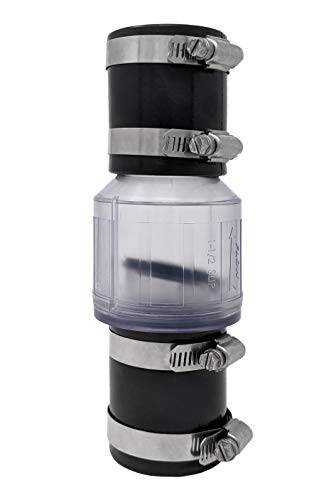
You don’t want to prime and glue in a tight pit. The PumpSpy clamps on with rubber couplings and a screwdriver.
The Zoeller 30-0041 is the check valve I’d put on most basement sump lines. It’s the clear version of Zoeller’s Quiet Check, and Zoeller’s technical sheet FM1709 lists it next to the white 30-0040 with the same body, the same 9-1/2 in. length and the same 2 lb weight.
The quiet part is a 1/2 lb spring on the flapper. A plain flapper waits for the column of water in the pipe to fall back and slam it shut, and that slam is the bang you hear when the pump stops. Zoeller says the spring closes the valve against pressure before any flow reversal can happen, which is what stops the noise.
The clear body is why it’s my top pick over the white one. You can see the flapper open while the pump runs and see it seated after the pump stops. If water keeps draining back to the pit, you’ll see the flapper hanging open, often held by a piece of debris, without taking anything apart.
Both ends are solvent-weld sockets with unions. You glue short pieces of your discharge pipe into each end, and the union nuts let you split the line later to pull the pump. Zoeller sells the 1-1/2 in. union assembly as service part 152294 if a nut or seal gets lost.
Zoeller rates it at 50 psi, or 115 ft of head, for both horizontal and vertical lines, and says it’s suitable below the basin cover. A sump line rarely sees anything close to that pressure, so the rating gives plenty of room. Zoeller asks you to call the factory before using it above 130°F.
The Amazon listing comes from a plumbing supply seller rather than Zoeller, and its title calls it a 2-port 50 psi valve, which matches Zoeller’s sheet. Zoeller gives it a 1-year limited warranty.
My call: buy this one unless you want a no-glue fit. I’ve used it, and being able to see the flapper saves a lot of guessing when a pump starts acting up.
Best for an all-white PVC line
You want Zoeller’s quiet valve in plain white to match the rest of your PVC, and you don’t need to see inside it.
You’ve had a valve stick open before. The clear 30-0041 lets you spot that from across the room.
The 30-0040 is the same Quiet Check as the top pick in a white PVC body. Zoeller’s FM1709 sheet lists both with a 1-1/2 in. pipe size, a 9-1/2 in. length and a 2 lb weight, and Zoeller’s product page shows the same 50 psi rating and the same 1-year limited warranty.
Inside, it uses the 1/2 lb spring that closes the flapper before the water in the pipe can turn around. Zoeller’s page says standard check valves may make a slamming sound when the flow reverses after a pump stops, and that this valve is the fix for that water hammer.
The ends are the same solvent-weld unions. Glue a stub of pipe into each socket, set the valve in the line with the flow arrow pointing away from the pump, and tighten the union nuts by hand. When the pump needs service, loosen the nuts and the valve and pump lift out with no cutting.
So why is it second? Only because you can’t see through it. The score below gives a clear body credit, since a stuck flapper is one of the commonest reasons a sump pump short-cycles. With a white body you find out by taking the union apart.
Where the white one makes sense is a finished space or a line that’s painted or boxed in, where you’ll never look at the valve anyway. Zoeller also sells a Quiet Check with a quarter-turn ball valve, the 30-0046, if your code or your plumber wants a shutoff in the line.
The Amazon listing calls it a full-flow solvent-weld union valve rated 50 psi with a 1/2 lb spring, which matches Zoeller’s sheet. Its main photo shows Zoeller’s “The Quiet Check Valve” lettering on the body.
My call: a fine choice when the clear one isn’t in stock or a white line matters to you. I’ve used it, and it’s the same valve where it counts.
Best for a no-glue swap
You’re replacing an old valve, you want it done with a hacksaw and a screwdriver, and you’d like to see inside.
Your line rises a long way above the valve. PumpSpy publishes no pressure rating, and both Zoellers and the Liberty do.
The PumpSpy CV-150 is the easiest swap on this page. It slides into the line on two 1-1/2 in. Buna-N rubber couplings, and PumpSpy says every clamp on it is stainless steel, so the screws won’t rust in a damp pit.
PumpSpy’s install guide is short. Take out the old valve, leave a 5-1/8 in. gap in the discharge pipe, cut the pipe if you need to make that gap, push a coupling onto each pipe end and tighten the hose clamps with a standard screwdriver. No primer, no cement and no waiting for glue to cure.
Like the Zoellers, it closes on a spring-loaded flapper. PumpSpy says this stops the water hammer noise a standard valve makes when the water in the pipe slams the flapper shut. The body is clear, so you can see water moving while the pump runs and see the flapper seat when it stops.
The catch is the numbers. PumpSpy doesn’t publish a pressure rating for the CV-150, and the body is ABS rather than PVC. That costs it on the score below. For a typical basement line it’s not a worry, but if your pipe climbs a long way before it turns outside, pick a valve with a rated number.
Rubber couplings also flex. Zoeller’s sheet for its own coupled valve warns against more than 10 ft of standing water above a valve held only by couplings, and while that note is for a different valve, it’s a good habit with any coupled fitting: strap the pipe so the valve isn’t carrying the weight.
The Amazon listing is sold by the maker and says the couplings fit 1-1/2 in. Schedule 40 pipe. PumpSpy gives it a 1-year warranty.
My call: the pick when you want to replace a noisy valve without glue. I’ve used it, and pulling the pump later is just two clamps.
Best for a tall discharge run
Your discharge climbs a long way, you run a Liberty pump, or you want the highest pressure rating you can get in a 1-1/2 in. valve.
You want a warranty in writing for the valve itself. Zoeller and PumpSpy both print one.
The Liberty QCV150 is the heavy-duty pick. Liberty’s literature rates it at 150 psi at 72°F, three times the Zoeller Quiet Check, which matters most on a line that rises a long way before it leaves the house.
It closes a different way. Liberty says its angled seat reduces the water hammer effect. The valve body in the Amazon photo is also printed “Spring Loaded”, and the listing calls it a spring-loaded valve.
Liberty calls the ends a socket-weld connection with a threaded union. You glue your pipe into the sockets the same way as with the Zoellers, and the union lets you split the line to pull the pump. The body is heavy-duty PVC with a full-port design, which Liberty says means less friction and easier pumping.
It goes in vertical or horizontal, like every valve here, and it’s a 1-1/2 in. valve, so it drops into the same line as the Zoellers. Liberty also sells a clear version, the QCV150C-CL, with compression ends instead of glue sockets, and a ball valve combo, the QBCV150.
Two things hold its score to 7.0. The body is opaque, and Liberty’s warranty page is written around pumps, with serial numbers and nameplates, without a term for this valve. I didn’t count a warranty Liberty doesn’t spell out.
The Amazon offer showed only 7 left when I checked on Oct 22, 2026 and 11 on Nov 10, 2026, from a plumbing retailer rather than Liberty. Liberty is a well-documented brand, so that’s enough under my stock rule, but check the listing before you count on it.
My call: buy it when pressure rating is the thing you care about most, or to match a Liberty pump. I’ve used it; for most basements the Zoeller does the same job with a warranty in writing.
Every number comes from the maker’s sheet or product page. Prices are in each card and the picks above.
| Pick | Spec score | Photo | How it closes | Ends | Pressure rating | Pros / cons | Buy |
|---|---|---|---|---|---|---|---|
| Zoeller 30-0041Most sump lines | 10 | | 1/2 lb spring | Glue + unions | 50 psi | Clear body / Needs glue | Check it on Amazon |
| Zoeller 30-0040All-white PVC | 9.0 | | 1/2 lb spring | Glue + unions | 50 psi | Same valve, white / Can’t see inside | Check it on Amazon |
| PumpSpy CV-150No-glue swap | 8.0 | | Spring | Rubber couplings | Not published | Clamps on, clear / No rating | Check it on Amazon |
| Liberty QCV150Tall discharge run | 7.0 | | Angled seat | Glue + union | 150 psi | Highest rating / No valve warranty | Check it on Amazon |
Teal marks a strength and amber a trade-off. All four are 1-1/2 in. and go in vertical or horizontal lines, per their makers.
Choose the symptom. The checker gives the likely cause and the fix, from Zoeller’s service checklist and the makers’ install guides.
| What you notice | Likely cause | What to do |
|---|---|---|
| Pump restarts within seconds | Check valve stuck open or missing | Clean or replace the valve |
| Bang when the pump stops | Plain flapper slamming shut | Fit a spring or angled-seat valve |
| Pump runs, little water | Clogged valve, line or vent hole; valve backwards | Clear it; flow arrow away from pump |
| Pump runs, no water | Air lock under the valve | Drill or clear the 3/16 in. vent hole |
| Small jet inside the pit | The vent hole working | Leave it; keep it below the cover |
| Drip at the valve | Loose clamp or union | Tighten clamps; reseat the union |
A quick test settles most of these. Pour a bucket of water into the pit until the pump kicks on, then watch the valve and listen when it stops. A good valve closes with no bang, and the water in the pipe stays put. If you hear water running back down the pipe, the flapper isn’t seating.
Zoeller also says to inspect and test the whole sump system at least every 3 months, so pair the bucket test with a look at the vent hole. For a pump that won’t run at all, see my sump pump not working guide.
It’s a one-way valve in the discharge pipe. Water passes up and out while the pump runs, and the flapper shuts when it stops so the water in the pipe can’t fall back.
PumpSpy points out that water left in the pipe falls back to the pit without a valve, and the pump has to move it again. In 1-1/2 in. Sch 40 pipe that’s about a gallon for every 10 feet of pipe.
Zoeller’s checklist ties a pump that starts and stops too often to a missing or stuck-open check valve. Fewer starts are easier on the pump.
Zoeller’s install sheet says to fit a check valve and a union in the discharge line. Every pick here has unions or couplings for that.
Zoeller’s checklist names a clogged check valve as a cause of weak flow. A clear body makes that easy to spot.
Does every sump pump need one? Zoeller’s installation instructions say to install a check valve and a union in the discharge line. Check your local code too. Without a valve, every foot of 1-1/2 in. pipe above the pump drains back each cycle, and the pump moves that water again.
Both stop backflow. The difference is when the flapper closes, and that decides whether you hear a bang.
| Standard flapper (Zoeller 30-0181) | Quiet check (picks here) | |
|---|---|---|
| How it closes | Weighted flapper falls shut when the water reverses | Spring or angled seat closes it before the water reverses |
| Noise | Can slam: the bang after the pump stops | Made to stop that slam |
| Pressure rating | 4.3 psi on its couplings, 10 ft of head at 130°F | 50 to 150 psi where published |
| Standing water above it | Zoeller: no more than 10 ft | Within the valve’s rating |
| Warranty | 1 year (Zoeller) | 1 year (Zoeller, PumpSpy) |
Zoeller 30-0181 figures from Zoeller’s product page and sheet FM0217. Solvent-welded into rigid pipe, Zoeller rates the same valve at 25 psi.
The standard flapper isn’t a bad valve. It’s cheap, it’s what many pumps ship with, and Zoeller says its flapper bends over a radius to make the hinge last. The noise is the trade. In a finished basement or under a bedroom, the bang every cycle is what sends people looking for a quiet valve.
For the full mechanics of swing and spring valves, including where each is used beyond sump lines, read swing check valve vs spring check valve. If the bang is on your water supply pipes rather than the sump line, that’s a job for a water hammer arrestor.
A sump line runs at low pressure, so this is headroom, not a daily load. It matters most on a tall discharge and on valves held by rubber couplings.
To turn feet of water into pressure, every 2.31 feet of rise is about 1 psi. A line that climbs 9 feet to the rim joist holds about 4 psi of standing water on the valve when the pump stops. That’s inside every rating here except the coupled standard valve at its limit, which is why Zoeller caps it at 10 feet above the valve.
Zoeller’s installation sheet gives the layout most plumbers follow: the valve just above the pit, and a small hole below it to let air out.
Zoeller says to fit its combined union and check valve preferably just above the basin, so the pump comes out easily for cleaning or repair.
Zoeller lists the Quiet Check as suitable below the basin cover. For high head or below-cover installs on 1-1/2 in. pipe, its install sheet also names its cast iron valve, 30-0164.
Drill a 3/16 in. hole in the discharge pipe even with the top of the pump. Zoeller says it must also sit below the basin cover, and you’ll see a small jet from it when the pump runs.
Find the flow arrow on the valve body and point it up on a vertical pipe, or away from the pump on a horizontal run.
Zoeller says not to use a discharge pipe smaller than the pump’s outlet. If your pump has a 1-1/4 in. outlet on 1-1/2 in. pipe, keep the 1-1/2.
The vent hole is the step people skip. Zoeller says it purges trapped air from the pump, and that the hole should be checked for clogging now and then.
Zoeller also notes the hole can cause too much turbulence on a high-head pump, and if you leave it out, the pump case and impeller must stay covered by water. My sump pump weep hole guide covers sizing and placement in more detail.
How far above the pump? Zoeller doesn’t give a set number beyond “just above the basin”. The working rule is to keep the valve where you can reach the union with the lid off, and keep the vent hole between the pump and the valve.
A coupled valve needs a hacksaw and a screwdriver. A glued one also needs PVC primer, cement and time for it to set. Unplug the pump first.
Zoeller says to always disconnect the pump from power before handling it. Then pour off or let the pit drain down.
Loosen the clamps or union nuts. On an old glued-in valve, cut the pipe above and below it.
PumpSpy’s CV-150 needs a 5-1/8 in. gap. For a glued union valve like the Zoeller, dry-fit stubs into the sockets and measure with the valve in place.
Arrow up or away from the pump. Backwards, the valve blocks the pump.
Coupled valves: tighten each hose clamp with a screwdriver. Glued valves: prime and cement the stubs into the sockets, then hand-tighten the union nuts.
Drill the 3/16 in. vent hole if there isn’t one, plug the pump in and fill the pit with a bucket. Watch for drips and listen when it stops.
Pipe size comes first. If you’re not sure whether your line is 1-1/4 or 1-1/2 in., my check valve size guide shows how to measure and when an adapter is fine. All four picks here are 1-1/2 in. If you’re replacing the pump at the same time, size it with my sump pump size calculator first, since a new pump may have a different outlet.
For glued valves, use PVC primer and cement made for PVC, and keep the joint still for the set time on the can before you run the pump.
These are real, well-made valves that scored under my 7.0 floor or didn’t fit this page. Here’s why.
| Valve | Spec score | What held it back | What it does well |
|---|---|---|---|
| Zoeller 30-0181 standard check valve, 1-1/4 or 1-1/2 in. | 6.6 | Plain weighted flapper; 4.3 psi on its couplings; opaque | Fits 1-1/4 or 1-1/2 in. pipe; stainless clamps; 1-year warranty |
| Zoeller 30-0241 Quiet Check with hose clamp ends | Not picked | Zoeller’s sheet says 40 psi and its page 50; the Amazon listing describes glue unions | Same spring as the 30-0040 |
| 2 in. valves (Zoeller 30-0042, Liberty CV200C) | Not picked | 2 in. size; Zoeller lists its 2 in. Quiet Check for sewage and effluent | Right size for a 2 in. line |
The 30-0181 is the valve many pumps come with, and it does the basic job. Next to the quiet valves it loses on noise and on its low rating when held by couplings. On a short line where the bang doesn’t bother you, it’s still a working valve. A sewage pit needs 2 in. parts; see my sewage ejector pump guide.
| Check | How to find it | What it points to |
|---|---|---|
| Pipe size | Measure the outside of the pipe: about 1.9 in. is 1-1/2 in. Sch 40 | All four picks are 1-1/2 in. |
| Noise | Does the old valve bang when the pump stops? | Any pick here; all close by spring or angled seat |
| Glue or clamps | Can you prime and cement in the pit? | No glue: PumpSpy. Glue is fine: Zoeller or Liberty |
| Height of the line | Feet from the valve to the highest point | Tall runs: Liberty’s 150 psi |
Most basements end at the Zoeller 30-0041. Pick the PumpSpy when you want a fast clamp-on swap, the white 30-0040 for a matching white line, and the Liberty for the highest rating. Whichever you buy, drill the vent hole and do the bucket test. A good valve paired with a pump alarm is cheap insurance; my sump pump alarm picks pair well with it.
The pump restarts seconds after it stops, you hear water running back down the pipe, or it bangs every cycle. Zoeller’s service checklist lists a stuck-open check valve as a cause of a pump that starts and stops too often. A clear-body valve lets you see whether the flapper is seating.
It’s a one-way flapper in the discharge pipe. The pump’s flow pushes it open; when the pump stops, it closes so the water left in the pipe can’t fall back into the pit. Quiet valves use a spring or an angled seat to close it before the water reverses.
Zoeller says to put its union and check valve preferably just above the basin, so the pump can come out easily. Its Quiet Check can also go below the cover. Keep a 3/16 in. vent hole in the pipe below the valve, even with the top of the pump.
On a sump line, people use both words for the same one-way valve. A testable backflow preventer on a drinking water line is a different, code-listed device; a sump check valve only keeps discharge water from falling back into the pit.
Zoeller’s installation instructions say to install a check valve and a union in the discharge line. Without it, water in the pipe drains back and the pump runs again to move it.
The flow arrow on the body points away from the pump: up on a vertical pipe. Installed backwards, it blocks the pump’s flow.
Yes for every valve here. Zoeller, Liberty and PumpSpy all list them for vertical or horizontal lines.
A plain flapper slams shut when the water column reverses after the pump stops. That’s water hammer. A spring-closed or angled-seat valve shuts before the reversal and stops the bang.
Zoeller requires a 3/16 in. vent hole in the discharge pipe below the check valve and below the basin cover, to purge trapped air. Check it for clogging now and then.
Match the discharge pipe, and don’t go smaller than the pump’s outlet, per Zoeller. Most basement sump lines are 1-1/2 in.; my size guide covers 1-1/4 vs 1-1/2 in.
I’m Isaac Daniels, a licensed journeyman plumber in Georgia. In my 7 years of experience, these are the products I’d install. Every number here comes from the makers’ own sheets, product pages and install guides, read on Oct 22, 2026, and every Amazon listing was matched to the maker’s model number the same evening. I checked the sheets and the listings again on Nov 10, 2026.
Each check scores 0 to 10 and counts one fifth. It rewards a valve that closes quietly, carries a published pressure rating, comes apart so the pump can be pulled, lets you see the flapper and has a warranty in writing. It’s my score from the makers’ documents, not a customer rating.
The same five checks put Zoeller’s standard 30-0181 at 6.6: 5 for its plain flapper, 3 for 4.3 psi on its couplings, 10, 5 and 10. That’s under my 7.0 floor, so it’s in the left-out table rather than the picks.
| Check (weight) | How it’s scored |
|---|---|
| Quiet closing (⅕) | 10 when the maker says a spring or angled seat closes it to cut water hammer; 5 for a plain weighted flapper |
| Pressure rating (⅕) | The maker’s published rating as fitted: 10 for 50 psi or more; 7 for 25 to 49; 3 below 25; 0 when none is published |
| Comes apart (⅕) | 10 when unions or clamp couplings let you split the line to pull the pump; 0 for glue-only |
| See inside (⅕) | 10 for a clear body you can see the flapper through; 5 for an opaque body |
| Warranty (⅕) | 10 when the maker publishes a warranty term for the valve; 0 when it doesn’t |
| Total | Average of the checks, to one decimal |
| Pick | Quiet closing | Pressure rating | Comes apart | See inside | Warranty | Score |
|---|---|---|---|---|---|---|
| Zoeller 30-0041 | 10 | 10 | 10 | 10 | 10 | 10 |
| Zoeller 30-0040 | 10 | 10 | 10 | 5 | 10 | 9.0 |
| PumpSpy CV-150 | 10 | 0 | 10 | 10 | 10 | 8.0 |
| Liberty QCV150 | 10 | 10 | 10 | 5 | 0 | 7.0 |