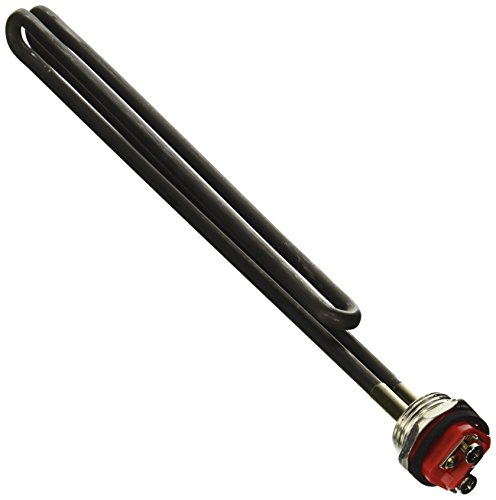
Rheem SP10869MM
$31.35 at Amazon
Check it on AmazonPrice as of Nov 22, 2026, 9:30 AM EST
Details ↓Watts, amps and the right element for your plate.
As an Amazon Associate I earn from qualifying purchases. How this site earns

Updated November 15, 2026
On 208V, a 240V element makes about 75% of its watts; Rheem lists its 4500W at 3380W. A 208V element on 240V can exceed the plate’s wattage. For a 240V, 4500W screw-in plate, my pick is the Rheem SP10869MM, if your maker’s parts list agrees.
All four are 240V screw-in elements. On 208V each makes about three quarters of its 240V wattage, which is how dual-rated heaters are meant to run.


Product prices and availability are accurate as of the date/time indicated and are subject to change. Any price and availability information displayed on Amazon.com at the time of purchase will apply to the purchase of this product.
Bradford White’s parts list shows why. Each 208V copper element shares its part number with a bigger 240V element.
Read the chart by row. Bradford White’s 208V, 4500W copper element and its 240V, 6000W element are one part, 415-42544-12. Its Incoloy list on page 12 does the same, with part 415-42545-19 for both.
So a “208V 4500W” element on a 240V circuit makes 6000W. Rheem’s TSB 1305 lists 25.0 amps for 6000W at 240V, against 18.8 amps for 4500W. Its recommended breaker is 35 amps with 8 AWG copper for 6000W, and 25 amps with 10 AWG for 4500W.
The danger is going past what the heater is approved for. A. O. Smith’s manual for its 120V point-of-use heaters says replacement elements must be the same voltage and no greater wattage than the rating plate. Its main care guide says to check the data plate for the correct wattage and voltage.
An element built only for 208V has a second problem. Rheem’s TSB 1306 says that when an element gets more than its design voltage, “the element will burn out.”
240V 4500W stainless steel resistored low watt density element
Prices and availability are accurate as of the time shown and may change.
Your plate says 240V and 4500W per element (or a dual-rated Rheem lists 3380W on 208V), the heater takes a 1 in. screw-in element, and the heater maker’s parts list approves this part, or its length and mounting, for your model.
The plate says 208V only or lists a different wattage, or the heater doesn’t take a 1 in. screw-in element. Match the plate and parts list instead.
This is the element I’d buy for a heater whose plate says 240V and 4500W and that takes a 1 in. screw-in element. Rheem’s listing prints both numbers you’ll see in the field: 4500W at 240V and 3380W at 208V. Those match the 4500W row of Rheem’s TSB 1317 exactly.
It’s a low watt density (LWD) element with a stainless steel sheath, folded back on itself. Rheem lists 13.44 in. from flange to tip, a .316 in. element diameter and 1 in. NPSM threads at 11-1/2 per inch. Rheem’s other screw-in elements and Camco’s list the same thread.
On a dual-rated Rheem heater wired to 208V, this is still the right part. TSB 1317 says Rheem’s residential electric heaters are rated for both voltages. You’ll get 3380W and about 16 gallons an hour at a 90°F rise, instead of 21 on 240V.
Check the plate before you order. A. O. Smith’s care guide tells owners to check the data plate for the correct wattage and voltage. If yours says 208V only and 4500W, the heater was built with 208V elements, and this one would give you about a quarter less heat than the plate promises.
On a meter it should read close to 12.8 ohms, the figure Rheem’s TSB 1305 gives for a 4500W, 240V element. That’s inside A. O. Smith’s 5 to 25 ohm range for a good element. A reading near 9.6 means a different part: TSB 1305 lists 9.6 ohms for both a 208V, 4500W and a 240V, 6000W element.
Rheem’s TSB 1305 lists 18.8 amps for this element at 240V. On 208V that falls to about 16.3 amps (3380W divided by 208V, my math), so a circuit already sized correctly for the heater carries less current than it does at 240V.
Why this pick: it’s Rheem’s own 4500W screw-in element, the listing gives its 208V output in plain numbers.
240V 5500W stainless steel resistored medium watt density element
Prices and availability are accurate as of the time shown and may change.
Your plate says 240V and 5500W, or it’s a dual-rated Rheem heater on 208V that lists 4130W.
Your plate says 4500W. A bigger element than the plate allows is the mistake A. O. Smith warns against.
Pick this one only when the plate says 5500W. Rheem’s listing gives a full set of numbers: 5500W at 240V, 4130W at 208V, and a cold resistance of 10.50 ohms. Rheem’s TSB 1305 lists 10.5 ohms for a 5500W, 240V element.
It also shows something most listings leave out: watt density at each voltage. Rheem lists 113 watts per square inch at 240V and 85 at 208V. On 208V the sheath puts out about a quarter less heat per square inch of surface.
At 240V it’s a medium watt density (MWD) element. That’s a step up in surface heat from the low density SP10869MM. It’s a stainless steel fold-back, 13.47 in. from flange to tip, with the same 1 in. NPSM thread as Rheem’s other screw-in elements.
Rheem’s own listing note says to use Rheem replacement parts on Rheem heaters for best results. If your heater is another brand and its plate says 5500W, check that maker’s parts list first. Bradford White, for example, lists its 240V 5500W copper element as part 415-42544-16.
Mind the breaker. Rheem’s TSB 1305 recommends a 30 amp breaker and 10 AWG copper for a 5500W heater at 240V, and says to check local codes. Never put this element in a heater whose plate says 4500W just to get faster recovery; A. O. Smith says no greater wattage than the plate.
The 208V math works the same way as for any element. Rheem’s TSB 1305 lists 22.9 amps for 5500W at 240V; on 208V it’s about 19.9 amps (4130W divided by 208V, my math). Recovery at a 90°F rise drops from 25 to 19 gallons an hour, per TSB 1317.
Why this pick: Rheem’s own 5500W element, with its 208V wattage and cold ohms printed.
240V 4500W stainless steel dry fire resistant low watt density element
Prices and availability are accurate as of the time shown and may change.
Your plate says 4500W at 240V, or 3380W at 208V, and you want an element built to resist dry firing.
The shorter SP10869MM is what your parts list calls for, or your plate lists a different wattage.
This is Rheem’s 4500W element with one extra claim: the listing calls it dry fire resistant. Dry firing means power reaches the element before it’s under water. A. O. Smith’s care guide warns that skipping the refill and air purge “can cause the upper heating element to burn out.”
The ratings are the same as the SP10869MM. Rheem’s listing says 208V 3380W and 240V 4500W, the same pair TSB 1317 gives. It’s a low watt density stainless steel element, 13.75 in. from flange to tip, with 1 in. NPSM threads.
The fit list is the broadest of the Rheem picks. Besides Rheem’s own OEM fit for Rheem, Ruud, Richmond, Vanguard and General Electric, the listing says it fits most Kenmore, A. O. Smith, Bradford White, Craftmaster, Lochinvar, Mor-Flo, Reliance, State and Whirlpool heaters that use screw-in elements.
Don’t read “dry fire resistant” as dry fire proof. The listing doesn’t give a time, a temperature or a test. Fill the tank and run a hot faucet first, exactly as A. O. Smith’s steps say: at least three minutes of full flow, then power on.
The listing calls it an OEM genuine factory authorized part, and its brand field reads Rheem. On a meter it should read near 12.8 ohms, like any 4500W, 240V element in Rheem’s TSB 1305.
On 208V it makes 3380W, so recovery at a 90°F rise falls from 21 to 16 gallons an hour, per Rheem’s TSB 1317. Next to the SP10869MM it’s 0.31 in. longer, at 13.75 in. against 13.44 in., and both use the same 1 in. NPSM thread.
Why this pick: same plate match and same 208V output as my top pick, plus a listed dry fire resistant build. A full tank before power is still the rule.
240V 4500W screw-in fold-back low watt density element
Prices and availability are accurate as of the time shown and may change.
Your plate says 240V and 4500W, the heater takes a 1 in. screw-in element and isn’t a Rheem, and you have hard water.
You want the 208V wattage printed by the maker. The Rheem picks list it; Camco doesn’t.
Camco’s 02583 is the non-Rheem pick for a 240V, 4500W plate. It’s a low watt density fold-back element, and Camco’s listing says that design “reduces lime deposit buildup” in hard water areas. Camco says it fits most replacements of the same wattage and voltage.
Camco doesn’t print a 208V figure. The physics doesn’t care about the brand, though. Using Rheem’s TSB 1306 formula, any 4500W, 240V element makes 75.111% on 208V, or about 3380W. That’s my math, not Camco’s, and it matches Rheem’s table.
Construction is different from the Rheem picks. Camco lists a 1 in. NPSM carbon steel bushing, a rubber gasket (#06822) and plated copper tubing. It needs a tank at least 13 in. across, so measure a compact or unusual heater before you order.
The fit list is long: American, A. O. Smith, Bradford White, Craftmaster before 1991, GE, certain GS Wood models, Kenmore, Lochinvar, Maytag, Mor-Flo, Reliance, Rheem, Richmond, Rudd, Sears, State and Whirlpool, plus heaters made after 1994. Still check your plate’s voltage and wattage first.
Camco says the element is UL listed for the US and Canada and carries a limited 1-year warranty, so keep the receipt. On a meter, a 4500W, 240V element should read near 12.8 ohms, per Rheem’s TSB 1305.
On 208V it would draw about 16.3 amps (3380W divided by 208V, my math), down from the 18.8 amps Rheem’s TSB 1305 lists at 240V. Camco also sells an ultra low watt density 5500W element, the 02933 in its LimeLife line, for 5500W plates in hard water.
Why this pick: a UL listed low watt density element with its gasket included, sold by Amazon.com and in stock on Oct 20 and Oct 22, for owners of other brands who want lime resistance.
Ratings come from the makers’ listings and Rheem’s bulletins. Scroll sideways on a phone.
| Pick | Spec score | Photo | Plate it matches | On 240V | On 208V | Density | Sheath | Short pros / cons | Buy |
|---|---|---|---|---|---|---|---|---|---|
| Rheem SP10869MM 240V 4500W screw-in | 9.5 | | 240V 4500W | 4500W | 3380W | LWD | Stainless steel | 208V output listed / No gasket listed | Check it on Amazon |
| Rheem SP10869PH 5500W plates | 9.0 | | 240V 5500W | 5500W | 4130W | MWD | Stainless steel | Ohms listed / Medium density | Check it on Amazon |
| Rheem SP17618AM Dry-fire resistance | 10 | | 240V 4500W | 4500W | 3380W | LWD | Stainless steel | Dry fire resistant / No time given | Check it on Amazon |
| Camco 02583 Hard water, other brands | 8.3 | | 240V 4500W | 4500W | About 3380W (my math) | LWD | Plated copper | UL listed / No 208V figure | Check it on Amazon |
Green marks a strength and amber marks a limit. LWD: low watt density. MWD: medium watt density. Camco lists a minimum tank diameter, not an element length.
Rheem’s TSB 1317 lists the 208V output for each common size. Every one lands at about 75% of the 240V rating.
| Element rating at 240V | Output on 208V | Recovery at 240V | Recovery at 208V |
|---|---|---|---|
| 3000W | 2255W | 14 GPH | 10 GPH |
| 3500W | 2630W | 16 GPH | 12 GPH |
| 3800W | 2855W | 17 GPH | 13 GPH |
| 4500W | 3380W | 21 GPH | 16 GPH |
| 5000W | 3755W | 23 GPH | 17 GPH |
| 5500W | 4130W | 25 GPH | 19 GPH |
| 6000W | 4500W | 27 GPH | 21 GPH |
Recovery is gallons per hour at a 90°F temperature rise, as Rheem’s TSB 1317 states it. Rheem says the dual rating doesn’t cover 120V point-of-use heaters or units built for 208V only; read your rating label for those.
Rheem’s bulletin says its residential electric water heaters are dual rated for 240V and 208V single phase. So a Rheem heater wired to 208V isn’t broken or wrong. It’s running at its lower rating, and the label shows both numbers.
What you lose is speed. A 4500W element on 208V heats about 16 gallons an hour at a 90°F rise instead of 21. A full tank still gets hot. It just takes longer to come back after a long shower.
An element is a fixed resistance. Power rises and falls with the square of the voltage, so a 13% lower voltage costs about 25% of the heat.
| Element rating | Ohms | Amps at 240V | Amps on 208V | Watts on 208V |
|---|---|---|---|---|
| 3500W at 240V | 16.5 | 14.6 A | 12.6 A | 2630W |
| 4000W at 240V | 14.4 | 16.7 A | 14.4 A | 3004W |
| 4500W at 240V | 12.8 | 18.8 A | 16.3 A | 3380W |
| 5500W at 240V | 10.5 | 22.9 A | 19.9 A | 4130W |
| 6000W at 240V | 9.6 | 25.0 A | 21.6 A | 4500W |
Ohms and 240V amps from Rheem TSB 1305. Amps on 208V are watts on 208V divided by 208 (my math), and watts on 208V are from TSB 1317 except 4000W, which is my math from Rheem’s TSB 1306 formula.
Rheem’s TSB 1306 gives the formula: the new voltage squared over the design voltage squared. For 208V on a 240V element, that’s 43,264 over 57,600, or 75.111%. Rheem’s own example is a 5500W element that delivers 4131W on 208V.
The current drops too. A 4500W, 240V element on 208V pulls about 16.3 amps instead of 18.8. Lower voltage across the same resistance means less current, not more, on a circuit already sized correctly for the heater.
TSB 1306 ends with a caution: Rheem “does not recommend the down-rating of electrical heating elements.” Its example is a 240V element supplied with 208V.
TSB 1317 covers Rheem’s own heaters. It says Rheem’s residential electric heaters are dual rated for 240V and 208V, with both ratings on the label. Follow the label on your heater.
A. O. Smith’s care guide says the heater’s electrical requirements are on its data plate. Find what yours says, then use the row that matches.
| What the plate says | What’s in the heater | What to buy |
|---|---|---|
| 240V, 4500W | 240V 4500W elements | A 240V 4500W element your heater’s parts list approves, such as the Rheem SP10869MM for many screw-in heaters |
| 240V 4500W and 208V 3380W | Dual-rated; 240V elements | The same approved 240V 4500W element, at either voltage |
| 240V, 5500W | 240V 5500W elements | A 240V 5500W element your heater’s parts list approves, such as the Rheem SP10869PH |
| 208V only, with a wattage | 208V elements, built for 208V | A 208V element of that exact wattage from the heater’s maker |
| 120V | 120V elements; A. O. Smith lists 120V from 6-gallon up to some 50-gallon tanks | A 120V element of the plate’s wattage, per the model’s element spec |
| Two wattages for two elements, or “simultaneous” | Different upper and lower elements, or both heating at once | Exactly what each line lists; check the model’s element spec and wiring diagram |
From Rheem TSB 1317, A. O. Smith’s residential electric use and care guide (100341465), its 2.5-gallon point-of-use manual (185834-000) and its element availability sheet (AOSTD63000), read Oct 20, 2026.
Copy the model number, voltage and wattage before you shop. If the plate lists a voltage and a wattage you don’t see among my picks, buy that exact rating, not the closest one.
A plate that says 208V only means the heater was built for 208V. A. O. Smith’s availability sheet shows 208V offered as its own input, from 1 kW up to 6 kW depending on the tank. Rheem makes 208V-only elements such as the SP10872NL, a 208V, 5000W copper element; its Amazon listing showed low stock on Oct 20.
Rheem’s TSB 1305 lists breaker and copper wire size by the heater’s total wattage. The numbers are for a heater rated at that voltage.
| Heater wattage | Breaker at 208V | Breaker at 240V | Wire at 208V | Wire at 240V |
|---|---|---|---|---|
| 3000W | 20 A | 20 A | 12 AWG | 12 AWG |
| 4000W | 25 A | 25 A | 10 AWG | 10 AWG |
| 4500W | 30 A | 25 A | 10 AWG | 10 AWG |
| 5000W | 30 A | 30 A | 10 AWG | 10 AWG |
| 5500W | 35 A | 30 A | 8 AWG | 10 AWG |
| 6000W | 40 A | 35 A | 8 AWG | 8 AWG |
Single phase rows from Rheem TSB 1305, page 2, copper wire per NEC Table 310-16 at 75°C, read Oct 20, 2026. Rheem’s bulletin opens with a reminder to check all local electrical codes before changing wiring.
Read the 208V column as a heater built for 208V at that wattage. A 4500W heater rated at 208V pulls 21.6 amps, per TSB 1305, and the table lists a 30 amp breaker for it.
A 240V, 4500W heater running on 208V is a different case. It only makes 3380W and draws about 16.3 amps, less than on 240V. That helps only if the circuit was sized correctly to begin with. A. O. Smith says to check the voltage, wire size and breaker rating and type against the data plate.
A. O. Smith’s spec text for its residential electric heaters says element operation “shall be double element, non-simultaneous” unless ordered differently. Only one element heats at a time, so a heater with two 4500W elements is a 4500W heater on the plate.
Simultaneous wiring is the exception. A. O. Smith says to make sure the breaker is big enough for the higher current when you order it. Wiring changes belong to an electrician.
Rheem’s TSB 1306 gives the recovery formula: element watts divided by 2.42 times the temperature rise, worked out at 50, 70 and 90°F.
| Element | 50°F rise | 70°F rise | 90°F rise |
|---|---|---|---|
| 4500W on 240V | 37.2 GPH | 26.6 GPH | 20.7 GPH |
| 4500W element on 208V (3380W) | 27.9 GPH | 20.0 GPH | 15.5 GPH |
| 5500W on 240V | 45.5 GPH | 32.5 GPH | 25.3 GPH |
| 5500W element on 208V (4130W) | 34.1 GPH | 24.4 GPH | 19.0 GPH |
My math from Rheem’s TSB 1306 formula, read Oct 20, 2026. TSB 1305’s recovery table rounds the 4500W row to 37, 27 and 21 GPH. A. O. Smith’s recovery table lists 20.5 GPH for 4.5 kW at a 90°F rise.
The rise is how much the heater warms incoming water. Water coming in at 50°F and heated to 120°F is a 70°F rise. In winter, colder supply water means a bigger rise and slower recovery.
On 208V, a 4500W element loses about 6.6 gallons an hour at a 70°F rise. If that’s not enough, moving up to a 5500W heater is a question for the maker and an electrician. The plate decides what elements it can take.
A. O. Smith lists “low supply voltage” as one cause of not enough hot water. If your plate says 240V but your building has 208V, that can explain slower recovery. It doesn’t prove the elements are good; the same list includes a bad lower element, so test before you buy.
Dual rating is a feature of plain electric tanks. Heat pump models differ by generation, so the manual for your exact model decides.
| Heater type | 208V allowed? | What the maker says |
|---|---|---|
| Rheem residential electric tank | Yes, dual rated | TSB 1317: rated for 240V and 208V single phase |
| A. O. Smith residential electric tank | Yes, if ordered for 208V | AOSTD63000 lists 208V inputs by tank size |
| A. O. Smith 120V point-of-use | No, one voltage only | Manual 185834-000: use only the voltage on the plate |
| A. O. Smith Voltex heat pump, 2012 manual | No | Manual 318257-002, April 2012: 240 VAC, 25 amp; “DO NOT use a 208 VAC service” |
| A. O. Smith Voltex Hybrid Electric, 2026 catalog | Yes | Catalog AOSRB80000, October 2026: “208/240 VAC 60Hz capable” |
From the documents named in each row, read Oct 20, 2026. Check your own heat pump model’s manual; I read A. O. Smith’s 2012 Voltex manual and its October 2026 catalog.
The 75% figure comes from Rheem’s bulletins on plain resistance elements. A. O. Smith’s April 2012 Voltex manual says twice that the service must be 240 VAC and not 208 VAC. Its October 2026 catalog lists the current Voltex Hybrid Electric line as 208/240 VAC capable.
If your building supplies 208V and you’re shopping for a heat pump model, read its installation manual for the voltage before you buy. My heat pump water heater guide covers the models.
These steps follow A. O. Smith’s residential electric use and care guide. If you’re not comfortable working on it, A. O. Smith says to have a qualified person do it.
Turn the power off at the breaker or remove the fuses.
Open the junction box and check the power wires with a non-contact tester, tested on a known live circuit before and after. Klein warns that no indication doesn’t prove no voltage, so A. O. Smith’s service handbook confirms with an AC voltmeter. If you can’t be sure the power is off, stop and call a qualified person.
Open a hot water faucet and let it run until the water is cool, to reduce the risk of scalding.
Connect a garden hose to the drain valve, turn off the cold supply, and drain the tank. An open hot faucet helps it drain.
Remove the access panel, insulation and thermostat cover, disconnect the element wires, and unscrew the element with an element wrench.
Check the new element’s voltage and wattage against the data plate before it goes in.
Clean the threads with a rag. Fit the new element with its rubber gasket, put a drop of dish soap on the gasket, and tighten with an element wrench. Leave the power wires off.
Close the drain valve, open the cold supply and keep a hot faucet open. Let the hot water run full for at least three minutes, until the tank is completely full.
Check the new element for leaks. If one won’t stop with tightening, drain the tank and check the gasket. Only when there are no leaks, replace the power wires, make sure the connections are tight, and put back the thermostat cover, insulation, access panel and junction box cover.
Restore power. A. O. Smith says it may take two hours for the tank to heat.
| Tool | Photo | Why | Buy |
|---|---|---|---|
| Camco 09951 element socket 1/2 in. drive |  | A. O. Smith says regular 1-1/2 in. sockets are often beveled and may slip. Camco’s fits standard hex bushing elements. | Check it on Amazon |
| Klein NCVT3P voltage tester pen 12 to 1000V AC |  | A. O. Smith’s steps call for a non-contact tester. Klein lists CAT IV 1000V and two ranges. It can show voltage, but no light doesn’t prove the wires are dead; confirm with a voltmeter. It can’t tell 208V from 240V. Klein’s 2021 recall covered NCVT1-family testers, not this one. | Check it on Amazon |
Step 8 matters most for a new element. A. O. Smith says failing to run water until all the air is out can burn out the upper element. More on the whole job in my element replacement guide and element wrench picks.
With power off and the wires removed, a multimeter across the two terminals reads the element’s resistance. Rheem’s TSB 1305 says what each size should read.
| Reading | A 240V element of | A 208V element of |
|---|---|---|
| About 16.5 ohms | 3500W | Not listed (about 2630W on 208V) |
| About 14.4 ohms | 4000W | 3000W |
| About 12.8 ohms | 4500W | Not listed (about 3380W on 208V) |
| About 12.4 ohms | Not listed | 3500W |
| About 10.8 ohms | Not listed | 4000W |
| About 10.5 ohms | 5500W | Not listed (about 4130W on 208V) |
| About 9.6 ohms | 6000W | 4500W |
From Rheem TSB 1305’s voltage, amps and ohms table, read Oct 20, 2026. Where a resistance has no rating at one voltage, the wattage in parentheses is from TSB 1317.
A. O. Smith’s guide says a good element in its heaters reads between 5 and 25 ohms. That range doesn’t fit every element: Rheem’s TSB 1305 lists 28.8 ohms for a 208V, 1500W element. Compare your reading with the figure for your element and follow your maker’s test steps.
Within range, the number narrows down the part, but it can’t prove the voltage: 9.6 ohms is both a 208V, 4500W and a 240V, 6000W element.
Use it to catch a wrong part. A 4500W element for a 240V heater should read near 12.8 ohms. One that reads 9.6 would make about 6000W on 240V.
A normal reading across the terminals doesn’t rule out a grounded element. A. O. Smith’s heat pump service handbook checks each terminal against the element flange or tank shell; any reading short of infinite means replace it.
Two readings show up in both columns. A 14.4 ohm element is a 4000W part at 240V or a 3000W part at 208V; check the label and the plate to know which job it’s doing.
Six ways an element swap goes wrong, and what the makers say to do instead.
Bradford White’s 208V, 4500W copper element is its 240V, 6000W part. In a 4500W, 240V heater it makes 6000W and draws 25.0 amps instead of 18.8, more than the plate allows.
A. O. Smith says no greater wattage than the rating plate. A bigger element runs the heater past its approved wattage and draws more current. Whether the circuit can carry it is for an electrician to check.
A 240V element on 208V makes 75% of its rating by design. A. O. Smith lists low supply voltage as a cause of not enough hot water, along with a bad lower element. Test before you replace.
A. O. Smith says to run a hot faucet at full flow for at least three minutes first, or the upper element can burn out.
A. O. Smith’s April 2012 Voltex manual says “DO NOT use 208 VAC,” while its 2026 catalog lists newer Voltex units as 208/240 capable. Check the manual for your exact model.
A. O. Smith’s steps call for a non-contact tester on the power wires before you touch them, even with the breaker off.
Yes, at about 75% of its rated watts. Rheem’s TSB 1317 lists a 4500W element at 3380W on 208V and a 5500W element at 4130W. The tank still gets hot; it recovers more slowly.
Rheem says its residential electric heaters are dual rated for 240V and 208V, with both ratings on the label. That doesn’t cover 120V point-of-use heaters or units built for 208V only, and A. O. Smith’s April 2012 Voltex heat pump manual says not to use 208V.
About 3380W, per Rheem’s TSB 1317 and the Rheem SP10869MM listing. At a 90°F rise that’s about 16 gallons an hour of recovery instead of 21.
Not unless the plate lists it. Bradford White’s 208V, 4500W copper element is the same part as its 240V, 6000W element, so in a 4500W, 240V heater it makes 6000W and draws 25.0 amps instead of 18.8. An element rated only for 208V can burn out on 240V, per Rheem’s TSB 1306.
Not freely. A 240V element on 208V runs at a lower output, which dual-rated heaters allow. A 208V element on 240V makes more than its 208V wattage, which can exceed what the heater is approved for. Match the rating plate.
Some are. A. O. Smith offers its residential electric heaters with 208V inputs, and Rheem’s residential tanks are dual rated. The rating plate says which voltage and wattage yours is built for.
Not for a 240V heater on a correctly sized circuit running at 208V; the element draws less current. A heater built for 208V at 4500W pulls 21.6 amps and Rheem’s TSB 1305 lists a 30 amp breaker for it. Wiring changes belong to an electrician.
Read its label and match it to the plate. A meter helps but can’t settle it alone: Rheem’s TSB 1305 lists 12.8 ohms for a 4500W, 240V element, and 9.6 ohms for both a 4500W, 208V element and a 6000W, 240V element.
A 240V element on 208V makes about a quarter less heat. A. O. Smith lists low supply voltage as a cause of not enough hot water. Check that the element reads in its normal range before replacing it.
None of the makers’ documents I read says so. Rheem’s listing for the SP10869PH shows its watt density dropping from 113 to 85 watts per square inch on 208V, so the sheath puts out less heat per square inch.
Isaac Daniels, a licensed journeyman plumber in Georgia (license #JP507711), owns PlumbingPicks and is responsible for this page. Ratings, amps, ohms and part numbers here come from Rheem’s technical service bulletins, A. O. Smith’s manuals and spec sheets, Bradford White’s parts list and the makers’ Amazon listings, named below. Numbers I worked out myself are marked as my math.
All four elements are 240V screw-in elements, so they get the same four checks from the Rheem and Camco listings and Rheem’s bulletins, averaged to one decimal. Every pick has to reach 7.0.
The score doesn’t override your rating plate. Buy the wattage the plate lists first. Among elements with that rating, the score shows which one prints its 208V output and resists lime and dry firing.
| Check (weight) | How it’s scored |
|---|---|
| 208V output printed (¼) | 10 = the maker or listing prints the element’s wattage on 208V; 7 = not printed, worked out with Rheem’s TSB 1306 formula |
| Sheath (¼) | 10 = stainless steel; 8 = plated copper |
| Watt density (¼) | 10 = low watt density (LWD); 8 = medium (MWD) |
| Dry fire build (¼) | 10 = listed as dry fire resistant; 8 = not listed, so the tank must be full before power, as with any element |
| Total | Average of the checks, to one decimal |
| Pick | 208V output printed | Sheath | Watt density | Dry fire build | Score |
|---|---|---|---|---|---|
| Rheem SP10869MM, 4500W | 10 | 10 | 10 | 8 | 9.5 |
| Rheem SP10869PH, 5500W | 10 | 10 | 8 | 8 | 9.0 |
| Rheem SP17618AM, 4500W | 10 | 10 | 10 | 10 | 10 |
| Camco 02583, 4500W | 7 | 8 | 10 | 8 | 8.3 |