
Camco 09951 socket
$24.98 at Amazon
Check it on AmazonPrice as of Nov 22, 2026, 9:30 AM EST

Find the failed element, test it and swap it the way A. O. Smith’s manual says.

As an Amazon Associate I earn from qualifying purchases.
Runs out fast? Usually the lower element. No hot water at all? The upper element or its reset button. A good one reads 5 to 25 ohms; swap a bad one with a 1-1/2 inch socket.


Product prices and availability are accurate as of the date/time indicated and are subject to change. Any price and availability information displayed on Amazon.com at the time of purchase will apply to the purchase of this product.
| Tool | Key specs | Pick it if | Skip it if |
|---|---|---|---|
| Camco 09951 element socket | Chrome-plated steel, fits a standard 1/2 in. drive, made for screw-in hex bushing elements | You have a 1/2 in. ratchet or breaker bar and want a socket made for the element nut. | Your tank uses a bolted flange element. That’s a different part. |
| Klein NCVT3P tester | Non-contact, 12–1000 V or 70–1000 V ranges, LED and beep, built-in flashlight | You want to confirm both power wires are dead before you touch a screw. | You already own a working non-contact tester. |
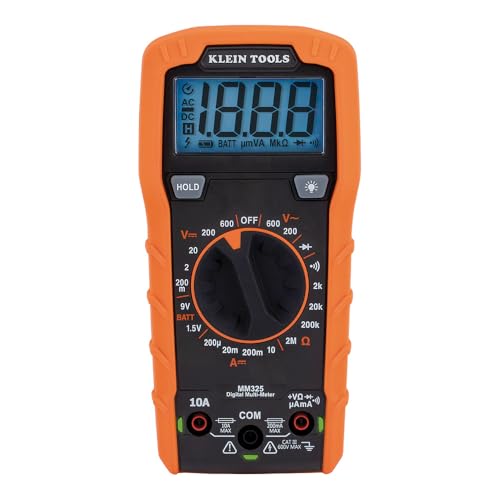
| Klein MM325 meter | Manual ranging, 600 V AC/DC, resistance to 2 MΩ, Lead-Alert LEDs, backlight | You need to read the element in ohms, which A. O. Smith’s test calls for. | You own any meter that reads resistance. |
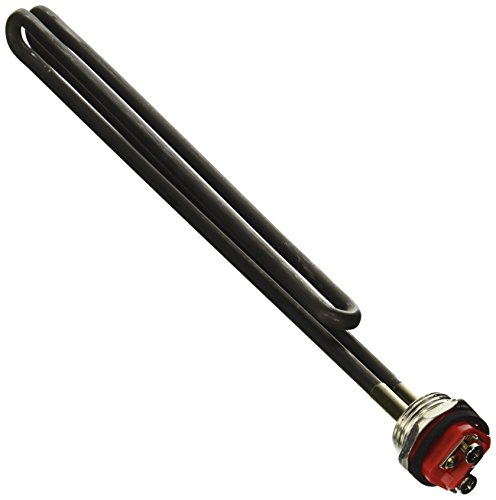
| Rheem SP10869MM | 240 V 4500 W, stainless, low watt density, 1 in. NPSM screw-in, 13.44 in. long | Your data plate says 240 V and 4500 W and the tank is a Rheem family brand. | The plate says 5500 W or 208 V. Match the plate. |
| Camco 02583 | 240 V 4500 W, low watt density, 1 in. NPSM, gasket 06822 included, UL listed | Your plate says 240 V and 4500 W and the tank is one of the many brands Camco lists. | You want stainless. The Camco sheath is plated copper. |
I’ve used each of these. Pick the element by the data plate on the tank, not by the old element. Wattage and voltage are covered in 4500 vs 5500 watt elements and 240V vs 208V elements.
More socket choices, including long-handle wrenches, are in water heater element wrenches.
Pick what you see. Then, if you’ve metered the element, enter the data plate and the reading.
| What you see | Most likely part (A. O. Smith’s list) | Other causes to rule out |
|---|---|---|
| No hot water at all | Upper element, tripped ECO, or upper thermostat | No power at the heater; a hot-side leak bigger than the tank can keep up with |
| Hot water runs out fast | Lower element, or more rarely the lower thermostat | Thermostats set low; a mixing valve in the faucet; a melted dip tube; low supply voltage |
| New heater, never got hot | Upper element burned out by a dry fire | Hot and cold connections swapped; no power |
| Water far too hot, relief valve dumps hot water | A shorted element | A failed thermostat, or one not tight to the tank |
| Lukewarm at one faucet only | Not the heater | A failed mixing valve in that faucet or shower |
Most tanks have two elements, each with its own thermostat. On non-simultaneous wiring, only one heats at a time.
Cold water enters near the bottom, so the lower element sits in the coldest water and runs the most. A. O. Smith says it plainly: the lower element does most of the work, so it usually wears out before the upper one. When it quits, the top of the tank still heats, so you get a short shower instead of none.
The upper element is different. Bradford White’s thermostat test says the upper thermostat switches power to the lower one once the top of the tank is hot. If the upper element dies, the top never gets hot, the hand-off never happens, and the water goes cold. That’s why no hot water at all points up, not down.
Rheem’s bulletin 1302 names the two setups. Non-simultaneous means only the upper or the lower element heats at one time. Simultaneous means both can heat together, for faster recovery. Bradford White’s parts book lists both versions for its double-element tanks.
The test takes five minutes, and you don’t drain anything to do it.
Use the water heater’s own breaker or pull its fuses. Rheem lists 25 A for a 4500 W heater and 30 A for 5500 W at 240 V.
Open the junction box on top and hold the tester to both power wires. A. O. Smith says they’re usually black/black or black/red.
Remove the upper or lower panel, fold the insulation back, and unclip the plastic cover. Test the thermostat’s top screws again.
A reading with the wires on can show you the rest of the circuit instead of the element.
Set the meter to ohms and touch one lead to each screw. A good element reads 5 to 25 ohms on A. O. Smith’s guide.
Use the table below, or the checker above. OL or a reading near zero means the element is done.
| Element on the plate | Should read about | Draws about |
|---|---|---|
| 3500 W at 240 V | 16.5 ohms | 14.6 A |
| 3800 W at 240 V | 15.2 ohms | 15.8 A |
| 4500 W at 240 V | 12.8 ohms | 18.8 A |
| 5500 W at 240 V | 10.5 ohms | 22.9 A |
| 4500 W at 208 V | 9.6 ohms | 21.6 A |
| 5500 W at 208 V | 7.9 ohms | 26.4 A |
| 1500 W at 120 V | 9.6 ohms | 12.5 A |
Values from Rheem Technical Service Bulletin 1305, read Oct 22, 2026. A 208 V element is a different part from a 240 V one, even at the same watts.
A meter only reads the coil inside. An element can read good and still leak at its gasket or be caked in lime, so look at it once it’s out. If both elements read good and the water is still cold, move on to the ECO button and the thermostats.
Thermostat tests and parts are in water heater thermostat replacement. A thermostat swap doesn’t need a drained tank; an element swap does.
The ECO had tripped. A. O. Smith says that usually means an element or thermostat let the tank overheat, so test both.
The ECO wasn’t tripped. A. O. Smith says the upper thermostat is next to check.
Leave the power off. A. O. Smith says not to turn it back on until the overheating cause is found and fixed.
The ECO, or energy cut-off, is the red button on the upper thermostat. It shuts off both elements if the water gets too hot. Press it with the power off, the same way you’d test an element, because the screws next to it carry line voltage when the breaker is on.
These are A. O. Smith’s steps, in order. Allow about two hours afterward for the tank to heat.
Breaker off. Open the junction box and confirm both wires are dead with a non-contact tester.
Run a hot faucet until the water runs cool. A. O. Smith warns you can be scalded draining a hot tank.
Hose on the drain valve, cold supply off, drain open, and a hot faucet open to let air in. Drain at least below the element.
Take the wires off and back it out with an element socket. A. O. Smith says a beveled mechanic’s socket may slip.
Wipe the tank threads, check the plate matches, and put a drop of dish soap on the new gasket so it doesn’t tear.
Close the drain, open the cold supply with a hot faucet open, and let it run full for at least three minutes.
A drip at the element means tighten more. If it won’t stop, drain again and replace the gasket.
Tighten both wires, refit the cover, insulation and panel, close the junction box, and turn the breaker on.
The socket size is 1-1/2 inches on standard screw-in elements, and the element threads are 1 inch NPSM with 11-1/2 threads per inch, per Rheem’s listing for the SP10869MM. Turn counterclockwise to remove. The first turn takes real force on an old element, so brace the tank with your other hand.
A. O. Smith’s steps drain the tank for either element. Draining also lets you see how much sediment comes out. If you’re in there anyway, it’s the time to look at the anode too.
Anode steps and sizes are in water heater anode rod replacement.
A dry fire is power reaching an element that isn’t under water. The element burns out in seconds. A. O. Smith calls it a common installation mistake, says it almost always explains a burned-out upper element on a new heater, and doesn’t cover it under warranty.
The fix is to bleed every bit of air out first. With a hot faucet open, let the water run full for at least three minutes before the breaker goes on. Sputtering at the faucet means air is still in the tank. Keep it running until the stream is smooth.
| Moment | What to do | Why |
|---|---|---|
| Before you drain | Breaker off and taped | Someone flipping it on mid-job burns the element out |
| While refilling | Hot faucet open, cold supply on | Air leaves through the faucet as the tank fills |
| Tank seems full | Run hot water full for 3 minutes | A. O. Smith’s step to clear the last air from the top |
| After power on | Wait about two hours for hot water | A. O. Smith’s typical heat-up time |
| What you see | Likely cause | Fix |
|---|---|---|
| Slow drip at the element threads | Gasket not fully seated | Tighten a little more with the socket |
| Drip won’t stop with tightening | Gasket pinched, rolled or torn | Drain below the element, pull it, fit a new gasket |
| Water around the gasket, old threads look rough | Debris or old gasket stuck in the tank opening | Clean the threads with a rag before refitting |
| Water from the top of the tank | Not the element | Check the pipe connections and the relief valve |
The gasket is what seals, not the threads. That’s why A. O. Smith calls for a drop of dish soap on the gasket: it helps the rubber turn without tearing as you tighten. Bradford White sells the element gasket on its own (part 223-34019-00), so you don’t need a whole element to fix a torn one.
Water coming from the relief valve pipe is a separate problem. See T&P relief valve replacement.
The data plate on the tank decides it. The old element’s stamp can be worn off or wrong.
| Check | Where to find it | Why it matters |
|---|---|---|
| Voltage | Data plate on the tank | Rheem rates its 240 V 4500 W element at 3,380 W on 208 V, about a quarter less |
| Wattage | Data plate on the tank | Rheem sizes the breaker and wire by total watts, so more watts can overload them |
| Mount style | Look at the old element | Most are 1 in. screw-in; older and some brands use a bolted flange |
| Length and shape | Old element; tank size | Camco says its fold-back 02583 needs a tank at least 13 in. across |
| Watt density | Element box | Camco says low watt density cuts lime buildup in hard water |
Bradford White’s parts book lists an Adapt-a-flange kit for tanks that take a flange element when you want to use a screw-in one. That’s a conversion, so match the plate and the kit before you buy.
Replacing both elements at once is your call. If one failed from lime and the other looks the same, swapping both saves draining the tank twice. Element choices by wattage are in 4500 vs 5500 watt elements.
| Part | Upper | Lower | Source |
|---|---|---|---|
| Heating element (Bradford White 240 V 4500 W) | 415-48642-00 | 415-48642-00 | Listed as qty 2 on its double-element models |
| Element gasket | 223-34019-00 | 223-34019-00 | Same gasket for each element |
| Thermostat | Upper thermostat with ECO | Lower thermostat | Different parts (A. O. Smith, Bradford White) |
On a standard two-element tank, the two elements match. Bradford White’s parts book gives one element number with a quantity of two. So you can buy one element for either spot, or two if you want to change both.
The thermostats are where people get caught. A. O. Smith notes the upper and lower thermostats are different, and only the upper one carries the red ECO button. If testing points to a thermostat, take a photo of it before you order.
| Mistake | What happens | Do this instead |
|---|---|---|
| Power on before the tank is full | The upper element dry-fires and burns out | Run hot water full for 3 minutes first |
| Buying by the old element’s stamp | Wrong voltage or wattage for the tank | Read the data plate on the tank |
| Thread tape instead of the gasket prep | Not in A. O. Smith’s steps; the rubber gasket makes the seal | Clean threads and a drop of dish soap on the gasket |
| A beveled mechanic’s socket | It slips and rounds the hex | Use an element socket or wrench |
| Loose wires on the element screws | A poor connection at a 240 V terminal | Tighten both wires; A. O. Smith says to make sure every connection is tight |
| Testing with the wires still on | The meter reads the circuit, not the element | Take both wires off before you meter |
The dry fire is the big one. It burns out a brand-new element in seconds, and A. O. Smith doesn’t cover it under warranty. Tape the breaker off while you work so nobody turns it on halfway through the refill.
Lime builds on elements as a crust and as loose sediment in the bottom of the tank. A. O. Smith says that in most cases it’s easier and cheaper to replace a lime-encrusted element than to scrape it. In very hard water, it says to pull and check the elements every time you drain the tank.
A. O. Smith’s schedule is a drain and flush after the first six months, then at least once a year. If the tank won’t drain because sediment has packed the bottom, it says to have a qualified person use a de-liming agent made for drinking water.
It reads outside 5 to 25 ohms, or it’s caked thick with lime.
You see sand or chips in the drain water, or the lower element keeps failing.
The tank itself leaks. No element or gasket fixes a rusted-through tank.
| Situation | Usually the better move | Why |
|---|---|---|
| One element tests bad, tank is dry | Replace the element | A single part and an hour’s work |
| Element failed on a new heater | Replace the element, refill properly | A dry fire is a fill problem, not a bad tank |
| Water leaks from the tank body or bottom seam | Replace the heater | The tank can’t be repaired |
| Elements keep failing in hard water | Replace the element; flush and consider a softener | Lime is the cause, not the heater |
If you land on a new heater, start with water heaters. Warranty terms vary by maker and model, so read your data plate’s model number against the maker’s warranty before you buy parts for an almost-new tank.
Most heaters run on 240 V. A. O. Smith warns an energized circuit can kill. Test both wires every time.
Run the hot water cool before you open the drain.
A. O. Smith warns of hydrogen gas. Run a kitchen hot faucet for a few minutes first, with no flame nearby.
If any of this is past your comfort level, A. O. Smith says to have a qualified person do it. Your local code may also require a licensed electrician or plumber for any wiring changes.
Yes, if you can shut off and test a 240 V circuit, drain the tank and use a socket. A. O. Smith’s manual lays out the steps for homeowners and says to call a qualified person if you’re not comfortable.
Turn the power off, take the wires off the element, and read across its two screws in ohms. A. O. Smith treats 5 to 25 ohms as good. A 4500 W, 240 V element should read about 12.8 ohms.
Usually the lower. A. O. Smith says it does most of the work, so it wears out first. A dead lower element gives you some hot water; a dead upper element gives you none.
A. O. Smith’s steps drain the tank, and that’s how I’d do it. You need the water below the element at least, and a fresh fill lets you bleed the air before power goes back on.
1-1/2 inches on standard screw-in elements. A. O. Smith says a regular socket may work but is often beveled and can slip, which is why element sockets exist.
A. O. Smith says it may take about two hours for the tank to heat up once the power is back on.
Not required. If the second one reads 5 to 25 ohms and isn’t caked in lime, it can stay. Swapping both saves a second drain if they’re the same age.
Often you can’t tell by looking. Heavy lime crust is the sign A. O. Smith names, and it says replacing a limed element beats cleaning it. Otherwise trust the meter: outside 5 to 25 ohms means replace.
Usually yes. Bradford White lists one element part number with a quantity of two on its double-element tanks. The thermostats differ, though: only the upper one has the ECO reset button.
Doing it yourself, you pay for the element and maybe a socket; see today’s prices in the tools above. A plumber adds labor, which varies by area.
I’m Isaac Daniels, a licensed journeyman plumber in Georgia. I’ve used each tool listed here. The steps follow A. O. Smith’s published manual, and the ohm values come from Rheem’s own bulletin.