
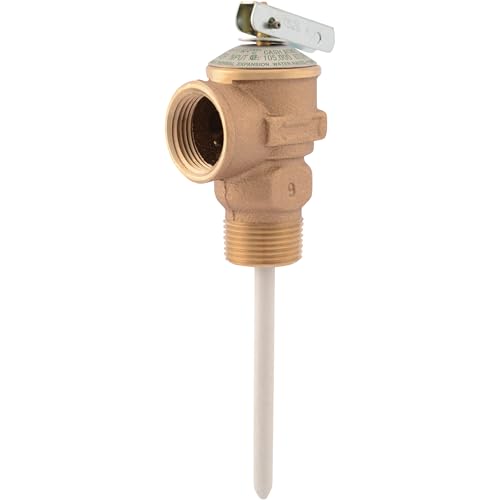
Cash Acme NCLX-5LX
$69.83 at Amazon
Check it on AmazonPrice as of Nov 22, 2026, 9:30 AM EST · low stock then

Match the ratings, shank and sensor before you buy.

As an Amazon Associate I earn from qualifying purchases.
All three picks are 3/4-inch. Get Cash Acme 23266-0150 for a heater-approved NCLX-5LX fit; get NCLX-5 or Watts 100XL-4 when the heater needs that geometry.
A T&P valve protects against excess temperature and pressure. These checks belong to the heater’s exact model, even if its old valve looks identical.
Keep clear of hot discharge. Follow the heater manual’s shutdown procedure and call a licensed plumber promptly. Never cap the valve or its pipe to stop a leak.
Use the heater model and serial number to obtain the correct manual. Don’t remove a pressurized valve just to measure its hidden shank or probe.
Choose by the heater’s approved configuration. Each option below is conditional on all six fit checks, not just the brand on the old valve.

Product prices and availability are accurate as of the date/time indicated and are subject to change. Any price and availability information displayed on Amazon.com at the time of purchase will apply to the purchase of this product.
| Valve | Key specs | Pick it if | Skip it if |
|---|---|---|---|
| Cash Acme NCLX-5LX | NCLX-5LX, 23266-0150, 3/4 in., 150 psi / 210°F, D: 2-5/16 in., CSA: 105,000 Btu/h | The heater maker approves the 3/4-inch NCLX-5LX geometry, ratings and installation location. | Your approved replacement is NCLX-5L, NCLX-5 or a different sensor configuration. Confirm the full model first. |
| Watts 100XL-4 | 100XL-4 family, 3/4 in., 150 psi / 210°F, 4 in. thermostat, CSA: 105,000 Btu/h, Brass per Watts | The heater maker approves this 100XL-4 configuration and your installer has resolved the shank dimensions. | You need an extended shank, an 8-inch thermostat, a different setting or unresolved heater compatibility. |
| Cash Acme NCLX-5 | NCLX-5, 3/4 in., 150 psi / 210°F, D: 1-3/16 in., CSA: 105,000 Btu/h, Confirm delivered tag | The approved replacement is the 3/4-inch, 150 psi NCLX-5 configuration. | Your heater needs 5L or 5LX reach, a different connection, or an unidentified replacement rating. |
Each valve fits only the heater configuration its maker approves, so the heater decides, not a score.
Cash Acme 23266-0150 is the most clearly identified 5LX offer among the listings we checked. The maker’s current table maps that exact number to a 3/4-inch NCLX-5LX at 150 psi. That gives you a specific model to check against the heater manual instead of choosing from a generic relief-valve photograph.
The 5LX suffix matters. Cash Acme gives NCLX-5LX a D dimension of 2-5/16 inches. NCLX-5L has a different D dimension, despite a very similar name. Keep the full suffix on the plumber’s parts list; shortening either name to NCLX makes the order less useful.
Both models appear in the maker’s standard-element table. That does not make them interchangeable. Ask the installer to compare the valve drawing with the heater’s designated opening, including the required position of the temperature-sensing element. The outside jacket alone cannot confirm that the sensor will be in the right water location.
Treat pressure setting as a separate check from physical fit. A valve that screws into the tank still needs the heater-approved temperature and pressure settings. The label on an incorrectly selected old valve is not enough evidence for buying another one. Start with the heater’s requirements and then verify the replacement tag.
For the same reason, don’t buy 5LX just because the old valve drips. The electric heater troubleshooting instructions distinguish expansion-related discharge from a valve that needs replacement. A new valve cannot settle which cause is present. Have the operating condition checked before treating a longer shank as the answer.
My call: choose this exact 23266-0150 listing when the heater’s approved replacement is the 5LX configuration. Have a licensed plumber handle removal and installation after the maker’s shutdown, cooling and depressurization steps. If the manual only identifies a 5L, stop and obtain the correct match rather than guessing from the extra letter.
This Amazon listing names the 100XL-4 at 3/4 inch with a 150 psi set pressure. Its title doesn’t give the temperature setting; Watts’ 0066100 page lists 210°F for this 3/4-inch 100XL. Read the delivered valve’s tag for 100XL-4 and 150/210 before it goes in.
Watts’ exact 0066100 product page lists a 4-inch thermostat probe. Its standard specification sheet distinguishes the 100XL-4 from the 100XL-8. If the heater calls for a different sensing arrangement, the shared 100XL name does not make this the right replacement. Keep the thermostat requirement separate from the connection size.
There is a dimension conflict to resolve before ordering for a tight opening. The exact product page labels the shank 1-1/8 inches. The 100XL-4 M7 drawing table gives D as 1-3/16 inches. We show both figures below rather than pick one.
That difference is a reason to ask Watts or the installer about the actual part and measurement endpoints. It is not a reason to add an extension fitting on your own. The heater’s designated relief opening and the sensor’s required position still control the installation.
A common question is whether this Watts valve directly replaces the factory valve on an A. O. Smith heater. The heater brand alone cannot answer it. Obtain the exact heater manual and compare its approved replacement requirements with the complete valve model. If any rating or geometry is unclear, send both model numbers to qualified service.
My call: use this 100XL-4 option only for a confirmed standard configuration. If the existing paperwork says extended shank or a different thermostat length, keep looking for that exact configuration. Leave the water heater shut down under its maker’s instructions if a failed safety valve prevents safe operation.
The plain NCLX-5 is a separate choice from the 5L and 5LX. Its listing names the 3/4-inch model at 150 psi, and Cash Acme gives that model its own dimensional row. If the heater specifies this configuration, keep the name exactly as written rather than assume an added suffix is an upgrade.
This offer does not state a full maker SKU in its title. We therefore identify it by its stated model, size and setting rather than assign one of the maker’s catalog numbers to the listing. Ask the installer to confirm the delivered identification against the heater paperwork before any old part comes off.
The 3/4-inch qualifier matters just as much as the suffix. Cash Acme also lists a half-inch NCLX-5, and its ratings differ. A search result that only says NCLX-5 leaves out information you need. Check the connection size on the replacement itself instead of using the product family as the whole specification.
Keep body reach and temperature sensing on the same parts request. A measurement taken from the exterior of an insulated heater can help describe the location, but it does not replace the maker drawing. Let the installer establish how the approved valve sits in the tank opening and where its sensing element belongs.
If you are comparing brands, put this exact configuration alongside the proposed Watts model in a written checklist. Compare the ratings and location requirements separately. Nothing in the shared 3/4-inch size proves that the shank, sensing arrangement or approval matches a particular heater.
My call: choose the NCLX-5 only after the 3/4-inch, 150 psi configuration is confirmed for your heater. If the old valve has an unreadable tag and the manual is missing, pause the order. Giving the heater maker its model and serial number is a better next step than buying by the shape of the lever.
| Valve and use | Connections | Relief settings | CSA temperature-steam capacity | Fit advantage | Limit | Buy |
|---|---|---|---|---|---|---|
| Cash Acme 23266-0150; confirmed 5LX fit | 3/4 in. male inlet / female outlet | 150 psi / 210°F | 105,000 Btu/h | Exact maker SKU | D differs from 5L | Check it on Amazon |
| Watts 100XL-4; confirmed standard fit | 3/4 in. male inlet / female outlet | 150 psi / 210°F | 105,000 Btu/h | 4 in. thermostat specified | Shank conflict needs clarification | Check it on Amazon |
| Cash Acme NCLX-5; confirmed standard fit | 3/4 in. male inlet / female outlet | 150 psi / 210°F | 105,000 Btu/h | Distinct standard model row | Full SKU absent from listing title | Check it on Amazon |
CSA temperature-steam capacity and ASME pressure-relief capacity are different columns. Compare the heater’s required rating with the appropriate column, not whichever number is larger.
Cash Acme’s table gives these four 3/4-inch models the same C dimension. Their other dimensions change. Keep the maker’s letters attached to the numbers when discussing fit.
| 3/4-inch model | 150 psi SKU in maker table | C, in. | D, in. | E, in. | Heater manual confirms geometry? |
|---|---|---|---|---|---|
| NCLX-5 | 23261-0150 | 4-7/8 | 1-3/16 | 3-1/16 | Record confirmation |
| NCLX-5L | 23354-0150 | 4-7/8 | 2-3/32 | 2-1/8 | Record confirmation |
| NCLX-5LX | 23266-0150 | 4-7/8 | 2-5/16 | 1-7/8 | Record confirmation |
| NCLX-A | 21714 | 4-7/8 | 3-5/16 | 7/8 | Record confirmation |
On Cash Acme’s drawing, C runs from the outlet centerline down to the tip of the sensing element. D is the threaded shank, from the bottom of the body to the end of the threads. E is the part of the probe that extends past the threads.
So the 5LX has a longer shank and a shorter exposed probe than the plain 5, while its overall reach (C) stays 4-7/8 inches.
A longer body dimension does not mean every part of the valve gets longer. The changing D and E values are why we would send the full Cash Acme row to the installer, not simply request a long valve. Equal C values are not a compatibility test.
Do not compare Cash Acme’s D with another brand’s shank field until the measurement endpoints are checked. Watts labels its thermostat measurement T. That drawing notation is separate from the 4-inch probe description on its product page and from the overall dimensions of another maker’s assembly.
Take photographs of accessible labels without removing the valve. Use this worksheet with the exact heater manual and the replacement’s identification.
| Check | Record from the heater/manual | Compare with the replacement | If unknown |
|---|---|---|---|
| Pressure setting | Approved set pressure; marked working pressure | Setting does not exceed heater limit | Ask heater maker |
| Temperature relief | Required temperature setting | Exact relief temperature on tag | Ask heater maker |
| Capacity and approval | Input Btu/h and required certifications | Required capacity column and listings | Ask qualified installer |
| Connections | Designated opening and outlet size | Both nominal sizes and thread types | Confirm exact model drawing |
| Shank/body reach | Approved reach through jacket and opening | Maker drawing endpoints | No guess from exterior length |
| Sensor location | Required immersed sensing location | Approved element configuration | Licensed plumber confirms |
Begin with the heater model, not its gallon capacity alone. A label saying how much water the tank holds does not identify the required relief capacity or sensor arrangement. On the gas heater manual cited below, replacement capacity is tied to the input Btu/h printed on the rating plate.
Keep a photo of the existing valve tag as supporting information. If its setting disagrees with the heater manual, have the conflict resolved before ordering. Repeating a previous installation error is still an error, even when the replacement carries the same brand name.
The units can look identical even when the test is different. Cash Acme publishes both CSA and ASME ratings in Btu/h.
| Published row | CSA capacity | ASME at 150 psig | What to do with it |
|---|---|---|---|
| 3/4 in. NCLX-5 / 5L / 5LX | 105,000 Btu/h | 500,000 Btu/h | Keep both labels; match heater requirement |
| 1/2 in. NCLX-5 | 15,000 Btu/h | Not ASME rated at this setting | Do not substitute from the family name |
| Watts 100XL-4 M7 | 105,000 Btu/h | Not tabulated here | Use its exact approved application |
For a worked example, suppose a gas heater’s plate lists 40,000 Btu/h input. A required relief-capacity check compares that input with the correct certified capacity of the proposed valve. The 105,000 Btu/h CSA number exceeds 40,000. That passes only the numerical comparison; the other fit checks remain.
The 40,000 figure is an example, not a specification for your heater. Nor is 500,000 Btu/h a substitute label for the CSA temperature-steam capacity. Ask the installer which approval and capacity the heater requires, then record the matched values together.
| Item | Listing or product field | Maker document | Decision |
|---|---|---|---|
| Watts 100XL-4 shank | 0066100 page: 1-1/8 in. | 100XL-4 M7 drawing D: 1-3/16 in. | Keep both; obtain clarification before relying on reach |
| Watts 100XL material | Title calls the body bronze | Watts 100XL page and ES-10L/100XL sheet: brass body | Use Watts’ brass body; the model and 150 psi setting match |
| Watts 100XL temperature | Title gives 150 psi, no temperature | Watts 0066100 page: 210°F | Check the tag reads 150/210 when it arrives |
| Cash Acme NCLX-5L | Title says NCLX-5L / 18821 and push-to-connect | Maker lists 18821-0150 as 5L; NCLX spec describes male/female threaded connections | Excluded until actual connection is confirmed |
| Cash Acme 23266-0150 material | Title says Brass | NCLX spec sheet: body bronze; internal parts brass and stainless steel | Use the maker’s bronze body |
| Zurn alternative offers | 125 psi or 175 psi, or incomplete model suffix | Selected examples require confirmed 150 psi configuration | No Zurn buy link without the exact matching model |
The shank disagreement is between two Watts publications, not proof of two different physical valves. We could not match their measurement endpoints. Ask Watts about the exact replacement part.
The electric heater manual separates pressure and expansion problems from persistent valve leakage. Large hot discharge can indicate overheating.
Have pressure and thermal expansion checked. The cited gas manual calls for a properly sized expansion tank on a closed system; the T&P valve is not a routine expansion control.
The electric manual calls for qualified replacement after its pressure, expansion and debris checks. Record the required model before shopping.
Keep people away, follow the heater’s emergency shutdown instructions and call qualified service promptly. Do not raise the valve setting or plug its outlet.
Replacing a valve does not show whether the old one was reacting to an unsafe condition. Have the plumber explain the cause and the replacement choice separately. For expansion diagnosis, our water heater expansion tank guide is the related starting point.
Watts requires qualified installation. Use this as a service checklist, with the exact heater manual controlling shutdown and restart.
A qualified technician follows the heater’s gas and electrical shutdown instructions. For the cited electric model, open the breaker or remove the fuses and verify power is off before working near electrical parts. Route uncertain isolation to an electrician.
A. O. Smith’s draining steps: turn off gas or power, run a hot faucet until the water is cool, then close the cold-water inlet valve to the heater. Drain to a safe spot and confirm there is no pressure before loosening the relief valve. Call a licensed plumber if shutoff or drainage cannot be confirmed.
The replacement must meet the heater’s rating requirements and occupy its designated relief opening. Watts says the temperature-sensing element must sit in the water within the top 6 inches of the tank. Do not add a shutoff between the tank and relief valve.
Watts says maximum system operating pressure must not exceed 75% of the valve’s set pressure. For a 150 psi valve, that is 112.5 psi of normal operating pressure. The 150 psi number is where the valve opens, not a safe working pressure.
Keep the outlet unrestricted and direct discharge to an approved safe location. The installer must reconcile the heater instructions, valve instructions and adopted local code before choosing the pipe or termination.
The cited electric manual requires a full tank and purged air before restoring power. The technician checks the installation for leaks and follows the heater’s exact restart procedure. Keep electrical parts dry and use qualified service for faults.
If you smell gas, do not operate electrical switches or try to light the heater. Leave the building and call the gas supplier from outside; follow the heater manual’s emergency directions. If the supplier cannot be reached, call the fire department. Gas or combustion work belongs to qualified service.
A correctly sized valve still needs a safe discharge route. These are examples from ICC’s explanation of the 2021 IPC and IRC, not a promise about your local adopted edition.
| 2021 IPC / IRC example | Reason to check it before the job |
|---|---|
| No direct drainage connection; required air gap | The termination arrangement must meet the adopted code |
| No smaller than the valve outlet before the air gap | Do not reduce the relief path |
| One discharge pipe for each relief device | Do not join relief devices into a shared restricted route |
| Gravity drainage; no traps or sags | Water must drain from the route |
| No valves or tee fittings in the discharge line | Keep the relief path clear |
| Insert fittings: one nominal size larger; end secured | Insert fittings reduce the passage; ask about the accepted assembly |
Don’t copy a termination height from a product photo. Watts’ Tag 100, its specification sheet and the heater manual use different clearance wording. Have the installer resolve the actual arrangement with the governing code. We do not turn those differences into a universal height drawing.
| Check | Watts document says | Safe next step |
|---|---|---|
| Lever operation | At least annually, with a connected safe discharge route | Keep clear of hot water; follow the installed valve/heater instructions |
| No free flow during prescribed operation | Shut down the heater and call a plumber immediately | Do not treat a blocked safety valve as normal |
| Physical reinspection | Tag 100: 2–4 years; ES-10L/100XL: at least every 3 years | Ask qualified service which current instructions apply; do not remove it yourself |
CPSC’s historical recall 10-087 concerns one-inch Watts 140X-9 valves, a different family. If that model is on your tag, follow the CPSC notice and contact Watts for the remedy. Matching a brand name alone does not identify whether a recall applies.
These cover the sizing questions people search for, including whether a Watts valve fits an A. O. Smith heater.
No. These three options have 3/4-inch connections, but shank geometry and temperature-sensing arrangements still differ. The heater manual must also approve the settings, capacity and required certifications.
Not from the brand and thread size alone. Use the exact heater model’s manual and compare the complete Watts configuration with its replacement requirements. Resolve the 100XL-4 shank discrepancy with Watts or the installer before relying on that dimension.
Shank describes the body reach into the heater opening. Sensor length is a separate check. Use the maker drawing and heater instructions together; a longer shank does not automatically give the correct immersed sensing location.
Do not assume so. Cash Acme publishes separate dimensional rows for 5L and 5LX. Have the installer confirm the full model and approved geometry rather than order by the shared NCLX name.
Do not raise the setting as a leak fix. The replacement must meet the heater’s requirements and must not exceed its marked working pressure. Have pressure, thermal expansion and overheating assessed by qualified service.
No. Never block the emergency relief path. Keep clear of hot discharge, follow the heater manual’s shutdown instructions and call a licensed plumber promptly.
Only the heater-approved sensing configuration is suitable. Watts distinguishes its 100XL-4 and 100XL-8 models. Choose the required element arrangement rather than treating extra length as a benefit by itself.
Watts requires a qualified service technician or licensed plumbing contractor for installation. Hot water, pressure and the heater’s energy supply must be made safe under the exact heater manual before the valve is loosened. Use qualified service.
The electric heater manual identifies high pressure or thermal expansion as possible causes of discharge. Persistent leakage requires diagnosis and qualified service; repeated valve swaps do not establish the cause. Never plug the outlet.
I’m Isaac Daniels, a licensed journeyman plumber in Georgia. The replacement requirements here come from the heater manuals and the valve makers’ own documents. The fit calls keep the complete model and its limits together.
We read the maker’s ratings and dimensional rows, then matched the supplied Amazon offers to named models. Each valve fits only the heater configuration its maker approves, so the heater decides, not a score. We re-read the Amazon offers on Oct 22, 2026, 6:24 AM EDT; sellers and stock can change.
We flag published conflicts instead of filling gaps from a product photo. CPSC searches on Oct 22, 2026 found no recall for these models; that search is not a guarantee. Confirm the installed tag and current manufacturer instructions with qualified service.
| Selection check | Our rule |
|---|---|
| Model | Genuine named brand and identifiable configuration |
| Offer | New and in stock in the Amazon read of Oct 22, 2026, 6:24 AM EDT |
| Fit | All heater requirements must be confirmed before installation |
| Conflicting information | Show both publications or exclude the unclear offer |
| Score | None; the heater’s approved model, ratings and geometry decide |