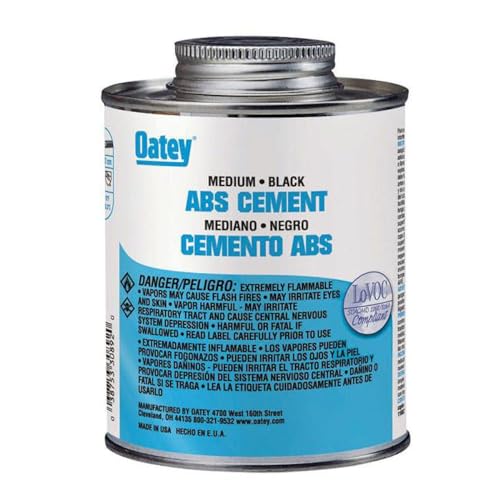
Oatey 30902
$17.28 at Amazon
Check it on AmazonPrice as of Nov 6, 2026, 5:30 AM EST
Why it’s my pick ↓
Four black ABS cements, the set and cure times their makers print, and how much to buy.

As an Amazon Associate I earn from qualifying purchases.
For most ABS drain, waste and vent work, use Oatey ABS Medium Black. Oatey’s sheet covers ABS up to 6 in. and prints set times by temperature. In hot, dry weather, Oatey’s Extra Special sets slower. For ABS up to 8 in., Weld-On 773 is rated for it. Don’t prime ABS.
All four are medium-body black cements for ABS pipe and fittings. All were new and in stock on Amazon on Oct 26, 2026.


Product prices and availability are accurate as of the date/time indicated and are subject to change. Any price and availability information displayed on Amazon.com at the time of purchase will apply to the purchase of this product.
Prices and availability are accurate as of the time shown and may change.
You’re joining ABS drain, waste and vent pipe up to 6 in. and want a cement with printed set and cure times.
You’re working 8 in. ABS. Oatey rates this one to 6 in.; Weld-On 773 goes to 8 in..
The 30902 is my top pick and scores 10.0. Oatey’s spec sheet answers every check on this page, and it’s the ABS cement with the clearest numbers for the person holding the can.
Oatey describes it as a medium-bodied black cement for all schedules and classes of ABS pipe and fittings up to 6 in. with an interference fit, for non-pressure applications. That’s the DWV, sewer and drain work most ABS goes into.
Set times are the reason it wins. Oatey prints them by temperature: 5 to 6 minutes at 30 to 50 °F, 3 to 4 minutes at 50 to 70 °F and 1 to 2 minutes at 70 to 90 °F. Its directions add 15 minutes for good handling strength, and Oatey’s How To Solvent Weld sheet gives cure times before testing by pipe size.
Listings: Oatey says it meets ASTM D2235, the standard for ABS solvent cement, and lists NSF 61 for DWV and sewer and IAPMO. The sheet gives a maximum VOC of 325 g/L, a minimum viscosity of 500 cps at 73 °F and a density of 7.42 ± 0.2 lb per gallon.
Oatey gives an application range of 40 to 110 °F and a 3-year shelf life. The same cement comes in 4 oz (30999), 8 oz (30889), 16 oz (30892), 32 oz (30902) and gallon (30915) cans, so you can match the can to the job. The 32 oz can here is the quart Oatey’s joints-per-quart table is built on.
Two directions from Oatey worth taping inside the lid: hold the joint for 30 seconds so the pipe doesn’t push back out, and never test with compressed air. Oatey’s install sheet also says plainly not to use primer on ABS pipe and fittings.
One mismatch to know about: Oatey’s website product text says set time is about 30 minutes, while its spec sheet gives 1 to 6 minutes by temperature. I follow the spec sheet, and the planner below uses it.
My call: if you’re buying one can of ABS cement for a house’s drain lines, this is it. Buy the 8 oz or 16 oz size for a single bathroom; the quart pays off on a whole rough-in.
Oatey ABS Extra Special Medium Black Cement, 32 oz, 30919
Prices and availability are accurate as of the time shown and may change.
You glue ABS in hot, dry weather and want a cement Oatey made for that job.
You work in cool or humid places. The standard 30902 does the same job with a quicker set.
The 30919 also scores 10.0. It’s Oatey’s Extra Special ABS cement, and Oatey says it’s formulated for hot, arid climates such as the Western states, where a cement can skin over before the joint goes together.
On paper it’s the 30902’s twin: medium body, black, all schedules and classes of ABS up to 6 in. with interference fit, non-pressure use, ASTM D2235, NSF 61 and IAPMO. Oatey gives the same 325 g/L VOC maximum, 500 cps minimum viscosity, 40 to 110 °F application range and 3-year shelf life. Density is 7.26 lb per gallon against the 30902’s 7.42.
The difference is the set. Oatey’s sheet gives 6 to 7 minutes at 30 to 50 °F and 5 to 6 minutes at 50 to 70 °F, against 5 to 6 and 3 to 4 minutes for the 30902. At 70 to 90 °F both are 1 to 2 minutes, so the extra time shows up most in mild weather.
That matters on big fittings. A 4 in. cleanout tee or a combo takes longer to coat and line up than a 1-1/2 in. trap arm, and Oatey’s directions say the cement must still be fluid when you push the joint together. Dried cement can’t be re-coated.
Like the 30902, Oatey says to allow 15 minutes for good handling strength and gives it a 3-year shelf life, so a can bought for summer work keeps for the next few seasons. Can sizes are 4 oz (30916), 8 oz (30917), 16 oz (30918), 32 oz (30919) and gallon (30920).
On Oct 26, Amazon showed this one as in stock but low, so check the listing before you plan a job around it.
My call: pick it for desert attics, summer slab work and any job where you’re coating large fittings by yourself.
RectorSeal John 647L Black Medium Body Low VOC ABS Solvent Cement, 1/4 pint, 55938
Prices and availability are accurate as of the time shown and may change.
You need a small can for a trap arm, a cleanout or one fitting, and want a listed ABS cement.
You want set times by temperature. RectorSeal rates it only as “Fast”.
The 647L scores 8.0. RectorSeal names it “John” in its line of first-name cements, and the quarter-pint can is the size most people need for one repair under a sink or behind a wall.
RectorSeal says it’s UPC listed by IAPMO, meets or exceeds ASTM D2235 and joins ABS pipe and fittings made to ASTM D1788. Its product page gives an actual VOC of 309 g/L against a 325 g/L maximum, and its general chart lists a 40 to 120 °F application range, the widest of the four.
Two checks score 0. RectorSeal rates the cure as “Fast” but prints no set times in minutes, and it publishes no viscosity figure. Its instructions do say to allow 15 minutes to set, so the handling check scores.
There’s a conflict to know about. RectorSeal’s product page says it handles ABS through 8 in. with a 3-year shelf life; its catalog says ABS fittings through 6 in. for Schedule 40 and 80, with a 2-year shelf life. I’d plan on the smaller figures: 6 in. and 2 years.
The Amazon listing also says “NSF approved for potable water”. RectorSeal’s ABS data doesn’t say that for the 647L, and ABS cement isn’t a water-supply product, so don’t read anything into it.
RectorSeal’s instructions match the other makers on primer: for ABS pipe, use a clear cleaner, not a primer. Its safety data sheet lists the cement as a Category 2 flammable liquid, with the warning to keep it away from heat, sparks and open flames.
RectorSeal sells the same cement in half pint (55940), pint (55942) and quart (55944) cans if you like it and need more. My call: a good can for the truck or a repair drawer. For a full rough-in, buy one of the Oatey quarts.
Low VOC Medium Body Black ABS Cement, 1/4 pint, 10246
Prices and availability are accurate as of the time shown and may change.
You’re cementing ABS bigger than 6 in., or ABS foam core, and want the maker’s rating to cover it.
You want printed set and cure times. IPS rates it only as “Fast” and points to the can label.
The 773 scores 7.0, the lowest here but still a pick, because it’s the only cement in this group whose maker rates it through 8 in. on every document I read.
IPS Corporation, which makes Weld-On, describes it as a black, ultra low VOC emission, medium bodied, fast setting ABS cement for all classes and schedules with interference fit through 8 in. (200 mm). It lists DWV, sewer and drain pipe, conduit and foam core.
Listings are strong: IPS says it meets ASTM D2235 and the Uniform Plumbing Code, is certified by NSF International and IAPMO, meets NSF/ANSI Standard 14 and is GreenGuard Gold certified. Its VOC figure, 309 g/L, ties RectorSeal’s actual figure as the lowest here.
Three checks score 0. The data sheet rates the set only as “Fast” with no minutes, gives no cure table, and gives no application temperature range; IPS says detailed directions are printed on the container label. It does give a 500 cps minimum viscosity, a 0.90 ± 0.04 specific gravity and a 3-year shelf life.
IPS is blunt on two safety points: don’t use primer of any kind on ABS, and never use Weld-On cements in systems that use or are tested with compressed air or gas. It also warns not to use it with flue gas venting systems.
Sizes: gallon (10241), quart (10243), pint (10244), half pint (10245) and quarter pint (10246). On Oct 26 this quarter pint was sold by IPS Corp, the maker, through Amazon. One listing for the pint shows a different Weld-On model number in its details than its title, so I left it out.
My call: pick the 773 for 8 in. ABS. Use Oatey’s cure table as a guide for testing, since IPS doesn’t print one.
| Cement | Spec score | Photo | Max ABS size | Set time | VOC | Apply at | Shelf life | Buy |
|---|---|---|---|---|---|---|---|---|
| Oatey 30902 | 10.0 | | 6 in. | 1 to 6 min by temperature | 325 g/L max | 40 to 110 °F | 3 years | Check it on Amazon |
| Oatey 30919 | 10.0 | | 6 in. | 1 to 7 min by temperature | 325 g/L max | 40 to 110 °F | 3 years | Check it on Amazon |
| RectorSeal 647L | 8.0 | | 6 in. (catalog) or 8 in. (page) | “Fast” | 309 g/L | 40 to 120 °F | 2 or 3 years | Check it on Amazon |
| Weld-On 773 | 7.0 | | 8 in. | “Fast” | 309 g/L | Not stated | 3 years | Check it on Amazon |
Every figure is from the maker’s own sheet or page. Where RectorSeal’s product page and catalog disagree, both numbers are shown.
| Cement | Why it isn’t a pick |
|---|---|
| Weld-On 771 ABS (milky) | Same maker as the 773, with no numeric set times on its sheet; the 773 adds the 8 in. rating and GreenGuard Gold |
| Weld-On 773 pint listing | The listing’s model details didn’t match the pint’s maker number, so I couldn’t confirm which can ships |
| Oatey 30889, 8 oz | The same cement as the 30902 in a smaller can; buy it if a quart is more than you need |
Pick the cement, the weather and the pipe size. The planner returns the maker’s set time, Oatey’s cure time before testing and how much cement the job takes.
| Pipe size | 60 to 100 °F | 40 to 60 °F | 20 to 40 °F | 0 to 20 °F |
|---|---|---|---|---|
| 1/2 to 1-1/4 in. | 15 min | 20 min | 30 min | Contact Oatey |
| 1-1/2 to 3 in. | 30 min | 45 min | 60 min | Contact Oatey |
| 4 to 5 in. | 2 hours | 4 hours | 36 hours | Contact Oatey |
| 6 to 8 in. | 8 hours | 16 hours | 3 days | Contact Oatey |
That’s Oatey’s average joint cure time for PVC and ABS cements, the “up to 180 psi” row, from its How To Solvent Weld sheet. Oatey defines cure time as the time required before pressure testing the system, stated for relative humidity of 60% or less; in damp or humid weather it says to allow 50% more.
Oatey also says the data is for new installations, not repairs or cut-ins on hot and cold water lines.
Set time is different. It’s how long before the joint stops moving. Oatey prints set times for its two ABS cements; RectorSeal and IPS rate theirs only as “Fast”, so the planner falls back on what each maker does say.
| Pipe size | 1/2 | 3/4 | 1 | 1-1/4 | 1-1/2 | 2 | 3 | 4 | 6 | 8 |
|---|---|---|---|---|---|---|---|---|---|---|
| Joints per quart | 325 | 250 | 150 | 125 | 90 | 70 | 50 | 30 | 10 | 8 |
Oatey publishes these as estimates from laboratory testing and says field conditions vary. A 32 oz can is one quart, so the 30902 or 30919 can makes about 50 joints at 3 in. or 90 at 1-1/2 in.. A quarter-pint can, the RectorSeal and Weld-On size here, is one-eighth of a quart: about 6 joints at 3 in. or 11 at 1-1/2 in..
My call: a bathroom group with a 3 in. toilet line and 1-1/2 in. and 2 in. trap arms and vents runs well under a quart. Buy the 16 oz can for that, and keep a quarter pint for later repairs. Cement that has thickened to a jelly goes in the trash: Oatey says if it has gelled, don’t use it.
From Oatey’s How To Solvent Weld sheet; the other makers’ directions agree on the points that matter.
Cut the pipe square, deburr the inside, chamfer the outside of the end and wipe off dirt. A plastic pipe saw or a ratchet cutter works on ABS.
The pipe should go 1/3 to 2/3 of the way into the fitting hub before cement. If it bottoms out loose, the fit is wrong.
Oatey and IPS both say not to use primer on ABS. RectorSeal says to use a clear cleaner instead.
Stir or shake the cement. Use an applicator at least half the pipe’s diameter. Put a liberal coat on the pipe end, a thin coat in the hub, then a second coat on the pipe.
Push the pipe into the hub with a quarter turn while the cement is still wet. Dried cement can’t be re-coated.
Hold the pipe bottomed in the hub for 30 seconds so it doesn’t push back out, then wipe off the extra cement.
Allow 15 minutes before handling, then the cure time in the table above before testing. Never test with compressed air or gas.
Oatey’s sheet warns against puddling: too much cement inside the hub can weaken the joint and lead to failure. That’s why the hub gets the thin coat and the pipe gets the heavy one. Lower temperatures and larger pipe may need a little extra hold time, Oatey adds.
My call: cut, dry fit and mark every joint in a run before you open the can. Then cement in order without stopping. ABS cement sets fast in warm weather, and a half-coated fitting is a cut-out.
ABS cement isn’t PVC cement in a different color, and ABS doesn’t take primer.
Use a black ABS cement that meets ASTM D2235. All four picks do.
Oatey: don’t use primer on ABS. IPS: no primer of any kind. RectorSeal: a clear cleaner, not a primer.
None of these four is sold for ABS-to-PVC transition joints. Check your local code for what it allows; many use a mechanical coupling instead.
Oatey and IPS both say never to test solvent-cemented plastic pipe with compressed air or gas.
Black is the industry’s color for ABS cement. RectorSeal’s catalog puts it plainly: clear for PVC, gray for electrical conduit, black for ABS, gold and orange for CPVC and blue for irrigation. That makes an inspector’s job easy, and it’s why a can of black cement is the right can for black pipe.
PVC is a different story. For PVC cement, primer and the purple-primer question, see our PVC cement guide and whether purple primer is required. For the pipe choice itself, our PVC vs. ABS pipe page compares the two.
Temperature changes how fast ABS cement sets, and age changes whether it works at all.
| Condition | What the makers say | What to do |
|---|---|---|
| Hot, dry (70 to 90 °F) | Oatey: 1 to 2 min set for both ABS cements; 30919 is made for hot, arid climates | Work in small batches; use the 30919 |
| Mild (50 to 70 °F) | Oatey: 3 to 4 min (30902), 5 to 6 min (30919) | The normal case |
| Cool (30 to 50 °F) | Oatey: 5 to 6 min (30902), 6 to 7 min (30919); cure up to 60 min for 3 in. at 20 to 40 °F | Plan longer cure before testing |
| Application range | Oatey: 40 to 110 °F. RectorSeal: 40 to 120 °F. IPS: not stated | Keep the can and pipe in that range |
| Humid weather | Oatey: allow 50% more cure time | Add half again to the cure table |
| Shelf life | Oatey and IPS: 3 years. RectorSeal: 3 years on its page, 2 in its catalog | Don’t use cement that has gelled |
Oatey gives set times down to 30 °F but an application range starting at 40 °F. I read that as: the set table covers cold air, but the cement and pipe should be at least 40 °F when you apply it. Keep the can in the truck cab or the house in winter, not on the trailer.
Keep the lid on between joints. Oatey says to keep the container closed when not in use, and an open can thickens as the solvent leaves it.
ABS cement is a flammable solvent. Treat the can like one.
RectorSeal’s SDS lists the 647L as a Category 2 flammable liquid: keep it away from heat, sparks, open flames and hot surfaces. No smoking.
The same SDS warns of respiratory irritation, drowsiness and dizziness. Ventilate crawlspaces and closets.
Oatey: wear safety glasses with side shields and rubber gloves, and avoid eye and skin contact.
All four list a VOC figure of 325 g/L or lower; the Weld-On 773 and RectorSeal 647L give 309 g/L.
Three questions settle it.
Up to 6 in.: any of the four. Over 6 in.: Weld-On 773, rated through 8 in..
Hot and dry: Oatey 30919. Everywhere else: Oatey 30902.
Use the joints-per-quart table. One repair: a quarter pint. A bathroom: 16 oz. A whole house: a quart or two.
| Your job | Cement | Why |
|---|---|---|
| New ABS drain lines in a house | Oatey 30902 | Rated to 6 in. with set times printed by temperature |
| Summer work in a hot, dry climate | Oatey 30919 | Slower set, made for hot, arid climates |
| One trap arm or cleanout repair | RectorSeal 647L | Quarter-pint can |
| 8 in. ABS sewer or foam core | Weld-On 773 | Rated through 8 in., including foam core |
No. Oatey says not to use primer on ABS pipe and fittings, IPS says no primer of any kind, and RectorSeal says to use a clear cleaner instead.
Oatey’s 30902 sets in 1 to 2 minutes at 70 to 90 °F, 3 to 4 minutes at 50 to 70 °F and 5 to 6 minutes at 30 to 50 °F. Oatey says to allow 15 minutes for handling strength.
Oatey’s cure table gives 30 minutes for 1-1/2 to 3 in. pipe at 60 to 100 °F, up to 60 minutes at 20 to 40 °F, and 50% more in humid weather. Larger pipe takes hours.
Use a cement made for ABS. All four here meet ASTM D2235, the standard for ABS solvent cement. PVC cements are made to a different standard.
A properly cured solvent-cemented joint is watertight. The makers rate these cements for drain, waste, vent and sewer pipe.
Yes. Oatey and IPS give a 3-year shelf life. Oatey says not to use cement that has gelled.
Oatey estimates a quart makes about 90 joints at 1-1/2 in., 70 at 2 in., 50 at 3 in. and 30 at 4 in..
The spec score uses the same ten checks for all four cements, from each maker’s data sheet, product page, catalog and install directions. It measures how completely each maker documents what an installer needs: size, set, cure, standards, VOC, temperature and shelf life. A check scores 0 when the maker doesn’t state it, so a missing fact never earns points.
| Check (points) | How it’s scored |
|---|---|
| Max pipe size stated (1) | The maker states the largest ABS pipe size the cement is for |
| Set times in minutes (1) | The maker prints set times in minutes, not only “Fast” |
| Handling or cure guidance (1) | The maker gives handling time or a cure table |
| Meets ASTM D2235 (1) | The maker says it meets ASTM D2235 |
| Third-party listing named (1) | The maker names a listing body such as IAPMO or NSF |
| VOC figure published (1) | The maker publishes a VOC figure |
| Application temperature range (1) | The maker gives an application temperature range |
| Shelf life stated (1) | The maker states a shelf life |
| Viscosity published (1) | The maker publishes a viscosity figure |
| Listing matches the maker (1) | The Amazon listing’s model matches the maker’s |
| Total (10) | Sum of the checks |
| Cement | Max pipe size stated | Set times in minutes | Handling or cure guidance | Meets ASTM D2235 | Third-party listing named | VOC figure published | Application temperature range | Shelf life stated | Viscosity published | Listing matches the maker | Score |
|---|---|---|---|---|---|---|---|---|---|---|---|
| Oatey 30902 | 1 | 1 | 1 | 1 | 1 | 1 | 1 | 1 | 1 | 1 | 10.0 |
| Oatey 30919 | 1 | 1 | 1 | 1 | 1 | 1 | 1 | 1 | 1 | 1 | 10.0 |
| RectorSeal John 647L | 1 | 0 | 1 | 1 | 1 | 1 | 1 | 1 | 0 | 1 | 8.0 |
| Weld-On 773 | 1 | 0 | 0 | 1 | 1 | 1 | 0 | 1 | 1 | 1 | 7.0 |
Tie: both Oatey cements score 10.0. I list the 30902 first because it fits more climates.
I’m Isaac Daniels, a licensed journeyman plumber in Georgia (license #JP507711). I’ve used every cement picked here. The specs come from Oatey’s spec sheets and How To Solvent Weld guide, IPS Weld-On’s 773 data sheet and RectorSeal’s 647L page, catalog and SDS, read Oct 26, 2026.