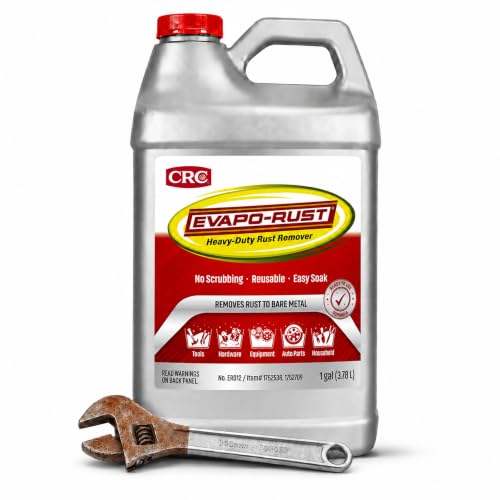
Evapo-Rust
$29.89 at Amazon
Check it on AmazonPrice as of Oct 23, 2026, 5:30 AM EDT
Details ↓
Three soak rust removers scored on their makers’ safety and data sheets, with soak times for every level of rust.
As an Amazon Associate I earn from qualifying purchases.
Get Evapo-Rust (9.6). Its maker says it won’t harm brass, copper or rubber. For the mildest safety sheet, get WD-40 Rust Remover Soak.
All three are water-based soaks you reuse: drop the part in, wait, rinse. Each was new and in stock on Amazon on Oct 23, 2026, and each scores 7.0 or higher.


Product prices and availability are accurate as of the date/time indicated and are subject to change. Any price and availability information displayed on Amazon.com at the time of purchase will apply to the purchase of this product.
Seven checks from each maker’s safety data sheet (SDS), data sheet and product page, equal weight. The rules and every input are in the method section.
Nobody publishes a rust test you can line up across brands, and we didn’t run one. So the score doesn’t claim one jug strips rust faster. It scores what a plumber cares about when a rusty pipe wrench, cutter or die head goes into a bucket overnight.
That’s the health warnings on the SDS, how acidic it is, whether the maker says it leaves brass and copper alone, whether it’s safe on rubber grips, plastic and paint, how long the maker says to soak, whether you can reuse it, and whether the Amazon listing matches the maker’s part number.
A well-known bath from Rust-Oleum scored 3.6 on the same checks. Its SDS lists chromium trioxide. It’s in the left-out table with the details.
What each maker publishes, which jobs each suits and where each lost points.
Heavy Duty Rust Remover, 1 gallon, part ER012
Prices and availability are accurate as of the time shown and may change.
You’re soaking a whole tool that has brass, rubber or plastic on it: a tubing cutter with a plastic knob, a pipe wrench with a painted handle, a basin wrench, a die head.
You need to remove an orange stain from porcelain. Evapo-Rust says the soak won’t work on rust stains.
Evapo-Rust is the one I’d fill a bucket with, and I’ve used it. CRC Industries makes it now, and the gallon jug is part ER012. It scored 9.6.
The reason is what it doesn’t touch. Evapo-Rust’s FAQ says it won’t clean or damage brass, copper or aluminum, and won’t harm rubber, plastic, clothing or glass.
Its product page adds PVC and Viton, and its FAQ says paint stays on as long as it contains no oxides. A plumber’s tools are a mix of steel jaws, brass parts, rubber grips and painted handles, and this is the only pick that names all of them.
It works by chelation. Evapo-Rust says its active ingredient bonds only to iron and is too weak to pull iron out of solid steel. That’s why it can leave unrusted metal alone.
The SDS, revised December 1, 2022, lists two health classes: skin irritation and eye irritation. That’s a 7.0 on health, and the reason to wear gloves and glasses anyway. It prints pH 5.9 and no flash point, and says used product is not a RCRA hazardous waste.
Soak times are clear. Evapo-Rust says 30 minutes for light rust and up to overnight for heavy rust. If rust stays in the pits, rinse and soak again. It also says to always rinse after a soak, because tiny bits of iron from the solution stay on the part. Air dried, the part stays rust-free for up to two days.
Reuse is where it shines. Evapo-Rust says one gallon removes about ½ pound of pure dry rust, and you reuse it until it stops working. Its sell sheet lists the gallon as ER012, 128 ounces, and the Amazon listing matches.
Two limits. It strips bluing and other oxide finishes in about 30 minutes. It isn’t recommended on magnesium. High-carbon steel can come out dark, which Evapo-Rust says is carbon on the surface, not damage.
My call: this is the bucket for the whole bag of tools. Soak overnight, rinse, dry, and oil the jaws.
WD-40 Specialist Rust Remover Soak, 1 gallon, UPC 079567300045
Prices and availability are accurate as of the time shown and may change.
You want the mildest jug on the shelf: you’ll be reaching into it, working in a heated shop, or soaking parts where fumes and skin contact matter.
The part has a painted finish you need to keep, or your garage sits below 60°F in winter.
WD-40 Specialist Rust Remover Soak is the gentlest jug here on paper, and I’ve used it. It’s a different product from WD-40 Multi-Use and from the Specialist Penetrant. It scored 8.9.
Its safety data is the best of the three. WD-40’s data sheet says it isn’t hazardous under US OSHA or Canadian rules and may only cause mild eye or skin irritation and dryness with long contact. It lists pH 6 to 8, no flash point and 0% VOC.
It needs no Prop 65 warning, and it’s on NSF’s nonfood compounds list as P1. That’s a 10 on health and a 10 on pH.
Its soak directions are the clearest anywhere: at least 30 minutes for light rust, overnight, which WD-40 defines as 8 hours, for medium rust, and up to 24 hours for heavy rust. If rust stays in the pits, soak again and rinse.
Temperature matters with this one. WD-40 says to use it at room temperature or warmer, because speed and performance drop significantly below 60°F. A cold garage in January is the wrong place for it.
It lost points on metals and paint. WD-40 names steel and aluminum as safe, but says nothing about brass or copper, a 5. On paint it says two things: it works without harming surrounding rubber, plastic and paint, but don’t use it on metal with bluing, browning, other oxide coatings or paint. That mix scores 7.
Reuse is clear. WD-40 says the solution darkens as it works and is spent when it turns black and stops working, and not to pour used solution back into the fresh jug. For disposal, it says to check with your local water treatment facility.
The Amazon listing carries model 300045 and UPC 079567300045, the item UPC on WD-40’s data sheet. That’s a 10.
My call: this is the jug for anyone who doesn’t want to think about gloves. Keep it warm and give heavy rust the full 24 hours.
B’laster Metal Rescue Rust Remover Bath, 1 gallon, part 128-MR
Prices and availability are accurate as of the time shown and may change.
You can keep the bath warm, such as a shop that runs warm or a bucket by the water heater closet, and you want a maker that says the gloves are optional.
You want a written soak time to plan around. Evapo-Rust and WD-40 both print one.
Metal Rescue is B’laster’s rust bath, the same company behind PB B’laster, and I’ve used it. The gallon is part 128-MR on B’laster’s data sheet. It scored 7.9.
Like Evapo-Rust, it works with a chelating agent that B’laster says is selective for rust. B’laster’s line is that it’s safe on everything except rust.
Its safety sheets don’t quite agree. The SDS, dated October 22, 2019, says it isn’t a hazardous substance or mixture. B’laster’s data sheet, updated May 10, 2021, says it causes serious eye irritation and to wear safety glasses. We score the stricter one: one health class, an 8.5. It says gloves are recommended but not necessary. The SDS prints pH 6.0 to 7.0, a 10.
Temperature is its edge. B’laster gives an optimal range of 68 to 150°F, the only maker here to print a top end. Warm water speeds it up, so it suits a heated shop.
It lost points for thin directions. B’laster’s data sheet says only “Just soak, check, rinse/dry” with no time, a 5. Its data sheet says it removes rust from iron or steel, and its product page says it can be used on all metal surfaces, with no mention of brass or copper. That’s a 5. “Safe on everything except rust” is a general claim, a 7.
Reuse is clear: B’laster says it’s reusable until the solution turns completely black, a 10. The SDS says to dispose of contents at an approved waste disposal plant.
The Amazon listing is part 128-MR, sold by B’laster’s own holding company, which matches the data sheet, a 10. It showed limited stock on Oct 23, so the card may show no price at times.
My call: a good bath if you check it often. Pull the part, look, and put it back until the rust is gone.
Safety and material facts from each maker’s SDS, data sheet and product page.
| Pick | Spec score | Photo | pH | Brass and copper | Soak time | Short pros / cons | Buy |
|---|---|---|---|---|---|---|---|
| Evapo-Rust | 9.6 | | 5.9 | Named safe | 30 min–overnight | Safe on rubber and PVC / Skin irritant | Check it on Amazon |
| WD-40 Rust Remover Soak | 8.9 | | 6–8 | Not named | 30 min–24 h | Mildest SDS / Slow below 60°F | Check it on Amazon |
| Metal Rescue | 7.9 | | 6.0–7.0 | Not named | Not stated | Works warm / No soak time | Check it on Amazon |
From CRC’s Evapo-Rust SDS (Dec 2022), sell sheet and FAQ; WD-40 Company’s Rust Remover Soak data sheet (08/2026) and product page; and B’laster’s Metal Rescue SDS (Oct 2019) and data sheet (May 2021), read Oct 23, 2026. Health classes for each are in the safety section below.
Plumbing tools and parts are never all steel. Here’s what each maker says in writing.
| Remover | Metals the maker names | Rubber, plastic and paint |
|---|---|---|
| Evapo-Rust | Won’t clean or damage brass, copper or aluminum; not for magnesium | Won’t harm rubber, plastic, PVC, Viton or most paints |
| WD-40 Rust Remover Soak | Safe on steel and aluminum | Won’t harm rubber, plastic or paint, but don’t soak painted metal |
| Metal Rescue | Iron and steel; “all metal surfaces” | “Safe on everything except rust” |
| Rust-Oleum Rust Dissolver (left out) | Iron, steel, aluminum, chrome, galvanized | Don’t let it dry on paint; not on marble |
Where does this matter on real tools? A tubing cutter has a steel wheel, a brass or plated feed screw and often a plastic knob. A pipe wrench has a painted handle. A press tool’s jaws are steel, but the tool body isn’t something you soak at all. Brass compression nuts and copper fittings don’t rust in the first place, so they only matter as passengers in the bucket.
My call: if you’ll drop a whole tool in, use Evapo-Rust. With the other two, take the steel part off when you can and soak just that part.
A soak sits in an open bucket for hours, and you reach into it. The SDS tells you how careful to be.
| Remover | pH | What the maker lists | Gloves |
|---|---|---|---|
| WD-40 Rust Remover Soak | 6–8 | Not hazardous; mild eye or skin irritation and dryness with long contact | Optional (non-irritating to skin, per WD-40) |
| Metal Rescue | 6.0–7.0 | SDS: not hazardous. Data sheet: causes serious eye irritation | Recommended, not necessary, per B’laster |
| Evapo-Rust | 5.9 | Skin irritation; eye irritation | SDS says wear protective gloves |
| Rust-Oleum Rust Dissolver (left out) | 1.0–3.0 | Skin and eye irritation, skin and breathing allergy, may cause genetic defects, may cause cancer, suspected of harming fertility | SDS says gloves, eye and face protection |
pH tells you how acidic a liquid is; 7 is neutral, and every step down is ten times more acidic. The three picks sit between about 6 and 8. Rust-Oleum’s bath sits at 1 to 3, which is why its SDS reads so differently.
My call: nitrile gloves and safety glasses with all of them anyway. The rust and grime coming off a drain tool aren’t clean either. Our nitrile gloves guide covers gloves that hold up.
Pick the remover, the rust and where the bucket sits. The planner gives the maker’s soak time and what the temperature does.
| Remover | Light rust | Medium rust | Heavy rust | Temperature |
|---|---|---|---|---|
| Evapo-Rust | 30 minutes | 30 minutes to overnight | Overnight, re-soak pits | No range printed |
| WD-40 Rust Remover Soak | At least 30 minutes | Overnight (8 hours) | Up to 24 hours | Slows a lot below 60°F |
| Metal Rescue | Not stated | Not stated | Not stated | Optimal 68–150°F |
From Evapo-Rust’s how-to and FAQ, WD-40’s Rust Remover Soak data sheet and B’laster’s Metal Rescue data sheet, read Oct 23, 2026.
The three makers agree on the method. The steps below follow their directions.
Wash off cutting oil, pipe dope and grease. WD-40 says to remove oils and greases with a detergent or degreaser first, and Evapo-Rust says surface dirt slows the soak.
Pull the steel parts off: cutter wheels, wrench jaws and nuts, die heads. Rust-Oleum’s data sheet says to take apart anything with moving parts before cleaning.
Use enough to cover the part completely, as WD-40 and Evapo-Rust both say. A plastic bucket with a lid keeps it from evaporating.
Use the maker’s time from the planner above. Pull the part, look in the pits, and put it back if rust remains.
Rinse with water. Evapo-Rust calls this step very important, because tiny bits of iron from the solution stay on the part.
Dry it right away and oil steel jaws, threads and pivots. WD-40 suggests a spray of WD-40 Multi-Use to stop flash rust.
Keep the soak separate from your drain tools’ cleaning bucket. Rust removers aren’t disinfectants, and a cable that’s been down a toilet line needs a wash and a disinfectant before it ever goes into a bucket you’ll reuse.
My call on the tools worth saving: pipe wrenches, chain wrenches, tubing and pipe cutters, die heads, basin wrenches and pliers. For our picks of those, see the pipe wrench guide and the pipe cutter guide.
| Tool | What to soak | What to keep out |
|---|---|---|
| Pipe wrench | Hook jaw, heel jaw and nut | Nothing, but oil the nut threads after |
| Tubing cutter | Wheel and rollers, off the frame if you can | Plastic knob, unless it’s Evapo-Rust |
| Pipe threader die head | Dies and the head | Ratchet handle bearings |
| Basin wrench | Jaw and shaft | Nothing |
| Drain auger cable | Only after it’s cleaned and disinfected | The drum and any motor |
| Press tool or cordless tool | Nothing | The whole tool; never soak a tool with a motor or battery |
All three picks are reusable. The makers tell you when the solution is done and how to get rid of it.
| Remover | When it’s spent | Disposal, per the maker |
|---|---|---|
| Evapo-Rust | When it stops working; a gallon removes about ½ lb of dry rust | Follow local, state and federal rules; the SDS says it isn’t RCRA hazardous waste |
| WD-40 Rust Remover Soak | When it turns black and no longer works | Check with your local water treatment facility |
| Metal Rescue | When it turns completely black | SDS: an approved waste disposal plant |
Half a pound of rust sounds small. Evapo-Rust points out that rust is about 1/17th the weight of the iron it came from, so a gallon handles a lot of tools.
My call on disposal: none of the makers says to pour it down a drain without asking. Spent solution carries the iron and whatever grime came off the tools. Call your city’s water treatment office or the household hazardous waste drop-off, and keep the jug labeled until then. And never pour used solution back into the fresh jug; WD-40 says so outright.
A soak is for metal you can take off and drop in a bucket. It isn’t a stain cleaner.
Evapo-Rust says it plainly: its soak will not work on rust stains. Those orange rings in a toilet bowl or down a tub aren’t rusty metal. They’re iron from the water, dried onto porcelain or fiberglass, and they need a stain cleaner made for that surface.
The bigger point: a stain that comes back after you clean it means iron in the water. Cleaning treats the mark, not the cause. Test the water, and if iron is high, look at an iron filter for well water. If you have a softener, an iron-rated resin cleaner keeps it working; see our water softener cleaner guide.
| What you see | What it usually is | What to do |
|---|---|---|
| Orange ring at the toilet waterline | Iron in the water | Stain cleaner for porcelain; test the water |
| Orange streak under a tub spout | Iron in the water, sometimes a dripping valve | Fix the drip; test the water |
| Rust flakes from a water heater | Tank or anode corrosion | See our anode rod guide |
| Rust on a chrome trim plate | Chrome worn through to the steel | Replace the trim; a soak will strip what’s left |
For rusty water from the heater, our anode rod replacement guide covers the part that wears out first.
Scored on the same seven checks, it came in at 3.6. Here’s why.
| Remover | Spec score | What we found | Why it’s out |
|---|---|---|---|
| Rust-Oleum Rust Dissolver, 1 gallon (SKU 286746) | 3.6 | Phosphoric acid, pH 1.0 to 3.0; SDS lists chromium trioxide with seven health classes, including cancer 1A and mutagen 1B | Under 7.0 on health and pH |
Rust-Oleum’s Rust Dissolver works fast. Its data sheet says 3 to 5 minutes on aluminum, chrome and new galvanized, and 15 to 30 minutes on iron and steel. It also works on more surfaces than the picks, including porcelain, tile and fiberglass.
The SDS for the gallon, revised August 4, 2026, is the problem. It lists phosphoric acid and chromium trioxide, signal word Danger, and health classes from skin irritation up to “may cause cancer” and “may cause genetic defects.” For a bucket you reach into, that’s not a trade I’d make when pH-neutral soaks do the same job overnight.
Not compared here because they’re different kinds of product: gels and jellies you brush on, rust converters that turn rust into a primer, and spray cleaners. They work differently, and one score wouldn’t be fair to all of them.
| Question | If yes | If no |
|---|---|---|
| Will you soak whole tools with brass, rubber or plastic on them? | Evapo-Rust | Next question |
| Do you want the mildest safety sheet? | WD-40 Rust Remover Soak | Next question |
| Is the bucket somewhere warm, and will you check it often? | Metal Rescue | Evapo-Rust or WD-40 |
| Is the bucket below 60°F? | Evapo-Rust, or bring it inside | Any of the three |
My call for a plumber: one gallon of Evapo-Rust in a lidded bucket, and a few minutes on Sunday night to drop in whatever came home rusty.
A rust remover won’t free a seized thread. For stuck nuts, see our penetrating oil guide, and for cleaning up threads and fittings by hand, our wire brush guide.
For plumbing tools and parts, Evapo-Rust, 9.6 on our spec score. It’s pH neutral, reusable, and its maker says it won’t harm brass, copper, aluminum, rubber, plastic or most paints.
Acid baths act fastest; Rust-Oleum’s Rust Dissolver works in 15 to 30 minutes on steel. Its SDS lists chromium trioxide and a cancer class, so we left it out for soaks you reach into.
A chelating soak. Evapo-Rust, WD-40 Rust Remover Soak and Metal Rescue all remove rust by soaking alone, then a rinse with water.
WD-40 Multi-Use loosens rust but doesn’t dissolve it. WD-40 Specialist Rust Remover Soak is a separate product that removes rust in 30 minutes to 24 hours.
An acid remover is quickest, but harsh. A neutral soak takes about 30 minutes for light rust and overnight for heavy rust, with no scrubbing.
Vinegar is an acid and keeps eating metal after the rust is gone. Evapo-Rust says its active ingredient bonds only to iron in rust and won’t harm unrusted steel.
Evapo-Rust says it won’t clean or damage brass, copper or aluminum. WD-40 names only steel and aluminum. Metal Rescue’s data sheet names iron and steel.
Yes, all three picks. Evapo-Rust says a gallon removes about ½ lb of dry rust. WD-40 and Metal Rescue say the solution is spent when it turns black.
Follow local rules. WD-40 says to check with your water treatment facility. Evapo-Rust’s SDS says used product isn’t RCRA hazardous waste.
WD-40 says its soak slows a lot below 60°F. Metal Rescue’s optimal range is 68 to 150°F. Bring the bucket indoors in winter.
No. Evapo-Rust says its soak won’t work on rust stains. Stains come from iron in the water, so test the water too.
Evapo-Rust says that’s carbon from the steel moving to the surface, not damage. Wiping or buffing can remove it.
I’m Isaac Daniels, a licensed journeyman plumber in Georgia (license #JP507711), and I’ve used all three picks. Every fact here comes from CRC’s, WD-40 Company’s, B’laster’s and Rust-Oleum’s own safety data sheets, data sheets and product pages, read Oct 23, 2026. Where I add advice of my own, it’s labeled as my call.
Seven checks, one seventh each, 0 to 10. When a maker’s SDS and data sheet disagree, as Metal Rescue’s do on eye irritation, the stricter one counts. This score reads paperwork; it isn’t a timed rust test, and buyers’ opinions play no part in it.
| Check (weight) | How it’s scored |
|---|---|
| Health hazards (1/7) | 10 minus 1.5 for each GHS health class the maker lists; minus 3 more for a cancer, mutagen or reproductive class; not below 0 |
| pH (1/7) | 10 for pH 5 to 9; 5 for 3 to 5; 0 below 3 |
| Brass and copper (1/7) | 10 when the maker says brass and copper are safe; 5 when it names other metals only; 0 for nothing |
| Rubber, plastic, paint (1/7) | 10 when the maker names them safe; 7 for a general safety claim or mixed advice; 0 for nothing |
| Soak directions (1/7) | 10 for soak times by rust level; 5 for “soak” with no time; 0 for none |
| Reuse (1/7) | 10 when the maker gives a capacity or a spent sign; 7 for “reusable” only; 0 for nothing |
| Listing match (1/7) | 10 when the Amazon listing’s part number or UPC matches the maker; 5 for one conflict; 0 if it can’t be tied to a product |
| Total | Average of the checks, to one decimal |
| Remover | Health | pH | Brass | Rubber | Soak | Reuse | Listing | Score |
|---|---|---|---|---|---|---|---|---|
| Evapo-Rust | 7.0 (2) | 10 (5.9) | 10 | 10 | 10 | 10 | 10 | 9.6 |
| WD-40 Rust Remover Soak | 10 (0) | 10 (6–8) | 5 | 7 | 10 | 10 | 10 | 8.9 |
| Metal Rescue | 8.5 (1) | 10 (6.0–7.0) | 5 | 7 | 5 | 10 | 10 | 7.9 |
| Rust-Oleum Rust Dissolver | 0 (7 + cancer) | 0 (1.0–3.0) | 5 | 0 | 10 | 0 | 10 | 3.6 |
Rust-Oleum’s reuse score is 0 because its data sheet and SDS don’t say it can be reused; its Amazon listing does. Its rubber score is 0 because its documents name porcelain, tile, fiberglass and glass, but not rubber or plastic.