
Eastman 48370 4 ft pair
$27.00 at Amazon
Check it on AmazonPrice as of Oct 23, 2026, 5:30 AM EDT
Details ↓
The right length and ends for your hookup.
As an Amazon Associate I earn from qualifying purchases.
For most washers, buy the Eastman 48370 4 ft braided pair. If the washer sits tight to the wall, get a pair with elbows. Whirlpool says to replace hoses after 5 years. A FloodStop kit shuts the water off if one leaks.
Three braided hose pairs, one for each common hookup. Every one was the genuine brand, new and in stock on Amazon when I checked. Prices come from Amazon and show the time they were read.
Product prices and availability are accurate as of the date/time indicated and are subject to change. Any price and availability information displayed on Amazon.com at the time of purchase will apply to the purchase of this product.
The number most hose ads skip. Here’s the working pressure each maker or listing publishes. Where a listing gives none, the bar says so.
The International Plumbing Code (section 604.8) calls for a pressure-reducing valve once static house pressure tops 80 PSI, so a 125 PSI rating has room to spare. The point of the chart is paperwork. Eastman and Fluidmaster put a number on their hoses. One listing doesn’t, and I’d rather buy the hose that has one when everything else is equal.
Eastman 48370 braided stainless washer hoses, 4 ft pair
Prices and availability are accurate as of the time shown and may change.
Your washer box or hose bibbs sit behind the washer, within about 3 feet of the inlets, and the washer has room to come out a little for service. Pick the 6 ft 48372 if the valves are farther away.
The back of the washer sits within a few inches of the wall. A straight nut there bends the hose sharply right at the fitting, and a pair with elbows fits better.
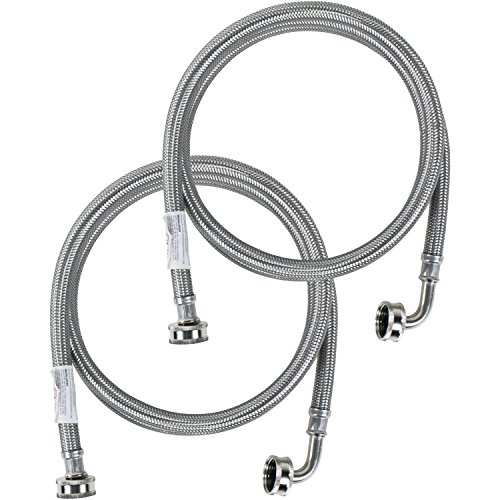
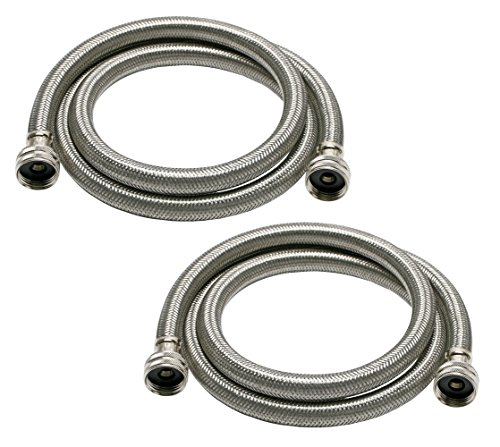
This is the hose pair I’d put on most washers. It’s two 4 ft braided stainless lines, part 48370, with 3/4 in. female hose thread nuts on both ends. One goes to hot, one to cold, and nothing needs solder, glue or crimping.
Eastman’s listing spells out the build, which is more than most hose listings do. There’s a PVC core, a braided nylon reinforcement layer, a clear vinyl shell, and an outer braid of grade 304 stainless steel. The ferrules are stainless and the hex nuts are nickel-plated solid brass.
The ratings are the reason it’s my top pick. The listing gives 125 PSI working pressure and 1,500 PSI burst, with water from 40 to 158°F and a 160°F maximum. It also says the hoses are UPC approved and CSA certified for residential use.
Length is the main choice. Four feet suits a standard laundry box set behind the washer. If your valves are off to one side, or the washer sits on a pedestal, the 6 ft pair, part 48372, has the same listed build and ratings.
Don’t buy longer than you need. Extra hose has to go somewhere, and it usually ends up in a loop pinched between the washer and the wall. Use the length picker below to size it from a tape measure.
The two hoses in the pair look identical. My call: wrap a strip of red tape on the hot line before you hook it up. A crossed pair means warm water on a cold cycle, which is easy to miss for weeks.
Like every hose here, it isn’t forever. Whirlpool says to replace washer inlet hoses after 5 years of use and to write the date on the hose label. Do that with a marker the day you install these.
My call: if you just need two good hoses that fit a normal hookup, this is the pair. It was sold by Amazon.com, new and in stock when I checked.
Certified Appliance Accessories WM60SSL2PK, 5 ft with 90-degree elbow
Prices and availability are accurate as of the time shown and may change.
The washer inlets point straight back at a wall that’s close, and you want a hard 90-degree turn at the fitting, with the standards named on the listing.
You want a pressure and temperature number on the listing. Eastman’s 48370 and Fluidmaster’s HE pair publish both.
Certified Appliance Accessories makes hoses for appliance installers, and its washer collection runs from rubber EPDM lines to braided stainless. This pair, part WM60SSL2PK, is two 5 ft braided stainless hoses with a 90-degree stainless elbow, per the listing.
The fittings are 3/4 in. female garden hose thread on both ends. The listing says the couplings are stainless steel with brass stems, and the pair comes with washers.
The listing describes the hose itself in layers. A PVC inner core is woven with polyester for strength under pressure, wrapped in clear vinyl, then covered with a stainless outer braid. The listing says the braid resists punctures, crimping and kinking.
The standards list is the longest on this page. The listing names UPC, NSF/ANSI 61, ASME A112.18.6 and CSA B125.6. ASME A112.18.6 and CSA B125.6 are the joint North American standard for flexible water connectors, the same pair Fluidmaster lists on its own spec sheet.
NSF/ANSI 61 covers parts that touch drinking water. A washer doesn’t need it. Still, a certification means outside testing to a standard, which tells you more than “burst proof” printed on a bag.
What the listing doesn’t give is a working pressure or a temperature range. It also says the pair fits all washing machines. That’s true of any washer with 3/4 in. hose thread inlets, which is the standard here, but check the back of yours.
The 90-degree elbow is the reason to choose it over a straight pair like Eastman’s 48370. A stated right-angle turn at the washer lets the hose drop straight down instead of pushing back toward the wall.
My call: buy this pair for a tight install where you want a true 90-degree turn and a listing that names its standards. It was sold by Amazon.com, new and in stock when I checked.
Fluidmaster 9WM60P2HE high-efficiency washer connectors, 60 in. pair
Prices and availability are accurate as of the time shown and may change.
Your washer fills slowly, or you just want the larger bore. Fluidmaster sells this HE line for high-efficiency washers and says it flows 45% faster.
Your washer sits tight to the wall and needs an elbow, or you want a hose listing that agrees with the maker’s catalog on every spec.
Fluidmaster is the toilet-valve company, and it also makes supply connectors. This 2-pack, part 9WM60P2HE, is from its high-efficiency washing machine line. The HE in the part number is the point: Fluidmaster says these have a larger diameter for 45% faster flow.
Fluidmaster’s retail catalog gives the size behind that claim. It lists the 9WM60P2HE as a 60 in. HE connector 2-pack with a 1/2 in. inside diameter, 3/4 in. hose fitting on each end.
The spec sheet fills in the build. It names a grade 304 stainless braid over a PVC inner hose, Santoprene washers, and nickel-plated brass nuts and ferrules. It says every Fluidmaster connector is lead free, at a weighted average of 0.25% lead or less.
The same sheet gives 125 PSI working pressure and 40 to 150°F working temperature. That top number is 10 degrees lower than Eastman’s listing for the 48370, which matters only if your water heater is set very hot.
The spec sheet lists ASME A112.18.6 and CSA B125.6. It also lists NSF 61, Section 9, but says that excludes hot water and HE washing machine connectors. A washer doesn’t need NSF 61, so it isn’t a reason to skip these.
Fluidmaster’s website adds a 5-year warranty, the only maker warranty I found on these hoses. The page also carries a California Prop 65 warning.
One listing detail is off. The Amazon bullets say 3/4 in. MH x 3/4 in. MH, meaning male ends. A washer inlet and a laundry valve are both male threads, so the hose needs female nuts. The catalog and the photos show nuts. I’ve put this in the conflicts table below.
My call: pick this pair if fill speed matters to you. It was sold by Amazon.com, new and in stock when I checked.
The specs that decide fit, from the listings and the makers’ documents. Scroll sideways on a phone. Tap a column with numbers to sort it on a desktop.
| Pick | Spec score | Photo | Length (ft) | Ends | Turn at washer | Working PSI | Max temp | Standards listed | Short pros / cons | Buy |
|---|---|---|---|---|---|---|---|---|---|---|
| Eastman 48370 Standard hookup | 7.8 | | 4 | 3/4 in. FHT | Straight | 125 | 160°F | UPC, CSA | Full ratings listed / Not color-coded | Check it on Amazon |
| Eastman 48372 Same build, longer | 7.8 | | 6 | 3/4 in. FHT | Straight | 125 | 160°F | UPC, CSA | Reaches far valves / More slack to manage | Check it on Amazon |
| Certified Appliance WM60SSL2PK 90-degree elbow | 7.0 | | 5 | 3/4 in. FGH | 90° stainless elbow | Not listed | Not listed | UPC, NSF/ANSI 61, ASME A112.18.6, CSA B125.6 | Most standards named / No ratings listed | Check it on Amazon |
| Fluidmaster 9WM60P2HE HE, 1/2 in. bore | 9.6 | | 5 | 3/4 in. hose fitting (catalog) | Straight | 125 | 150°F | ASME A112.18.6, CSA B125.6 | 5-year warranty / Listing end type is wrong | Check it on Amazon |
Ratings from the Amazon listings (Creators API), Fluidmaster’s spec sheet and catalog, read Oct 19, 2026. “Not listed” means the seller’s listing gives no number, not that the hose is weaker.
Read the table by your hookup, not by the ratings. Every hose pair here has 3/4 in. hose thread nuts and stainless braid. What really separates them is length, whether there’s an elbow, and the bore. If a leak would reach a finished room, add an automatic shutoff between the valves and the hoses.
The most common mistake is buying the longest pair “to be safe.” Measure first, then pick the shortest hose that still lets the washer come out for service.
The valves in the laundry box or on the wall, and the hot and cold inlets on the back of the washer.
Run a tape from each valve to its inlet the way the hose will hang, not in a straight line through the washer.
Add enough to slide the washer forward without unhooking it. My call: about a foot is plenty for most laundry rooms.
Hose pairs here come in 4, 5 and 6 ft. Round up to the next size, never down.
| Measured path plus pull-out room | Buy | Picks on this page |
|---|---|---|
| Up to 4 ft | 4 ft pair | Eastman 48370 |
| 4 to 5 ft | 5 ft pair | Certified Appliance WM60SSL2PK, Fluidmaster 9WM60P2HE |
| 5 to 6 ft | 6 ft pair | Eastman 48372 |
| Over 6 ft | Move the washer or the box | Longer hoses exist, but a box that far away usually means the washer isn’t where the plumber planned it |
| Washer on a pedestal | Add the pedestal height | Often the 5 or 6 ft pair |
| Washer under a dryer (stacked) | Measure from the box down to the inlets | Often the 5 or 6 ft pair |
My call from the hose lengths each maker sells. Measure your own hookup; laundry boxes aren’t all set at the same height.
Too short is the worse mistake. A hose pulled tight puts the full weight of the washer’s shake on the threads. Too long leaves a loop that gets pinched when you push the washer back. If you’re placing a new laundry box, our washing machine outlet box guide covers where it goes.
The second fit question, after length. It comes down to how close the back of the washer sits to the wall.
| Your setup | Straight ends | Elbow at the washer |
|---|---|---|
| Washer pulled well out from the wall | Fine | Not needed |
| Washer within a few inches of the wall | Hose bends hard at the nut | Hose drops straight down |
| Inlets point straight back | Hose aims at the wall | 90° turn follows the wall |
| Front-load washer in a closet with doors | Can push the washer out | Lets it sit closer |
| Valves directly above the inlets | Clean drop | Either works |
My call from how each fitting meets the washer. Certified Appliance lists its elbow as 90 degrees, so check other brands’ photos for the angle.
The tight spot is behind the washer, so the turn belongs at the inlet. Check the photos for which end carries the elbow.
A sharp bend right at the nut is where a hose wears first. If you can see one, an elbow is the fix.
Skip adding a loose brass elbow to a straight hose. Every extra joint is one more place to leak.
If your washer box valves point down instead of out, the hose already drops straight, and a straight pair is fine at the box end. The elbow question is almost always about the washer end, where the inlets stick straight out of the back panel.
Google’s top question on this search. Every hose on this page is braided. Here’s why, and when rubber still gets used.
| Braided stainless (all picks here) | Rubber (EPDM) | |
|---|---|---|
| Outer layer | Stainless steel braid | Rubber |
| What the makers say it resists | Punctures, crimping and kinking (Certified Appliance listing) | No metal jacket |
| Inside | PVC core, often with a nylon or polyester layer | Rubber |
| Pressure rating published | 125 PSI on Eastman and Fluidmaster | Varies by brand |
| Whirlpool’s replacement advice | Replace after 5 years | Replace after 5 years |
| Who makes both | Certified Appliance Accessories sells EPDM and braided lines | Same |
Build details from the Eastman, Certified Appliance and Fluidmaster listings and documents, read Oct 19, 2026. Whirlpool’s advice is from its washer product help page.
My call: braided stainless, every time, for a washer. The braid takes the scrapes and pinches that a rubber hose shows as wear, and the two best-documented hoses here are braided. Braided doesn’t mean permanent, though. Whirlpool’s 5-year rule doesn’t say “unless braided.”
My call on checking them: a rubber hose shows a bulge plainly, while a braid hides the core underneath. So feel along a braided hose for a lump, and look for rust at the ferrule, each time the washer comes out.
Fluidmaster sells two washer lines, and the difference is inside. Here’s what the documents say, and what they don’t.
| Fluidmaster standard (9WM, B9WM) | Fluidmaster HE (9WM60P2HE) | |
|---|---|---|
| Inside diameter | Not stated in the catalog I read | 1/2 in. (catalog) |
| Flow | 7.18 to 7.26 GPM at 80 PSI (spec sheet, connectors in general) | 45% faster flow (Fluidmaster) |
| Lengths | 48, 60 and 72 in. (spec sheet) | 60 in. in this pack |
| NSF 61, Section 9 | Listed for cold water connectors | Excluded for HE connectors (spec sheet) |
| Working pressure | 125 PSI | 125 PSI |
From Fluidmaster’s water supply connector spec sheet, retail catalog and washing machine connector page, read Oct 19, 2026. The spec sheet gives one flow range for its connectors and doesn’t break out HE.
High-efficiency washers don’t need an HE hose to work. They use less water per load, and any hose here will fill them. The HE line is about fill speed. If your washer takes a long time to fill at the start of a cycle, a bigger bore is one cheap thing to try, after you’ve checked the inlet screens for grit.
The search behind this one is usually a leak. Here are the time markers the makers publish, and the signs that mean replace now.
| What you see | What it means | Do this |
|---|---|---|
| A bulge or lump in the hose | The core is swelling | Shut the valves; replace the pair today |
| A kink or flat spot | Weak point, often from a tight wall | Replace, and add an elbow |
| Cuts or frayed braid | Outer layer damaged | Replace |
| Rust or green crust at a nut | A slow drip at the threads | Replace the washer or the hose |
| Drip at the valve or inlet | A worn washer or loose nut | Snug it; replace if it keeps dripping |
| 5 years since install | Whirlpool’s replacement point | Replace both hoses and write the date on them |
Bulges, kinks, cuts, wear and leaks are Whirlpool’s own list. The rust row and the actions are my call.
Always replace both hoses at once. They’ve seen the same years and the same pressure, and the cold one is just as old as the hot one. Use the new washers that come with the new pair, and make sure the old rubber washers didn’t stay stuck inside the washer inlets.
A short job with a bucket, a towel and a pair of pliers. These steps follow the FloodStop manual’s order, without the valve kit.
Turn off the hot and cold valves at the laundry box. Unplug the washer before you pull it out.
Unscrew each hose at the valve end over a bucket, then at the washer end. Some water always comes out.
Look inside the washer inlets for an old washer stuck in the threads, and for the inlet screens.
Start each nut by hand so it doesn’t cross-thread. Hot to hot, cold to cold.
FloodStop’s manual says a light quarter turn with a wrench, or until snug. Over tightening crushes the washer.
Open the valves slowly and check every nut for drips. Check again after the first load.
If a laundry valve won’t shut all the way, stop there. Swapping hoses with a valve that leaks by is how floors get soaked, and the fix is a new valve or box. Our page on replacing a washer box valve walks through it.
A better hose lowers the odds of a leak. A shutoff kit limits what a leak costs. Here’s what the FloodStop manual says it covers.
| Situation | FloodStop 20011 | Hose alone |
|---|---|---|
| Hose bursts while you’re out | Sensor trips; both valves close; alarm | Runs until someone shuts the valve |
| Power outage | Runs on 4 AA backup batteries | n/a |
| Valves sit unused for months | Cycles itself monthly | Hand valves can stick |
| Water already in the washer | Can still leak out, per IPS | Same |
| Sensor touching the washer | Keep the paper sleeve on; metal trips it | n/a |
| No outlet nearby | Needs FSAWAE9 extension wire, 30 ft max; no extension cords | n/a |
From IPS’s FloodStop FS34H installation and operating manual and the 20011 product page, read Oct 19, 2026.
The valves stop new water. A pan under the washer catches what’s already in the machine and hoses.
The manual says sensors can be chained. FloodStop sells extra ones as model FSAXS01.
IPS says you may need extra fittings to fit your valves, and recommends a licensed plumber if you’re unsure.
The kit in that table is the FloodStop 20011 on Amazon, with two 3/4 in. straight valves. It’s a point-of-use kit for the washer only. If you want the whole house covered, that’s a main-line valve, and our smart leak detector and shutoff guide compares those. For sensor placement, see where to put water leak sensors. A washing machine drain pan covers the rest.
I check every listing against the maker’s documents. These didn’t line up, and here’s what I went with.
| Product | One source says | Another says | I used |
|---|---|---|---|
| Fluidmaster 9WM60P2HE ends | Amazon listing: 3/4 in. MH x 3/4 in. MH (male) | Fluidmaster catalog: 3/4 in. hose fitting both ends; photos show nuts | Female nuts, per the catalog and photos |
| FloodStop 20011 valves | IPS product page: standard-port ball valves | IPS manual and Amazon listing: full port | Both shown; flow isn’t the concern on a washer |
| Eastman temperature range | 48370 listing: 40 to 158°F | Eastman 48376 listing: 15 to 158°F | 40 to 158°F for the pairs on this page |
| Fluidmaster temperature | Spec sheet: 40 to 150°F | Eastman 48370 listing: up to 160°F | Each maker’s own number |
| Fluidmaster NSF 61 | Spec sheet lists NSF 61, Section 9 | Same sheet excludes HE washer connectors | Not NSF 61 for the HE pack |
None of these change which pair you’d buy. The Fluidmaster end-type error is the one to know about, since a buyer reading only the listing might think the hose won’t fit. It will. The other rows are about which number to trust when two pages from the same maker disagree.
Two different parts that both get called the washing machine hose. This page is the supply side.
| Supply (fill) hose | Drain hose | |
|---|---|---|
| Carries | Pressurized hot and cold water in | Used water out to the standpipe |
| Pressure | Full house pressure, all the time | Pump pressure only while draining |
| Ends | 3/4 in. hose thread nuts | Hook end into a standpipe or a clamp |
| If it fails | Runs until shut off | Spills during drain only |
| Our guide | This page | Best washing machine drain hoses |
The supply hose is the one that can flood a house, because it holds pressure even when the washer is off. That’s also the reason Whirlpool’s advice for an empty house or a long trip is to turn off the water supply to the washer. If your drain side overflows, our standpipe height guide is the place to start.
| Question | If yes | If no |
|---|---|---|
| Does the washer sit within a few inches of the wall? | A pair with a 90-degree elbow: Certified Appliance WM60SSL2PK | Keep going |
| Is your measured run plus pull-out room over 5 ft? | Eastman 48372, 6 ft | Keep going |
| Do you want the bigger bore for faster fill? | Fluidmaster 9WM60P2HE | Eastman 48370, 4 ft |
| Would a leak reach a finished room? | Add the FloodStop 20011 kit | Hoses alone, plus a 5-year date |
Most people land on the Eastman 48370 and stop there, which is the right answer for a standard hookup. The other picks solve one specific problem each. If you’re redoing the whole laundry hookup, start with the outlet box, then size the hoses to it.
Braided stainless with a published pressure rating, sized to your hookup. My call is the Eastman 48370 4 ft pair for a standard laundry box: its listing gives 125 PSI working and 1,500 PSI burst, and it’s UPC approved and CSA certified.
Braided, in my call. The stainless jacket resists punctures, crimping and kinking, per Certified Appliance’s listing, and the best-documented hoses are braided. Either way, Whirlpool says to replace washer inlet hoses after 5 years.
No. They differ in length, straight or elbow ends, bore size and what the outer layer is made of. Every pair on this page has 3/4 in. hose thread nuts, which is what washer inlets and laundry valves are made for, but check the back of your washer.
Whirlpool says after 5 years of use, and sooner if you see bulges, kinks, cuts, wear or leaks. Write the install date on the hose label with a permanent marker.
Measure from each valve to its washer inlet along the path the hose will hang, add room to slide the washer forward, and round up to 4, 5 or 6 ft. Don’t buy extra length to be safe; the loop gets pinched behind the washer.
No. Any hose here will fill an HE washer. Fluidmaster’s HE line has a 1/2 in. inside diameter, and Fluidmaster says it flows 45% faster. It’s a fill-speed choice, not a requirement.
If the washer has 3/4 in. hose thread inlets, yes. That’s the inlet these hoses are built for. Check your washer’s manual or the inlet itself before you buy.
Only if the washer sits close to the wall. An elbow at the washer end lets the hose drop instead of bending hard at the nut. With room behind the washer, straight ends are fine.
On an upper floor or over a finished room, my call is yes. The FloodStop 20011 closes both valves and sounds an alarm when its sensor gets wet. IPS says water already in the washer and hoses can still leak out, so use a drain pan too.
I’m Isaac Daniels, a licensed journeyman plumber in Georgia (license #JP507711). Every rating here comes from the makers’ spec sheets, catalogs, manuals and listings, read the same day.
Each check scores 0 to 10 and counts one fifth. It rewards a hose whose maker puts its pressure and temperature limits, standards and warranty in writing, and an Amazon.com sale. It’s our score from published facts, not a customer rating or a burst test.
| Check (weight) | How it’s scored |
|---|---|
| Pressure rating (⅕) | 10 when the maker’s own document gives a working pressure; 8 when only the Amazon listing gives one; 5 when neither does |
| Temperature rating (⅕) | 10 when the maker’s own document gives a temperature range; 8 when only the listing does; 5 when neither does |
| Standards named (⅕) | 10 for four or more named standards or listings (UPC, CSA, NSF/ANSI 61, ASME A112.18.6, ICC-ES and the like); 9 for three; 8 for two; 7 for one; 5 for none |
| Maker warranty (⅕) | 10 for a published maker warranty of 5 years or more; 8 for 1 to 4 years; 5 when I found none |
| Sold by Amazon.com (⅕) | 10 when sold by Amazon.com at our check; 8 for another seller |
| Total | Average of the checks, to one decimal |
| Pick | Pressure rating | Temperature rating | Standards named | Maker warranty | Sold by Amazon.com | Score |
|---|---|---|---|---|---|---|
| Eastman 48370 / 48372 | 8 | 8 | 8 | 5 | 10 | 7.8 |
| Certified Appliance WM60SSL2PK | 5 | 5 | 10 | 5 | 10 | 7.0 |
| Fluidmaster 9WM60P2HE | 10 | 10 | 8 | 10 | 10 | 9.6 |