Saddle Valves: Why Inspectors Fail Them
Know the code exception, spot a restricted supply, and replace the clamp-on connection with a proper branch.
As an Amazon Associate I earn from qualifying purchases. How this site earns


The short answer
I would replace a self-piercing saddle with a proper branch and accessible shutoff. Georgia allows a narrow exception on existing residential ice maker and humidifier supplies, only when the pipe instructions permit it. [1]
- Recessed fridge branch
- Eastman 60233 has a crimp PEX inlet and a 1/4 in. OD outlet. [5] [6]
- Exposed 3/8 in. branch
- Eastman 10738LF has a 3/8 in. OD outlet. It does not directly fit a 1/4 in. fridge tube. [4] [6]
- Active leak or seized valve
- Isolate upstream and arrange the repair. Do not force the saddle handle.
A saddle valve is the little clamp-on tap someone used to feed a fridge or a humidifier. It clamps around the pipe, a needle pierces it, and that is the connection. I explain why inspectors fail saddle valves, when Georgia’s narrow exception applies, and how I plan a proper replacement.
Check your replacement route
I start with the pipe and the appliance connection, not the valve handle. This guide cannot replace an in-person inspection or the installation instructions.
Why they fail
I separate a flow problem from a leak problem before I decide what needs replacing. A self-piercing saddle valve creates a small opening through the pipe wall. That opening can restrict the refrigerator supply; GE specifically warns that this type of valve can cause small or hollow cubes and slow ice production. [2]
- 1
A restricted opening
The needle opening is small enough for deposits or debris to become a concern. Slow ice production is a clue to check the supply, not proof that the fridge itself has failed.
- 2
A seal against the pipe
The clamp and gasket form a joint against the outside of the pipe. I look for moisture, staining and deposits there before touching an old valve. Visible deposits deserve a closer inspection; they do not establish the exact leak source by themselves.
- 3
A stiff or damaged shutoff
I do not force a stuck saddle valve or promise that a quarter-turn replacement cannot fail. If the existing shutoff will not operate safely, I isolate the branch upstream and plan the repair before removing anything.
- 4
A hidden connection
Behind an appliance, a small leak may go unnoticed until the cabinet or flooring shows damage. An accessible shutoff makes maintenance easier. Sub-Zero calls for an easily accessible valve and says to avoid self-piercing valves because of restricted flow. [3]
I would use a proper branch and accessible stop on new inspected work. The inspection decision still depends on the adopted code, the pipe instructions and the appliance instructions, rather than a blanket claim that every saddle valve is illegal.
Are Saddle Valves Legal or Illegal? What the Code Actually Says
I use Georgia’s official 2026 amendment packet, section 605.9, for the exception below. It is effective January 1, 2026. [1]
This is worth getting exactly right, because “are saddle valves legal” has more than one true answer depending on where you are standing.
The model IPC lists saddle-type fittings among prohibited joints and connections. Georgia’s amendment adds the exception described below.
I read Georgia’s 2026 exception as permission for two appliance uses on an existing home water system: a refrigerator ice maker or a humidifier. The pipe maker must also allow the fitting. It does not authorize saddle fittings on every residential branch or on new construction. [1]
Read the shape of that exception, because it is narrow and every word in it is doing work:
- 1Two appliances only. Ice maker or humidifier. Not a water filter, not a coffee machine plumb-in, not a bidet seat, not a boiler fill.
- 2Existing systems only. It is a retrofit allowance. Piping a saddle into new work is not covered.
- 3Residential only. It does not travel to commercial work.
- 4Subject to the pipe manufacturer’s instructions. I check the exact piping system instructions before relying on this exception. A prohibition in those instructions means the exception does not authorize that connection. Do not infer approval for PEX or CPVC from permission for a different pipe.
None of that makes a saddle valve a good idea. It makes it, in one narrow set of circumstances in one state, not automatically a violation. I check the adopted requirements for the project and ask the local inspection office when their application is unclear. Georgia’s statewide exception is not erased simply by crossing a county line.
What to use instead
I use a proper branch off the supply line, an accessible shutoff and tubing sized for the appliance. A tee and quarter-turn stop are a repair plan, not a guaranteed twenty-minute job. Access, pipe condition and the joining method determine the work.
I kept the two Eastman models below separate because their outlets serve different tubing sizes. The angle stop is not a direct substitute for the fridge box. For a fridge, I check the appliance’s required connection before choosing either route.
Picks by need
Product photo: Amazon
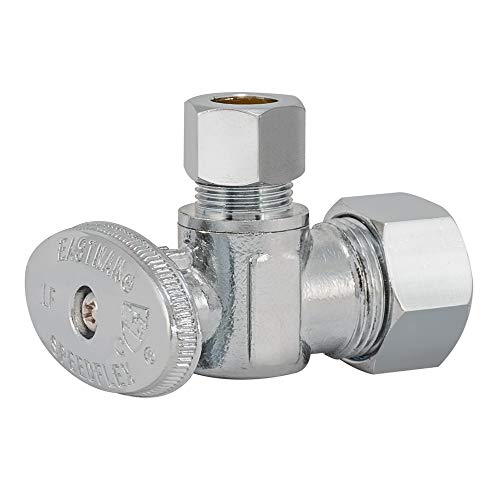
Eastman 10738LF quarter-turn angle stop
For a branch requiring a 3/8 in. OD compression outlet [4] [6]
I would use this angle stop where the branch design calls for its compression connections. It has a brass ball mechanism and a chrome-plated brass body. [4]
Buy it if the inlet and 3/8 in. outlet match the planned branch. Skip it for a direct 1/4 in. fridge tube connection: those sizes do not match. The tradeoff is that a separate, correctly sized branch arrangement may be needed; I would not force a tubing nut onto the wrong outlet. [4] [6]
- Mechanism
- Quarter-turn brass ball
- Fit source
- [4]
$9.39 at AmazonPrice as of Nov 22, 2026, 9:30 AM EST
Check price on AmazonNew, in stock, sold by Amazon.com when checked November 15, 2026. Availability and seller can change.
Product photo: Amazon
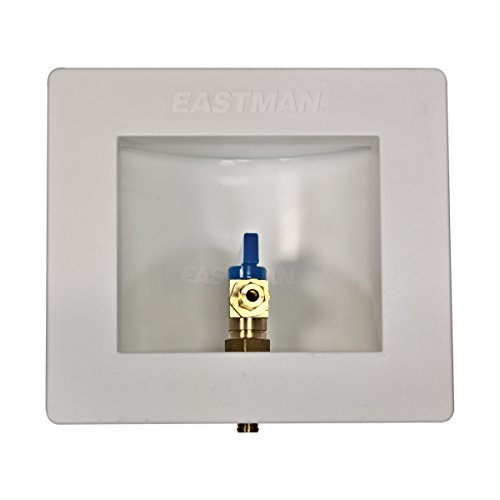
Eastman 60233 ice maker outlet box
For a recessed fridge connection on a crimp PEX branch
I would choose this recessed box when the wall is accessible and the supply is a compatible crimp PEX system. Eastman identifies model 60233 as F1807 crimp PEX, not expansion PEX. Its quarter-turn valve feeds a 1/4 in. OD compression outlet. [5] [6]
Buy it if the branch uses that connection method and there is room to mount the box. Skip it for a direct copper sweat, CPVC or expansion PEX connection. The tradeoff is wall access and the appropriate crimp or clamp tooling, rather than a clamp-on shortcut.
The listing describes a support bracket and faceplate, with a rough opening of 5-3/4 by 4-7/8 by 3-1/2 in. I confirm the supplied instructions and wall depth before cutting. [6]
- Valve
- Quarter-turn ball valve
- Fit source
- [5]
$20.51 at AmazonPrice as of Nov 22, 2026, 9:30 AM EST
Check price on AmazonNew, in stock, sold by Amazon.com when checked November 15, 2026. Availability and seller can change.
| Model | Supply inlet | Appliance outlet | Check before ordering |
|---|---|---|---|
| Eastman 10738LF | 5/8 in. OD compression, 1/2 in. nominal [4] [6] | 3/8 in. OD compression [4] [6] | Does not directly fit a 1/4 in. fridge tube. [5] [6] |
| Eastman 60233 | 1/2 in. crimp PEX, F1807 [5] [6] | 1/4 in. OD compression [5] [6] | Requires a compatible crimp PEX branch and room for a recessed box. |
Match the inlet to your pipe. Compression, sweat, and push-to-connect inlets are not interchangeable, and copper, CPVC and PEX all want different treatment. See compression vs push-to-connect valves and under-sink shutoff valves.
For a fridge specifically, I plan the tubing and proper stop together. See ice maker water line kits.
Working the ice maker complaint backwards
Before you condemn anything, find out where the water stops. The order that saves the most time:
- 1I check whether the fridge makes any ice and whether the dispenser works. No ice and no water can point to the supply, filter, appliance controls or a frozen line. Small, hollow or slow-forming cubes can indicate restricted flow, one reason to inspect a self-piercing connection.
- 2Pull the fridge out and find the valve. Look at it before you touch it: a green or white crust on the pipe at the clamp, or a stain running down from it, is a reason to stop and inspect for leakage before doing a flow check.
- 3
I turn off the ice maker and isolate the water upstream before disconnecting tubing. If I can safely control that shutoff, I secure the tube in a container and briefly restore supply to check flow, then shut it off again.
Good flow points downstream toward the fridge inlet or filter. A dribble points to an upstream restriction, which can include the saddle, tubing or another shutoff. I do not disturb a leaking or seized saddle to perform this check.
- 4Do not “open it more” to fix a dribble. I do not use force or keep backing out the stem to chase more flow. If the valve is stiff or leaking, the next step is upstream isolation and repair.
- 5Check the floor in front of the fridge. Cupped or lifted flooring in a line out from the wall can indicate water damage that needs investigation; it does not prove the saddle is the source.
Replacing one that is already there
- 1Shut off and drain the section. Do not attempt to work around a live saddle valve.
- 2Remove the saddle and look at the hole it left. That pinhole is now an open hole in the pipe. The section it sits on comes out.
- 3Cut out that piece and fit a proper tee. Do not be tempted to patch over the pierce point with a clamp; that is trading one temporary fix for another.
- 4Fit a quarter-turn stop on the branch, somewhere you can actually reach.
- 5
I restore pressure using the joint manufacturer’s procedure and check every new joint immediately and again the next day. I follow required inspection and pressure-test procedures before closing a wall.
If the pipe is old and the pierce point is corroded around the hole, treat it as you would any other pinhole: pinhole leaks in copper pipe.
The bit that varies by pipe material
I plan the repair for the actual pipe material before shutting off the water. The tee, the joining method and the amount of sound pipe available decide the repair route.
- 1Copper. Cut out the damaged section with enough sound pipe for the chosen fitting, sweat or press in a tee. Straightforward. If the run is wet and will not drain, that is an argument for a mechanical fitting rather than a torch.
- 2CPVC. The pierced section comes out and a solvent-cemented tee goes in. but you need slack, and existing CPVC may have little usable movement. Plan on a coupling either side, and respect the cure time before you turn the water on.
- 3PEX. I use the fitting method approved for the specific tubing. Cut, fit a tee in your system’s method, and check your pipe manufacturer’s instructions while you have them open.
- 4Galvanized steel. Stop and think. A threaded run may require disassembly back to a union or an approved repair arrangement, and disturbing old galvanized frequently turns a small repair into a repipe. This is a legitimate call-a-plumber moment even for competent DIY.
If you cannot replace it today
If it is actively leaking, I isolate the water and arrange a repair now. A sensor or a future to-do list is not a substitute for stopping an active leak. In a rental, I report the defect to the landlord and follow the authorized repair route.
Sometimes it is a rental, or the wall is closed, and the saddle stays for now. In that case, treat it as a known risk rather than a working valve:
- 1Leave it alone. I avoid forcing a stiff or suspect valve; I identify a working upstream shutoff before it is needed.
- 2Put a leak sensor on the floor beneath it. It can warn of water at that location, but it does not stop a leak. See where to put water leak sensors.
- 3Write it on the list for the next time the wall or the appliance is open.
- 4Tell the next person. If you are selling, a saddle valve is the kind of thing a home inspector writes up. Knowing it is there beats finding out during a negotiation.
FAQ
Are saddle valves against code?
The model IPC lists saddle-type fittings as prohibited. Georgia’s 2026 amendment makes a narrow exception for refrigerator ice makers and humidifiers on existing residential systems when the pipe instructions allow them. I check the adopted code and exact installation before deciding.
Why did my ice maker stop getting water?
If it is fed by a saddle valve, a restricted inlet is one possibility. GE warns that self-piercing valves can restrict flow. I also check the appliance filter, tubing and other shutoffs rather than diagnosing from the valve type alone.
Can I just replace the saddle valve with another one?
The pipe already has a hole in it from the first one, so that section needs replacing regardless. Once you are cutting the pipe, fitting a proper tee and a quarter-turn stop is the repair I would plan, with access and pipe condition deciding the scope.
Is a saddle valve ever legal?
Sometimes, narrowly. Saddle-type fittings appear on the model code’s prohibited-connections list with no exception, but Georgia’s adopted version carries an exception for refrigerator ice makers and humidifiers on an existing residential water distribution system, provided the pipe manufacturer’s instructions do not prohibit them. That is a specific carve-out in one state, not a general permission. Check what your jurisdiction has adopted.
How can I tell if my saddle valve is leaking?
Look for green or white crust on the pipe at the clamp, a stain running down from it, or flooring in front of the appliance that has cupped or lifted. I check for active moisture and trace the source; a leak can also be in the tubing or another fitting.
The valve is stiff. Should I force it closed?
No. I do not force a stiff shutoff or rely on it to isolate a repair. If you need the water off, close the fixture shutoff or the main instead, and plan on replacing the saddle rather than operating it.
Sources
- Georgia DCA, 2026 amendments to the 2024 IPC, page 13, section 605.9. The prohibited-fitting item and Georgia exception, effective January 1, 2026.
- GE Appliances, Refrigerator Self-Tapping Water Valve. Restricted flow and ice-production symptoms.
- Sub-Zero, Water Line Saddle Valve. Accessible shutoff and self-piercing valve warning.
- Eastman, SpeedFlex Quarter-Turn Compression Angle Stop Valve. Model-specific connection table and brass ball mechanism.
- Eastman Appliance Installation and Repair Catalog, page 77. Model 60233, crimp PEX F1807 inlet and compression outlet.
- Eastman 10738LF Amazon listing and Eastman 60233 Amazon listing. Included parts and rough opening.
Related guides
- 1
- 2
- 3
- 4
For the plumbers reading this
I keep the code question separate from the product choice. A fitting can fall within a narrow code exception and still be a poor match for the appliance instructions or the pipe in front of you. For a replacement, I record the inlet material, the joining method and the outlet size before ordering.
On a fridge branch, the difference between a 3/8 in. outlet and a 1/4 in. outlet matters more than whether both handles turn a quarter turn. If the job changes from an exposed branch to a recessed box, I plan the wall access and support as part of the work. [5] [6]
More guides like this
- 1
- 2
- 3
- 4
- 5
How I chose
I compare the existing product names with Eastman’s connection tables and the appliance guidance. The 60233 is the recessed crimp PEX option; the 10738LF is an exposed angle stop with a larger outlet. I would not treat either as a universal saddle-valve replacement. [5] [6]
I check for a new Amazon offer and compare the listing model with the maker’s information. I also check the CPSC recall records by brand and model. A clear recall search is not a product certification. The fit still depends on sound pipe, the correct joining tools and the appliance instructions.
I keep an accessible shutoff in the plan. If the pipe is corroded, the upstream shutoff does not hold, the joint method is unfamiliar or the work requires a permit, I would have a qualified plumber handle the connection and inspection.
For the branch itself, I compare the pipe markings with the fitting instructions before cutting. A crimp PEX barb, an expansion PEX fitting and a compression inlet are distinct connections. I do not choose from the outside appearance of the valve alone.
Product prices and availability are accurate as of the date/time indicated and are subject to change.