
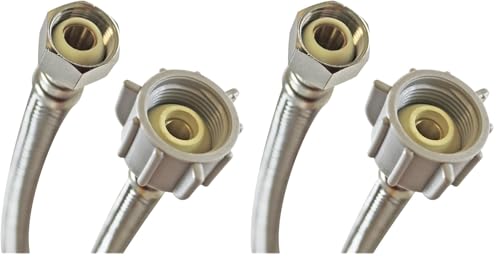
Fluidmaster B1T12
$5.14 at Amazon
Check it on AmazonPrice as of Oct 23, 2026, 5:30 AM EDT

Both ends, every common valve size and the part that fits each.
As an Amazon Associate I earn from qualifying purchases.
Most toilets take a 3/8 in. compression x 7/8 in. ballcock line. The 7/8 end fits every toilet. The 3/8 end fits most shut-off valves, so check yours before you buy.
The toilet end threads onto the fill valve shank under the tank. The wall end threads onto your shut-off valve, and that’s where sizes differ.
Buy a 3/8 x 7/8 line such as Fluidmaster’s B1T12. This is the outlet on stops like BrassCraft’s G2CR19X.
Buy a 1/2 x 7/8 line such as Fluidmaster’s B3T16.
Buy a 1/2 FIP x 7/8 line such as Fluidmaster’s B4T12. The thread is 0.840 in. across.
Buy Fluidmaster’s Universal Click Seal. It lists all four valve sizes, including 7/16 in. compression.
Here’s a quick way to spot the iron pipe outlet. A 1/2 in. pipe thread is 0.840 in. across, per ASME B1.20.1, and a U.S. nickel is 0.835 in. If the outlet’s threads are about as wide as a nickel, it’s iron pipe. A 3/8 in. compression outlet is clearly smaller.
Still unsure? Take the old line off with the water shut off and carry it to the store. The nut on the wall end is the size you need.
Fluidmaster’s B1T line comes in 6, 9, 12 and 20 inch lengths, and its Click Seal line adds a 16 inch.
Run a tape or a piece of string from the valve outlet to the fill valve shank along the curve the line will take.
If the path is 10 in., buy the 12. A line pulled tight puts side load on both nuts.
A 20 in. line on a 7 in. path ends up in a loop behind the bowl. Buy the length that fits.
Fluidmaster says its toilet lines have exceptional flexibility and won’t kink or crease. That’s the reason a gentle curve works and a sharp fold doesn’t.
These are Fluidmaster’s steps for its Click Seal lines. For a standard line, follow the steps on its package.
Turn the shut-off valve closed, then flush to empty the tank.
Take it off at both ends and clean the threads on the valve outlet and the fill valve shank.
Thread it on by hand, then turn it 1/2 turn beyond hand-tight with an adjustable wrench.
Before threading the Click Seal nut onto the fill valve shank, turn it counter-clockwise until the threads align.
Turn it clockwise by hand. It only clicks in the tightening direction.
Check the valve end for leaks. If it drips, tighten just enough to stop it. Don’t over-tighten.
Fluidmaster rates its Click Seal lines at 15 to 20 in-lb of torque. No tools go on the Click Seal nut, and only an adjustable wrench goes on the metal nut at the valve.
One genuine Fluidmaster line for each valve outlet, plus a BrassCraft stop if yours needs replacing. All were new and in stock on Amazon on Oct 21, 2026. Prices show the time they were read.



Product prices and availability are accurate as of the date/time indicated and are subject to change. Any price and availability information displayed on Amazon.com at the time of purchase will apply to the purchase of this product.
| Part | Key specs | Pick it if | Skip it if |
|---|---|---|---|
| Fluidmaster B1T12 | 3/8 comp x 7/8 BC, 12 in. (B1T12), 20 in. (B1T20), Also 6 and 9 in., Braided stainless, Nickel-plated brass nut | Your shut-off valve has a 3/8 in. compression outlet, which is what most angle stops have. | Your valve has a 1/2 in. compression or iron pipe outlet. The B3T16 and B4T12 below fit those. |
| Fluidmaster 4T12UCSR, fits 4 valve sizes | 4T12UCSR, 12 in., Fits 4 valve sizes, 125 PSI working, 1,500 PSI burst, 15 to 20 in-lb | You can’t tell what’s on your valve, or you’re buying one line to keep on hand for any toilet. | You know your valve is 3/8 in. compression and the path is longer than 12 in. Get the B1T in your length. |
| Fluidmaster B4T12 | 1/2 FIP x 7/8 BC, 12 in. (B4T12), 16 in. (B4T16), Straight female thread, Braided stainless, 0.840 in. pipe thread | Your valve, or the pipe stub you’re connecting to, has a male 1/2 in. iron pipe thread about as wide as a nickel. | Your valve has a compression outlet. The B1T or B3T fits it, and a FIP nut won’t. |
| Fluidmaster B3T16 | 1/2 comp x 7/8 BC, 16 in., No Burst, Braided stainless, Made in USA, per listing | You’ve confirmed the valve outlet itself is 1/2 in. compression, not 3/8. | The 1/2 in. you measured was the pipe in the wall. The valve outlet is probably 3/8, so get the B1T. |
| BrassCraft G2CR19X | G2CR19X, 1/2 nom comp inlet, 3/8 OD comp outlet, Quarter-turn, Chrome, Copper or PEX | Your old stop leaks at the handle, won’t shut off fully, or won’t turn, and it’s on 1/2 in. copper or PEX. | Your stop works and doesn’t leak. Just replace the line. |
The Universal Click Seal’s toilet end is a plastic nut. Fluidmaster’s steps: turn it counter-clockwise until the threads line up, then clockwise by hand until it clicks. It clicks only in the tightening direction, and Fluidmaster’s FAQ rates it at 15 to 20 in-lb.
The valve end is still a metal nut. Thread it on, then go 1/2 turn past hand-tight with an adjustable wrench. Open the water slowly. If it weeps, tighten just enough to stop it and no more.
A 1/2 inch NPT pipe thread is 0.840 inch across, per ASME B1.20.1. A U.S. nickel is 0.835 inch, per the U.S. Mint. Hold a nickel against the outlet threads. If they match, you need the B4T. A 3/8 inch compression outlet is clearly smaller.
If that thread is the end of a bare pipe with no valve, stop. A toilet needs its own shut-off. BrassCraft makes angle stops with a 1/2 inch FIP inlet and a 3/8 inch OD outlet, and then the B1T line fits.
Most of the confusion comes from two sizing systems. Copper pipe uses nominal sizes. Supply tubes use the real outside diameter (OD).
| Size you’ll see | How it’s measured | Actual outside size | Where it shows up |
|---|---|---|---|
| 3/8 in. OD compression | Real outside diameter | 0.375 in. | Stop outlet, supply line nut |
| 3/8 in. nominal copper | Nominal; OD is 1/8 in. bigger | 0.500 in. | Copper water pipe |
| 1/2 in. nominal copper | Nominal; OD is 1/8 in. bigger | 0.625 in. (5/8) | Pipe out of the wall, stop inlet |
| 1/2 in. iron pipe (NPT) | Nominal pipe size | 0.840 in. | Threaded stub-outs and outlets |
So when someone says their toilet supply is 1/2 inch, they usually mean the pipe coming out of the wall. BrassCraft’s G2CR19X shows how the two fit together. It has a 1/2 in. nominal compression inlet, which slides onto 1/2 in. copper with a 5/8 in. OD, and a 3/8 in. OD compression outlet for the supply line.
That’s why a “1/2 inch” supply and a 3/8 inch line aren’t a contradiction. The stop steps the size down. If your valve outlet really is 1/2 in., you need a 1/2 in. line, and Fluidmaster’s B3T16 or Universal fits it.
Both start with 3/8 in. compression at the valve. The far end is different, so check the part name before you buy.
| Line | Valve end | Fixture end | Example |
|---|---|---|---|
| Toilet connector | 3/8 in. compression | 7/8 in. ballcock | Fluidmaster B1T12 |
| Faucet connector | 3/8 in. compression | 1/2 in. FIP | Fluidmaster B1F12CS |
| Toilet, iron pipe valve | 1/2 in. FIP | 7/8 in. ballcock | Fluidmaster B4T12 |
| Toilet, 1/2 in. compression valve | 1/2 in. compression | 7/8 in. ballcock | Fluidmaster B3T16 |
A 1/2 in. FIP faucet nut won’t thread onto a 7/8 in. ballcock shank, so a faucet line can’t stand in for a toilet line. Dishwashers use a different fitting again, which our dishwasher supply line size guide covers.
| What you have | Buy this | Lengths | Why |
|---|---|---|---|
| 3/8 in. compression valve outlet | Fluidmaster B1T | 6, 9, 12, 20 in. | Matches both ends |
| 1/2 in. compression valve outlet | Fluidmaster B3T16 | 16 in. | 1/2 in. nut on the valve end |
| Male 1/2 in. iron pipe outlet | Fluidmaster B4T12 or B4T16 | 12, 16 in. | FIP nut on the valve end |
| 7/16 in. compression or unknown | Fluidmaster Universal Click Seal | 12 in. | Lists all four valve sizes |
| Leaking or stuck stop on 1/2 in. copper | BrassCraft G2CR19X, then a B1T | n/a | New stop, 3/8 in. outlet |
| Bare pipe, no shut-off | An angle stop first | n/a | A toilet needs its own valve |
If water seeps from the stop’s handle, or it won’t close all the way, a new line won’t help. BrassCraft’s G2CR19X has a 1/2 inch nominal compression inlet, which fits 1/2 inch copper at 5/8 inch OD under ASTM B88, and a 3/8 inch OD outlet for the standard toilet line.
It shuts off with a 90° turn. BrassCraft says PEX needs a stainless steel tube insert. Changing a stop means shutting off the house water and draining the line first. If the old stop is soldered on, the call-a-plumber section below applies.
Makers publish two numbers: the pressure the line runs at every day, and the pressure where it bursts. Here’s what each one lists.
| Part | Working pressure | Burst | Temperature |
|---|---|---|---|
| Fluidmaster Universal Click Seal | 125 PSI | Up to 1,500 PSI | Not listed |
| Fluidmaster Click Seal lines (FAQ) | Not listed | Up to 1,500 PSI | Not listed |
| Eastman 48088 braided connector | 125 PSI | 2,500 PSI | 40 to 150°F |
| BrassCraft 1/2 x 3/8 angle valve | 125 psi max | Not listed | 40 to 140°F |
The working number is the one that matters for your house. Every part in this table that lists one gives 125 PSI. The burst number is a safety margin, and the Eastman line, which lists 2,500 PSI, is included only to show how the ratings compare.
Swapping the line is a normal fix.
Replace the stop. That needs the house water shut off.
A new stop may need soldering or a new stub.
Don’t loosen anything on a live line.
Usually not at the line. Most toilet supply lines are 3/8 in. compression at the valve and 7/8 in. ballcock at the toilet. The pipe coming out of the wall is often 1/2 in. copper, and the stop steps it down to a 3/8 in. outlet.
The size of the nut on the valve end. A 3/8 line fits a 3/8 in. compression outlet, and a 1/2 line fits a 1/2 in. compression outlet. Both have the same 7/8 in. ballcock nut at the toilet.
3/8 in. compression x 7/8 in. ballcock, like Fluidmaster’s B1T line.
7/8 in. ballcock. Every toilet connector in this guide has a 7/8 in. ballcock nut on the toilet end.
A common one is 1/2 in. nominal compression in and 3/8 in. OD compression out, like BrassCraft’s G2CR19X.
Measure the path from the valve outlet to the fill valve shank and round up. Fluidmaster’s B1T line comes in 6, 9, 12 and 20 in.
For Fluidmaster’s Click Seal lines, the metal nut at the valve goes 1/2 turn past hand-tight, and the toilet nut is hand-tightened until it clicks. Fluidmaster rates them at 15 to 20 in-lb.
No. A faucet line like Fluidmaster’s B1F12CS ends in a 1/2 in. FIP nut, and a toilet fill valve needs a 7/8 in. ballcock nut.
The toilet end is. The valve end varies, which is why Fluidmaster makes a Universal Click Seal that fits 3/8, 7/16 and 1/2 in. compression and 1/2 in. iron pipe.
Fluidmaster says its Fits-All line fits all toilets, so the toilet end is the same. Check your shut-off valve for the other end.
I’m Isaac Daniels, a licensed journeyman plumber in Georgia (license #JP507711). The sizes and steps here come from Fluidmaster’s and BrassCraft’s own pages and listings, and the pipe sizes come from the published standards named below.