
Lucas-Milhaupt Ultra Flux
$13.87 at Amazon
Check it on AmazonPrice as of Oct 24, 2026, 5:30 AM EDT · low stock then
Details ↓
Four paste fluxes compared on their makers’ data sheets, plus a matcher for which flux your joint needs.
As an Amazon Associate I earn from qualifying purchases.
Get Lucas-Milhaupt Ultra Flux, 8.7 on our spec score: an AWS FB3‑A paste for copper, brass and steel. For stainless or a long heat, get Harris Stay-Silv Black. Copper tube into a wrought copper fitting with phos-copper rod needs no flux.
All water-based paste fluxes for silver and phos-copper brazing rod. Each was new and in stock on Amazon as of Oct 22, 2026, and each scores 7.0 or higher on our spec score.


Product prices and availability are accurate as of the date/time indicated and are subject to change. Any price and availability information displayed on Amazon.com at the time of purchase will apply to the purchase of this product.
Six checks from each maker’s technical data sheet, equal weight. The rules and every input are in the method section near the end.
All four are AWS A5.31 class FB3 fluxes, the class the Copper Development Association names for brazing copper and copper alloy tube. Three are FB3‑A, the general-purpose class. Harris Stay-Silv Black is FB3‑C, which adds boron for longer heats.
Since the class already sets the basics, the score splits them on what else each maker puts in writing: how hot the flux stays active, which metals it names, and how to thin it, rinse it, store it and read it.
What each maker’s data sheet says, which joints each one suits, and where each one lost points on our checks.
75014 silver brazing flux, 7 oz jar with brush cap, AWS FB3‑A
Prices and availability are accurate as of the time shown and may change.
You braze copper to brass, steel or copper-nickel with silver or phos-copper rod, and you want a sheet that tells you exactly how to thin and rinse the flux.
Your parts take a long heat, or you braze stainless or carbide. Harris Stay-Silv Black is made for that.
Ultra Flux is Lucas-Milhaupt’s water-based paste for silver brazing, and I’ve used it. Part 75014 is the 7 oz jar with a brush in the cap. It conforms to AWS A5.31 FB3‑A, AMS 3410 and Federal Specification O-F-499D Type B. It scored 8.7, tied for the top.
Its data sheet puts more numbers in writing than the others. It says the paste dilutes to a slurry with 60 cc of cold or hot water per pound of flux. That measured amount is a 10 on thinning. The other three sheets only say the flux can be thinned.
The sheet also warns that more water means fewer fluxing salts and more spitting. The original paste is 35% water by weight.
Cleanup is spelled out too. The residue is corrosive and has to come off after brazing, and it dissolves easily in water at 120°F or hotter. A stated water temperature is a 10.
Lucas-Milhaupt warrants its water-based fluxes for 12 months from shipment in the original, unopened container. It names 65 to 75°F, cool and dry, as the best storage range. That’s a 10 on storage. If the paste separates on the shelf, the sheet says to stir it until the consistency comes back.
The sheet names steel, stainless steel, copper, copper alloys, nickel and nickel alloys, four families for an 8. It rules out aluminum bronze and other aluminum alloys. It lists torch, induction and furnace heating.
Two checks cost it points. The active range tops out at 1600°F, an 8. The sheet doesn’t describe a color change at brazing heat, a 6.
Lucas-Milhaupt’s product page adds that Ultra Flux is low spattering and made in the USA. The jar comes in 1 lb and 5 lb sizes too, parts 75015 and 75016.
My call: for a box of mixed copper and brass work, this is the jar I’d keep. The thinning rule means a dip pot comes out the same every time.
SSBF5 hi-temp brazing flux, 5 lb jar, AWS FB3‑C
Prices and availability are accurate as of the time shown and may change.
You braze stainless, nickel alloys or carbide, or your parts are heavy enough that the flux has to last through a long heat.
You mostly braze copper and brass fittings with a torch. A 7 oz jar of FB3‑A paste, like Ultra Flux, fits that work.
Stay-Silv Black is the boron-modified paste from the Harris Products Group, a Lincoln Electric company, and I’ve used it. It conforms to AWS A5.31 FB3‑C, AMS 3411, Federal Specification O-F-499 Type B and EN 1045 Type FH12. It scored 8.7, tied with Ultra Flux.
The boron is the point. Harris’s data sheet says it extends the flux’s active life, so it can take longer heating cycles. Harris names induction brazing and heavy parts, which often need a long heat.
The active range runs from 1050 to 1700°F, a 10. The Amazon listing says 1800°F, and the maker’s sheet says 1700. I go by the sheet.
Harris’s Brazing Flux 101 page explains a second job for the boron. Some oxides are harder to flux, and it names stainless steel, nickel alloys and tungsten carbide. The data sheet names those plus copper alloys and steel, five families for a 10.
Harris also says the flux turns clear close to brazing temperature, a cue for when to feed the rod. That’s a 10. Harris’s Flux 101 page says the color is “really more brown”.
It lost points on paperwork. The sheet says the flux may be water thinned, without a measured amount, an 8. For removal it gives a hot water wash and a rag or Scotch-Brite pad, with no temperature, another 8. It gives no shelf or storage terms, a 6.
The linked listing is the 5 lb jar, SSBF5. Harris makes it in ½ lb and 1 lb jars too. Amazon’s 1 lb listing shows the ½ lb jar in its photo, and its item data names soldering-flux chemicals, so I didn’t link it.
Harris prints a fluoride warning on the sheet: it burns eyes and skin and can be fatal if swallowed.
My call: buy this for stainless, carbide or big parts. On everyday copper and brass fittings, a white FB3‑A flux does the job.
97030 paste brazing flux, 7 oz jar with brush cap, AWS FB3‑A
Prices and availability are accurate as of the time shown and may change.
You want a general FB3‑A paste from the maker of Sil-Fos rod, for copper, brass and steel parts with a torch.
You thin flux for a dip pot and want a measured water rule. Ultra Flux’s sheet gives one.
Handy Flux is Lucas-Milhaupt’s fluoride/borate paste, and I’ve used it. Part 97030 is the 7 oz jar with a brush cap. It conforms to AWS A5.31 FB3‑A and AMS 3410. Lucas-Milhaupt calls it an all-purpose flux. It scored 8.3.
It has a link to phos-copper rod that the others don’t. Lucas-Milhaupt’s Sil-Fos 15 sheet says the rod fluxes itself on copper only. Brass and bronze joints should be fluxed with Handy Flux.
The data sheet reads a lot like Ultra Flux’s. Both are recommended with filler metals that flow from 1100 to 1600°F, and both protect parts up to 1600°F. That top end is an 8.
It names steel, stainless steel, copper, copper alloys, nickel and nickel alloys, four families for an 8. It isn’t recommended for aluminum bronze or other aluminum alloys. Torch, induction and furnace heating are all listed.
Cleanup matches Ultra Flux. The residue is corrosive, and it dissolves easily in water at 120°F or hotter, a 10.
Storage terms are the same as well: a 12-month warranty in the unopened container, with 65 to 75°F as the best storage range, for a 10. If it separates after long storage, stir it back to a smooth paste.
Where it trails Ultra Flux is thinning. The sheet says Handy Flux may be thinned with water to a smooth, even consistency for brushing or dipping, with no measured amount. That’s an 8. Like Ultra, it describes no color change at brazing heat, a 6.
Lucas-Milhaupt makes it in jars of 1 and 5 lb and pails of 25 and 50 lb. The product page says it’s made in the USA.
My call: if you braze brass valves or adapters with Sil-Fos, this is the flux that rod’s own maker names. Keep the cap on, since the sheet asks for dry storage.
SSWF7 brazing flux, 6.5 oz brush-cap bottle, AWS FB3‑A
Prices and availability are accurate as of the time shown and may change.
You braze copper to brass with phos-copper or silver rod and want a flux that shows you when the joint is ready.
You want written storage terms and a rinse temperature. Handy Flux and Ultra Flux sheets give both.
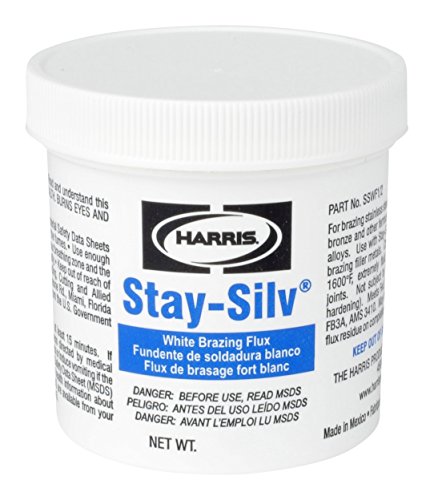
Stay-Silv White is Harris’s standard paste flux, and I’ve used it. Part SSWF7 is the 6.5 oz size with a brush in the cap. It conforms to AWS A5.31 FB3‑A, AMS 3410, Federal Specification O-F-499 Type B and ISO 18496. It scored 8.0.
Harris’s Brazing Flux 101 page says white flux is used for 90% of silver brazing work. Its data sheet calls it a mix of boric acid and fluoride compounds.
Its best feature is one you can see. The flux turns clear close to brazing temperature, which Harris calls a useful sign that you’re ready to feed the rod. That’s a 10 on the heat cue, a check the Lucas-Milhaupt sheets don’t cover.
Harris spells out the rod pairings. Use it with high-silver BAg filler metals on copper, brass, steel, stainless and nickel alloys, and with phos-copper BCuP rod for copper to brass. Those four metal families score an 8. Aluminum bronze is the stated exception.
Its active range is 1050 to 1600°F. The low end is the lowest of the four, but the score checks the top end, so it’s an 8.
The rest is general. Harris says the flux may be water thinned, with care not to dilute it too far, an 8. Removal is a hot water wash and a rag or non-woven pad, with no temperature, another 8. There are no storage or shelf terms, a 6.
The listing has a mismatch I can’t ignore. Its title and bullets say a 6.5 oz bottle made in the USA. The photo shows a Stay-Silv white jar, and that jar’s label says it’s made in Mexico. Either way it’s Harris white flux, but check the container when it arrives.
Harris also makes it in ¼, ½, 1 and 5 lb jars and 25 and 60 lb pails.
My call: pick this one if you’re new to brazing. Watching the flux go clear takes some of the guesswork out of the heat.
Class, active range, size and paperwork, from each maker’s technical data sheet.
| Pick | Spec score | Photo | AWS class | Active range | Size linked | Rinse | Storage terms | Short pros / cons | Buy |
|---|---|---|---|---|---|---|---|---|---|
| Lucas-Milhaupt Ultra Flux | 8.7 | | FB3‑A | 1100–1600°F | 7 oz | 120°F+ | 12 months | Measured thinning / No heat cue | Check it on Amazon |
| Harris Stay-Silv Black | 8.7 | | FB3‑C | 1050–1700°F | 5 lb | Hot water | None | Long heats / Big jar | Check it on Amazon |
| Lucas-Milhaupt Handy Flux | 8.3 | | FB3‑A | 1100–1600°F | 7 oz | 120°F+ | 12 months | Sil-Fos maker’s pick / No heat cue | Check it on Amazon |
| Harris Stay-Silv White | 8.0 | | FB3‑A | 1050–1600°F | 6.5 oz | Hot water | None | Turns clear / Photo mismatch | Check it on Amazon |
From Lucas-Milhaupt’s Ultra Flux and Handy Flux technical data sheets and product pages, and Harris’s Stay-Silv White and Black technical information sheets, read Oct 22, 2026.
Pick the metals, the rod and the heat. The matcher uses the Copper Development Association’s chart and the makers’ sheets.
| Joint | BCuP phos-copper rod | BAg silver rod |
|---|---|---|
| Copper tube to wrought copper fitting | No flux | FB3‑A flux |
| Copper tube to cast fitting | FB3‑A flux | FB3‑A flux |
| Copper to brass, or brass to brass | FB3‑A flux | FB3‑A flux |
| Steel, stainless or nickel alloy | Don’t use BCuP | FB3‑A, or FB3‑C black |
| Tungsten carbide | Don’t use BCuP | FB3‑C black |
| Aluminum or aluminum bronze | Not these fluxes | Not these fluxes |
The Copper Development Association’s Copper Tube Handbook draws the copper rows as a chart. Only one joint gets a “flux not required” label: copper tube, a wrought copper fitting and BCuP rod. Every brass, cast or BAg combination is marked “flux required”.
Lucas-Milhaupt explains why. Its Sil-Fos 15 rod fluxes itself on copper because of its phosphorus, but that only works on copper. The same sheet says not to use it on iron- or nickel-based metals.
A flux has to stay active from the time the rod starts to flow until the joint is full. Here are the four fluxes against common plumbing and HVAC rods.
Every rod the Copper Development Association lists as common in plumbing, HVAC and fire sprinkler work brazes between 1145 and 1550°F. All four fluxes cover that span. So for copper tube work, the range alone won’t decide between them.
The extra 100°F on Stay-Silv Black matters when the heat runs long or hot. The same figure shows standard brazing fluxes protecting to about 1600°F and special fluxes to about 1900°F.
The handbook says joints of 1 inch and larger can be hard to bring up to temperature all at once. My call: on those big fittings, that’s where I’d reach for the black flux.
AWS A5.31 is the American Welding Society’s spec for brazing fluxes. The class on the jar tells you what kind of flux is inside.
| Class on the label | What the maker says it is | Our picks in this class |
|---|---|---|
| FB3‑A | General-purpose paste for silver brazing (Harris white, Lucas-Milhaupt Ultra and Handy) | Ultra Flux, Handy Flux, Stay-Silv White |
| FB3‑C | Paste with boron added for longer heats and harder-to-flux metals (Harris black) | Stay-Silv Black |
| FB3‑F | The same kind of flux as a dry powder (Harris Stay-Silv Powder) | None; powder isn’t a pick here |
The Copper Development Association says the fluxes best suited for brazing copper and copper alloy tube meet AWS A5.31 FB3‑A or FB3‑C. So any of the four picks fits the handbook’s rule for copper tube.
The AMS number is an aerospace spec that rides along: AMS 3410 on the three white-type pastes and AMS 3411 on the black one. Federal Specification O-F-499 Type B appears on three of the four sheets.
My call: when you’re matching a spec on a drawing or a job submittal, read the class off the jar or data sheet, not the brand. Two brands with the same class meet the same AWS requirements.
The jars can look alike on a supply-house shelf. The Copper Development Association says the two can’t be swapped.
| Soldering flux | Brazing flux | |
|---|---|---|
| Filler metal melts | At 840°F or below (AWS definition of soldering) | Above 840°F; plumbing rods braze at 1145–1550°F |
| Typical working heat | About 350–600°F | About 1100–1600°F for FB3‑A pastes |
| Swap them? | No | No |
The handbook is plain about it: brazing fluxes differ in composition from soldering fluxes, and the two types cannot be used interchangeably. It adds that brazing fluxes are water-based, unlike soldering fluxes.
Heat is the other gap. Most soldering happens at 350 to 600°F, and the handbook’s figure shows brazing flux only starting to melt at about 800°F.
For soldered water lines, our solder and flux guide covers the right paste. For the choice between brazing and press fittings on copper, see ProPress vs brazing.
The flux tells you how hot the joint is if you know what to watch for. These are the stages from the Copper Development Association’s figure.
| About this hot | What the flux does | What it tells you |
|---|---|---|
| 212°F | Water boils out of the paste | Heat is just starting to soak in |
| 600–800°F | Flux bubbles | Keep the flame moving; not ready yet |
| 800°F | Flux begins to melt | Getting close |
| 1100°F | Flux is clear and quiet | Sweep the flame along the joint and feed rod |
| 1600°F | Standard fluxes stop protecting | Too hot for FB3‑A paste; back off |
Clean the tube end and fitting cup to bright metal. Our emery cloth guide and deburring tool guide cover that prep.
The Copper Development Association says to apply flux sparingly to the clean tube, so little ends up inside the finished joint. Fluxing the outside of the fitting too cuts oxidation and gives you a temperature guide.
Push the tube hard against the fitting stop and turn it if you can. Support the joint so it can’t move while you heat.
Start about an inch from the fitting, sweeping the flame around the tube. Move to the base of the fitting cup until the flux goes quiet.
When the flux looks liquid and clear, sweep the flame back and forth along the joint, toward the base of the fitting cup. Feed rod with the flame slightly ahead of it. A full fillet should show all the way around.
Let the fitting cool on its own, then wash the residue off with warm water and a rag or brush.
The handbook recommends an oxy-fuel torch with a neutral flame, with air-fuel sometimes used on smaller sizes. Our acetylene torch kit guide and plumbing torch guide cover both kinds.
If the rod balls up and won’t flow, the handbook says it points to oxidized surfaces or too little heat. More flux won’t fix a joint that isn’t hot enough. If the tube or fitting starts to oxidize while you heat, the handbook says there’s too little flux.
Brass valves, adapters and fittings are where flux matters most on a copper system, because phos-copper rod can’t clean brass by itself.
Yellow brass starts to melt at 1660°F, only about 110°F above the top of the common rod range. Copper doesn’t melt until 1981°F, so brass leaves far less room for overheating.
Lucas-Milhaupt’s Sil-Fos sheet says brass and bronze joints should be fluxed, and it names Handy Flux. Harris pairs its white flux with phos-copper rod for copper to brass. Either way, flux both the copper and the brass.
My call: put most of the heat on the copper tube and the heavier side of the joint, and let the brass come up last. Watch for the flux to go clear on the brass before you feed rod.
| Brass joint | Rod | Flux | Source |
|---|---|---|---|
| Copper tube to a brass valve or adapter | BCuP or BAg | FB3‑A | CDA chart, Harris white sheet |
| Brass to brass | BCuP or BAg | FB3‑A | CDA chart |
| Bronze fitting | BCuP | Flux required (Handy Flux named) | Lucas-Milhaupt Sil-Fos 15 sheet |
| Aluminum bronze | Not covered | Not these fluxes | All four flux sheets |
Brazing flux residue is corrosive, and it can hide a bad joint. All four makers say it has to come off.
| Source | How to remove it |
|---|---|
| Lucas-Milhaupt (Ultra, Handy) | Dissolves easily in water at 120°F or hotter; a post-braze rinse is required |
| Harris (White, Black) | Hot water wash plus a rag or non-woven pad; wire brush, steam or blasting for more |
| Copper Tube Handbook | Warm water with a clean cloth, brush or swab, after the joint cools |
The handbook gives the reason that matters most to a plumber. Hardened flux can hold pressure for a while and hide a joint that isn’t fully brazed. Wash it off before you pressure test.
It also says to let fittings cool naturally before you wet them. It says wrought fittings can be cooled more readily than cast ones, but all fittings should cool on their own first.
My call: rinse the same day. Lucas-Milhaupt calls the residue corrosive, so I don’t leave it on.
Paste flux keeps a long time if it’s sealed, and its fumes need air moving away from your face.
| Topic | What the makers say |
|---|---|
| Warranty | Lucas-Milhaupt: 12 months from shipment, original unopened container |
| Storage | Lucas-Milhaupt: cool and dry, 65–75°F |
| Separated paste | Lucas-Milhaupt: stir until the consistency returns; old flux can be warmed in a water bath |
| Powder flux | Harris: keep the lid tight, since powder draws moisture from the air |
| Warning | Harris: contains fluorides; burns eyes and skin; can be fatal if swallowed |
| Fumes | Harris: keep your head out of fumes and use enough ventilation; see ANSI Z49.1 |
The Copper Development Association adds a note about rods: some BAg rods contain cadmium, which gives off toxic fumes when heated. Check the rod’s label and make sure the room has airflow.
Harris also makes a boric-acid-free flux line, ECO SMART. Its Brazing Flux 101 page says the European Union’s REACH rules list boric acid as a substance of very high concern.
My call: keep a damp rag nearby for flux on your skin, and wear safety glasses. The fluoride warning is on every jar for a reason.
Flux comes three ways. This page picks pastes, because that’s what fits most copper and brass joints.
| Form | How it’s used | Trade-off |
|---|---|---|
| Paste (our picks) | Brushed or dipped onto the clean joint before heat | Can separate on the shelf; stir it back |
| Powder (FB3‑F) | Hot rod dipped into it, or mixed with water into paste | Won’t separate, but draws moisture |
| Flux-coated or cored rod | Flux rides on or inside the rod | No separate jar; one rod, one flux |
Harris’s Brazing Flux 101 page explains “hot rodding” with powder: heat the end of the rod, dip it in the powder, and the flux sticks. Its powder is FB3‑F, active from 1200 to 1600°F.
Flux-coated and flux-cored rods carry their own flux. Lucas-Milhaupt sells a flux-cored Handy One rod, according to its Amazon listing. Those rods are a different product from a jar of flux, so they aren’t scored here.
These came up in Amazon searches on Oct 22, 2026. Here’s what kept each off the list.
| Flux or listing | What we found | Why it’s out |
|---|---|---|
| Markal Silver Brazing Flux Paste, 2 oz | Torch, furnace, resistance or induction heating, per the listing | No silver brazing flux page or data sheet on markal.com |
| Forney 37250 brazing flux | Forney: borax type, ½ lb, 30-day warranty; listing: 8 oz tub, 90 days | No class or range, and the maker and listing disagree |
| Harris Stay-Silv Black, 1 lb listing | Photo shows the ½ lb jar; item data lists soldering-flux chemicals | Listing doesn’t match Harris’s product |
| “For Harris” Stay-Silv listings | Third-party listings named after Harris part numbers | Not sold as the Harris brand |
| Handy Flux listing with no brand | Brand field empty, part number “1” | Can’t tie it to Lucas-Milhaupt’s part |
Markal and Forney may work fine on a brass repair. But neither maker publishes an AWS class or an active range I could check, so there’s nothing to score fairly against the four data sheets.
For the Harris and Lucas-Milhaupt look-alikes, the issue is the listing, not the flux. If the photo, size or brand doesn’t match the maker’s part, I can’t tell you what will arrive.
| Question | If yes | If no |
|---|---|---|
| Copper tube into a wrought copper fitting with BCuP rod? | No flux needed | Next question |
| Stainless, nickel alloy, carbide or a long heat? | Harris Stay-Silv Black (FB3‑C) | Next question |
| Do you thin flux for dipping or spraying? | Lucas-Milhaupt Ultra Flux | Next question |
| Do you use Sil-Fos rod on brass? | Lucas-Milhaupt Handy Flux | Next question |
| Want a flux that turns clear at brazing heat? | Harris Stay-Silv White | Any FB3‑A pick |
My call for most plumbers and HVAC techs: keep a 7 oz jar of FB3‑A paste in the truck for brass valves and cast fittings, and skip flux on copper-to-wrought-copper joints with phos-copper rod. Add the black flux only if you braze stainless or heavy parts.
If you bend and flare copper on the same jobs, our tube bender and flaring tool guide covers that side. For the difference between cast and wrought fittings, see cast vs wrot copper fittings.
Lucas-Milhaupt Ultra Flux and Harris Stay-Silv Black tie at 8.7 on our spec score. Ultra is the FB3‑A pick for copper and brass; Stay-Silv Black is the FB3‑C pick for stainless and long heats.
An AWS A5.31 FB3‑A or FB3‑C flux, per the Copper Development Association. Copper tube into a wrought copper fitting with BCuP rod needs no flux at all.
No. The Copper Development Association says the two differ in composition and can’t be used interchangeably. Brazing flux is water-based and works far hotter.
Yes, except copper to wrought copper with phos-copper rod, where the rod’s phosphorus does the fluxing. Brass, cast fittings, steel and every BAg silver joint need flux.
Not these four. Their makers describe fluoride and boric acid or borate mixes. Some fluxes, like Forney’s 37250, are sold as borax type, with no AWS class stated.
Yes. Lucas-Milhaupt says phos-copper rod fluxes itself on copper only, so brass and bronze joints should be fluxed.
Clean the joint, apply flux sparingly to the tube, assemble and heat. Feed rod when the flux turns liquid and clear, about 1100°F, then wash the residue off with warm water.
Harris’s black flux adds boron, so it lasts through longer heats and helps on stainless, nickel alloys and carbide. It’s rated to 1700°F; the white is rated to 1600°F.
Warm or hot water and a cloth or brush. Lucas-Milhaupt says its residue dissolves in water at 120°F or hotter.
Lucas-Milhaupt warrants its paste for 12 months unopened. Paste that separates can be stirred back, and old flux can be warmed in a water bath.
No. All four sheets rule out aluminum bronze, and Lucas-Milhaupt’s also rule out other aluminum alloys. Aluminum takes its own flux and rod.
They carry their own flux, which is the point of them. Follow the rod maker’s label for the metals it covers.
I’m Isaac Daniels, a licensed journeyman plumber in Georgia (license #JP507711), and I’ve used all four picks. Every spec here comes from Lucas-Milhaupt’s and Harris’s own data sheets and product pages, read Oct 22, 2026. Where I add advice of my own, it’s labeled as my call.
Each check scores 0 to 10 and counts one sixth. It’s our score from maker documents, not a customer rating or a lab test of our own.
| Check (weight) | How it’s scored |
|---|---|
| Heat range top (⅙) | 10 when the maker’s sheet gives an active range up to 1700°F or more; 8 for 1600°F |
| Metals named (⅙) | Base-metal families named on the sheet (copper and its alloys, steel, stainless, nickel alloys, tungsten carbide): 10 for 5; 8 for 4; 6 for 3 or fewer |
| Rinse temp (⅙) | 10 when the sheet gives a water temperature for removing residue; 8 when it says hot water only |
| Thinning amount (⅙) | 10 when the sheet gives a measured water-per-pound amount; 8 when it only says the flux can be thinned |
| Storage terms (⅙) | 10 when the sheet gives storage or warranty terms; 6 when it doesn’t |
| Heat cue (⅙) | 10 when the sheet says the flux turns clear near brazing temperature; 6 when it doesn’t |
| Total | Average of the checks, to one decimal |
| Pick | Range top | Metals | Rinse | Thinning | Storage | Heat cue | Score |
|---|---|---|---|---|---|---|---|
| Lucas-Milhaupt Ultra Flux | 8 (1600°F) | 8 (4) | 10 (120°F) | 10 (60 cc/lb) | 10 (12 months) | 6 (none) | 8.7 |
| Harris Stay-Silv Black | 10 (1700°F) | 10 (5) | 8 (hot water) | 8 (general) | 6 (none) | 10 (turns clear) | 8.7 |
| Lucas-Milhaupt Handy Flux | 8 (1600°F) | 8 (4) | 10 (120°F) | 8 (general) | 10 (12 months) | 6 (none) | 8.3 |
| Harris Stay-Silv White | 8 (1600°F) | 8 (4) | 8 (hot water) | 8 (general) | 6 (none) | 10 (turns clear) | 8.0 |