Condensing vs non-condensing tankless
What changes between the two, which one your house is set up for, and one maker’s models side by side.

The short answer
Condensing: 0.93 vs 0.82 UEF on Rheem’s pair, PVC vent, needs a drain. Non-condensing: metal vent, no drain.
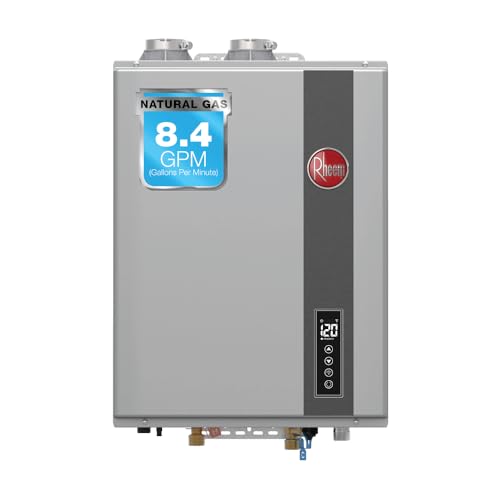
Best condensing → RTGH-84DVLN-3
Best non-condensing indoor → RTG-95DVLN-3
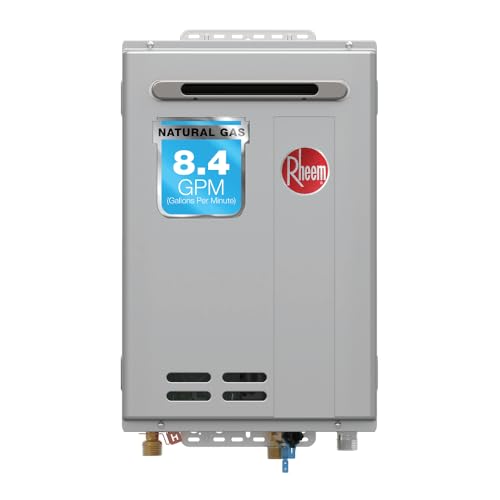
Best for an outside wall → RTG-84XLN-3
Check it on Amazon
As an Amazon Associate I earn from qualifying purchases. Disclosure.
One condensing, two non-condensing

I picked all three from one maker on purpose. Rheem’s RTGH and RTG lines share the same controls, warranty and connections, so the differences you see below come from condensing versus not, not from brand. For more brands, the gas tankless guide and Navien vs Rinnai cover them.
Rheem RTGH-84DVLN-3: the condensing pick
Best condensing
Rheem RTGH-84DVLN-3
Condensing indoor tankless water heater, natural gas, 157,000 BTU/h
Pros
- 0.93 UEF, the highest here
- Vents in Schedule 40 PVC, CPVC or polypropylene
- Runs up to 60 ft in 2 in. pipe, 150 ft in 3 in.
- Copper primary, stainless secondary heat exchanger
- 15-year heat exchanger, 5-year parts warranty
Cons
- Needs a condensate drain (1/2 in. NPT connection)
- Neutralizer sold separately where code asks
- Heavier: 52.9 lb
157,000 BTU/h8.4 gpm max0.93 UEFPVC vent52.9 lb
Buy it if
You have a drain near the heater spot and want the lowest gas bills, or you’re venting through a wall where PVC is easier than stainless.
Skip it if
There’s no practical way to run a condensate line. A non-condensing unit needs no drain.
The Rheem RTGH-84DVLN-3 is the condensing heater I’d put in a house with a drain nearby. Rheem’s spec sheet lists 157,000 BTU/h input, up to 8.4 gpm at a 35°F rise and 4.6 gpm at 67°F, and Rheem’s listing gives it a 0.93 UEF. It scores 9.8, the top of this page.
Efficiency is the headline. At 0.93 against the RTG’s 0.82, more of the gas you pay for ends up in the water. A. O. Smith describes the same idea in its own numbers: a 0.95 UEF unit turns 95 cents of each gas dollar into hot water.
Venting is the practical win. Rheem allows Schedule 40 PVC, CPVC or polypropylene, up to 60 ft of straight 2 in. pipe or 150 ft of 3 in., with six feet taken off for each 90-degree elbow. That reach is why Navien suggests condensing units for new builds and additions where the vent route is long.
The cost is a drain. The RTGH has a 1/2 in. NPT condensate connection, and A. O. Smith says the water is slightly acidic and some local codes require a neutralizer. Rheem lists an optional neutralizer, RTG20329AR. If the nearest drain is uphill, plan on a condensate pump.
Everything else matches its RTG siblings: 0.4 gpm minimum activation flow, freeze protection to −30°F intake air, 1/2 in. side clearance, built-in display, and a 15-year heat exchanger, 5-year parts and 1-year labor warranty. It’s indoor-only as sold; Rheem’s RTGH-X kit converts it for outdoor mounting.
Colder water makes the case stronger. A. O. Smith says colder incoming water needs more heating, which magnifies a condensing unit’s efficiency advantage, while homes in warm climates get less payback. On Rheem’s zone table the RTGH-84 delivers 3.6 gpm for a 105°F shower in the coldest zone and 7.0 gpm in the warmest, so size it for your winter groundwater.
Rheem RTG-95DVLN-3: the non-condensing indoor pick
Best non-condensing indoor
Rheem RTG-95DVLN-3
Non-condensing indoor tankless water heater, natural gas, 199,900 BTU/h
Pros
- 9.5 gpm max, the highest flow here
- No condensate drain needed
- Fits Metal Fab, Rainbow and UBBINK vent for tankless swaps
- Lighter than the condensing unit: 46.5 lb
- 15-year heat exchanger, 5-year parts warranty
Cons
- 0.82 UEF
- Category III stainless vent, 43 ft max straight run
- Concentric 3/5 in. vent costs more per foot than PVC
199,900 BTU/h9.5 gpm max0.82 UEFStainless vent46.5 lb
Buy it if
You’re replacing an existing non-condensing tankless, or there’s no easy route for a condensate drain.
Skip it if
The vent run is long or twisty. Stainless tops out at 43 ft straight.
The Rheem RTG-95DVLN-3 is the indoor non-condensing unit I’d choose for a straight swap. It scores 9.4. Its 199,900 BTU/h burner gives the highest flow on this page, 9.5 gpm at a 35°F rise and 5.0 gpm at 67°F, and it needs no condensate drain.
Its efficiency is lower: 0.82 UEF on Rheem’s listing and sheet. That’s the trade A. O. Smith describes, a non-condensing unit in the 0.80–0.82 range because the exhaust leaves hot instead of feeding a second heat exchanger.
Venting is where it fits old installs. Rheem lists compatibility with Metal Fab, Rainbow and UBBINK Category III stainless vent, specifically for tankless-to-tankless replacements, so an existing stainless run may carry over. The limit is 43 ft of straight 3/5 in. concentric pipe, less 1.6 ft for each 90-degree elbow.
Navien’s case for non-condensing is lower cost, smaller size and lighter weight, with less maintenance than a condensing unit’s annual service. Rheem’s numbers bear out the size: 24.2 x 13.5 x 10.27 in. and 46.5 lb, against the RTGH’s 23.7 x 17.7 x 9.8 in. and 52.9 lb.
The rest is shared with the RTGH: 0.4 gpm minimum activation, freeze protection to −30°F intake air, built-in display plus an included external remote, and the 15-year heat exchanger, 5-year parts, 1-year labor warranty.
A. O. Smith adds a reason this matters on a swap from a tank: a home whose old gas water heater had compatible metal venting may be able to reuse it, though it says to have a plumber confirm. Non-condensing exhaust runs 300–500°F, A. O. Smith says, which is why plastic can’t carry it.
For bigger houses, Rheem lets up to six units run together on a manifold with standard cables, and the RTG-95DVELN-3 version adds Wi-Fi and Rheem’s LeakGuard leak detection. The RTG-95DVLN-3 picked here has neither, which keeps the install simpler.
Rheem RTG-84XLN-3: the outdoor pick
Best for an outside wall
Rheem RTG-84XLN-3
Non-condensing outdoor tankless water heater, natural gas, 180,000 BTU/h
Pros
- No vent pipe at all
- No condensate drain
- Lightest here: 42 lb
- Freeze protection to −4°F ambient
- 15-year heat exchanger, 5-year parts warranty
Cons
- 0.82 UEF
- Needs an outside wall with gas, water and power
- Lower max flow than the RTG-95
180,000 BTU/h8.4 gpm max0.82 UEFOutdoor, no vent42 lb
Buy it if
You can mount the heater on an outside wall and want to skip both the vent and the drain.
Skip it if
You live where it gets very cold for long stretches, or the outside wall is far from the gas line.
The Rheem RTG-84XLN-3 sidesteps the whole venting question. It mounts outdoors, so Rheem’s sheet lists no vent at all, and as a non-condensing unit it makes no condensate. It scores 9.4, tied with the RTG-95.
Rheem lists 180,000 BTU/h input, 8.4 gpm at a 35°F rise and 4.5 gpm at 67°F, and 0.82 UEF on its listing. It’s the smallest and lightest of the three at 20.75 x 13.5 x 9.4 in. and 42 lb.
Freeze protection is the question people ask about outdoor units. Rheem’s sheet lists freeze protection to −4°F ambient for the RTG series. The unit uses up to 132 W for antifreeze, so it needs power to protect itself; a power cut in a deep freeze is the risk to plan around.
An outdoor unit trades the vent run for exposed piping. Rheem sells a pipe cover (AP22459) for the lines under the heater, and the water lines still need insulation wherever they’re exposed.
If you want condensing efficiency outdoors, Rheem’s route is the RTGH with its RTGH-X outdoor conversion kit, which still needs the condensate drain. For a simple outdoor swap with no drain, this is the one.
A. O. Smith points to exterior walls as a natural fit for non-condensing units, especially where a drain line would have to run through several rooms. On an outdoor unit the rest of the install is short: gas, water and a 120 V circuit at the wall, with 12 in. clear above and below per Rheem.
Rheem’s outdoor line also comes in a 199,900 BTU/h size (RTG-95XLN-3) and a Wi-Fi LeakGuard version, if you need more flow. The 180,000 BTU/h RTG-84XLN-3 matches the condensing RTGH-84’s 8.4 gpm top flow, which is why I paired them here.
The three heaters side by side
| Heater | Spec score | Photo | Type | Input | Max gpm | UEF | Vent | Weight | Buy |
|---|---|---|---|---|---|---|---|---|---|
| RTGH-84DVLN-3 | 9.8 | | Condensing, indoor | 157,000 | 8.4 | 0.93 | PVC/CPVC/PP | 52.9 lb | Check it on Amazon |
| RTG-95DVLN-3 | 9.4 | | Non-condensing, indoor | 199,900 | 9.5 | 0.82 | Cat. III stainless | 46.5 lb | Check it on Amazon |
| RTG-84XLN-3 | 9.4 | | Non-condensing, outdoor | 180,000 | 8.4 | 0.82 | None | 42 lb | Check it on Amazon |
| Flow by temperature rise (gpm) | 35°F | 45°F | 67°F |
|---|---|---|---|
| RTGH-84DVLN-3 (condensing) | 8.4 | 6.7 | 4.6 |
| RTG-95DVLN-3 (non-condensing) | 9.5 | 7.4 | 5.0 |
| RTG-84XLN-3 (non-condensing) | 8.4 | 6.7 | 4.5 |
Flow falls as the temperature rise grows. A 67°F rise is roughly what a cold-climate winter asks for, and there the three units deliver 4.5 to 5.0 gpm. Rheem rates the RTGH-84 for three bathrooms on its sizing note and the RTG-95 for three and a half. The tankless size calculator works it out for your groundwater temperature.
What changes between the two
| Condensing | Non-condensing | Source | |
|---|---|---|---|
| Heat exchangers | Two: primary plus a stainless secondary that pre-heats incoming water | One | Navien, A. O. Smith |
| Efficiency (UEF) | Above 0.90, often 0.95; Rheem RTGH: 0.93 | About 0.80–0.82; Rheem RTG: 0.82 | A. O. Smith, Rheem |
| Exhaust temperature | Around 100–120°F | Hotter: 300°F or more leaves the first exchanger | A. O. Smith |
| Vent pipe | Schedule 40 PVC, CPVC or polypropylene (Rheem RTGH) | Category III stainless (Rheem RTG: Metal Fab, Rainbow, UBBINK) | Rheem, Navien |
| Condensate drain | Required; slightly acidic water | Not needed | A. O. Smith, Navien |
| Neutralizer | Some local codes require one | No | A. O. Smith |
| Size and weight | Larger, heavier (two exchangers) | Smaller, lighter | Navien |
| Maintenance | Annual (Navien) | Minimal by comparison (Navien) | Navien |
Navien explains the second heat exchanger: after the burner heats water in the primary exchanger, the still-hot exhaust passes through a stainless secondary exchanger that pre-heats the incoming cold water. A. O. Smith puts numbers on it: exhaust leaves the primary at 300°F or more, and the secondary cools it to about 100–120°F. As it cools, water vapor condenses, which is where the name comes from.
That cooler exhaust is why a condensing unit can vent through PVC. A. O. Smith notes PVC costs less per foot and bends around obstacles more easily than metal, and Navien says plastic venting allows longer runs and more flexible paths.
Which type fits your house?
Answer four questions. The chooser follows Navien’s and A. O. Smith’s guidance and the Rheem spec sheets.
What a UEF number means for your gas bill
UEF, Uniform Energy Factor, is the share of the fuel that ends up as hot water. A. O. Smith’s example: a 0.95 UEF unit turns 95 cents of every gas dollar into hot water, and the other 5 cents go out the vent. At Rheem’s 0.93 against 0.82, the condensing unit wastes about 7 cents per dollar and the non-condensing unit about 18.
How much that saves depends on how much hot water you use, what you pay for gas and how cold your incoming water is, A. O. Smith says. The more hot water a house uses, the faster the difference adds up.
A. O. Smith frames it the same way for fuel: a household using 50 gallons of hot water a day burns less gas with a 0.95 unit than a 0.82 unit, because each unit of fuel gives up more of its heat. Your local utility may offer rebates on high-efficiency models that offset part of the higher price.
| UEF | Of each gas dollar, into hot water | Up the vent | Example |
|---|---|---|---|
| 0.82 | 82 cents | 18 cents | Rheem RTG (non-condensing) |
| 0.93 | 93 cents | 7 cents | Rheem RTGH-84 (condensing) |
| 0.95 | 95 cents | 5 cents | A. O. Smith’s Energy Star example |
Electric tankless heaters sit outside this whole comparison. A. O. Smith notes they work differently and don’t need venting at all, so there’s no condensing or non-condensing choice to make. The electric vs gas tankless guide covers that decision, including the electrical service a whole-house electric unit needs.
Copper, stainless and why it matters
A. O. Smith explains the materials. Copper conducts heat very well and is the traditional choice, found in non-condensing models. Stainless steel resists the acidic condensate a condensing unit makes, which is why the second exchanger is stainless. Some condensing designs use a single heavy stainless exchanger with water making several passes instead of two exchangers.
Rheem’s two lines follow that pattern: the RTG has a copper primary only, and the RTGH pairs a copper primary with a stainless secondary. Both carry the same 15-year heat exchanger warranty.
How much hot water each heater delivers where you live
| RTGH-84 (condensing), 105°F shower | Zone 1, 37°F water | Zone 3, 47°F | Zone 5, 57°F | Zone 7, 67°F | Zone 9, 77°F |
|---|---|---|---|---|---|
| Average flow (gpm) | 3.6 | 4.1 | 4.8 | 5.7 | 7.0 |
Rheem’s RTGH sheet sizes by groundwater zone, from 37°F water in zone 1 to 77°F in zone 9, at a 120°F setting mixed down to a 105°F shower.
Its fixture guide uses 2 gpm for a shower or dishwasher and 3 gpm for a washing machine. At 2 gpm a shower, that’s a little under two showers at once in the coldest zone and three and a half in the warmest. The non-condensing RTG sheet gives flow by temperature rise instead, shown in the comparison table above.
Venting, drains and neutralizers
- 1Vent route
Condensing: PVC, CPVC or polypropylene, long runs. Non-condensing: Category III stainless from approved makers, shorter runs. Rheem’s sheets give the elbow deductions.
- 2Condensate line
Condensing only. Run it from the 1/2 in. NPT connection to a floor drain, utility sink or outside, per A. O. Smith, or to a condensate pump.
- 3Neutralizer
Condensing only, where code requires. A. O. Smith says some local codes want a small tank that treats the acidic condensate.
- 4Gas line
Rheem lists 1/2 in. gas line compatibility (up to 24 ft on the RTGH, subject to local code) and a 3/4 in. NPT connection.
- 5Clearances
Both lines: 12 in. top and bottom, 1/2 in. sides and front, 24 in. recommended for service.
Navien’s FAQ answers the common upgrade question: yes, you can replace a non-condensing heater with a condensing one, and the main addition is a condensate drain line to a nearby floor drain or a pump. The old stainless vent usually comes out, since a condensing unit vents in plastic.
The reverse question, “does a non-condensing tankless need a drain?”, is about condensate, and the answer is no. It still needs a relief valve discharge like any water heater. The condensate pump guide covers pumps for condensing units.
How far each one can vent
| 90° elbows in the run | RTGH condensing, 2 in. PVC | RTGH condensing, 3 in. PVC | RTG non-condensing, 3/5 in. stainless |
|---|---|---|---|
| 0 | 60 ft | 150 ft | 43 ft |
| 1 | 54 ft | 144 ft | 41.5 ft |
| 2 | 48 ft | 138 ft | 38.5 ft |
| 3 | 42 ft | 132 ft | 34 ft |
| 4 | 36 ft | 126 ft | 28 ft |
These are Rheem’s maximum straight-pipe lengths from each spec sheet. For the condensing RTGH, each 90-degree elbow costs 6 ft and each 45 costs 3. For the non-condensing RTG, Rheem’s table steps down with each elbow, ending at 11.5 ft with six. A heater in the middle of a house with a long, bending vent route usually points to condensing.
Upkeep for each type
Both types
Flush scale from the heat exchanger. Rheem sells an isolation valve kit (RTG20326) that makes flushing easier and an AllClear water treatment system (RTG20251) for hard water.
Condensing extras
Navien calls for annual maintenance on condensing models. Keep the condensate line clear, and replace the neutralizer media where you have one, per the maker.
The descaling guide walks through the flush. If the heater stops with a code, the Rheem error code guide covers what each one means.
Upfront cost, gas bills and tax credits
Condensing
Lower gas bills from the higher UEF. Navien says condensing models often qualify for federal tax credits and utility rebates. Costs more to buy and needs a drain.
Non-condensing
Lower price, smaller and lighter, minimal maintenance by Navien’s comparison. Higher gas use and stainless vent cost.
A. O. Smith lists its own qualified manufacturer code for federal tax form 5695 on its site, a reminder that credits go by model. Check the exact model before counting on one. The tankless install cost guide breaks down the labor side.
Questions people ask
What is the difference between condensing and non-condensing tankless water heaters?
A condensing unit has a second heat exchanger that captures exhaust heat, reaching above 0.90 UEF, and vents through plastic but needs a condensate drain. A non-condensing unit has one exchanger, about 0.80–0.82 UEF, and vents through metal.
Does a non-condensing tankless water heater need a drain?
Not for condensate. Only condensing units produce condensate that needs a drain line. That’s why Navien suggests non-condensing where a drain is hard to add, such as an attic or interior wall.
Are Rinnai tankless water heaters condensing or non-condensing?
Rinnai makes both. Its SENSEI RX models are condensing; check the model’s spec sheet. My Rinnai picks are in the gas tankless guide.
Can I replace a non-condensing tankless with a condensing one?
Yes. Navien says the main addition is a condensate drain line to a floor drain or pump; a condensing unit also vents in PVC or polypropylene instead of stainless.
Do condensing tankless water heaters need a neutralizer?
Some local codes require one. A. O. Smith says the condensate is slightly acidic; Rheem sells an optional neutralizer for its RTGH line.
Does a condensing tankless need its own drain line?
Yes. Navien says condensing units require a dedicated drain line. A. O. Smith says it can run to a floor drain, a utility sink or outside, and the water is slightly acidic.
Is a condensing tankless worth it in a warm climate?
Less so. A. O. Smith says homes in warm climates get less payback from condensing efficiency because incoming water stays warmer year-round.
Can a non-condensing tankless use my old water heater vent?
Sometimes. A. O. Smith says homes with compatible metal venting from a previous gas water heater can often reuse it; have a plumber confirm it matches the new heater’s requirements.
Which lasts longer, condensing or non-condensing?
Rheem warranties both lines the same: 15 years on the heat exchanger, 5 years on parts. Navien notes condensing units need annual maintenance.
How the spec score works
The spec score uses the same seven checks for each heater, from Rheem’s spec sheets and Rheem’s own listings. It’s my score from those documents.
| Check (points) | How it’s scored |
|---|---|
| Efficiency (3) | 3 × UEF ÷ 0.93 |
| Max flow (2) | 2 × gpm at a 35°F rise ÷ 9.5 |
| Heat exchanger warranty (1) | 15 years stated |
| Parts warranty (1) | 5 years stated |
| Minimum flow published (1) | Activation flow on the sheet |
| Freeze protection published (1) | Rating on the sheet |
| Venting reach (1) | Longest straight vent run ÷ 60 ft; an outdoor unit with no vent scores 1 |
| Total (10) | Sum, to one decimal |
Why trust me
I’m Isaac Daniels, a licensed journeyman plumber in Georgia. In my 7 years of experience, these are the products I’d install. The specs come from Rheem’s RTGH and RTG spec sheets and listings, and the explanations from Navien and A. O. Smith, read Oct 23, 2026.
How I pick
- One maker’s condensing and non-condensing lines, so the comparison isn’t about brand.
- Genuine listings sold by Amazon, new and in stock on the day of the update.
- Every pick scores 7.0 or higher on the checks above.
- Prices come from Amazon’s own product data with the time they were read.
Sources
- Rheem, RTGH Series Super High Efficiency Condensing Tankless Gas Water Heaters spec sheet, Form TK-RTGH Series Rev. 1 (10/23).
- Rheem, RTG Series High Efficiency Non-Condensing Tankless Gas Water Heaters spec sheet, Form TK-RTG Series Rev. 1 (07/23).
- Navien, “Condensing vs. Non-Condensing Tankless Water Heaters” (navieninc.com).
- A. O. Smith, “How to Decide Between Condensing vs. Non-Condensing Tankless Water Heaters” (hotwater.com).
- Product listing details for the three heaters (Amazon product data, Oct 23, 2026).