
Cash Acme VR20
$25.95 at Amazon
Check it on AmazonPrice as of Oct 24, 2026, 5:30 AM EDT
Details ↓
Three vacuum relief valves scored on spec sheets, and when the code requires one.
As an Amazon Associate I earn from qualifying purchases.
Get the Cash Acme VR20 (9.5): NSF 372 lead-free with a dust cover. The Watts LFN36-M1 (9.2) vents the most air. Bottom-fed heaters need one by code.
All three are ANSI Z21.22 valves for water heaters and storage tanks. Each was new and in stock on Amazon on Oct 24, 2026. I’ve used these picks.

Product prices and availability are accurate as of the date/time indicated and are subject to change. Any price and availability information displayed on Amazon.com at the time of purchase will apply to the purchase of this product.
Answer two questions about how cold water enters the tank. The checker reads IPC 2021 section 504.
The code language is short. IPC 2021 section 504.1 says an approved means, such as a cold water dip tube with a hole at the top or a vacuum relief valve installed in the cold water supply line above the top of the heater or tank, shall be provided to prevent siphoning.
Section 504.2 says bottom-fed water heaters and bottom-fed tanks connected to water heaters shall have a vacuum relief valve, and it must comply with ANSI Z21.22.
Many states and cities adopt the IPC, often with local changes, and others use a different plumbing code. Your local inspector has the final word.
3/4 in. vacuum relief valve with dust cover, 22398LF
Prices and availability are accurate as of the time shown and may change.
You’re adding or replacing the vacuum relief valve on a residential water heater or storage tank.
The water runs hotter than 210°F, as on some commercial or steam-heated tanks. Pick the Watts or Zurn at 250°F.
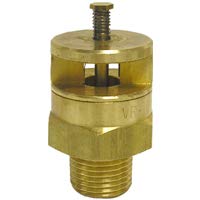
The VR20 is the valve I’d put on most water heaters, and I’ve used it. It scored 9.5, the top score here.
Cash Acme’s spec sheet says it protects hot water supply systems and pressure vessels against negative pressure, the vacuum that can burn out heaters and collapse storage tanks, especially copper ones. Installed on the cold water supply line, it closes tightly under pressure and opens at a 1 in. mercury vacuum, letting air in to break the vacuum.
It’s the only pick that publishes its opening point. It’s certified to ANSI Z21.22/CSA 4.4 and NSF/ANSI 372, and listed by CSA. Cash Acme says every valve is tested for performance before shipping.
The body and cap are lead-free DZR brass with a stainless spring, a silicone seat disc and a polypropylene dust cover about 1.75 in. across that protects the slotted vent. It comes in 1/2 in. (22397LF) and 3/4 in. (22398LF) male inlets.
The sheet gives 13 SCFM at 2 in. Hg, a 200 psi maximum inlet pressure and 210°F. That temperature is the one place it trails the Watts and Zurn, which list 250°F. For a home water heater set at normal temperatures, 210°F is well above what the tank should ever reach.
Cash Acme recommends installing it upright. Its drawing shows 1-3/8 in. across the body and about 2-1/2 in. tall with the dust cover.
Ignore the Amazon listing’s wording. It talks about over-pressure and thermal expansion, calls the body bronze and says the valve reseals after pressure relief. Cash Acme’s own sheet says it’s a vacuum relief valve with a brass body. For thermal expansion you need an expansion tank, not this valve.
On Oct 24, 2026 the listing was sold by Amazon.com.
3/4 in. lead-free brass vacuum relief valve, 0556031
Prices and availability are accurate as of the time shown and may change.
You want the most venting capacity, or the tank sees low-pressure steam, like a jacketed kettle or steam coil heater.
Your inspector asks for NSF/ANSI 372 paperwork by name. Cash Acme and Zurn print it on their sheets.
The LFN36-M1 is Watts’ water heater vacuum relief valve, and I’ve used it. It scored 9.2.
Watts’ ES-LFN36 sheet lists a venting capacity of 15 CFM for both sizes, the highest of the three. The valve permits air to enter and prevent vacuum conditions that could siphon the water out, collapsing a tank or water heater or burning out equipment.
It’s tested and rated to ANSI Z21.22 and CSA certified, with a lead-free brass body, a silicone disc, a 302 stainless spring, a Buna-N O-ring and a glass-filled polysulfone float under a polypropylene cover.
Watts lists more uses than the others: domestic water heaters and supply tanks, table top heaters, jacketed steam kettles, unit heaters, low pressure steam systems and steam coil heaters. The sheet gives a 15 psi maximum steam pressure and 250°F, and says to use a pigtail in steam service so live steam can’t damage the valve.
Two marks against it. Watts says “Lead Free” and that it meets lead-free installation rules, but the sheet doesn’t name NSF/ANSI 372 the way the other two do. And Watts’ product page lists 200 psi maximum working pressure in its description but 15 psi in its spec table; the 15 is the steam figure. The Amazon listing gives 200 psi for water, which matches the description.
The sheet carries an important note: vacuum relief valves are not designed or approved as backsiphonage backflow preventers. For that, Watts points to its 288A vacuum breakers. See vacuum breaker vs anti-siphon valve for the difference.
It’s about 2 in. across and 2 in. tall and weighs 4 oz, per Watts, and comes in 1/2 and 3/4 in. Amazon.com sold the 3/4 in. listing on Oct 24, 2026.
Prices and availability are accurate as of the time shown and may change.
Your tank has a 1/2 in. tapping and you want 250°F, 200 psi and NSF 372 together.
You need 3/4 in. The 3/4 in. VR10XL wasn’t in stock on Amazon when I checked.
The VR10XL is Zurn Wilkins’ vacuum relief valve, and I’ve used it. It scored 8.2.
Zurn’s TP-VR10XL sheet says it’s for commercial and residential water lines, protecting water supply systems and pressure vessels against internal vacuum that could drain a system by siphonage, burn out heaters or collapse storage tanks.
It meets ANSI Z21.22/CSA 4.4 and is certified to NSF/ANSI 372 by IAPMO R&T, with a body of low-lead brass to ASTM B 371, Buna nitrile and silicone elastomers, and 300 series stainless internals. It has the strongest ratings sheet of the three: 200 psi and 250°F, with 13 CFM capacity.
Zurn draws it at 2-1/2 in. tall and 1-1/4 in. across, with a 1 lb shipping weight. At 2-1/2 in. it’s taller than the 2 in. Watts, about the same as the Cash Acme with its cover.
It lost points on one check: Zurn’s sheet lists no vent cap or dust cover. The other two cover the vent so dust and debris stay out of the seat.
Zurn’s typical installation drawing shows it on the cold supply to a hot water storage tank alongside its TP220 relief valve and XT expansion tank. That’s the right company for it: the T&P valve handles over-pressure and over-temperature, the expansion tank handles thermal expansion, and this valve handles vacuum.
On Amazon only the 1/2 in. size was in stock, sold by Plumber’s Paradise, on Oct 24, 2026. Check your tank’s tapping or tee size before ordering.
Zurn lists its threads to ANSI B1.20.1, the standard tapered pipe thread, and names two of its T&P valves (TP1100A-4C and TP220-5C) and its XT expansion tank as matching accessories. Zurn lists its Buna nitrile and silicone elastomers to FDA 21 CFR 177.2600, the FDA rule for rubber parts meant for repeated contact with food.
| Pick | Spec score | Photo | Venting | Max temp | Max water pressure | Lead-free cert | Short pros / cons | Buy |
|---|---|---|---|---|---|---|---|---|
| Cash Acme VR20 | 9.5 | | 13 SCFM | 210°F | 200 psi | NSF/ANSI 372 | Opening point published / Lower max temp | Check it on Amazon |
| Watts LFN36-M1 | 9.2 | | 15 CFM | 250°F | 200 psi | Lead-free stated | Most venting, steam use / No NSF 372 named | Check it on Amazon |
| Zurn Wilkins VR10XL | 8.2 | | 13 CFM | 250°F | 200 psi | NSF/ANSI 372 | Best ratings sheet / No vent cap listed | Check it on Amazon |
Sources: Cash Acme VR20 spec sheet (CA_VR20_V01, 9/21/20); Watts ES-LFN36 and LFN36M1 3/4 product page; Zurn Wilkins TP-VR10XL (Rev. C, 5/23).
| Valve | Why it’s not a pick |
|---|---|
| Eastman 60156 (1/2 in.) | The listing says CSA certified and ANSI Z21.22 rated, but I didn’t find an Eastman spec sheet to check capacity, temperature or pressure. |
| Cash Acme 2239LF listing | Its model number doesn’t match Cash Acme’s 1/2 in. part (22397LF), so I couldn’t tie it to the sheet. |
| “Fits LFN36-M1” look-alikes | Third-party valves sold as compatible with Watts, not genuine Watts parts. |
| Pressure vacuum breakers (Zurn 720A, 710) | Those are irrigation backflow devices, a different product. |
Water pressure holds the valve shut, so nothing leaks out.
A main break, a drained line or a pump shutting off can pull a vacuum on the tank.
Cash Acme’s VR20 opens at a 1 in. mercury vacuum and lets air in.
Air in the tank stops water from siphoning out and keeps the tank from collapsing.
Water pressure closes the valve again.
All three makers describe the same failures it prevents: water siphoned out of the tank, burned-out heating elements or heaters, and collapsed storage tanks. Cash Acme singles out copper tanks. An electric element left running in a tank that has siphoned dry is one way that burnout happens.
| Setup | Where the makers or code put it |
|---|---|
| Top-fed heater, no dip tube hole | On the cold supply line above the top of the heater or tank (IPC 504.1) |
| Bottom-fed heater or tank | Required (IPC 504.2); the makers show it on the cold side |
| Separate storage tank | On the tank’s supply; Zurn’s drawing shows it with the T&P valve and expansion tank |
| Steam kettles, coil heaters | Watts lists these uses; use a pigtail in steam service |
Cash Acme says its VR20 goes on the cold water supply line and should be installed upright. Its Amazon listing says either side is fine, which doesn’t match the maker’s sheet. I’d follow the sheet and the code: cold side, above the top of the heater or tank where the code calls for that.
Use a tee in the cold line above the heater, with the valve pointing up. Wrap the male threads with thread tape or use a rated pipe dope, as with any threaded brass fitting; see Teflon tape vs pipe dope.
| Device | What it protects against | Can it replace a vacuum relief valve? |
|---|---|---|
| T&P relief valve | Too much pressure or temperature in the tank (IPC 504.4) | No |
| Thermal expansion tank | Pressure rise as heated water expands | No |
| Vacuum breaker / backflow preventer | Dirty water siphoning back into the drinking water | No, and Watts says a vacuum relief valve can’t replace it either |
| Dip tube with a siphon hole | Siphoning a top-fed tank (IPC 504.1) | Yes, for top-fed heaters only |
People mix these up because they all sit near the water heater. A T&P relief valve lets water out when the tank gets too hot or too pressurized. A vacuum relief valve lets air in when the tank is being sucked empty. They do opposite jobs, and a bottom-fed heater needs both.
| Question | What to look for |
|---|---|
| Thread size | Match the tee or tank tapping: 1/2 or 3/4 in. male NPT. All three come in both; on Amazon the Zurn was 1/2 in. only. |
| Temperature | Watts and Zurn list 250°F; Cash Acme lists 210°F. |
| Pressure | All three list 200 psi for water. |
| Venting | Watts 15 CFM; Cash Acme 13 SCFM at 2 in. Hg; Zurn 13 CFM. |
| Lead-free paperwork | Cash Acme and Zurn name NSF/ANSI 372; Watts says lead-free. |
| Steam | Only Watts lists low-pressure steam use (15 psi). |
For a home water heater, any of the three covers the job; pick by thread size and whether your inspector wants NSF 372 named on the sheet. For a steam kettle or coil heater, the Watts is the one with steam ratings.
Turn off power or gas, then close the cold supply valve.
Open a hot tap to drop the pressure in the line.
Use a wrench on the hex, not the cap.
Seal the threads and install it upright, per Cash Acme.
Open the supply, purge air at a hot tap, then look for leaks at the threads.
A vacuum relief valve that drips or sprays when the system is under normal pressure isn’t sealing. The makers don’t publish a service life, so replace it when it leaks, and whenever you replace the water heater. See why is my water heater leaking if you’re not sure where water is coming from.
| Part | Cash Acme VR20 | Watts LFN36-M1 | Zurn VR10XL |
|---|---|---|---|
| Body | Lead-free DZR brass | Lead-free brass | Low-lead brass, ASTM B 371 |
| Seat / disc | Silicone disc, integral body seat | Silicone disc | Buna nitrile and silicone |
| Spring / internals | Stainless spring, brass parts | 302 stainless spring | 300 series stainless |
| Cover | Polypropylene dust cover | Polypropylene cover | None listed |
DZR means dezincification resistant, a brass made to resist losing zinc in aggressive water. Silicone seats tolerate heat well, which matters on a valve that sits on a water heater.
| Clue | Top-fed | Bottom-fed |
|---|---|---|
| Cold inlet | On top of the tank, with a dip tube inside | Near the bottom of the tank |
| Common on | Most residential tank heaters | Some storage tanks |
| Code path | IPC 504.1: dip tube hole or vacuum relief valve | IPC 504.2: vacuum relief valve required |
| Where to confirm | The heater manual or data plate | The heater or tank manual |
A top-fed heater sends cold water down a plastic dip tube to the bottom of the tank. A small hole near the top of that tube breaks a siphon, which is why IPC 504.1 accepts it as an anti-siphon means. A bottom-fed tank has no dip tube, so a siphon can pull water straight out of the bottom; that’s why 504.2 requires the valve.
A separate storage tank fed by a boiler or a tankless heater can be bottom-fed. Zurn’s typical installation drawing shows exactly that setup: a hot water storage tank with the vacuum relief valve on the cold supply.
| Watts application | Note from the ES-LFN36 sheet |
|---|---|
| Jacketed steam kettles | Use a pigtail between the steam space and the valve |
| Unit heaters and steam coil heaters | Shown with a pigtail and a steam trap |
| Low-pressure steam heating | Maximum steam working pressure 15 psi |
| Under 5 psi steam | Watts says the pigtail isn’t needed below 5 lbs |
Steam equipment can pull a vacuum as it cools, the condition Watts says the valve is there to break. Watts is the only maker here that rates its valve for steam, at up to 15 psi, and it calls for a pigtail so live steam can’t reach the valve’s seat.
| Valve | Height | Width | Weight |
|---|---|---|---|
| Cash Acme VR20 | About 2-1/2 in. with dust cover | 1-3/8 in. body; cover about 1-3/4 in. | Not listed |
| Watts LFN36-M1 | 2 in. | 2 in. | 4 oz |
| Zurn Wilkins VR10XL | 2-1/2 in. | 1-1/4 in. | 1 lb shipping |
All three are small enough to fit in a tee above a residential heater. Leave room above the valve so its vent stays open; a valve buried in insulation or pressed against a ceiling can’t breathe in air when it needs to.
On our spec score, the Cash Acme VR20 (9.5), then the Watts LFN36-M1 (9.2).
On bottom-fed heaters and tanks, yes: IPC 504.2. Top-fed heaters need a dip tube hole or a vacuum relief valve under IPC 504.1.
On the cold supply line, upright. IPC 504.1 says above the top of the heater or tank.
No. Watts says vacuum relief valves aren’t approved as backsiphonage backflow preventers.
Match the tee or tank tapping, usually 1/2 or 3/4 in. male NPT.
No. A T&P valve lets water out; a vacuum relief valve lets air in.
A valve that leaks under normal pressure isn’t sealing. Replace it.
Cash Acme’s VR20 opens at a 1 in. mercury vacuum. Watts and Zurn don’t publish an opening point.
IPC 504 covers storage water heaters and tanks. A tankless unit with a storage tank may need one on the tank.
ANSI Z21.22, which IPC 504.2 names. All three picks meet it.
I’m Isaac Daniels, a licensed journeyman plumber in Georgia (license #JP507711), and I’ve used all three picks. Every figure comes from the Cash Acme, Watts and Zurn Wilkins spec sheets and the Watts product page, read Oct 24, 2026, plus IPC 2021 section 504.
The six vacuum relief valve checks below each count for one sixth of the score. Each is scored 0 to 10 from the spec sheets, then averaged to one decimal. No bench test, no customer reviews.
| Check (weight) | How it’s scored |
|---|---|
| ANSI Z21.22 / CSA (1/6) | 10 if the maker states ANSI Z21.22 rating and CSA certification |
| Lead-free certification (1/6) | 10 if NSF/ANSI 372 is named; 7 if lead-free is stated without it |
| Venting capacity (1/6) | 15 CFM or more 10; 13 CFM 9 |
| Max temperature (1/6) | 250°F 10; 210°F 8 |
| Max water pressure (1/6) | 200 psi stated consistently 10; stated with a conflicting figure 8 |
| Vent cap or dust cover (1/6) | 10 if listed; 0 if not |
| Total | Average of the checks, to one decimal |
| Valve | Z21.22 | Lead-free | Venting | Temp | Pressure | Cap | Score |
|---|---|---|---|---|---|---|---|
| Cash Acme VR20 | 10 | 10 | 9 | 8 | 10 | 10 | 9.5 |
| Watts LFN36-M1 | 10 | 7 | 10 | 10 | 8 | 10 | 9.2 |
| Zurn VR10XL | 10 | 10 | 9 | 10 | 10 | 0 | 8.2 |