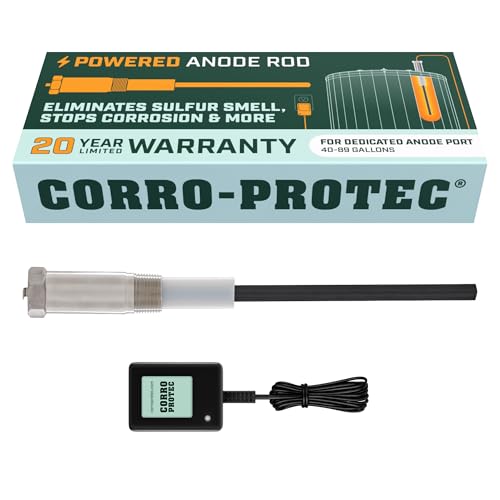
Corro-Protec 96387 dedicated-port powered anode
$179.95 at Amazon
Check it on AmazonPrice as of Nov 22, 2026, 9:30 AM EST
Read the fit details
Match your heater before buying.

As an Amazon Associate I earn from qualifying purchases.
For compatible 40–89-gallon dedicated ports, choose Corro-Protec 96387. For outlet installations, choose 96383. For a 39-3/8 in. magnesium plug rod, the Rheem SP11309T.
A rod’s metal diameter, pipe thread, wrench size and length answer different questions. Write down the label beside each number before comparing parts.
A plug-style rod occupies its own opening. Match the heater’s parts list and the selected rod’s connection, length and material.
An outlet assembly also carries the hot-water connection. A dedicated-port rod is not a direct substitute for that assembly.
Do not loosen the rod to identify it. Follow the heater maker’s energy shutdown, cooling and pressure-release instructions, or call a licensed plumber.
96387 covers 40–89-gallon dedicated-port installations. The 10–120-gallon 96383 outlet kit can also use a dedicated port under the maker’s instructions. Check your exact heater before ordering. For a plain sacrificial swap, the Rheem SP11309T is a 39-3/8 in. magnesium rod.


Product prices and availability are accurate as of the date/time indicated and are subject to change. Any price and availability information displayed on Amazon.com at the time of purchase will apply to the purchase of this product.
| Anode | Key specs | Pick it if | Skip it if |
|---|---|---|---|
| Corro-Protec 96387 dedicated-port powered anode | 96387; 40–89 gal, 3/4 in. NPT, 12 × 2 × 2 in. assembly, 24 V; 15 mA output, 12 ft cord | Your compatible 40–89-gallon heater has a dedicated anode port and suitable power. | The installation uses the outlet, tank capacity is outside 40–89 gallons, or power suitability is unknown. |
| Corro-Protec 96383 hot-water-outlet powered anode | 96383; 10–120 gal, 3/4 in. NPT, 12 × 2 × 2 in. assembly, 24 V; 15 mA output, 304 stainless fittings | Your compatible 10–120-gallon heater needs the outlet fittings, or its dedicated-port installation follows the maker’s directions. | Heater suitability, connection space or electrical supply is unconfirmed. A separate port alone does not exclude this kit. |
| Rheem SP11309T magnesium anode rod | SP11309T, Magnesium, 0.750 in. × 39-3/8 in., 3/4 in. NPT, 1-year limited warranty | Your heater’s parts list calls for a 39-3/8 in. magnesium anode on a 3/4 in. NPT plug, and there’s room overhead to pull and insert a solid rod. | Your heater uses a combined outlet anode, needs a different length, or has too little clearance for a one-piece rod. |
Two powered anodes and a magnesium rod: your heater’s port and parts list decide, so none of the three is scored. All three were new and in stock on Oct 22, 2026, 12:00 PM EDT.
The 96387 is the option for a compatible 40–89-gallon heater with a dedicated anode opening. Amazon’s part-number field identifies 96387 and its UPC matches Corro-Protec’s technical sheet. That resolves the model behind the general product title. It does not establish approval for every heater within that capacity range.
Corro-Protec specifies a titanium electrode with a mixed-metal-oxide coating and a 3/4-inch NPT connection. Its published product dimensions are 12 by 2 by 2 inches. Treat that as the assembly envelope, not an interchangeable sacrificial-rod length. The heater’s existing rod may need much more removal clearance.
The maker lists 24 V and 0.015 A output, a regular 110 V outlet requirement and a power supply with a 12-foot cord. The package includes the powered rod, supply and installation guide. An unsuitable outlet still needs an electrician; extra headroom cannot solve an electrical problem.
The grounding connection matters as much as the thread. The dedicated-port guide requires the ground eyelet against bare metal at a tank-cover screw. Qualified service should follow that guide with the energy isolated. After refill and restart, the green operating light is checked; the maker also requires an annual light check.
The October 20 Amazon read showed a new, in-stock offer sold by Corro-Protec. Select the 40–89-gallon option on Amazon and check the delivered model before opening the heater. A similar family photo does not identify a different capacity variant, and the standard package is not an outlet-fitting kit.
My call: choose 96387 when the dedicated opening, heater suitability and electrical supply are confirmed together. For an outlet installation, compare the linked 96383 kit instead. Have a plumber assess seized parts, limited removal space or piping that moves under tool load before any attempt to loosen the old assembly.
The 96383 is Corro-Protec’s 10–120-gallon hot-water-outlet model. The Amazon listing names that application, and its UPC matches the maker’s 96383 entry. The listing’s model-number field contains an identifier rather than the service part number; the matching UPC is what ties this offer to the maker’s specification.
Its titanium and mixed-metal-oxide electrode uses a 3/4-inch NPT connection. Corro-Protec lists product dimensions of 12 by 2 by 2 inches and 304 stainless steel installation fittings. The box includes the rod, power supply, 12-foot cord, instructions and outlet fittings. Check the delivered fittings against the current guide before dismantling piping.
A separate anode port does not rule this kit out. Page 8 of the outlet guide permits either the hot-water outlet with its wye fitting or a dedicated anode port. Its FAQ says the dedicated-port installation omits the wye. Follow the appropriate port guide rather than transfer the entire outlet assembly to another opening.
The power requirements match the 96387: regular 110 V outlet, 24 V output and 0.015 A output current. Installation still requires the supplied grounding connection. The eyelet must touch bare tank metal, not paint. Have an electrician handle an unsuitable outlet and a plumber handle uncertain outlet-piping work.
Corro-Protec’s instructions call for a full, purged tank before restart and a green operating-light check after connection. That powered-system check differs from measuring sacrificial-rod depletion. Record the model and installation date, then check the light annually. A dark light needs troubleshooting; it is not evidence that the electrode has worn away.
My call: choose 96383 for a compatible outlet installation requiring its fittings. It remains an option for a suitable dedicated port under the maker’s directions; 96387 is the simpler standard package for that port in its capacity range. Both were New, in stock and sold by Corro-Protec in the dated API read.
The SP11309T is the pick when your heater takes a plain sacrificial rod and you want to stay with magnesium. Rheem’s parts store lists it as a 0.750 in. diameter, 39-3/8 in. magnesium anode with a 3/4 in. NPT hook-up. Rheem calls it an OEM genuine part tested to its own specifications.
Rheem says it’s a direct replacement for Rheem, Ruud and Richmond heaters. It also names GE, State, Kenmore, Bradford White, A. O. Smith, American, Craftmaster, Lochinvar, Reliance, Mor-Flo and Whirlpool under “fits most brands”. Most is the word to hold onto: the parts list for your heater still decides.
Length is the check people skip. This rod is 39-3/8 in., the same published length as Rheem’s AP11526T-2 in the sizing tables below, but a different diameter. A gallons rule won’t tell you whether 39-3/8 in. is right; your heater’s service-parts drawing will.
It’s a one-piece rod, so plan the removal space before you buy it. Measure from the top of the heater to the ceiling or anything above the anode head. If the solid rod won’t clear, a segmented service part that matches your heater, or qualified service, is the next step.
Magnesium is the more reactive of the two common sacrificial metals, as Bradford White’s guidance on this page explains. Keep the material your heater’s maker approves unless the water assessment points elsewhere. Rheem recommends checking these rods and replacing them periodically.
Before the old rod comes out, follow the heater maker’s shutdown, cooling and pressure-release steps in the safe-service section below. The SP11309T carries a 1-year limited warranty on Rheem’s page.
My call: I’ve used the SP11309T, and for a heater whose parts list calls for a 39-3/8 in. magnesium rod on a 3/4 in. NPT plug, it’s the straightforward genuine Rheem swap.
| Option and use | Capacity / connection | Package advantage | Limit | Amazon |
|---|---|---|---|---|
| Corro-Protec 96387 dedicated-port powered anode For dedicated ports | 40–89 gal; 3/4 in. NPT; 24 V / 15 mA | Rod, supply, 12 ft cord; 12 × 2 × 2 in. assembly | No outlet fittings; verify heater suitability | Check it on Amazon |
| Corro-Protec 96383 hot-water-outlet powered anode For outlet installations | 10–120 gal; 3/4 in. NPT; 24 V / 15 mA | Outlet fittings included; dedicated-port use also permitted | Confirm piping clearance; follow the guide for the chosen port | Check it on Amazon |
| Rheem SP11309T magnesium anode rod For a sacrificial plug-style rod | Fits most brands; 3/4 in. NPT; 0.750 × 39-3/8 in. | Genuine Rheem part; no power supply | Needs removal clearance; confirm your parts list | Check it on Amazon |
Keep the unit and the measuring point together. A number copied from an Amazon title can describe the metal rod, the connecting thread or the tool.
| Measurement | Example from a maker | What it establishes | What it does not establish |
|---|---|---|---|
| Nominal pipe connection | Bradford White segmented service parts: 3/4 in. NPT | Thread family for those parts | Rod metal diameter or whole-heater compatibility |
| Rod metal diameter | Rheem SP11309C: 0.750 in. | Diameter of that sacrificial rod | The nominal pipe size from that number alone |
| Socket across flats | Example A. O. Smith manual: 1-1/16 in. | Tool for the anode head described in that manual | Diameter of the rod or its port |
| Part length | Rheem AP11526T-2: 39-3/8 in. | Published length of that exact part | Fit for every heater of the same gallon capacity |
The identical-looking 3/4 and 0.750 numbers are easy to confuse. One can be a nominal thread designation; the other can describe the actual metal diameter. Read the field heading before you compare them. Neither proves the original rod’s length, material or outlet arrangement.
A socket is another independent measurement. The cited A. O. Smith electric manual specifies a 1-1/16-inch socket for its anode removal procedure. That is an example from one manual, not a promise that every heater takes that tool. Check the accessible head and the exact instructions before choosing a socket.
Rheem’s common-service-parts sheet lists several magnesium rods with different lengths and diameters. These examples identify parts, not universal replacements for a brand or tank capacity.
| Measurement example | Published value | What the label means |
|---|---|---|
| Rheem SP11309C rod diameter | 0.750 in. | Metal diameter |
| Rheem AP11526T-2 length | 39-3/8 in. | One exact part’s length |
| Bradford White segmented-parts connection | 3/4 in. NPT | Nominal pipe thread |
Start with the heater’s model and serial number, then locate its service-parts drawing. A. O. Smith’s example manual asks for that identity when identifying repair parts and illustrates both a separate anode and a heat-trap/anode combination. Keep the complete replacement number, including its suffix, on your fit worksheet.
Treat a removed rod as a useful clue rather than the only specification. A. O. Smith describes the anode as a consumable part and says to replace it when depleted. If the original metal has already worn away, measuring what remains does not establish the length of a new service part.
Do not replace a model-specific length with a rule such as any rod for a 50-gallon heater. Gallons describe tank capacity; the parts list describes the installed assembly. If an online listing only provides the former, the length and connection questions remain unanswered.
Use one row per check. Photograph accessible labels and compare the heater manual with the proposed replacement; leave hot or pressurized parts assembled.
| Field | Record this | Pass condition | If unknown |
|---|---|---|---|
| Heater identity | Brand, complete model, serial number | Parts list belongs to this heater | Find the exact manual first |
| Port layout | Separate plug or outlet assembly | Replacement uses the approved location | Ask qualified service to identify it |
| Connection and length | Full service part, thread, metal diameter, length | Every required dimension is confirmed | Do not infer from tank gallons |
| Access | Headroom and obstructions above the actual port | Removal and installation method can be completed safely | Have a plumber assess access |
| Material or power | Maker-approved material; selected powered version and supply | Water conditions and installation requirements are addressed | Check with the heater and anode makers |
Use the passport to separate an unknown from a failure. A missing thread specification does not mean the part fits; it means the check is unfinished. A different outlet style is a known mismatch. Keeping those two cases separate prevents a convenient-looking search result from becoming an accidental compatibility claim.
For a phone conversation with qualified service, have the heater label and the original parts drawing ready together. Say which field is unclear: port style, part number, length, clearance or material. That gives the plumber a specific sizing question without requiring you to open the tank just to gather information.
A replacement may be shorter or segmented while the installed rod is still solid. Measure the access above the actual port, not above a nearby patch of tank jacket.
| Situation | Useful distinction | Next step |
|---|---|---|
| A solid rod sits below a low ceiling | Old-part removal and new-part insertion are separate problems | Have a plumber plan removal without moving the tank or stressing piping |
| A segmented service part is specified | Segments improve access but do not establish material or port fit | Match the exact maker cross-reference |
| A powered rod appears shorter | Its power and connection requirements still apply | Check the selected version and removal route |
| A vent or pipe blocks the rod head | Overhead space alone cannot describe tool access | Do not alter a gas vent to make room; call qualified service |
Bradford White’s January 2025 bulletin says its segmented service anodes address low-clearance applications. It lists both outlet-device and plug styles. That distinction stays in place when you switch from solid to segmented; flexibility is an access feature, not permission to change the connection layout.
The same bulletin permits field cutting of its segmented sacrificial service parts. That does not authorize cutting a powered electrode or wire. Before handling an old rod, cool and depressurize the heater, wear safety glasses and cut-resistant gloves, and follow the tool’s PPE instructions. Have qualified service handle cutting where access is cramped.
Bradford White names material and water chemistry as the two main influences on anode activity. A different material can change the maintenance decision even when the replacement has the same physical dimensions.
| Type | What the maker evidence supports | What to confirm |
|---|---|---|
| Magnesium sacrificial | Bradford White describes it as more reactive than aluminum | Heater-approved material and inspection schedule |
| Aluminum sacrificial | Bradford White identifies it for some more-conductive-water conditions | Exact service part and current water conditions |
| Aluminum-alloy service part | Bradford White lists A420 as a separate service material | Do not relabel an alloy without its actual specification |
| Powered anode | Corro-Protec has distinct port and capacity versions | Exact version, heater suitability and power supply |
Softened water is one reason to revisit the inspection schedule. The A. O. Smith electric manual says a water softener can make its anode deplete faster and calls for more frequent inspection as needed. That does not identify a universal replacement material or a calendar interval for every heater.
Odor is a separate diagnostic question. Bradford White describes several water conditions that affect anode behavior, including sulfur and bacteria. A sulfur smell is not a measurement of rod length. Keep the material decision tied to the heater and the water conditions rather than treating an aluminum-zinc label as a complete diagnosis.
My call: keep the heater-approved material unless its maker’s advice and the water assessment support a change. For odor troubleshooting, start with our rotten-egg water smell guide. Do not remove corrosion protection and leave the opening plugged as an odor workaround.
| Linked offer | Identity check | Maker specification |
|---|---|---|
| Corro-Protec 96387 | Amazon part 96387; UPC 094922963871 | 96387: 40–89 gal, dedicated port |
| Corro-Protec 96383 | Amazon UPC 094922963833 | 96383: 10–120 gal, outlet kit; dedicated port also permitted |
The linked models match by part number or UPC. Keep the chosen tank-capacity option in view on Amazon: changing the option can change the product. Product dimensions describe the powered assembly, not the length of a sacrificial replacement.
This is a service-planning checklist, not permission to open an unidentified heater. Follow the exact heater manual and have a licensed plumber handle unclear shutdown, seized parts or outlet-piping work.
Use the heater’s own shutdown procedure. The cited electric manual starts by turning the breaker off or removing its circuit fuses. Corro-Protec also distinguishes gas and electric isolation. If safe isolation is uncertain, stop and use qualified service.
The A. O. Smith example tells you to run a hot faucet until the water is cool, then close the cold-water supply. Route drain water to a safe place. If it remains hot, the valve is blocked or drainage cannot be controlled, call a plumber.
Follow the heater manual’s faucet and draining directions. Never test whether a tank is depressurized by cracking the rod loose. Keep clear of discharge and leave the T&P relief path unrestricted.
With the heater cooled and depressurized, wear safety glasses and cut-resistant gloves for sharp old rods. Follow any cutting tool’s own PPE and glove instructions. Corro-Protec warns that handling or cutting can cause cuts and heat injuries; cramped cutting work belongs with qualified service.
Compare the complete replacement identification, port layout and required length. Let qualified service resolve a seized head or piping that moves under tool load. Do not disturb a vent, gas connection or electrical enclosure to gain access.
The example electric manual requires a full tank before power is restored. Follow its refill and leak-check sequence and the powered-anode guide where applicable. If water has reached electrical parts, keep power off and call qualified service.
Follow the heater’s emergency instructions and leave the area. Do not operate switches or attempt rod work. Call the gas supplier or emergency services from a safe location.
A different anode size is not a patch for a leaking tank. Follow the heater’s shutdown directions and call qualified service.
Do not improvise a bleach dose or mix cleaners. Have qualified service use the heater maker’s sanitation instructions, including required ventilation and protective equipment.
A. O. Smith’s example sacrificial-rod schedule starts at six months, then annually or more often as needed. Corro-Protec’s powered system instead needs a working power circuit and an annual green-light check.
| Condition | What the example manual says | How to apply it |
|---|---|---|
| First service | Inspect after six months | Use your exact heater manual if its interval differs |
| Later inspections | Annually or more frequently if needed | Record depletion and water conditions |
| Water softener in use | Anode may deplete faster | Ask qualified service about a shorter inspection interval |
| Substantially depleted rod | Replace as needed | Do not keep a worn part solely because an interval has not elapsed |
Keep a service record with the heater model, installed anode number and inspection date. Add any material change and the reason for it. That gives the next service visit a useful reference and keeps a future replacement from being chosen by the length of an already depleted rod.
| Powered-system check | Corro-Protec’s requirement | When to seek help |
|---|---|---|
| Ground connection during installation | Eyelet contacts bare metal at a tank-cover screw, not paint | Have qualified service resolve uncertain attachment; do not open energized electrical parts |
| Before restarting | Tank full, trapped air purged and connections checked | Keep heater power off if refill or leak checks are uncertain |
| Operating light after connection | Supply and rod connected; allow the water to warm | If the green light stays off, follow maker troubleshooting or contact support |
| Annual powered-anode check | Confirm the green indicator remains on | A dark light needs diagnosis; it is not sacrificial-metal depletion |
The linked 96387 and 96383 specify a 24 V, 15 mA supply. Corro-Protec’s US accessory selector identifies its 15 mA supply as CP-BA01115. Keep the adapter label with the rod’s model in your service record. An arbitrary adapter with a similar plug is not an approved substitute.
Do not transfer household sizing to an RV. An aftermarket Atwood compatibility label does not establish what the exact RV heater maker approves. Check the RV heater’s own drain-plug and anode instructions.
Identify the RV heater model and tank design first. Keep its drain-plug and anode instructions separate from the household port and length examples above. No RV rod is a household recommendation here.
No. Match the heater’s service part, port arrangement, connection, length and approved material. A shared brand or tank capacity leaves several of those checks unanswered.
The gallon capacity alone does not identify a sacrificial rod. Use the exact model’s service-parts list. For a powered replacement, confirm both the selected capacity version and the permitted installation port.
Not when the specification says 3/4-inch NPT. That is the nominal pipe-thread designation. A separate metal-diameter field, such as the 0.750-inch value for Rheem SP11309C, describes the rod itself.
The cited A. O. Smith electric manual specifies 1-1/16 inches for its removal procedure. Check your heater’s exact manual and head before choosing a tool; that example is not a universal socket rule.
Only when the heater and replacement maker’s requirements permit it. Bradford White allows field cutting of the segmented sacrificial service parts in its bulletin. Do not extend that permission to powered electrodes or unrelated parts.
A maker-matched segmented service part can help insertion in low-clearance applications. You still need a safe plan to remove the old solid rod. Confirm plug versus outlet layout and material before changing styles.
Bradford White describes magnesium as more reactive and identifies aluminum for some more-conductive-water conditions. The suitable material depends on the heater and water conditions. Match its approved service part rather than rank materials in isolation.
Check the actual parts drawing. Bradford White lists both anode outlet device and separate plug-style service parts. The brand name alone is not enough to select the layout.
Do not leave the heater without its required corrosion protection. Have the water conditions and approved anode material assessed. A smell diagnosis and an anode sizing check answer different questions.
Treat a tank leak as a service problem. Follow the heater’s shutdown directions and call qualified service. An anode is corrosion protection, not a repair for a tank that is already leaking.
I’m Isaac Daniels, a licensed journeyman plumber in Georgia. We used heater manuals and maker service-parts documents to keep the connection, length and material checks separate. Each fit call stays conditional on the exact heater and replacement.
We matched the Amazon listings’ part-number or UPC fields to Corro-Protec’s 96387 and 96383 specifications, then checked each installation guide. The Rheem SP11309T matches Rheem’s own parts listing. We re-read the Amazon offers on Oct 22, 2026, 12:00 PM EDT: all three were new and in stock. Our choices describe connection fit.
We checked 2,801 CPSC recall records from 2018 onward for Corro-Protec, 96387, 96383 and the CP-BA01115 supply identifier; none matched. That check does not cover earlier recalls or a different adapter label.
On Oct 22, 2026, 12:00 PM EDT, CPSC’s three Rheem recalls covered a water heater repair, furnaces and air handlers; none named an anode rod. These parts have no numerical score because port fit is not a performance ranking.
| Selection check | Rule |
|---|---|
| Identity | Genuine named brand; no no-name compatible replacement |
| Offer | Explicit New and in stock in the dated detailed read |
| Fit | Exact heater, port, length and material or powered version |
| Uncertainty | Show the missing field rather than invent a dimension |
| Score | None; the heater’s port and parts list decide, so matching an assembly is not a performance ranking |