
Fluke 325
$299.49 at Amazon
Check it on AmazonPrice as of Oct 24, 2026, 5:30 AM EDT
Details ↓
Four clamp meters for water heater, pump and control work, scored on what Fluke and Klein publish.
As an Amazon Associate I earn from qualifying purchases.
Buy the Fluke 325: it reads small loads in 0.01 A steps, tests capacitors and temperature, and has a two-year warranty. Get the Klein CL390 for a thermocouple in the box, or the CL710 for a CAT IV 600 V rating.
Each is sold by Amazon.com, new and in stock when we checked at 3:14 a.m. on Oct 22, 2026, and each scored 7.0 or higher on our spec score.


Product prices and availability are accurate as of the date/time indicated and are subject to change. Any price and availability information displayed on Amazon.com at the time of purchase will apply to the purchase of this product.
Five checks from each maker’s datasheet or manual, equal weight. The rules and every input are in the method section near the end.
All four are handheld, true-rms clamp meters that read AC current through the jaw and voltage and resistance through test leads. All four carry a two-year warranty in writing.
The spread comes from three things a plumber uses: a low amp range for small loads, a capacitance function for pump capacitors, and a temperature input. The Fluke 323 has none of the three, which is why it trails.
What each maker’s sheet says, what it means on a plumbing call, and where each one fell short on our checks.
Prices and availability are accurate as of the time shown and may change.
You test water heater elements, well pumps and their capacitors, and want one meter that covers all three.
You want a probe and case in one box. The Klein CL390 ships with its thermocouple.
The Fluke 325 is the clamp meter I’d hand a plumber who works on electric water heaters and well pumps, and I’ve used it. It’s sold by Amazon.com, and it has the most functions in Fluke’s 320 Series, the 323, 324 and 325.
What sets it apart on our work is the low range. Fluke’s datasheet lists AC current ranges of 40.00 A and 400.0 A, so a 4,500 W element’s 18.75 A draw shows in 0.01 A steps. The 323 reads in 0.1 A steps only.
AC current accuracy is ±(2% + 5 digits) from 45 to 65 Hz. At 18.75 A that works out to about ±0.43 A, by our math from Fluke’s figures.
Capacitance runs on 100.0 µF and 1000 µF ranges through the test leads. That’s the function you’d use on the capacitors in a well pump control box, and it scored a 10.
Contact temperature reads from 14 to 752°F, another 10. Fluke lists the meter, test leads, soft case and manual in the box, with no temperature probe, so plan on buying one.
It’s the only one of Fluke’s three that measures DC current, to 400 A, and frequency from 5 to 500 Hz. It adds Min/Max, which the 323 and 324 lack.
Safety is rated CAT III 600 V and CAT IV 300 V, a 9 on our check. The jaw takes a wire up to 30 mm (600 MCM). Resistance reads to 40 kΩ, with continuity at 30 Ω or less.
The warranty is two years, printed on the datasheet. The meter weighs 283 g and has a backlight, which helps in a dark utility closet.
My call: if you buy one meter for water heaters, pumps and controls, buy this one.
Prices and availability are accurate as of the time shown and may change.
You check pipe and tank temperatures as often as amps, and want the probe in the box.
You test at the service entrance. Its rating is CAT III 600 V; the CL710 carries CAT IV 600 V.
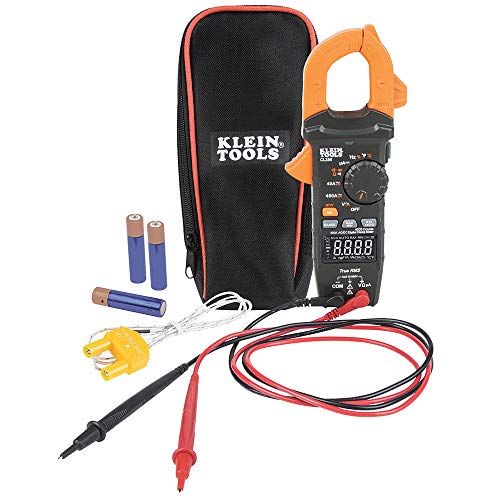
The Klein CL390 is the one with a thermocouple in the box, and I’ve used it. It’s sold by Amazon.com. Klein’s product page lists a carrying case, test leads, the thermocouple and batteries with the meter.
Its manual lists AC current on 40.00 A and 400.0 A ranges, with 0.01 A steps on the low one. Accuracy is ±(2.0% + 9 digits), about ±0.47 A at a 4,500 W element’s 18.75 A, by our math.
One habit to learn: the low range is a separate dial setting. Klein’s manual says to turn to the 4/40A setting for better resolution when the reading is under 40 A.
Temperature runs from −40 to 1,832°F through a K-type thermocouple plugged into the meter’s jacks. That’s a 10, and it’s the reason I’d pick this one over the CL710.
Capacitance runs from 40.00 nF up to 4.000 mF, which is 4,000 µF. DC microamps read to 200 µA, and resistance to 40.00 MΩ.
Safety is CAT III 600 V, Class 2, double insulated. That’s an 8 on our check. Klein’s manuals define CAT III as the building’s distribution side and CAT IV as the source of the installation.
The jaw opens 1.6 in, the widest of the four. Klein rates it for a 6.6 ft (2 m) drop, and the non-contact voltage tester is built into the jaw.
The display is a 4000-count reverse-contrast LCD. Klein’s manual says it’s built to read in dark or bright light. It runs on 3 AAA batteries and shuts off after about 5 minutes idle. Klein rates calibration as accurate for one year and covers its electrical test tools for two years from purchase.
My call: buy it if you want temperature and amps from one meter without shopping for a probe.
Prices and availability are accurate as of the time shown and may change.
You work near the panel and service entrance and want the highest safety rating of the four.
You need temperature readings. The CL710 has no temperature function; the CL390 and Fluke 325 do.
The Klein CL710 has the highest safety rating here, and I’ve used it. It’s sold by Amazon.com, with right-angle test leads, a storage pouch and batteries, per Klein’s datasheet.
Its manual lists CAT IV 600 V and CAT III 1000 V, a 10 on our check. Voltage reads to 1,000 V AC or DC, and Klein says overload protection is 1,000 V on every setting.
AC current runs on 60.00 A and 600.0 A ranges. The low range steps in 0.01 A at ±(2.0% + 8 digits), about ±0.46 A at a 4,500 W element’s 18.75 A, by our math.
It has a low impedance (LoZ) mode, which Klein’s manual says is for identifying and eliminating ghost or stray voltages. None of the other three lists one. Like the CL390, it has a non-contact voltage tester in the jaw, with alerts that grow stronger closer to the voltage source.
Capacitance reaches 6,000 µF, the widest here, and resistance reaches 60 MΩ. Frequency reads from 1 Hz to 500 kHz.
There’s no temperature function; Klein’s datasheet leaves that line blank. That scored a 5 and is the one gap against the CL390.
The display is a 6000-count transflective reverse-contrast LCD, and the dial lights up. The jaw opens 1.4 in. Klein rates it for a 6.6 ft (2 m) drop and IP40.
The manual says it’s for indoor use and shouldn’t be exposed to moisture, rain or snow. At 13 oz (369 g) with batteries, it’s the heaviest of the four. Klein rates calibration as accurate for one year, and the meter shuts off after 5 minutes idle unless you turn that off. Klein’s test tool warranty is two years.
My call: pick it if your calls take you to the panel as often as the water heater.
Prices and availability are accurate as of the time shown and may change.
You mostly confirm that power is there and a load is drawing current.
You test pump capacitors or need tenths of an amp. The Fluke 325 adds both.
The Fluke 323 is the simplest meter here, and I’ve used it. It’s sold by Amazon.com, with test leads and a soft case.
It reads AC current to 400 A and AC or DC voltage to 600 V, true-rms on both, which the listing says reads linear or non-linear loads accurately, regardless of waveform. Fluke’s page says it’s for verifying load current, AC voltage and the continuity of circuits, switches, fuses and contacts.
The trade-off is its single 400.0 A range. It reads in 0.1 A steps, so the ±(2% + 5 digits) spec comes to about ±0.88 A at 18.75 A, by our math. That scored a 7.
It has no capacitance or temperature function, so both scored a 5. The listing adds that it doesn’t measure DC current.
Resistance reads on 400.0 Ω and 4000 Ω ranges at ±(1% + 5 digits). A 4,500 W, 240 V element’s rated resistance works out to about 12.8 Ω, well inside the low range.
Safety matches the 325: CAT III 600 V and CAT IV 300 V, a 9. The jaw takes a wire up to 30 mm (600 MCM), and continuity beeps at 70 Ω or less.
Fluke says its slim, compact body suits measuring in tight cable compartments. It weighs 265 g, lighter than the 325 or either Klein. A hold button freezes the reading on the display, and Fluke’s page lists test leads, a soft case and a quick reference guide in the box.
There’s no backlight and no Min/Max; Fluke saves those for the 324 and 325. The warranty is two years, the same as the rest of the series.
My call: it’s enough to prove a circuit is live and a load is pulling current. Step to the 325 if you test capacitors.
Tap a column heading on a computer to sort by spec score.
| Pick | Spec score | Photo | Low amp range | Safety | Capacitance | Temperature | Short pros / cons | Buy |
|---|---|---|---|---|---|---|---|---|
| Fluke 325 | 9.8 | | 40.00 A, 0.01 A steps | CAT III 600 V, CAT IV 300 V | To 1000 µF | 14 to 752°F | DC amps, Min/Max / Probe not listed | Check it on Amazon |
| Klein CL390 | 9.6 | | 40.00 A, 0.01 A steps | CAT III 600 V | To 4,000 µF | −40 to 1,832°F | Thermocouple included / No CAT IV | Check it on Amazon |
| Klein CL710 | 9.0 | | 60.00 A, 0.01 A steps | CAT IV 600 V, CAT III 1000 V | To 6,000 µF | None | LoZ mode / Indoor use | Check it on Amazon |
| Fluke 323 | 7.2 | | 400.0 A only, 0.1 A steps | CAT III 600 V, CAT IV 300 V | None | None | Simple dial / No DC amps | Check it on Amazon |
From Fluke’s 320 Series datasheet (4217271A_EN) and Fluke 323 page, Klein’s CL390 and CL710 instruction manuals, Klein’s CL390 product page and CL710 datasheet, read Oct 22, 2026.
A 240 V element’s amps and ohms follow from its wattage. Here’s the arithmetic for the common sizes.
| Element | Amps at 240 V | Ohms (rated) | Range it lands in |
|---|---|---|---|
| 3,500 W | 14.6 A | 16.5 Ω | 40 A or 60 A range; 400 Ω range |
| 4,500 W | 18.75 A | 12.8 Ω | 40 A or 60 A range; 400 Ω range |
| 5,500 W | 22.9 A | 10.5 Ω | 40 A or 60 A range; 400 Ω range |
Our arithmetic: amps = watts ÷ volts; ohms = volts² ÷ watts, at the element’s rated 240 V. Ranges from each maker’s datasheet or manual.
Every element here draws under 40 A, so the low range does the work. On the Fluke 325, CL390 and CL710 that means hundredths of an amp; on the Fluke 323 it means tenths.
Test resistance with the power off. Klein’s manuals say not to measure resistance or continuity on a live circuit. Our guides on 4500 vs 5500 W elements and 240 V vs 208 V elements cover what changes when the voltage or wattage does.
Every maker states accuracy as a percent of the reading plus a few counts of the last digit. The last digit is where the meters differ.
| Pick | Range used | Step | Maker’s accuracy | At 18.75 A |
|---|---|---|---|---|
| Fluke 325 | 40.00 A | 0.01 A | ±(2% + 5 digits) | ±0.43 A |
| Klein CL710 | 60.00 A | 0.01 A | ±(2.0% + 8 digits) | ±0.46 A |
| Klein CL390 | 40.00 A | 0.01 A | ±(2.0% + 9 digits) | ±0.47 A |
| Fluke 323 | 400.0 A | 0.1 A | ±(2% + 5 digits) | ±0.88 A |
Two percent of 18.75 A is 0.375 A on every meter. The digits add the rest: 5 digits at 0.01 A is 0.05 A, but 5 digits at 0.1 A is 0.5 A. That’s why the 323’s spec looks the same on paper and lands twice as wide.
My call: a tenth of an amp rarely changes a diagnosis on a water heater. It matters more on small loads, like a recirculating pump or a control circuit.
The function each job needs, and which of the four has it, from the makers’ function lists.
| Job | Function | Fluke 325 | Klein CL390 | Klein CL710 | Fluke 323 |
|---|---|---|---|---|---|
| Element drawing current? | AC amps (clamp) | Yes | Yes | Yes | Yes |
| Element burned open? | Resistance (leads, power off) | Yes | Yes | Yes | Yes |
| Power at the thermostat? | AC volts | Yes | Yes | Yes | Yes |
| Well pump run capacitor | Capacitance | Yes | Yes | Yes | No |
| Pipe or tank temperature | Thermocouple input | No probe in the box | Probe included | No | No |
| Ghost voltage on a dead wire | LoZ mode | No | No | Yes | No |
| Wire hot before you touch it | Non-contact voltage | No | Yes | Yes | No |
Functions from Fluke’s 320 Series datasheet and Klein’s CL390 and CL710 manuals and datasheet, read Oct 22, 2026. The jobs are my call as a licensed plumber.
For pump work, the capacitance line is the one that splits the field. A well pump control box holds the start parts, and a meter without capacitance can’t check them.
A non-contact tester is also sold on its own; see our voltage tester for plumbers guide.
The rating says where in a building’s wiring the meter is built to be used. Higher is closer to the utility.
| Rating | Klein’s manual definition | Picks with it |
|---|---|---|
| CAT IV | Circuits connected at the source of the building’s low-voltage mains installation | CL710 (600 V); Fluke 325 and 323 (300 V) |
| CAT III | Circuits connected to the distribution part of the building’s low-voltage mains installation | All four (CL710 to 1000 V; others 600 V) |
My call: a 240 V water heater circuit sits on the distribution side, which all four are rated for. The CAT IV numbers matter at the meter base or service entrance.
Klein’s manuals also say to follow local and national safety codes and to use protective equipment against shock and arc blast where live conductors are exposed.
These came up in Amazon searches on Oct 22, 2026. Here’s what kept each off the list.
| Meter | What we found | Why it’s out |
|---|---|---|
| Fieldpiece SC260 | Compact HVACR clamp meter, sold by a third-party seller | Fieldpiece’s SC260 page wasn’t found, so we couldn’t check specs |
| Milwaukee 2235-20 | 400 A clamp meter | Listed with a future ship date, third-party seller |
| Fluke 902 FC | HVAC clamp meter | Only 6 left from a third-party seller |
| Klein CL900 and CL910 | 2000 A AC/DC clamp meters | A bigger class of meter than water heater and pump work needs |
| AstroAI, KAIWEETS, Luhajoja | Clamp meters from smaller brands | We picked well-documented brands first |
| Question | If yes | If no |
|---|---|---|
| Do you test pump capacitors? | Fluke 325, CL390 or CL710 | Fluke 323 can work |
| Do you need temperature? | CL390 (probe included) or Fluke 325 | CL710 |
| Do you work at the service entrance? | CL710 (CAT IV 600 V) | Any of the four |
| Do you want the fewest settings? | Fluke 323 | Fluke 325 |
My call for a plumber who services electric water heaters and wells: the Fluke 325. For a plumber who also checks recirculating pump lines by temperature, the CL390 saves buying a probe.
If a water heater thermostat is the suspect, our thermostat replacement guide walks through the swap after the meter finds it.
The Fluke 325, on our spec score of 9.8. It reads small loads in 0.01 A steps, measures capacitance and temperature, is rated CAT III 600 V and CAT IV 300 V, and has a two-year warranty.
A meter with a jaw that closes around one wire to read the current in it. Fluke’s listing says the jaw reads current in a conductor without touching or interrupting the circuit. Test leads add voltage, resistance and more.
A clamp meter reads amps without opening the circuit, and the four here also read volts and ohms through leads. For water heaters and pumps, I’d carry a clamp meter first.
Checking that a load is drawing current and how much. On a plumbing call, that’s an element, a well pump or a sump pump, read against its rating.
At 240 V, a 3,500 W element draws about 14.6 A, a 4,500 W about 18.75 A and a 5,500 W about 22.9 A. That’s amps = watts ÷ volts.
Yes, two ways. Clamp one supply wire to read amps with power on, or read the element’s resistance with power off. A 4,500 W, 240 V element is rated at about 12.8 Ω.
The four here list AC current accuracy of ±(2% + 5 to 9 digits). At 18.75 A that’s about ±0.43 to ±0.47 A on the meters with a 0.01 A step, and ±0.88 A on the Fluke 323.
It depends on the model. The Fluke 323, 325 and Klein CL390 read to 400 A; the Klein CL710 reads to 600 A.
All four here are true-rms. Fluke’s datasheet says true-rms gives accurate measurements on non-linear signals.
Three of the four can: the Fluke 325 to 1000 µF, the Klein CL390 to 4,000 µF and the CL710 to 6,000 µF, all through the test leads. The Fluke 323 can’t.
Use a meter rated for where you’re working, never measure resistance or continuity on a live circuit, and use protective equipment where live conductors are exposed, per Klein’s manuals.
Per Klein’s manuals, CAT III covers the building’s distribution wiring and CAT IV covers the source of the installation. The CL710 is CAT IV 600 V; the Flukes are CAT IV 300 V.
I’m Isaac Daniels, a licensed journeyman plumber in Georgia (license #JP507711), and I’ve used all four picks. Every spec here comes from Fluke’s and Klein’s datasheets, manuals and product pages, read Oct 22, 2026. Where I add advice of my own, it’s labeled as my call.
Each check scores 0 to 10 and counts one fifth. Anything the maker doesn’t list scores a neutral 5. It’s our score from maker documents, not a customer rating or a lab test of our own.
| Check (weight) | How it’s scored |
|---|---|
| Low-amp steps (⅕) | 10 for a 0.01 A step on a 40 A or 60 A range; 7 for 0.1 A steps only |
| Safety rating (⅕) | 10 for CAT IV 600 V; 9 for CAT IV 300 V with CAT III 600 V; 8 for CAT III 600 V only |
| Capacitance (⅕) | 10 when it measures to 1,000 µF or more; 5 when there’s no capacitance function |
| Temperature (⅕) | 10 for a thermocouple temperature input; 5 when there’s none |
| Warranty (⅕) | 10 for two years in writing; 8 for one year; 5 when none is stated |
| Total | Average of the checks, to one decimal |
| Pick | Low-amp steps | Safety | Capacitance | Temperature | Warranty | Score |
|---|---|---|---|---|---|---|
| Fluke 325 | 10 (0.01 A) | 9 (CAT IV 300 V) | 10 (1000 µF) | 10 (14 to 752°F) | 10 (2 yr) | 9.8 |
| Klein CL390 | 10 (0.01 A) | 8 (CAT III 600 V) | 10 (4,000 µF) | 10 (−40 to 1,832°F) | 10 (2 yr) | 9.6 |
| Klein CL710 | 10 (0.01 A) | 10 (CAT IV 600 V) | 10 (6,000 µF) | 5 (none) | 10 (2 yr) | 9.0 |
| Fluke 323 | 7 (0.1 A) | 9 (CAT IV 300 V) | 5 (none) | 5 (none) | 10 (2 yr) | 7.2 |